CBRS First Post-IPO Earnings Report: Revenue Doubles but Gross Margin Guidance Plummets, OpenAI's Massive Order Faces a Long Road to Realization

marsbitPubblicato 2026-06-24Pubblicato ultima volta 2026-06-24

Introduzione

Cerebras Systems (CBRS) released its first quarterly report since going public. Q1 core revenue of $191.3M beat expectations, surging 92% YoY, with full-year revenue guidance raised to $855-$865M. However, the company's Q2 gross margin guidance of 36%-38% represents a sharp drop from Q1's 47%, sending shares down over 10% after-hours. Management attributed the margin pressure to temporary costs from leasing back hardware to deploy capacity for OpenAI, highlighting a business model shift from selling chips to selling compute power. While growth is strong, key investor debates center on valuation, customer concentration, and long-term contracts. Revenue remains heavily concentrated (86% from two UAE-linked entities in FY25), though major deals with OpenAI (a $20B+ contract) and AWS provide a long-term growth narrative. Analysts are broadly bullish, citing Cerebras's unique wafer-scale chip architecture as a potential advantage in the AI inference market. However, skeptics point to the narrow moat of its speed advantage, uncertainties around margin recovery amid its business transition, and a high valuation (~50x forward sales) that prices in the flawless execution of its large, long-dated contracts.

Author: David, Chaoxiang Research

Chaoxiang Guide: Cerebras (CBRS) delivered its first quarterly report since the IPO. Q1 core revenue was $191 million, a 92% year-over-year increase, exceeding market expectations. However, Q2 core gross margin guidance dropped sharply from 46.5% to 36%-38%, causing the stock price to fall over 10% after-hours. This company, which makes chips from an entire wafer and bets on the AI inference track, holds OpenAI contracts worth over $20 billion and an AWS cooperation framework. Full-year revenue guidance is $855-$865 million. The growth data is solid, but the valuation debate is equally significant.

Key Points of Focus

  1. Revenue beats expectations, guidance beats even more. Q1 core revenue was $191.3 million (up 92% YoY), higher than the consensus estimate of approximately $181 million. Full-year core revenue guidance of $855-$865 million (up 69% YoY) exceeds the market expectation of $828 million. On a GAAP basis, cloud and services revenue reached $82.8 million, a 178% YoY increase, making it the fastest-growing segment.
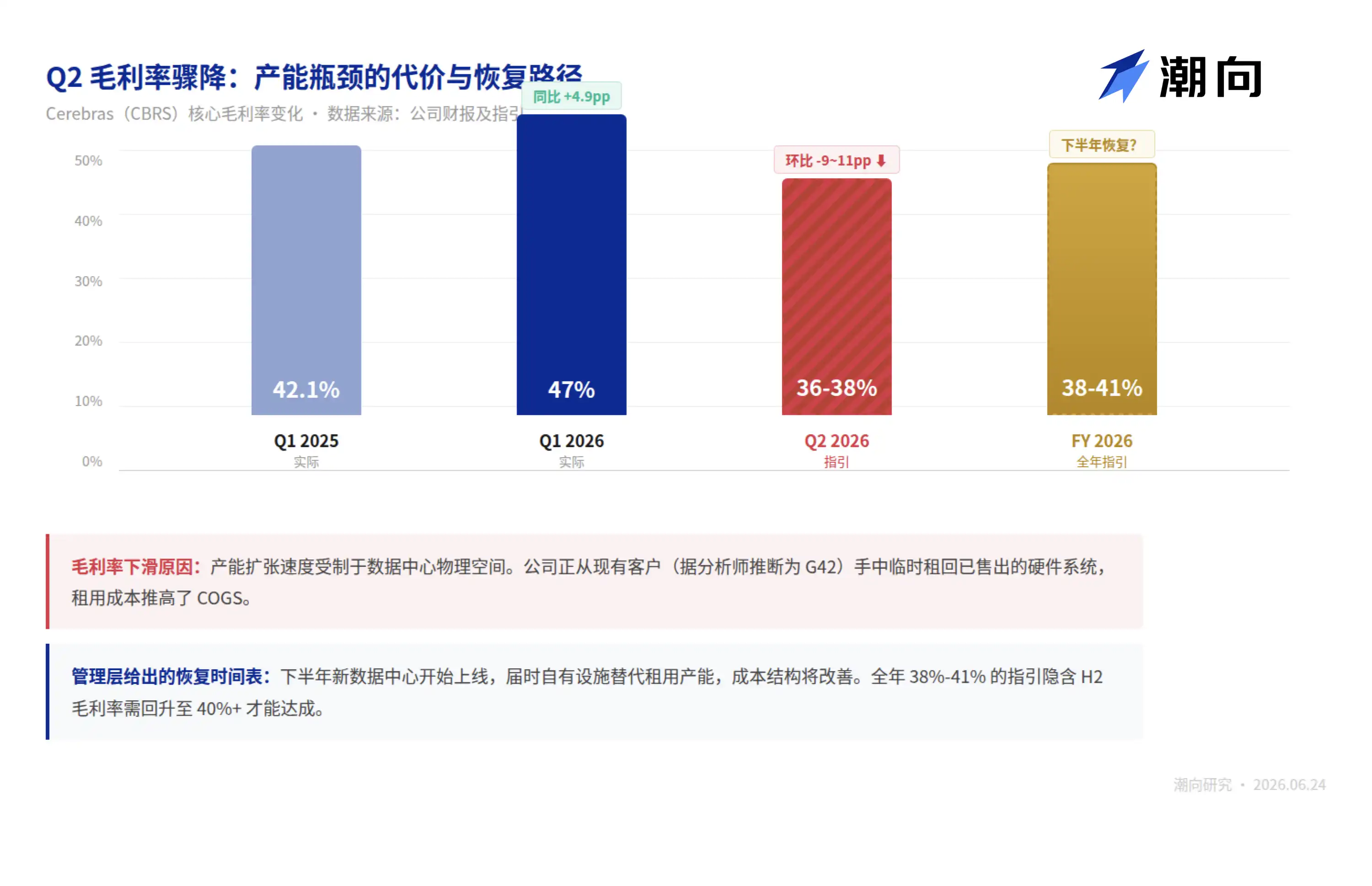
  2. The sharp drop in gross margin guidance is the biggest negative this quarter. Q1 core gross margin was 47%, up nearly 5 percentage points YoY. However, Q2 guidance fell to 36%-38%, a drop of about 10 percentage points from Q1; full-year guidance is 38%-41%. Management attributed this to insufficient data center capacity: the company is temporarily leasing back systems from existing customers who have already purchased the hardware to deploy capacity, worsening short-term costs. After-hours stock price fell over 10%.
  3. Customer concentration shows signs of improvement but is far from resolved. 86% of FY2025 revenue came from two UAE-related entities (MBZUAI accounted for 62%, G42 for 24%). OpenAI will start contributing revenue in February 2026, and the AWS cooperation is expected to reflect financially only in 2027. Genuine revenue diversification will not be verifiable until 2027.
  4. Valuation pricing extends to 2028. Based on the after-hours price of about $200, CBRS trades at about 90x trailing twelve-month revenue; even using the full-year guidance midpoint of $860 million, the forward P/S is still above 50x. The median price target from 10 covering analysts is $300 (range $250-$340), which implicitly assumes the OpenAI contract worth over $20 billion and AWS deployments are fulfilled on schedule and volume.
  5. Short-term catalysts and headwinds coexist. Catalysts: Accelerated deployment of OpenAI's 750MW computing power, AWS inference solution rollout, new data center capacity coming online in the second half. Headwinds: Lock-up period contains unconventional early release clauses (triggered if market cap exceeds $40 billion, current market cap is near that threshold), unclear path to gross margin recovery, OpenAI itself is not yet profitable and has already scaled back some computing power commitments.

Earnings Reveal Business Model Shift: From Selling Chips to Selling Computing Power

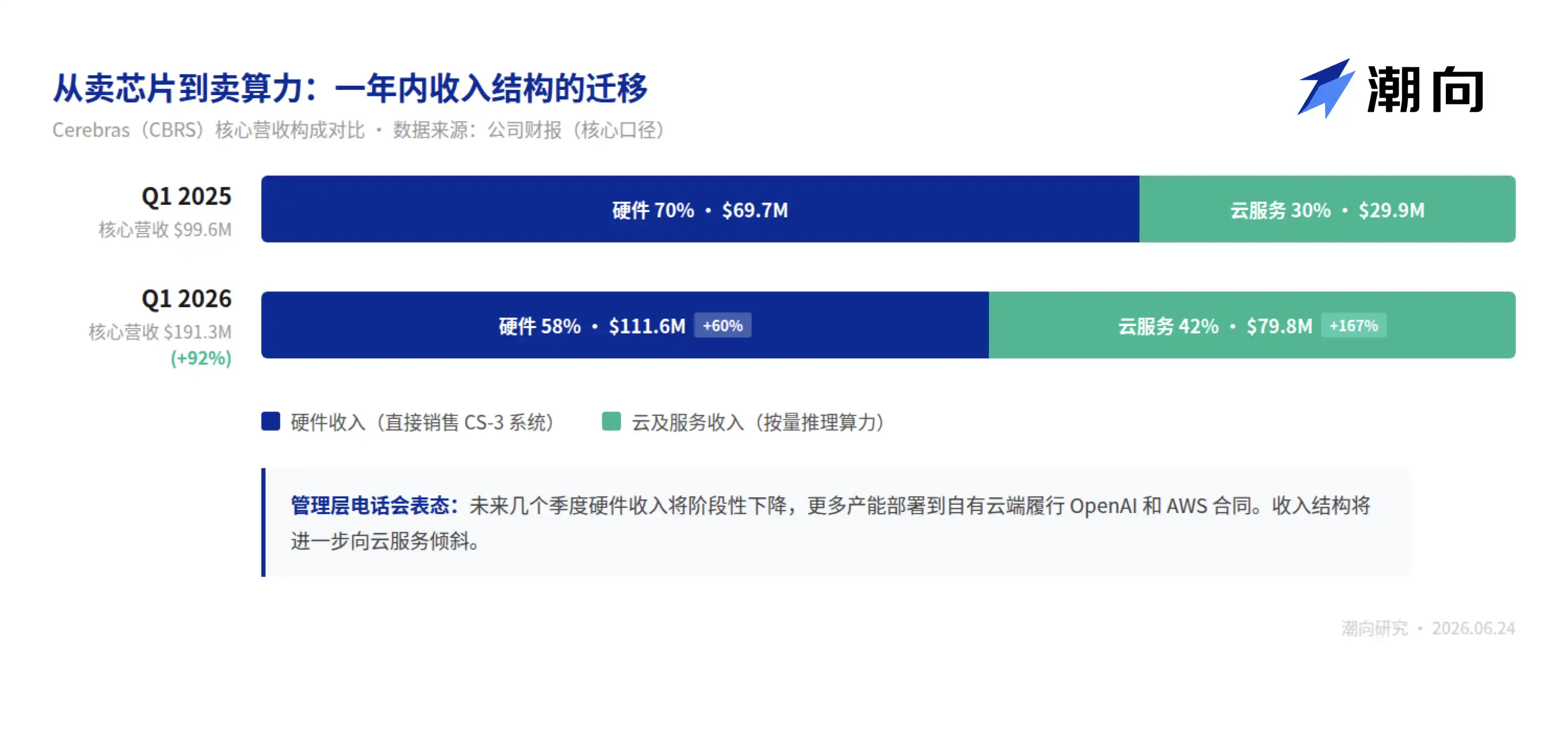
The most easily overlooked detail in the Q1 report is the change in revenue mix.

Under the core metric, hardware revenue was $111.6 million, accounting for 58% of total revenue; cloud and services revenue was $79.8 million, accounting for 42%. A year ago, this ratio was roughly 70:30. Cloud services revenue grew 167% YoY, nearly three times the growth rate of hardware.

Management made this trend clearer on the earnings call:

Hardware revenue will decline sequentially in the coming quarters because the company will deploy more hardware capacity into its own cloud to fulfill OpenAI's and AWS's inference computing power contracts, rather than selling directly to customers. Cerebras is shifting from a "chip-selling company" to a "computing power-selling company."

This transformation directly explains the sharp drop in Q2 gross margin guidance.
An analyst pressed for details on capacity deployment during the call. Management revealed:

The company's current bottleneck is not chip supply from TSMC, but the physical space in data centers. To deliver computing power to OpenAI as soon as possible, Cerebras is "temporarily leasing back" hardware systems already sold to G42 (its previous largest customer and a minority equity investor).

Deploying its own systems in leased third-party facilities worsens the cost structure in the short term, which is the main reason for the gross margin guidance drop from 47% to 36%-38%. Management's timeline indicates new data centers will start coming online in the second half of the year, easing cost pressures at that time.

The financial structure of the OpenAI contract is also worth unpacking. On the surface, it's a multi-year computing power purchase worth over $20 billion, but underneath, three relationships are layered: OpenAI provided Cerebras with a $1 billion operating capital loan (reflected on the Q1 balance sheet as $621 million in current loans and $362 million in non-current loans), while also receiving warrants for Cerebras stock.

In other words, OpenAI simultaneously plays the roles of largest customer, creditor, and potential shareholder for Cerebras. Risk disclosures in the S-1 indicate that if Cerebras fails to deliver capacity as agreed, OpenAI has the right to terminate the contract and trigger loan repayment.
The cooperation framework with AWS adopts a "split inference" architecture: AWS's Trainium 3 chip handles prompt input (prefill stage), while Cerebras's CS-3 system is dedicated to high-speed output generation (decode stage). This design allows Cerebras to handle only the part of the inference pipeline where its speed advantage is greatest. However, management declined to disclose the specific scale of the AWS cooperation during the Q&A and stated that revenue contribution would only appear on the financials in 2027.

The common feature of these two large contracts is: Contract sizes are massive, but realization paths are long, and heavily dependent on Cerebras's data center construction progress.

Full-year revenue guidance of $855-$865 million implies the next three quarters need to average around $220 million each, with sequential acceleration in growth. Management's statement is "year-over-year growth will increase each quarter in 2026, with more revenue concentrated in the second half."

The Bull Case: Nine Banks Initiate Coverage with Buy Ratings, What Are They Buying?

On June 8, the day the IPO quiet period ended, nine underwriting banks simultaneously initiated coverage, all issuing Buy or Outperform ratings. CBRS stock rose 18.3% that day. This kind of coordinated bullishness is not uncommon for US IPOs (underwriters have inherent interests), but their investment theses point to the same core proposition.

Thesis One: The battlefield for AI computing power is shifting from training to inference, and the rules of competition in inference differ from training.

Morgan Stanley analyst Joseph Moore issued an Overweight rating with a $250 price target in his June 8 initiation report. His core argument is: The training scenario competes on total computing throughput, where NVIDIA GPU clusters dominate absolutely; the inference scenario competes on the speed and latency of single responses, as models must process millions of user requests per second, and speed directly impacts service cost and user experience. Cerebras's wafer-scale chips, with their on-chip SRAM capacity far exceeding conventional GPUs (data doesn't need frequent movement to external memory), possess a structural advantage in inference latency. Moore's statement is that Cerebras is "the only company that has commercially deployed wafer-scale processors," giving it a first-mover advantage over NVIDIA.

Citi analyst Atif Malik gave the highest price target among coverages at $340. Mizuho added a technical detail in its June 8 report: The WSE-3 chip has 44GB of built-in SRAM, several times that of Google's latest TPU and Groq's LPU, a hardware gap that cannot be closed through architectural optimization in the short term.

Thesis Two: Two major contracts advance Cerebras from a "technology story" to a "revenue story."

The OpenAI contract exceeds $20 billion, covering 750MW of inference computing power, to be delivered over multiple years. Amortized over five years, this contract alone would contribute approximately $4 billion in annual revenue, nearly 5 times the midpoint of the 2026 full-year revenue guidance. Although management refused to disclose the specific amount for the AWS cooperation, the framework is confirmed: Cerebras's inference capabilities will be offered globally to enterprise customers through Amazon Bedrock.

Q1 earnings data provided early validation. OpenAI began deploying Cerebras systems in February, and cloud service revenue jumped from less than $30 million YoY to nearly $80 million in one quarter. Management's statement is "year-over-year growth will increase each quarter in 2026, with more revenue concentrated in the second half." The full-year guidance of $855-$865 million exceeds the consensus estimate of $828 million.

Thesis Three: The density of coverage right after the quiet period is itself a signal.

The median price target from 10 analysts is $300, with a low of $250 (Morgan Stanley) and a high of $340 (Citi). Based on the after-hours price of $200, the median target implies about 50% upside. Wedbush ($270 target), Needham ($300), Barclays ($280), TD Cowen ($275), and Craig-Hallum (Buy) all initiated coverage in the same week.

The underlying assumption of the bull case can be summed up in one sentence:

If AI inference becomes a larger computing power market than training (multiple institutions predict inference spending will surpass training by 2027), and Cerebras's speed advantage is real and sustainable, then it only needs to capture 3%-5% of the market where NVIDIA holds an 80%+ share to justify its current valuation.

The Bear Case: Gross Margin, Customer Concentration, and the Fragility of a $45 Billion Valuation

For each of the bull's three theses, the bears have counterarguments.

Counterargument One: The moat from inference speed advantage may be narrower than imagined.

Cerebras's speed advantage is built on on-chip SRAM capacity, but NVIDIA is not standing still. The B300 chip released by NVIDIA in March significantly increased HBM bandwidth, and Groq's LPU architecture is also iterating rapidly on the inference front.

Viewed from another angle: Cerebras's customers are currently highly concentrated in just OpenAI and AWS. OpenAI is also one of NVIDIA's largest GPU purchasing clients, and AWS's in-house Trainium chip is covering more and more inference scenarios. Cerebras's major customers are simultaneously betting on alternatives, meaning its speed premium will face continuous price negotiation pressure.

Counterargument Two: The gross margin decline might not be just "temporary."

Management attributed the Q2 gross margin drop from 47% to 36%-38% to temporary leasing costs due to insufficient data center capacity. But this explanation assumes "costs will improve when new data centers come online in the second half."

Considering that revenue scale is expected to jump in the second half (management explicitly stated revenue is back-end loaded), and new data center capacity ramp-up itself requires time and capital investment, this recovery path is not easy.

A deeper issue is the impact of the business model shift itself on gross margin. Cerebras's shift from selling hardware to selling cloud computing power means taking on data center construction, operation, and depreciation costs. As depreciation expenses for self-built data centers are accounted for, uncertainty remains over whether cloud service gross margins can stay above 50%. The profitability ceiling of this business model has yet to be tested.

Counterargument Three: Customer concentration is a problem that has "changed names but is not solved."

In 2024, G42 alone contributed 85% of Cerebras's revenue. In 2025, G42's share dropped to 24%, but MBZUAI (Mohamed bin Zayed University of Artificial Intelligence) surged from nothing to 62%. The S-1 prospectus clearly labels these two as "related parties." The two UAE-related entities combined still account for 86% of revenue. Revenue source diversification is more about a change in names rather than substantive dispersion.

Finally, CBRS's IPO lock-up period contains an unconventional clause:

If the company's market cap consistently exceeds $40 billion, insider shares can be released early. At the after-hours price of $200, the current market cap is about $45 billion, already near the trigger line. On the short side, as of May 29, the short interest was 17.15% of the float, which is on the high side. If the lock-up period triggers an early release, unleashing a large number of insider shares, combined with existing short pressure, the stock could face concentrated selling.


Crypto di tendenza

Domande pertinenti

QWhat was the main negative surprise in Cerebras' (CBRS) Q2 guidance according to the article?

AThe main negative surprise was the sharp decline in the Q2 core gross margin guidance from 47% in Q1 to a range of 36%-38%. This triggered a more than 10% drop in the stock price after hours.

QWhat are the two major contracts that represent the 'revenue story' for Cerebras' future growth?

AThe two major contracts are: 1) The over $20 billion, multi-year contract with OpenAI for 750MW of inference compute power, with revenue contribution starting from February 2026. 2) The collaboration framework with AWS to offer inference solutions via Amazon Bedrock, with revenue expected to show up in financials from 2027.

QWhy does the article argue that Cerebras' customer concentration issue is 'not solved' despite the changing names?

AIn FY2025, 86% of Cerebras' revenue still comes from two UAE-affiliated entities: MBZUAI (62%) and G42 (24%). These are noted as related parties. Therefore, while the name of the largest contributor changed, revenue remains heavily concentrated within a related group, not genuinely diversified.

QAccording to the bullish analyst logic, what is Cerebras' key structural advantage in the AI inference market?

AIts key structural advantage is the massive on-chip SRAM capacity (44GB on the WSE-3) of its wafer-scale processors. This allows data to be processed without frequent transfers to external memory, significantly reducing latency, which is critical for real-time AI inference serving user requests.

QWhat is the primary reason given by management for the expected sharp decline in Q2 gross margins?

AManagement attributed the decline to a shortage of data center capacity. To expedite deployment for OpenAI, Cerebras is temporarily leasing back hardware systems already sold to existing customers (like G42). This short-term rental arrangement worsens the cost structure, pressuring margins. They expect pressure to ease when new data centers come online in the second half of the year.

Letture associate

The Full Story of How Crypto Unicorn Blockstream Is Mired in Serious Fraud Allegations

This article details serious allegations of fraud against Bitcoin infrastructure company Blockstream, founded by Bitcoin pioneer Adam Back. In June 2024, investigative account NatInfoSec published a report accusing Blockstream's mining note (BMN) program of potentially operating a multi-billion dollar scheme with Ponzi-like characteristics. The core allegations focus on Blockstream Mining Notes (BMNs), which offer investors fixed annual yields up to approximately 20% from Bitcoin mining. NatInfoSec's investigation raises several key issues: 1. **Suspicious Hashrate & Payout Capacity**: The analysis suggests Blockstream would need 20-45 EH/s of mining power to cover its BMN obligations, but its public dashboard shows only around 15 EH/s. Furthermore, no verifiable public evidence (e.g., grid connection records, import data) was found to support the massive mining operation required. 2. **Questionable Payout Source**: The BMN contract allows Blockstream to use Bitcoin from *any source* (Substitute Performance BTC) to fulfill investor payouts, raising concerns that payouts may not come from actual mining revenue. 3. **High-Risk, Fixed Returns**: Offering ~20% fixed yields in the volatile, cyclical Bitcoin mining industry is viewed as highly unusual and requires clear explanation. 4. **Undisclosed Criminal Record of Key Figure**: Christopher William Cook, a key figure in Blockstream's mining operations and CEO of spin-off Exacore, was found to have a federal felony conviction for mail fraud in 2008, a fact not disclosed in BMN offering documents. His background was also allegedly embellished. 5. **Potential Contagion to BSTR SPAC**: Questions were raised about whether these liabilities and Cook's record should have been disclosed in the SEC filings for Bitcoin Standard Treasury Company (BSTR), a separate Adam Back-associated firm planning a SPAC merger. The crypto community is divided. BitMEX Research validated Cook's criminal record and expressed concern over the high yields but found other evidence lacking or misleading, noting the legal separation between BMN, Blockstream, and BSTR. Blockstream defenders, like Samson Mow, argue the mining is real. Critics, however, emphasize the lack of independent, verifiable proof of the mining operation's scale and the true source of investor payouts. The article concludes that BMN remains shrouded in key unanswered questions regarding its actual size, the verifiability of its underlying mining assets and payouts, the source of its high yields, and the full role and disclosure concerning Chris Cook. Blockstream had not issued a comprehensive response at the time of writing.

marsbit12 min fa

The Full Story of How Crypto Unicorn Blockstream Is Mired in Serious Fraud Allegations

marsbit12 min fa

The Full Story Behind Encryption Unicorn Blockstream's Deep Entanglement in Serious Fraud Allegations

This article details allegations of serious fraud surrounding the crypto company Blockstream, founded by Bitcoin pioneer Adam Back. Investigation account NatInfoSec accuses Blockstream of raising billions through its Blockstream Mining Note (BMN) products, which offer high fixed yields of up to 20% from purported mining revenue. The core allegations are: 1) Blockstream's public mining hash rate (15 EH/s) appears insufficient to cover the massive payout obligations from sold BMN notes, raising questions about the true source of investor payouts. 2) Key executive Christopher William Cook, central to the mining operations, has a prior federal conviction for mail fraud, a fact not disclosed to investors. Cook's background and lavish lifestyle are highlighted as red flags. 3) The structure allows payouts from any source of BTC, not necessarily mining revenue, which critics argue gives it Ponzi-like characteristics. The controversy also touches on Bitcoin Standard Treasury Company (BSTR), a related entity planning a SPAC上市. Critics question whether BMN's liabilities and Cook's record should be disclosed in BSTR's filings. BitMEX Research offered a tempered analysis, confirming Cook's criminal record is likely true and the high yields concerning, but found other claims like insufficient抵押证据 less substantiated. Community debate centers on the need for verifiable proof of Blockstream's mining output and revenue. The article concludes that while fraud is not proven, BMN presents significant, unresolved questions regarding its actual scale, the source of its high fixed returns, the verifiability of its mining operations and payouts, and the full disclosure of associated risks and personnel backgrounds. Blockstream has not yet issued a formal response.

链捕手1 h fa

The Full Story Behind Encryption Unicorn Blockstream's Deep Entanglement in Serious Fraud Allegations

链捕手1 h fa

Trading

Spot
Futures

Articoli Popolari

Cosa è $S$

Comprendere SPERO: Una Panoramica Completa Introduzione a SPERO Mentre il panorama dell'innovazione continua a evolversi, l'emergere delle tecnologie web3 e dei progetti di criptovaluta gioca un ruolo fondamentale nel plasmare il futuro digitale. Un progetto che ha attirato l'attenzione in questo campo dinamico è SPERO, denotato come SPERO,$$s$. Questo articolo mira a raccogliere e presentare informazioni dettagliate su SPERO, per aiutare gli appassionati e gli investitori a comprendere le sue basi, obiettivi e innovazioni nei domini web3 e crypto. Che cos'è SPERO,$$s$? SPERO,$$s$ è un progetto unico all'interno dello spazio crypto che cerca di sfruttare i principi della decentralizzazione e della tecnologia blockchain per creare un ecosistema che promuove l'impegno, l'utilità e l'inclusione finanziaria. Il progetto è progettato per facilitare interazioni peer-to-peer in modi nuovi, fornendo agli utenti soluzioni e servizi finanziari innovativi. Al suo interno, SPERO,$$s$ mira a responsabilizzare gli individui fornendo strumenti e piattaforme che migliorano l'esperienza dell'utente nello spazio delle criptovalute. Questo include la possibilità di metodi di transazione più flessibili, la promozione di iniziative guidate dalla comunità e la creazione di percorsi per opportunità finanziarie attraverso applicazioni decentralizzate (dApps). La visione sottostante di SPERO,$$s$ ruota attorno all'inclusività, cercando di colmare le lacune all'interno della finanza tradizionale mentre sfrutta i vantaggi della tecnologia blockchain. Chi è il Creatore di SPERO,$$s$? L'identità del creatore di SPERO,$$s$ rimane piuttosto oscura, poiché ci sono risorse pubblicamente disponibili limitate che forniscono informazioni dettagliate sul suo fondatore o fondatori. Questa mancanza di trasparenza può derivare dall'impegno del progetto per la decentralizzazione—un ethos che molti progetti web3 condividono, dando priorità ai contributi collettivi rispetto al riconoscimento individuale. Centrando le discussioni attorno alla comunità e ai suoi obiettivi collettivi, SPERO,$$s$ incarna l'essenza dell'empowerment senza mettere in evidenza individui specifici. Pertanto, comprendere l'etica e la missione di SPERO rimane più importante che identificare un creatore singolo. Chi sono gli Investitori di SPERO,$$s$? SPERO,$$s$ è supportato da una varietà di investitori che vanno dai capitalisti di rischio agli investitori angelici dedicati a promuovere l'innovazione nel settore crypto. Il focus di questi investitori generalmente si allinea con la missione di SPERO—dando priorità a progetti che promettono avanzamenti tecnologici sociali, inclusività finanziaria e governance decentralizzata. Queste fondazioni di investitori sono tipicamente interessate a progetti che non solo offrono prodotti innovativi, ma contribuiscono anche positivamente alla comunità blockchain e ai suoi ecosistemi. Il supporto di questi investitori rafforza SPERO,$$s$ come un concorrente degno di nota nel dominio in rapida evoluzione dei progetti crypto. Come Funziona SPERO,$$s$? SPERO,$$s$ impiega un framework multifunzionale che lo distingue dai progetti di criptovaluta convenzionali. Ecco alcune delle caratteristiche chiave che sottolineano la sua unicità e innovazione: Governance Decentralizzata: SPERO,$$s$ integra modelli di governance decentralizzati, responsabilizzando gli utenti a partecipare attivamente ai processi decisionali riguardanti il futuro del progetto. Questo approccio favorisce un senso di proprietà e responsabilità tra i membri della comunità. Utilità del Token: SPERO,$$s$ utilizza il proprio token di criptovaluta, progettato per servire varie funzioni all'interno dell'ecosistema. Questi token abilitano transazioni, premi e la facilitazione dei servizi offerti sulla piattaforma, migliorando l'impegno e l'utilità complessivi. Architettura Stratificata: L'architettura tecnica di SPERO,$$s$ supporta la modularità e la scalabilità, consentendo un'integrazione fluida di funzionalità e applicazioni aggiuntive man mano che il progetto evolve. Questa adattabilità è fondamentale per mantenere la rilevanza nel panorama crypto in continua evoluzione. Coinvolgimento della Comunità: Il progetto enfatizza iniziative guidate dalla comunità, impiegando meccanismi che incentivano la collaborazione e il feedback. Nutrendo una comunità forte, SPERO,$$s$ può affrontare meglio le esigenze degli utenti e adattarsi alle tendenze di mercato. Focus sull'Inclusione: Offrendo basse commissioni di transazione e interfacce user-friendly, SPERO,$$s$ mira ad attrarre una base utenti diversificata, inclusi individui che potrebbero non aver precedentemente interagito nello spazio crypto. Questo impegno per l'inclusione si allinea con la sua missione generale di empowerment attraverso l'accessibilità. Cronologia di SPERO,$$s$ Comprendere la storia di un progetto fornisce preziose intuizioni sulla sua traiettoria di sviluppo e sui traguardi. Di seguito è riportata una cronologia suggerita che mappa eventi significativi nell'evoluzione di SPERO,$$s$: Fase di Concettualizzazione e Ideazione: Le idee iniziali che formano la base di SPERO,$$s$ sono state concepite, allineandosi strettamente con i principi di decentralizzazione e focus sulla comunità all'interno dell'industria blockchain. Lancio del Whitepaper del Progetto: Dopo la fase concettuale, è stato rilasciato un whitepaper completo che dettaglia la visione, gli obiettivi e l'infrastruttura tecnologica di SPERO,$$s$ per suscitare interesse e feedback dalla comunità. Costruzione della Comunità e Prime Interazioni: Sono stati effettuati sforzi attivi di outreach per costruire una comunità di early adopters e potenziali investitori, facilitando discussioni attorno agli obiettivi del progetto e ottenendo supporto. Evento di Generazione del Token: SPERO,$$s$ ha condotto un evento di generazione del token (TGE) per distribuire i propri token nativi ai primi sostenitori e stabilire una liquidità iniziale all'interno dell'ecosistema. Lancio della Prima dApp: La prima applicazione decentralizzata (dApp) associata a SPERO,$$s$ è stata attivata, consentendo agli utenti di interagire con le funzionalità principali della piattaforma. Sviluppo Continuo e Partnership: Aggiornamenti e miglioramenti continui alle offerte del progetto, inclusi partnership strategiche con altri attori nello spazio blockchain, hanno plasmato SPERO,$$s$ in un concorrente competitivo e in evoluzione nel mercato crypto. Conclusione SPERO,$$s$ rappresenta una testimonianza del potenziale del web3 e delle criptovalute di rivoluzionare i sistemi finanziari e responsabilizzare gli individui. Con un impegno per la governance decentralizzata, il coinvolgimento della comunità e funzionalità progettate in modo innovativo, apre la strada verso un panorama finanziario più inclusivo. Come per qualsiasi investimento nello spazio crypto in rapida evoluzione, si incoraggiano potenziali investitori e utenti a ricercare approfonditamente e a impegnarsi in modo riflessivo con gli sviluppi in corso all'interno di SPERO,$$s$. Il progetto mostra lo spirito innovativo dell'industria crypto, invitando a ulteriori esplorazioni delle sue innumerevoli possibilità. Mentre il percorso di SPERO,$$s$ è ancora in fase di sviluppo, i suoi principi fondamentali potrebbero effettivamente influenzare il futuro di come interagiamo con la tecnologia, la finanza e tra di noi in ecosistemi digitali interconnessi.

87 Totale visualizzazioniPubblicato il 2024.12.17Aggiornato il 2024.12.17

Cosa è $S$

Cosa è AGENT S

Agent S: Il Futuro dell'Interazione Autonoma in Web3 Introduzione Nel panorama in continua evoluzione di Web3 e criptovalute, le innovazioni stanno costantemente ridefinendo il modo in cui gli individui interagiscono con le piattaforme digitali. Uno di questi progetti pionieristici, Agent S, promette di rivoluzionare l'interazione uomo-computer attraverso il suo framework agentico aperto. Aprendo la strada a interazioni autonome, Agent S mira a semplificare compiti complessi, offrendo applicazioni trasformative nell'intelligenza artificiale (AI). Questa esplorazione dettagliata approfondirà le complessità del progetto, le sue caratteristiche uniche e le implicazioni per il dominio delle criptovalute. Cos'è Agent S? Agent S si presenta come un innovativo framework agentico aperto, progettato specificamente per affrontare tre sfide fondamentali nell'automazione dei compiti informatici: Acquisizione di Conoscenze Specifiche del Dominio: Il framework apprende in modo intelligente da varie fonti di conoscenza esterne ed esperienze interne. Questo approccio duale gli consente di costruire un ricco repository di conoscenze specifiche del dominio, migliorando le sue prestazioni nell'esecuzione dei compiti. Pianificazione su Lungo Orizzonte di Compiti: Agent S impiega una pianificazione gerarchica potenziata dall'esperienza, un approccio strategico che facilita la suddivisione e l'esecuzione efficiente di compiti complessi. Questa caratteristica migliora significativamente la sua capacità di gestire più sottocompiti in modo efficiente ed efficace. Gestione di Interfacce Dinamiche e Non Uniformi: Il progetto introduce l'Interfaccia Agente-Computer (ACI), una soluzione innovativa che migliora l'interazione tra agenti e utenti. Utilizzando Modelli Linguistici Multimodali di Grandi Dimensioni (MLLM), Agent S può navigare e manipolare senza sforzo diverse interfacce grafiche utente. Attraverso queste caratteristiche pionieristiche, Agent S fornisce un framework robusto che affronta le complessità coinvolte nell'automazione dell'interazione umana con le macchine, preparando il terreno per innumerevoli applicazioni nell'AI e oltre. Chi è il Creatore di Agent S? Sebbene il concetto di Agent S sia fondamentalmente innovativo, informazioni specifiche sul suo creatore rimangono elusive. Il creatore è attualmente sconosciuto, il che evidenzia sia la fase embrionale del progetto sia la scelta strategica di mantenere i membri fondatori sotto anonimato. Indipendentemente dall'anonimato, l'attenzione rimane sulle capacità e sul potenziale del framework. Chi sono gli Investitori di Agent S? Poiché Agent S è relativamente nuovo nell'ecosistema crittografico, informazioni dettagliate riguardanti i suoi investitori e sostenitori finanziari non sono documentate esplicitamente. La mancanza di approfondimenti pubblicamente disponibili sulle fondazioni di investimento o sulle organizzazioni che supportano il progetto solleva interrogativi sulla sua struttura di finanziamento e sulla roadmap di sviluppo. Comprendere il supporto è cruciale per valutare la sostenibilità del progetto e il suo potenziale impatto sul mercato. Come Funziona Agent S? Al centro di Agent S si trova una tecnologia all'avanguardia che gli consente di funzionare efficacemente in contesti diversi. Il suo modello operativo è costruito attorno a diverse caratteristiche chiave: Interazione Uomo-Computer Simile a Quella Umana: Il framework offre una pianificazione AI avanzata, cercando di rendere le interazioni con i computer più intuitive. Mimando il comportamento umano nell'esecuzione dei compiti, promette di elevare le esperienze degli utenti. Memoria Narrativa: Utilizzata per sfruttare esperienze di alto livello, Agent S utilizza la memoria narrativa per tenere traccia delle storie dei compiti, migliorando così i suoi processi decisionali. Memoria Episodica: Questa caratteristica fornisce agli utenti una guida passo-passo, consentendo al framework di offrire supporto contestuale mentre i compiti si sviluppano. Supporto per OpenACI: Con la capacità di funzionare localmente, Agent S consente agli utenti di mantenere il controllo sulle proprie interazioni e flussi di lavoro, allineandosi con l'etica decentralizzata di Web3. Facile Integrazione con API Esterne: La sua versatilità e compatibilità con varie piattaforme AI garantiscono che Agent S possa adattarsi senza problemi agli ecosistemi tecnologici esistenti, rendendolo una scelta attraente per sviluppatori e organizzazioni. Queste funzionalità contribuiscono collettivamente alla posizione unica di Agent S all'interno dello spazio crittografico, poiché automatizza compiti complessi e multi-fase con un intervento umano minimo. Man mano che il progetto evolve, le sue potenziali applicazioni in Web3 potrebbero ridefinire il modo in cui si svolgono le interazioni digitali. Cronologia di Agent S Lo sviluppo e le tappe di Agent S possono essere riassunti in una cronologia che evidenzia i suoi eventi significativi: 27 Settembre 2024: Il concetto di Agent S è stato lanciato in un documento di ricerca completo intitolato “Un Framework Agentico Aperto che Usa i Computer Come un Umano”, mostrando le basi per il progetto. 10 Ottobre 2024: Il documento di ricerca è stato reso pubblicamente disponibile su arXiv, offrendo un'esplorazione approfondita del framework e della sua valutazione delle prestazioni basata sul benchmark OSWorld. 12 Ottobre 2024: È stata rilasciata una presentazione video, fornendo un'idea visiva delle capacità e delle caratteristiche di Agent S, coinvolgendo ulteriormente potenziali utenti e investitori. Questi indicatori nella cronologia non solo illustrano i progressi di Agent S, ma indicano anche il suo impegno per la trasparenza e il coinvolgimento della comunità. Punti Chiave su Agent S Man mano che il framework Agent S continua a evolversi, diversi attributi chiave si distinguono, sottolineando la sua natura innovativa e il potenziale: Framework Innovativo: Progettato per fornire un uso intuitivo dei computer simile all'interazione umana, Agent S porta un approccio nuovo all'automazione dei compiti. Interazione Autonoma: La capacità di interagire autonomamente con i computer attraverso GUI segna un passo avanti verso soluzioni informatiche più intelligenti ed efficienti. Automazione di Compiti Complessi: Con la sua metodologia robusta, può automatizzare compiti complessi e multi-fase, rendendo i processi più veloci e meno soggetti a errori. Miglioramento Continuo: I meccanismi di apprendimento consentono ad Agent S di migliorare dalle esperienze passate, migliorando continuamente le sue prestazioni e la sua efficacia. Versatilità: La sua adattabilità attraverso diversi ambienti operativi come OSWorld e WindowsAgentArena garantisce che possa servire un'ampia gamma di applicazioni. Man mano che Agent S si posiziona nel panorama di Web3 e delle criptovalute, il suo potenziale per migliorare le capacità di interazione e automatizzare i processi segna un significativo avanzamento nelle tecnologie AI. Attraverso il suo framework innovativo, Agent S esemplifica il futuro delle interazioni digitali, promettendo un'esperienza più fluida ed efficiente per gli utenti in vari settori. Conclusione Agent S rappresenta un audace passo avanti nell'unione tra AI e Web3, con la capacità di ridefinire il modo in cui interagiamo con la tecnologia. Sebbene sia ancora nelle sue fasi iniziali, le possibilità per la sua applicazione sono vaste e coinvolgenti. Attraverso il suo framework completo che affronta sfide critiche, Agent S mira a portare le interazioni autonome al centro dell'esperienza digitale. Man mano che ci addentriamo nei regni delle criptovalute e della decentralizzazione, progetti come Agent S giocheranno senza dubbio un ruolo cruciale nel plasmare il futuro della tecnologia e della collaborazione uomo-computer.

554 Totale visualizzazioniPubblicato il 2025.01.14Aggiornato il 2025.01.14

Cosa è AGENT S

Come comprare S

Benvenuto in HTX.com! Abbiamo reso l'acquisto di Sonic (S) semplice e conveniente. Segui la nostra guida passo passo per intraprendere il tuo viaggio nel mondo delle criptovalute.Step 1: Crea il tuo Account HTXUsa la tua email o numero di telefono per registrarti il tuo account gratuito su HTX. Vivi un'esperienza facile e sblocca tutte le funzionalità,Crea il mio accountStep 2: Vai in Acquista crypto e seleziona il tuo metodo di pagamentoCarta di credito/debito: utilizza la tua Visa o Mastercard per acquistare immediatamente SonicS.Bilancio: Usa i fondi dal bilancio del tuo account HTX per fare trading senza problemi.Terze parti: abbiamo aggiunto metodi di pagamento molto utilizzati come Google Pay e Apple Pay per maggiore comodità.P2P: Fai trading direttamente con altri utenti HTX.Over-the-Counter (OTC): Offriamo servizi su misura e tassi di cambio competitivi per i trader.Step 3: Conserva Sonic (S)Dopo aver acquistato Sonic (S), conserva nel tuo account HTX. In alternativa, puoi inviare tramite trasferimento blockchain o scambiare per altre criptovalute.Step 4: Scambia Sonic (S)Scambia facilmente Sonic (S) nel mercato spot di HTX. Accedi al tuo account, seleziona la tua coppia di trading, esegui le tue operazioni e monitora in tempo reale. Offriamo un'esperienza user-friendly sia per chi ha appena iniziato che per i trader più esperti.

1.1k Totale visualizzazioniPubblicato il 2025.01.15Aggiornato il 2026.06.02

Come comprare S

Discussioni

Benvenuto nella Community HTX. Qui puoi rimanere informato sugli ultimi sviluppi della piattaforma e accedere ad approfondimenti esperti sul mercato. Le opinioni degli utenti sul prezzo di S S sono presentate come di seguito.

活动图片