Sui Launches Gasless Stablecoin Transfers, Supported by Fireblocks

marsbitPubblicato 2026-05-21Pubblicato ultima volta 2026-05-21

Introduzione

Sui has officially launched "Gasless Stablecoin Transfers," a new protocol-level feature enabling users and enterprises to send supported stablecoins on Sui without paying gas fees or needing a separate SUI token balance. As the feature rolls out, stablecoin transfer fees on Sui are now effectively $0. Major stablecoins like USDsui, suiUSDe, AUSD, FDUSD, USDB, USDC, and USDY are already supported. This aims to simplify payments and remove a key barrier to mass adoption: requiring users to hold another token for gas. The enterprise platform Fireblocks, securing over $14 trillion in digital asset transactions, has integrated the feature in advance, enhancing institutional accessibility. Other wallets and custodians are also set to support zero-gas transactions. Sui co-founder Adeniyi Abiodun stated this brings Sui closer to being a global payment rail. Fireblocks' Ran Goldi noted it removes a major friction point for businesses building on-chain payments. This is a permanent structural change to Sui's mainnet, not a subsidy. It positions Sui as low-cost infrastructure for enterprises, traders, and AI agents. Sui's stablecoin transfer volume has surpassed $1 trillion since August 2025, with its architecture supporting high-frequency payments. Recent growth includes three SUI Exchange-Traded Products (ETPs) launching in 2026 and the expansion of major stablecoin projects like USDsui and SuiUSDe on the network. Zero-gas stablecoin transfers are now being gradually deployed o...

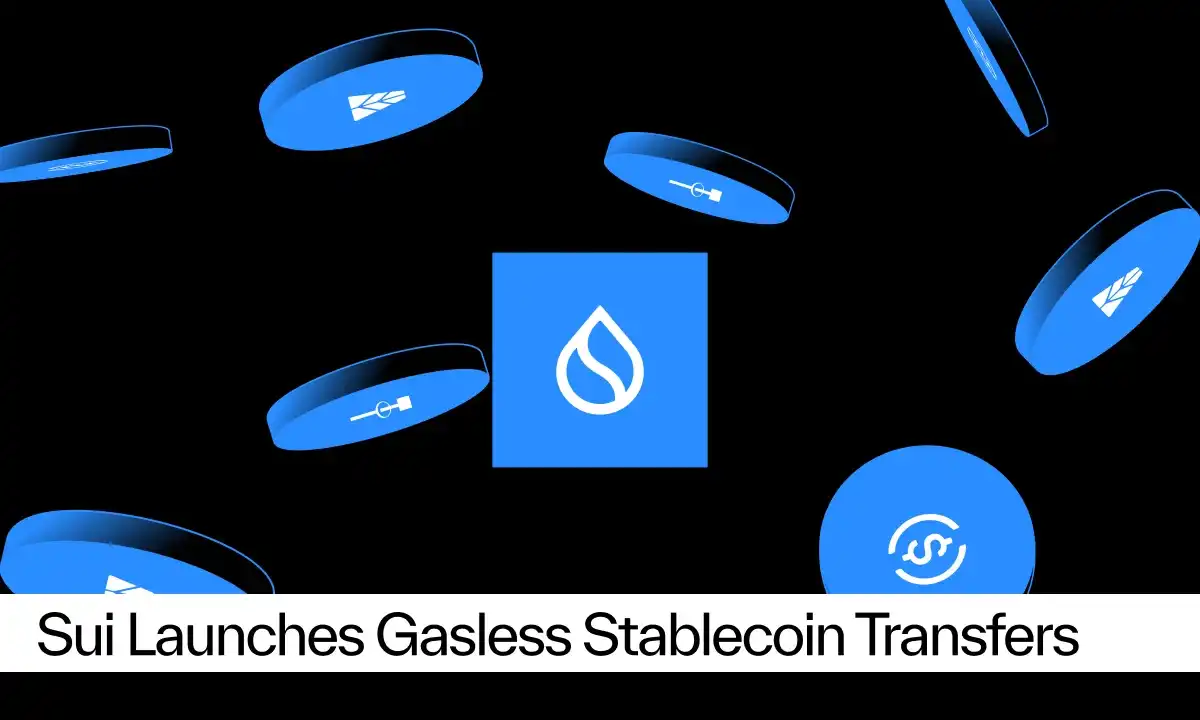
On May 20, Sui officially announced the launch of "Gasless Stablecoin Transfers".

This is a brand-new protocol-level feature that enables users and enterprises to send supported stablecoins on Sui without paying gas fees or managing a separate SUI token balance.

As this feature begins a gradual roll-out to validators, the transaction fee for stablecoin transfers on the Sui network has now officially been reduced to $0.

Currently, multiple major stablecoins are supported, including USDsui, suiUSDe, AUSD, FDUSD, USDB, USDC, and USDY. This feature aims to simplify the payment process and eliminate one of the biggest friction points in the mass adoption of stablecoins: users needing to hold another token for gas to complete a transaction.

As an enterprise-grade platform securing over $14 trillion in digital asset transactions, Fireblocks has already completed integration ahead of the official launch, as part of Sui's payment ecosystem expansion. Furthermore, numerous institutional custodians and retail-facing wallets will support gasless transactions at launch, allowing users to send specific stablecoins without holding or spending SUI.

Sui's upcoming native support for gasless stablecoin transfers allows users to send supported stablecoins without needing to hold or consume SUI.

Adeniyi Abiodun, Co-founder and CPO of Mysten Labs, stated: "Stablecoins are becoming a major part of global finance, but the infrastructure around them remains unnecessarily complex. From the very beginning, we believed that people shouldn't be charged to move their own money. With the launch of Gasless Stablecoin Transfers, we are one step closer to making Sui a global payment rail for enterprises, AI agents, and everyday consumers alike."

Fireblocks' support further enhances the accessibility of Sui's payment infrastructure for institutions, enabling businesses and financial service providers to securely access and manage on-chain stablecoin activities through trusted digital asset infrastructure.

Ran Goldi, SVP of Payments & Network at Fireblocks, stated: "The future of payments will run on stablecoin rails, but the institutional-grade experience still needs to catch up. Sui is making all the right moves. Gasless Stablecoin Transfers removes one of the biggest friction points for businesses building on-chain payment flows and customer experiences."

Gasless Stablecoin Transfers represent a structural change in how both single and bulk peer-to-peer stablecoin transfers operate on the Sui mainnet. This is not a subsidy, an officially sponsored program, or a temporary marketing campaign. In a competitive market where margins are everything, this upgrade makes Sui the default stablecoin infrastructure for businesses wanting to reduce complexity and operational costs, for traders tired of transaction failures and fee friction, and for AI agents that automatically select the "lowest cost path" to execute payments.

Since August 2025, Sui's total stablecoin transfer volume has exceeded $1 trillion, while its stablecoin ecosystem continues to expand rapidly across institutional, retail, and developer use cases. Sui's horizontally scalable architecture and object-centric model enable the network to support high-frequency payment activities with predictable performance and low operational costs, making it ideal for new payment applications, the agent economy, and enterprise-grade financial systems.

These new protocol mechanisms achieve this goal by significantly reducing processing costs, and Gasless Stablecoin Transfers further eliminate the issues associated with gas pre-funding and volatile treasury management. The end result is simpler infrastructure for institutions and an operational and cost model that truly works for the agent economy and autonomous systems. Free transfers mean gas fees will never exceed the payment amount itself, making micropayments of any size a reality.

The recent momentum in the Sui ecosystem further reflects the rapidly growing market demand for scalable financial infrastructure and stablecoin payments. Already in 2026, three SUI Exchange Traded Products (ETPs) from 21Shares, Grayscale, and Canary Capital have launched globally, further expanding institutional access to the Sui ecosystem. Meanwhile, significant stablecoin projects, including Bridge's Sui Dollar (USDsui) and Ethena's eSui Dollar (SuiUSDe), continue to expand Sui's digital dollar ecosystem, reinforcing its position as internet-scale financial infrastructure.

Gasless Stablecoin Transfers have now begun a gradual roll-out on the Sui mainnet. To learn more about payments on Sui, please visit Sui Payments.

About Sui

Sui is a next-generation Layer 1 blockchain positioned as "making money flow as freely as messages," built for scalable finance and global payments. Created by the core team behind Meta's stablecoin project and built on an object-centric model, Sui makes assets, permissions, and user data programmable and ownable. Sui provides Builders with everything they need to build high-performance payment and financial applications, including instant agentic payments. Learn more: http://sui.io .

About Fireblocks

Digital asset infrastructure company Fireblocks helps institutions of all sizes build, manage, and scale their businesses on the blockchain. Through the industry's most scalable and secure infrastructure platform, Fireblocks offers capabilities for stablecoin payments, settlement, custody, tokenization, trading, financial operations, and compliance reporting. Its services span institutional finance, consumer digital experiences, banks, payment service providers, stablecoin issuers, exchanges, and custodians. Thousands of institutions, including Worldpay, BNY, Galaxy, and Revolut, use Fireblocks to secure over $14 trillion in digital asset transactions across 150+ blockchains. Learn more: http://fireblocks.com .

Domande pertinenti

QWhat is the main new feature announced for the Sui blockchain?

ASui announced the launch of 'Gasless Stablecoin Transfers,' a new protocol-level feature that enables users and businesses to send supported stablecoins on Sui without paying gas fees or needing to manage a separate SUI token balance.

QWhich major digital asset infrastructure platform has integrated the new Sui feature before its launch?

AFireblocks, the enterprise-grade platform that secures over $14 trillion in digital asset transactions, has integrated the 'Gasless Stablecoin Transfers' feature prior to its official launch.

QAccording to the Sui co-founder, what role are stablecoins playing and what problem does the new feature address?

AAdeniyi Abiodun, Co-Founder and CPO of Mysten Labs, stated that stablecoins are becoming an important part of global finance, but their infrastructure still has unnecessary complexity. The new feature addresses this by allowing people to transfer their money without being charged, moving Sui closer to becoming a global payments rail.

QHow does the 'Gasless Stablecoin Transfers' feature benefit institutional users specifically?

AThe feature eliminates one of the biggest friction points for institutions building on-chain payment flows and customer experiences. It provides simpler infrastructure and a true operational and cost model suitable for the agent economy and autonomous systems by removing the need for gas pre-funding and volatile treasury management.

QWhat is one key statistic mentioned that highlights the growth of stablecoin activity on Sui?

ASince August 2025, the total volume of stablecoin transfers on Sui has exceeded $1 trillion, demonstrating significant growth and adoption in its stablecoin ecosystem across institutional, retail, and developer use cases.

Letture associate

Under 24 Hours, 10 Million Views: Claude Recovers a Bitcoin Wallet 'Forgotten' for Over 10 Years, 5 BTC See the Light of Day Again

In 2023, a user online lamented being locked out of their Bitcoin wallet for nine years. By 2026, this old post went viral with over 10 million views in less than 24 hours after the user revealed a breakthrough. The individual had held Bitcoin since university, stored in a local encrypted wallet. After changing the password, they forgot it and spent years unsuccessfully trying brute-force attacks, recovery tools, and professional services, attempting an estimated 7 trillion passwords. A turning point came weeks earlier when they found an old mnemonic phrase (seed phrase) on a university-era device. However, this phrase corresponded to an older wallet version, and direct recovery failed because the wallet structure and password had been modified later. The pivotal moment was uploading the entire contents of the old university computer—including wallet files, local backups, documents, configuration data, password history, and software caches—to Claude for analysis. Claude did not "crack Bitcoin." Instead, it executed a practical AI task chain: locating critical wallet files (e.g., wallet.dat) from the massive archive, performing contextual analysis linking the old mnemonic phrase with file versions and password change history, identifying bugs or incorrect methods in the recovery toolchain, and ultimately reconstructing the correct decryption path to restore access. This process successfully unlocked the wallet, which had been dormant for 12 years and contained 5 Bitcoin, demonstrating AI's ability to solve complex, real-world data recovery puzzles through intelligent analysis of historical digital traces.

华尔街日报2 min fa

Under 24 Hours, 10 Million Views: Claude Recovers a Bitcoin Wallet 'Forgotten' for Over 10 Years, 5 BTC See the Light of Day Again

华尔街日报2 min fa

When Hyperliquid Takes Away Solana's "Internet Capital Markets" Script

The article discusses how Solana's vision of becoming the "Internet Capital Markets" is being challenged, primarily by the rise of Hyperliquid. While Solana positioned itself as a high-performance blockchain for tokenizing all global assets, its native token SOL has significantly underperformed, and its core narrative faces pressure. Hyperliquid, initially a perpetual contracts platform, has evolved into a specialized Layer 1 financial network. Its focused, trading-optimized design is attracting users and capital, suggesting a vertical L1 may be better suited for a core capital market than a general-purpose chain like Solana. This external competition was compounded by an internal $200M+ exploit on Solana's key derivatives protocol, Drift, creating a strategic vacuum. In response, Solana founder Anatoly Yakovenko heavily promoted the Phoenix protocol as a decentralized, composable alternative. However, Phoenix's trading volume remains far behind leading platforms. Solana supporters also launched critiques against Hyperliquid's decentralization, citing its limited validators and closed-source code. Critics countered that Solana's own decentralization metrics have weakened, and the foundation's overt backing of Phoenix caused friction with other ecosystem builders. The piece concludes that Solana risks losing the "Internet Capital Markets" race if it cannot regain dominance in derivatives, potentially remaining a meme coin hub rather than achieving its grand ambition of hosting all global assets.

marsbit1 h fa

When Hyperliquid Takes Away Solana's "Internet Capital Markets" Script

marsbit1 h fa

Trump Signs Executive Order, Kraken, Coinbase and Others May Gain Access to Fed Payment Channels

President Trump has signed an executive order, "Incorporating Financial Technology Innovation into the Regulatory Framework," pressuring the Federal Reserve to reassess its rules on granting non-bank financial companies—including crypto and fintech firms—access to its payment systems, specifically master accounts that connect to the Fedwire settlement system. Currently, such accounts are primarily reserved for depository institutions. The order mandates a review to determine if broader access is permissible and to establish an application process. This move, supported by figures like Senator Cynthia Lummis, aims to reduce barriers to innovation and lower public payment costs by fostering fairer competition. It does not grant immediate access but could pave the way for companies like Kraken, Coinbase, Ripple, and Circle to reduce reliance on intermediary banks, lowering costs and speeding up settlements. A key precedent is the Kansas City Fed granting Kraken's parent company a restricted master account in March, offering limited payment services without interest or credit privileges. This model is seen as a potential template for allowing controlled access while mitigating systemic risk. Other firms like Anchorage, Paxos, and BitGo, which hold specialized banking charters, are also well-positioned to apply. The banking industry, represented by the American Bankers Association, opposes easing access, arguing any institution handling bank-like payments must meet the same stringent regulatory, consumer protection, and risk-management standards as traditional banks. Their core concerns include potential systemic risks, compliance gaps in areas like anti-money laundering, and the diversion of liquidity from the traditional banking system. The outcome of the Fed's review will be crucial in determining whether and how crypto and fintech firms can integrate more directly into the core U.S. financial infrastructure, balancing innovation with financial stability.

marsbit1 h fa

Trump Signs Executive Order, Kraken, Coinbase and Others May Gain Access to Fed Payment Channels

marsbit1 h fa

Trading

Spot
Futures

Articoli Popolari

Come comprare SUI

Benvenuto in HTX.com! Abbiamo reso l'acquisto di SUI Network (SUI) semplice e conveniente. Segui la nostra guida passo passo per intraprendere il tuo viaggio nel mondo delle criptovalute.Step 1: Crea il tuo Account HTXUsa la tua email o numero di telefono per registrarti il tuo account gratuito su HTX. Vivi un'esperienza facile e sblocca tutte le funzionalità,Crea il mio accountStep 2: Vai in Acquista crypto e seleziona il tuo metodo di pagamentoCarta di credito/debito: utilizza la tua Visa o Mastercard per acquistare immediatamente SUI NetworkSUI.Bilancio: Usa i fondi dal bilancio del tuo account HTX per fare trading senza problemi.Terze parti: abbiamo aggiunto metodi di pagamento molto utilizzati come Google Pay e Apple Pay per maggiore comodità.P2P: Fai trading direttamente con altri utenti HTX.Over-the-Counter (OTC): Offriamo servizi su misura e tassi di cambio competitivi per i trader.Step 3: Conserva SUI Network (SUI)Dopo aver acquistato SUI Network (SUI), conserva nel tuo account HTX. In alternativa, puoi inviare tramite trasferimento blockchain o scambiare per altre criptovalute.Step 4: Scambia SUI Network (SUI)Scambia facilmente SUI Network (SUI) nel mercato spot di HTX. Accedi al tuo account, seleziona la tua coppia di trading, esegui le tue operazioni e monitora in tempo reale. Offriamo un'esperienza user-friendly sia per chi ha appena iniziato che per i trader più esperti.

515 Totale visualizzazioniPubblicato il 2024.12.12Aggiornato il 2025.03.21

Come comprare SUI

Discussioni

Benvenuto nella Community HTX. Qui puoi rimanere informato sugli ultimi sviluppi della piattaforma e accedere ad approfondimenti esperti sul mercato. Le opinioni degli utenti sul prezzo di SUI SUI sono presentate come di seguito.

活动图片