Glassnode on Snowflake: Digital Asset Data Delivered Directly to your Warehouse

insights.glassnodePubblicato 2026-06-04Pubblicato ultima volta 2026-06-04

Introduzione

Glassnode has launched a data sharing environment on Snowflake, making comprehensive on-chain and market data directly accessible within institutional data warehouses. This eliminates the need for custom API pipelines and ETL management. The offering includes on-chain analytics, derivatives, spot & exchange data, ETF & corporate treasury metrics, with multiple time resolutions. A key feature is point-in-time (PiT) data to ensure historical accuracy and eliminate look-ahead bias in backtesting. Designed for quantitative trading, risk management, and macro research, the integration allows users to query data via SQL alongside other datasets. Access is provisioned through private Snowflake Marketplace listings.

The most sophisticated institutional teams don't just need better data. They need it inside the environments where their research and execution workflows already run.

We've launched Glassnode's Snowflake Data Sharing environment, becoming the first provider to bring comprehensive on-chain analytics into the Snowflake ecosystem.

To get started or learn more about Glassnode Data Shares, talk to our product experts.

Request access

Access Trusted Digital Asset Data Directly in Your Environment

Snowflake is the data warehouse of choice for institutional finance. But until now, integrating digital asset data into these workflows meant building custom API ingestion pipelines, managing ETL jobs, and reconciling data updates. That's engineering overhead that should be spent on alpha generation.

Our Snowflake integration eliminates all of it. Through Snowflake Marketplace private listings, our data shares deliver the full history of every trusted Glassnode metric directly into your environment.

You query it like any other table in your warehouse, because that's exactly what it is.

What's Included

This is the same data that powers the research workflows of the world's leading crypto-native institutions, now accessible without a single API call.

On-Chain Analytics | Address activity, entity behavior, supply dynamics, exchange flows, miner metrics, and advanced clustering-based insights across Bitcoin, Ethereum, and beyond.

Derivatives | Futures open interest, funding rates, liquidations, plus our recently expanded options suite: premiums, taker flows, combo strategies, implied volatility surfaces, and more.

Spot & Exchange Data | Exchange balances, inflow/outflow dynamics, and venue-level breakdowns showing capital rotation in real time.

ETFs & Corporate Treasuries | Bitcoin and Ethereum ETF flows, AUM dynamics, and corporate treasury holdings.

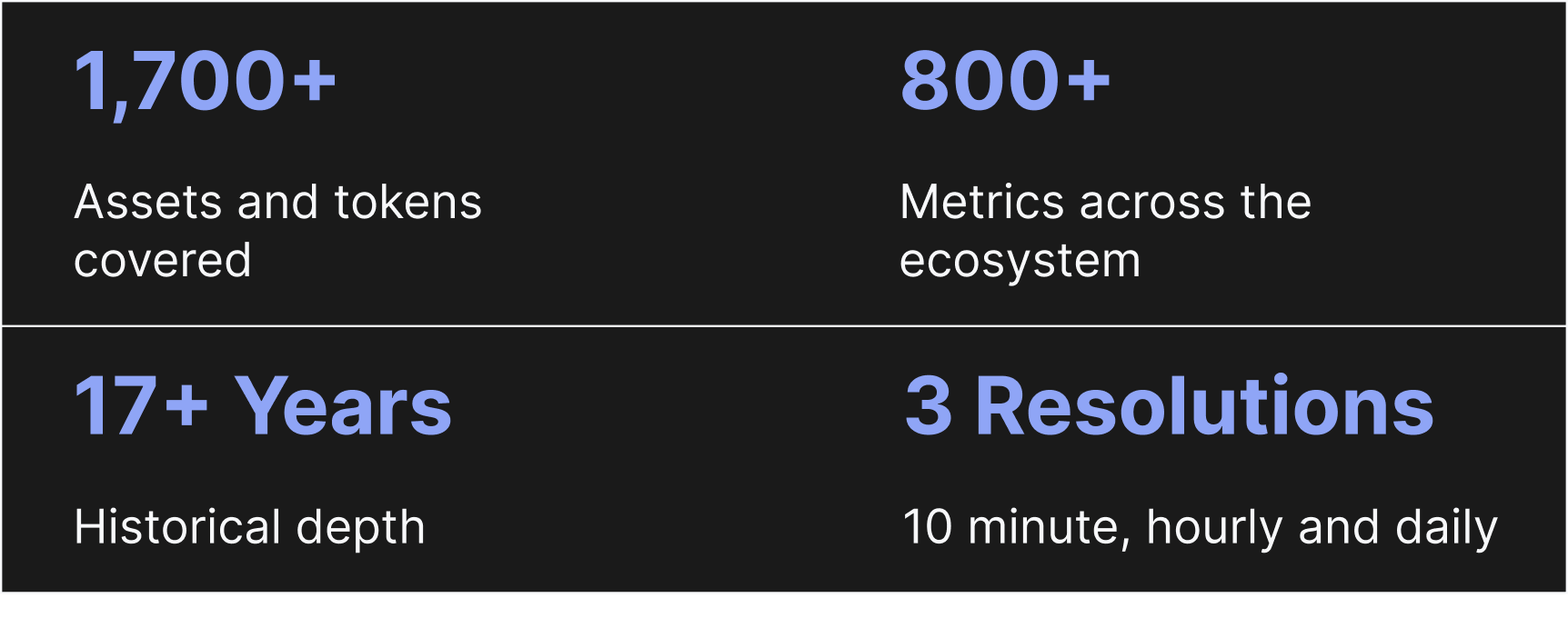
Multiple Resolutions | 10-minute, hourly, and daily granularity for everything from intraday signals to long-horizon macro research.
Built For The Workflows You Run

Quantitative & Systematic Trading | Query the full depth of on-chain, derivatives, and market data in SQL alongside your proprietary signals. PiT variants for backtesting fidelity. Sub-hourly resolution for intraday signals. No rate limits, no pagination.

Risk & Portfolio Construction | A unified view of exchange concentration, leverage dynamics, ETF flows, and supply overhangs. Native Snowflake delivery means direct integration with existing risk dashboards.

Multi-Strategy & Macro Research | Join Glassnode data with equity, fixed income, and macro datasets already in your warehouse. Same query layer, no middleware.

Fund Operations & Compliance | No bespoke pipelines means less operational risk. Snowflake's access controls and audit logging handle governance out of the box. Point-in-time timestamps provide data lineage for regulatory requirements and internal governance.

Eliminate Look-Ahead Bias from Backtests

For quantitative teams, historical data integrity is non-negotiable. Backtesting on retroactively revised data isn't backtesting. It's overfitting.

Glassnode is the first to offer point-in-time (PiT) blockchain data in Snowflake. PiT metrics are append-only and historically immutable. Each data point reflects exactly what was known when it was computed. No retroactive corrections, no look-ahead bias.

This matters because on-chain data is inherently mutable. Clustering improvements, late-reported exchange data, and refined labeling can all trigger revisions to standard metrics. PiT variants freeze the record, so your backtests reflect the information that was actually available to participants at each point in time. Every PiT data point includes a computed_at timestamp for full auditability.

Getting Started

Whether you're building backtested systematic models, integrating crypto into a cross-asset framework, or standing up institutional-grade risk infrastructure, Glassnode on Snowflake is the fastest path from blockchain data to production.

To request a trial or to learn more about Glassnode Data Shares, reach out to our institutional team at sales@glassnode.com.

The setup for Glassnode on Snowflake

  1. Retrieve your Snowflake account identifier via Snowflake's standard process or a simple SQL query.
  2. Share it with the Glassnode team. We provision access through Snowflake Marketplace private listings.
  3. Accept the listing. After initial replication, the data is live in your warehouse.

Data shares are organized by package (on-chain, market, signals, common, metadata), so you subscribe to what you need. Updates flow automatically.

Alternatively, you can initiate a trial via the Snowflake listing.

i️
Find the full setup documentation in Glassnode docs.

Glassnode Delivers the Analytical Depth That Drives Alpha

Coverage alone doesn't differentiate. What sets us apart is analytical depth built over nearly a decade of institutional-grade data engineering.

Proprietary entity adjustment | Our clustering technology identifies real-world entities (exchanges, institutions, long-term holders, miners) rather than raw addresses. Noisy blockchain data becomes actionable intelligence.

Full-stack derivatives | On-chain, futures, options, and spot from a single provider with unified methodology and consistent quality.

Expanding coverage | New chains, instruments, and products get added continuously. Your Snowflake environment reflects every update automatically.

* Default historical data during the trial is limited to 14 days and 1h/24h resolutions - contact sales@glassnode.com to request a trial with higher resolution and extended history.


  • Follow us on X for timely market updates and analysis
  • Join our Telegram channel for regular market insights
  • For on-chain metrics, dashboards, and alerts, visit Glassnode Studio

Domande pertinenti

QWhat problem does the Glassnode Snowflake Data Sharing environment aim to solve for institutional teams?

AIt aims to eliminate the engineering overhead of building custom API ingestion pipelines, managing ETL jobs, and reconciling data updates, allowing institutional teams to access comprehensive on-chain and market data directly within their Snowflake data warehouse for seamless integration into their existing research and execution workflows.

QAccording to the article, what is a key feature of Glassnode's data offering on Snowflake that is specifically important for quantitative backtesting?

AA key feature is the provision of point-in-time (PiT) blockchain data, which is append-only and historically immutable. This eliminates look-ahead bias by ensuring each data point reflects exactly what was known at the time it was computed, with no retroactive corrections.

QWhat types of data categories are included in the Glassnode Data Shares accessible via Snowflake?

AThe data categories include: On-Chain Analytics (address activity, entity behavior, supply dynamics, etc.), Derivatives (futures, options metrics), Spot & Exchange Data (exchange balances, flows), ETFs & Corporate Treasuries data, and data at Multiple Resolutions (10-minute, hourly, daily).

QWhat are the primary institutional use cases or workflows mentioned as being supported by Glassnode on Snowflake?

AThe primary use cases are: Quantitative & Systematic Trading, Risk & Portfolio Construction, Multi-Strategy & Macro Research, and Fund Operations & Compliance. It supports these by allowing direct SQL querying alongside other datasets, providing unified views, and integrating with existing dashboards and governance controls.

QWhat are the initial steps required to set up and access Glassnode Data Shares through Snowflake?

AThe steps are: 1. Retrieve your Snowflake account identifier. 2. Share it with the Glassnode team, who will provision access via Snowflake Marketplace private listings. 3. Accept the listing, after which the data will be live in your warehouse after initial replication. Alternatively, a trial can be initiated directly via the Snowflake listing.

Letture associate

The Verdict in Choi Tae-won's Divorce Case: Revealing the Inheritance Undercurrent Behind SK Hynix's Trillion-Won Empire

SK Group Chairman Chey Tae-won's high-profile divorce case, involving a record 1.38 trillion won settlement, has drawn attention to the succession plans for Korea's second-largest conglomerate, especially its crown jewel, SK hynix. Unlike traditional chaebol scripts centered on the eldest son, Chey's three children from his marriage to former President Roh Tae-woo's daughter, Roh Soh-yeong, are carving distinct, non-traditional paths. Eldest daughter Chey Yun-jung (b. 1989) is seen as the most evident successor. With a scientific and consulting background, she holds executive roles at SK bioscience and SK Inc.'s growth support department, focusing on future strategy and biopharma. Her marriage is to an AI infrastructure entrepreneur, not a traditional business alliance. Second daughter Chey Min-jung (b. 1991) took a unique route, voluntarily serving as a South Korean naval officer, including an anti-piracy deployment. She later worked on policy and strategy for SK hynix in Washington D.C. before co-founding an AI-driven healthcare startup. She married a former U.S. Marine Corps officer, connecting her to U.S. defense and policy circles—networks crucial for a global semiconductor giant. The only son, Chey In-geun (b. 1995), who studied physics like his father, worked briefly at SK E&S before joining McKinsey. Despite fitting the traditional "heir" profile as the eldest son, he remains silent and holds no public position or shares in SK, suggesting the old succession playbook is obsolete. As SK hynix's valuation soars, becoming a geopolitical asset in the AI era, the heirs' legitimacy is no longer automatic. They must prove themselves in fields like AI biotech, global policy, and strategic consulting. Their marriages also reflect new elite networks in tech and defense, not old political alliances. Their inheritance is the complex challenge of navigating a globalized, tech-driven world, not just a corporate throne.

marsbit2 giorni fa 09:06

The Verdict in Choi Tae-won's Divorce Case: Revealing the Inheritance Undercurrent Behind SK Hynix's Trillion-Won Empire

marsbit2 giorni fa 09:06

From OpenSea to OpenRouter: Is Alex Atallah Repeating His 'Exit at the Peak' Playbook?

From OpenSea to OpenRouter: Is Alex Atallah Repeating His "Exit at the Peak" Playbook? According to the Wall Street Journal, payments giant Stripe is in talks to acquire the AI model aggregation platform OpenRouter in a potential deal valuing the company near $100 billion. This would mark founder Alex Atallah's second creation of a company reaching a $100 billion valuation, following his co-founding of NFT marketplace OpenSea. OpenRouter, founded just over three years ago, has grown rapidly by acting as a unified gateway for developers to access over 400 AI models. It currently has about 10 million users and processes over 200 trillion tokens monthly. While the platform's annualized revenue is around $50 million, its valuation has skyrocketed from $1.3 billion in March 2026. The potential acquisition by Stripe, a company OpenRouter's founder once likened it to, represents a major expansion into AI infrastructure for the payments leader. This move echoes Atallah's previous timing with OpenSea, where he departed before the NFT market's significant downturn. For OpenRouter, selling now may be strategic. Despite its scale, its business model—charging a 5-5.5% fee on AI inference calls—faces pressure from competition, open-source models, and potential price wars among model providers, limiting its profitability narrative for an IPO. A key asset for potential acquirers like Stripe is OpenRouter's vast repository of real-world AI usage data, which offers unique insights into model performance and developer preferences that are difficult to replicate. Whether this potential deal signifies a new valuation benchmark for AI infrastructure or another market peak signal remains to be seen.

链捕手2 giorni fa 08:42

From OpenSea to OpenRouter: Is Alex Atallah Repeating His 'Exit at the Peak' Playbook?

链捕手2 giorni fa 08:42

Trading

Spot
活动图片





