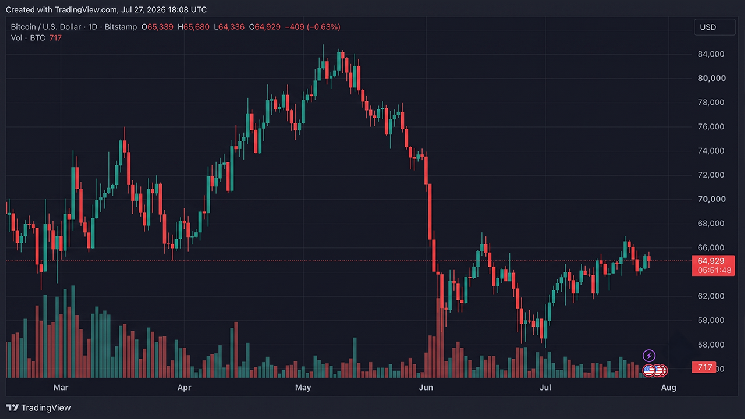
According to Matt Hougan, Chief Investment Officer of Bitwise, cryptocurrency markets are showing early signs of recovery: Bitcoin is rising while technology stocks are falling.
In his market commentary on July 22nd, Hougan noted on X that since July 1st, Bitcoin has risen by 9%, while the Nasdaq-100 index has fallen by 6%. He also pointed to improving sentiment and increasing inflows into ETFs, while cautioning that the market has not yet reached a confirmed bottom.
The executive believes the next crypto cycle will focus on the convergence of blockchain technology and traditional finance, rather than being another cycle driven primarily by speculation. He explained:
"The next crypto bull market will be about stablecoins, tokenization, 24/7 trading, instant settlement, and scaling institutional DeFi to trillions, leading to revolutionary changes in the financial industry, akin to how the internet revolutionized media and shopping in the early 2000s."
The Bitwise CIO noted that blockchain infrastructure offers advantages like faster settlement, global access, and continuous market operation. However, he observed that many investors are still focused on whether crypto has recovered, instead of preparing for broader changes in financial markets.
Previous Bitcoin Forecast Focused on Institutional Demand
Hougan's latest comments build on his earlier view that institutional investor adoption of crypto will drive the next phase of the market. He argued that demand for Bitcoin ETFs could lead to a reduction in available supply as more investors access cryptocurrencies through traditional financial products.
The Bitwise executive also pointed to broader market factors contributing to a potential crypto recovery, including improved market structure, institutional participation, and growing demand from traditional investors—all part of nine factors fueling a crypto bull rally.
He also argued that geopolitical uncertainty could increase Bitcoin's appeal as a global asset, explaining how geopolitical chaos could push Bitcoin higher as investors seek alternatives to traditional financial systems.
Hougan criticized crypto narratives focused mainly on blockchain throughput, arguing that its adoption will depend on practical financial use cases. His views on the "blockspace as a commodity" theory reflect his emphasis on real utility.
Hyperliquid and Robinhood Represent Two Sides of On-Chain Finance
Hougan highlighted Hyperliquid and Robinhood as two companies approaching the crypto-finance convergence from different sides. He wrote:
"So how should you start preparing for the new bull market? By paying attention to two companies leading this convergence from opposite sides: Hyperliquid (HYPE) and Robinhood (HOOD)."
Hyperliquid represents a crypto-native approach. The Layer 1 blockchain started with perpetual futures trading but later expanded into traditional markets, including commodities and stock indices.
Hougan noted that nearly half of Hyperliquid's trading volume now comes from traditional assets like oil, silver, and the S&P 500 index, highlighting the platform's expansion beyond crypto markets. As examples of how blockchain applications can link usage to value, he pointed to the revenue generation model and token buybacks.
Robinhood embodies the traditional finance side of this shift. On July 1st, the brokerage launched Robinhood Chain to support tokenized stocks and decentralized finance services, demonstrating how financial companies are moving from blockchain experiments to real products. Bitwise's CIO expects competitors and large institutions, including Blackrock, Coinbase, Figure, Visa, Stripe, and JPMorgan, to continue exploring similar infrastructure.
Investors Focusing on Companies Building Financial Infrastructure
Hougan expects a broad crypto market recovery could benefit major assets and public companies linked to the industry, but believes some categories may be particularly well-positioned. He wrote:
"I believe the coming bull market will be large enough to lift most of the sector. I am optimistic about major cryptocurrencies—Bitcoin, Ethereum, Solana, etc.—as well as crypto stocks. But there are two types of investments that I think are particularly well-positioned."
These categories include crypto applications generating real revenue and traditional companies building blockchain-based financial products. In the executive's view, this distinction will separate companies preparing for the emergence of a new financial system from those merely testing blockchain concepts.
Hougan argues that the next bull market will arrive as traditional finance and crypto become increasingly intertwined. He stated:
"I'm more convinced than ever that the next bull market will arrive precisely when traditional finance and crypto become inextricably linked. Investors would be wise to position themselves accordingly during this time."
In Hougan's view, blockchain adoption will increasingly move beyond crypto-native platforms and permeate broader financial markets. As tokenization, stablecoins, and blockchain-based settlement evolve, companies building these connections will influence how financial products are created and traded.
end-content