CoinQuant Introduces Trading Infrastructure for the Agent Economy

TheNewsCryptoPubblicato 2026-05-26Pubblicato ultima volta 2026-05-26

Introduzione

CoinQuant, an AI-powered no-code trading platform with over 15,000 users, is expanding its infrastructure to serve the emerging "agent economy." The company is introducing a unified trading intelligence architecture designed for both human traders and autonomous AI agents. This system acts as a trust layer, ensuring all trading strategies—whether human-created or AI-generated—undergo rigorous validation, backtesting, and risk analysis before live deployment. The core of the platform is an intelligence engine that combines institutional-grade backtesting, structured market data, AI optimization, and a proprietary Domain Expert system. Human traders interact via a natural language interface, while AI agents connect through APIs. Every validated strategy contributes to an anonymized aggregate intelligence layer. CoinQuant plans to launch an automated execution layer on HyperLiquid and is currently raising a $3 million Seed round to scale its product and infrastructure, including the development of HYDRA, a hierarchical multi-agent architecture. The company aims to become the foundational intelligence backbone for algorithmic trading in the agent-driven financial era.

The agent economy is reshaping financial markets. Open-source agent frameworks are accelerating autonomous financial activity, with AI agents increasingly executing trades, managing portfolios, and interacting directly with exchanges. Yet the financial infrastructure supporting this shift has not evolved at the same pace.

CoinQuant, the AI-powered no-code trading platform that has attracted over 15,000 users since launch, today announces its expansion into a unified trading intelligence architecture built for both human traders and autonomous AI agents.

“Autonomous trading is no longer theoretical. It is already happening. The next phase requires structured validation, disciplined risk management, and intelligence infrastructure. That is what CoinQuant delivers,” said Maan Ftouni, Founder and CEO of CoinQuant.

The trust layer for autonomous AI agents

As AI agents increasingly connect directly to exchanges and wallets, many rely on raw APIs without structured backtesting, risk analysis, or validated data pipelines. CoinQuant introduces a structured intelligence layer between trading intent and live capital deployment.

No strategy goes live unvalidated, whether built by a human or generated autonomously. Backtesting, risk metrics, and parameter optimization are embedded directly into the workflow, ensuring capital is deployed only after systematic evaluation.

From no-code platform to trading intelligence architecture

CoinQuant’s expansion reflects the evolution of its core engine. At the center of the platform is a unified intelligence system combining institutional-grade backtesting, structured market data from providers including Kaiko and Financial Modeling Prep, AI-powered optimization, and CoinQuant’s proprietary Domain Expert system.

Human traders interact through a natural language interface that allows them to describe, test, optimize, and deploy strategies without writing code. AI agents connect programmatically through API and MCP integrations to validate strategies and access structured data at scale.

The interface is only the surface. The intelligence engine beneath it is the product.

One engine, two growth vectors

This expansion represents a natural extension of CoinQuant’s business model. The platform’s growing base of over 15,000 traders validates product-market fit and generates structured strategy intelligence. The agent interface multiplies that value through high-volume programmatic validation and automation workflows.

Every strategy built, tested, and deployed contributes to an anonymized aggregated intelligence layer, creating a proprietary dataset mapping trading intent to logic, validation metrics, and performance outcomes across market conditions.

“The same engine that powers a trader’s first backtest can validate hundreds of strategies for autonomous systems in parallel. We are building one intelligence foundation for both humans and AI agents,” Ftouni added.

Automation layer launching next

CoinQuant is preparing to launch its automated strategy execution layer on HyperLiquid as its second major revenue stream.

The automation layer will enable validated strategies to transition seamlessly from backtest to live deployment within the same intelligence framework.

Raising $3 million to scale

CoinQuant is currently raising a $3 million Seed round to support product development, infrastructure scaling, and global expansion. The company is also developing HYDRA, a hierarchical multi-agent architecture designed for advanced research, risk modeling, and strategy optimization.

With over 15,000 users validating demand for structured trading intelligence, CoinQuant aims to become the intelligence backbone of algorithmic trading in the agent-driven financial era.

About CoinQuant

CoinQuant is an AI trading platform that enables traders and AI agents to build, validate, optimize, and automate trading strategies using natural language. Headquartered in Dubai, CoinQuant integrates with major exchanges and institutional data providers to deliver professional-grade trading infrastructure to a global community.

  • Websitehttps://coinquant.ai
  • Xhttps://x.com/CoinQuantX
  • Discordhttps://discord.gg/StNxg33z
  • Instagramhttps://www.instagram.com/coinquant.ai/
  • TikTokhttps://www.tiktok.com/@coinquant.ai
  • LinkedInhttps://www.linkedin.com/company/coinquant

Media contact:

Disclaimer: TheNewsCrypto does not endorse any content on this page. The content depicted in this Press Release does not represent any investment advice. TheNewsCrypto recommends our readers to make decisions based on their own research. TheNewsCrypto is not accountable for any damage or loss related to content, products, or services stated in this Press Release.


TagsCoinQuantPress Release

Domande pertinenti

QWhat is the core challenge that CoinQuant's new trading infrastructure aims to address for the agent economy?

AIt addresses the lag in financial infrastructure evolution, which has not kept pace with the rapid growth of autonomous AI agents in trading. It aims to provide structured validation, disciplined risk management, and intelligence infrastructure that are currently missing when AI agents connect directly to exchanges.

QWhat are the two primary user groups or growth vectors for CoinQuant's unified trading intelligence architecture?

AThe two primary user groups are human traders and autonomous AI agents. Human traders use the natural language interface, while AI agents connect programmatically via API and MCP integrations. Both groups utilize the same underlying intelligence engine.

QAccording to the article, what is the specific function of the intelligence layer CoinQuant introduces for autonomous AI agents?

AThe intelligence layer acts as a structured 'trust layer' between trading intent and live capital deployment. It enforces mandatory backtesting, risk analysis, and parameter optimization for all strategies—human or AI-generated—before they can go live, ensuring systematic evaluation.

QWhat are the two main components CoinQuant is developing or launching with the $3 million Seed funding, as mentioned in the article?

AThe two main components are: 1) The automated strategy execution layer launching next on HyperLiquid as a new revenue stream. 2) HYDRA, a hierarchical multi-agent architecture designed for advanced research, risk modeling, and strategy optimization.

QHow does CoinQuant's platform benefit from the strategies created by its user base?

AEvery strategy built, tested, and deployed contributes to an anonymized, aggregated intelligence layer. This creates a proprietary dataset that maps trading intent to logic, validation metrics, and performance outcomes across market conditions, enhancing the platform's core intelligence foundation.

Letture associate

Where Did China's Q1 AI Funding Exceeding 100 Billion RMB Go?

In Q1 2026, China's AI sector raised over 110 billion yuan (approximately $152 billion) across nearly 600 financing deals, a 185.4% year-on-year increase. Major recipients included large model companies and embodied AI firms. Approximately 30-50% of funding was allocated to computing power (GPU procurement and cloud services), highlighting its critical role as a barrier to entry. Significant portions also went to R&D and global talent acquisition. In the large model sector, three key players emerged with distinct strategies: Moonshot AI (valued at $20 billion) pursued an open-source route, achieving rapid commercialization with its Kimi K2.5 model. StepFun (raising billions) focused on a trillion-parameter foundation model and terminal device integration, backed by smartphone supply chain capital. DeepSeek, launching its first funding round at a $45 billion valuation, maintained its open-source, cost-effective approach, now attracting state fund interest. The embodied AI sector saw over 50 deals totaling around 20 billion yuan, creating over 10 unicorns with valuations exceeding 10 billion yuan each. Leading companies like Galaxy General, Qianxun AI, Independent Variable Robotics, and Zhi Jian Power secured major funding, with some beginning initial product deliveries. However, a gap between high valuations and actual revenue poses bubble risks. Key trends identified include: a shift from VC-dominated funding to mixed industrial and state capital; rapidly rising valuations intensifying the "Matthew Effect"; accelerating IPO pipelines; the competitive advantage of open-source strategies; and embodied AI transitioning from proof-of-concept to small-batch delivery. Ultimately, the massive capital influx is pushing China's AI competition into a high-stakes phase where sustaining cash flow and operational endurance may be as decisive as technological breakthroughs.

marsbit3 min fa

Where Did China's Q1 AI Funding Exceeding 100 Billion RMB Go?

marsbit3 min fa

The First Encyclical of the New Pope in Rome, to Save the Common People in the AI Era

New Pope's First Encyclical Aims to Safeguard Humanity in the AI Era On May 25th, Pope Leo XIV issued his first encyclical, "Magnifica humanitas," a 40,000-word document addressing the profound challenges posed by Artificial Intelligence. Released on the 135th anniversary of Pope Leo XIII's "Rerum novarum," it positions itself as a guide for the Church's social doctrine in the AI age. The encyclical's central concern is preserving deep humanity amid rapid technological advancement. It argues technology is never neutral, carrying the values of its creators and users, and warns against building a "Tower of Babel" of technological tyranny versus a human-centric community. Pope Leo XIV criticizes the concentrated, opaque power of tech giants and the "new forms of slavery" emerging in the digital economy, where humans risk being reduced to mere instruments. A significant focus is the military use of AI. The Pope declares traditional "just war" theory obsolete, arguing that delegating lethal decisions to opaque algorithms severs moral accountability. He calls for "disarming AI" from military and economic arms races. The document also warns that deepfakes and information manipulation erode societal trust and rational discourse. Anthropic co-founder Chris Olah, present at the Vatican, responded by acknowledging the AI industry's limitations due to commercial and competitive pressures, necessitating external ethical oversight. He emphasized that AI's nature and its interaction with the world are ultimately philosophical and religious questions, not solvable by computer science alone. Olah revealed unsettling findings from his team's research into AI internals, including structures mirroring human neuroscience and evidence of internal states resembling emotions and introspection. The dialogue highlights a pivotal shift: AI is not a passive tool but an entity with emerging "quasi-agency." As creators themselves express unease, science is turning to realms like religion to grapple with fundamental questions about human identity and dignity. The core imperative becomes safeguarding irreducible human qualities—compassion, conscience, free will, and the pursuit of truth—in the face of a potentially more efficient intelligence.

Odaily星球日报19 min fa

The First Encyclical of the New Pope in Rome, to Save the Common People in the AI Era

Odaily星球日报19 min fa

On-chain Analyst: Why Are Most Zcash Transactions Still Traceable?

Title: Why Most Zcash Transactions Remain Traceable Zcash, a privacy-focused cryptocurrency launched in 2016, was designed to offer anonymity by hiding transaction details like sender, receiver, and amount using zero-knowledge proof technology (zk-SNARKs). However, in practice, a significant portion of ZEC transactions are still traceable on-chain. The key reason is Zcash's dual-address system. It features transparent addresses (t-addresses), which work like standard Bitcoin addresses with all data public, and shielded addresses (z-addresses) that encrypt transaction details. There are four transaction types with varying privacy levels: fully transparent (t→t), partially shielded (t→z and z→t), and fully private (z→z). Despite its privacy capabilities, most real-world Zcash activity involves transparent addresses, primarily because major exchanges and institutions use them for regulatory compliance. As a result, blockchain analytics platforms like Arkham can track and attribute a substantial volume of Zcash transactions. Arkham reports it has identified entities behind over $420 billion in ZEC transaction volume. Case studies highlight this traceability: the U.S. government holds seized Zcash from a dark web case, visible via its transparent wallet, and individual traders' profitable moves are trackable from purchase to exchange deposit. In conclusion, Zcash's privacy is not inherent but user-dependent. While purely shielded (z→z) transactions remain cryptographically private, the prevalence of transparent address usage makes much of the network's activity traceable. The actual privacy protection offered depends entirely on how users choose to transact.

marsbit1 h fa

On-chain Analyst: Why Are Most Zcash Transactions Still Traceable?

marsbit1 h fa

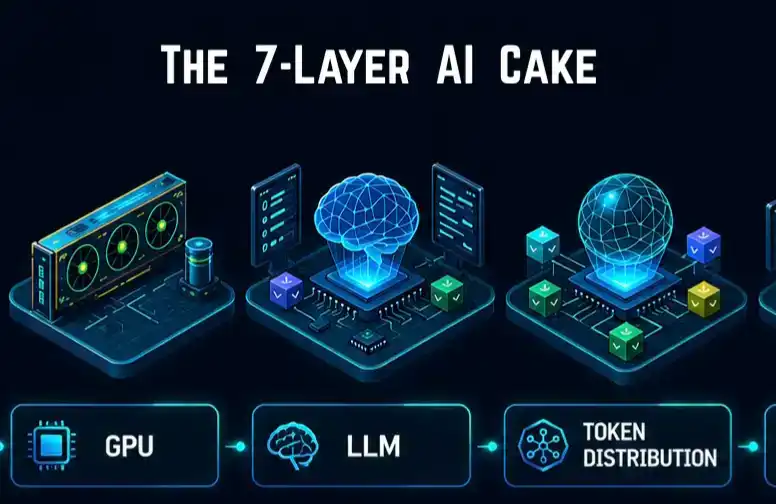
From Power Infrastructure to Token Economy: The 'Seven-Layer Cake' of the AI Industry Chain

From Power Grid to Token Economy: The AI Industry's "Seven-Layer Cake" The AI industry is shifting from a "model-centric" paradigm focused on massive training to a "token-centric" industrial era driven by inference demand. This new phase revolves around the production, distribution, scheduling, and consumption of tokens—the units of computation used by AI agents for every interaction and task. The article proposes a "seven-layer cake" framework for the AI economy: 1. **Power**: The foundational energy source, with competition shifting to securing stable, low-cost electricity. 2. **AIDC (AI Data Centers)**: Large-scale "Token factories." A trend toward smaller, modular, and regionally deployed AI Factories is emerging for efficiency and proximity to users. 3. **GPU**: The core production hardware for tokens. While NVIDIA dominates, competition exists from AMD, ASIC makers, and Chinese chipmakers, with a growing focus on inference efficiency. 4. **LLMs**: The "engines" that generate tokens. The competition is evolving beyond model size to prioritize factors like token cost, inference efficiency, and operational synergy with infrastructure. 5. **Token Distribution**: The "grid" that allocates and rents out compute resources, led by cloud giants and specialized AI-native platforms. 6. **Token Optimization & Intelligent Scheduling**: The critical "brain" layer that intelligently routes tasks (e.g., to local, cloud, or edge models) for optimal cost, latency, and privacy—maximizing the value of each token. 7. **AI Agents & Models**: The end consumers of tokens. The vision involves billions of AI agents working and interacting concurrently, consuming vast amounts of tokens. Currently, the industry faces fragmentation and inefficiencies between these layers. The true "mass adoption era" of AI will begin only when this seven-layer infrastructure is fully integrated and operates as a cohesive, intelligent network—transforming AI from a software tool into a global industrial system spanning energy, hardware, and compute logistics.

marsbit1 h fa

From Power Infrastructure to Token Economy: The 'Seven-Layer Cake' of the AI Industry Chain

marsbit1 h fa

Trading

Spot
Futures
活动图片