Rules Change Mid-Game, Polymarket’s Billion-Dollar Bitcoin Prediction Market Mired in Settlement Controversy

foresightnews_apiPubblicato 2026-06-05Pubblicato ultima volta 2026-06-05

Introduzione

A nearly $150 million prediction market contract on Polymarket is in turmoil after the platform refused to settle in favor of traders who correctly predicted that MicroStrategy (now Strategy) would sell Bitcoin. The core dispute revolves around a sale of 32 BTC, which occurred between May 26-31 but was officially disclosed in an SEC 8-K filing on June 1. The original contract stated it would resolve to "Yes" if Strategy sold any Bitcoin before May 31, 11:59 PM ET, using public disclosures and on-chain data as proof. After the filing on June 1, traders who saw the disclosure rushed to buy "Yes" contracts, believing it was conclusive evidence. However, Polymarket's operators later added a rule that the disclosure itself must occur by the deadline, not just the transaction, invalidating the filing as proof. This retroactive rule change has sparked accusations of market manipulation, leaving traders like "willo2," who invested $527,000, facing total losses. The controversy highlights a deeper structural flaw in Polymarket's decentralized settlement system, which relies on UMA's optimistic oracle. Disputed resolutions are ultimately decided by a vote among UMA token holders, a mechanism critics say is vulnerable to manipulation by large holders ("whales") who can vote in their own financial interest rather than on objective facts. Data suggests a high concentration of voting power and significant overlap between voters and Polymarket traders. The dispute emerges as prediction m...


By: Oluwapelumi Adejumo

Compiled by: Saoirse, Foresight News


A nearly $150 million prediction market contract is in chaos: the Polymarket platform is refusing to pay out winnings to traders who accurately predicted that Strategy would sell a portion of its Bitcoin. The core dispute centers on a mismatch between the actual transaction time and the official disclosure time, exposing fundamental systemic flaws in how decentralized prediction markets handle the settlement of large-scale contracts. Traders are now locked in a tug-of-war over a fine-print rule, facing the risk of having their expected millions in profits wiped out.


Strategy (formerly MicroStrategy), an asset management firm holding nearly $60 billion in Bitcoin, filed a regulatory 8-K form on June 1, confirming it sold 32 Bitcoins between May 26 and May 31, with a market value of approximately $2.5 million. For participants in Polymarket's "Will Strategy sell Bitcoin before May 31?" contract, this regulatory disclosure was supposed to be irrefutable proof for the "Yes" bet. However, the current disputed ruling heavily favors the "No" camp.


After the contract deadline, Polymarket's operators added a new rule: since the official disclosure of this sale landed on June 1, exceeding the deadline, the transaction would not be considered valid evidence for the contract. This last-minute rule change has sparked numerous accusations of market manipulation. At a critical juncture where the prediction market sector is striving for compliance with traditional finance, its decentralized, lottery-like settlement mechanisms are facing intense industry scrutiny.


Complete Timeline of the Disputed Contract


The controversy stems from the contract's original terms: the contract would be settled as "Yes" if Strategy sold any amount of Bitcoin before 11:59 PM ET on May 31. The rules explicitly stated that official company disclosure documents and on-chain data were the two primary sources for adjudication.
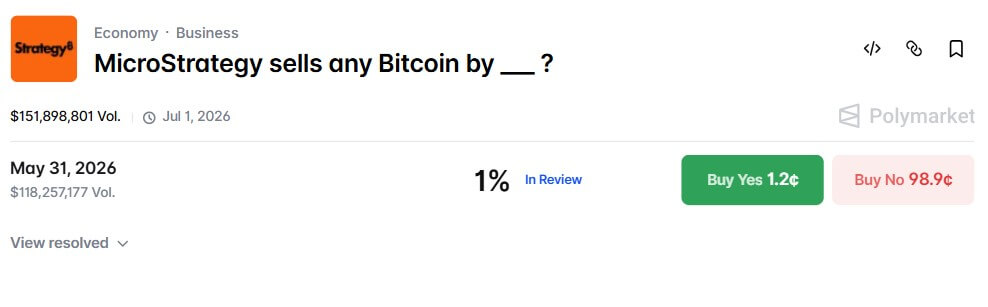

Polymarket contract regarding the disputed Bitcoin sale by Strategy (Source: Polymarket)


When Strategy submitted the mandatory disclosure document on June 1, trading for this contract remained open. Several traders, spotting the disclosure and perceiving an arbitrage opportunity, rushed to enter the market: user 'willo2' invested $527,000 to go all-in on "Yes," while the market odds still implied an 80% probability of a "No" outcome. This trader initially expected to secure a 20% arbitrage profit. However, as large buy orders flooded in, Polymarket retroactively added the rule, deeming the disclosure date invalid because it was past the deadline. As a result, this user lost their entire principal.


Willo posted on X platform in protest: "This limit was never written in the contract rules, it makes no logical sense, and Polymarket itself hasn't followed this standard before. If the disclosure had to be made by May 31, trading should have been halted directly at that time, but the market continued to operate normally afterward."


Industry analysts collectively criticized the platform's contradictory operations. Jeff Dorman, Chief Investment Officer of Arca, pointed out a fatal flaw: if the contract strictly required May 31 midnight as the final cutoff, the platform should have closed trading at that exact time. Allowing users to open positions on June 1 while later retroactively demanding the disclosure date align with the deadline is tantamount to setting a trap for traders who followed the contract's written rules. Jonatan Pallesen, a data researcher specializing in decentralized projects, stated bluntly:


The platform's failure to explicitly state hidden conventions upfront and its post-hoc addition of rules constitutes implicit fraud; institutional players familiar with the platform's unwritten rules can exploit these gaps to harvest ordinary retail traders, who default to expecting payouts based on factual transactions but end up suffering losses.


UMA Oracle Reveals Underlying Structural Flaws


The Strategy wager dispute has evolved from a single contract conflict into a collective interrogation of Polymarket's entire settlement system. Unlike traditional exchanges that rely on centralized clearinghouses and legal departments to execute derivatives settlements, Polymarket outsources the fact-finding entirely to the UMA (Universal Market Access) optimistic oracle. UMA's operating logic is: token holders determine disputed outcomes through on-chain voting; a trader can initiate a dispute by posting a $750 bond. If the disagreement persists unresolved, the final verdict is determined by a vote among UMA token holders weighted by their token holdings, based on stake proportion rather than objective fact-checking.


Many industry insiders warn that this system is highly susceptible to manipulation by whales. Prominent crypto analyst Eric Conner noted that token voting mechanisms inherently suffer from design flaws: large holders (whales) can exploit ambiguous rules to protect their own positions, disregarding objective facts to overturn settlement results and avoid significant losses.


Data from a Wall Street Journal investigation corroborates these concerns: in the vast majority of disputed orders on Polymarket, the top ten wallets hold over half the voting power; approximately 60% of active UMA voting accounts are linked to Polymarket trading addresses, and in one-fifth of dispute cases, voters themselves have a direct financial stake in the outcome. In the first five months of 2026, disputed orders on Polymarket exceeded 1,150, surpassing the platform's total for the entire previous year; constrained by its decentralized architecture, the platform's official team has no authority to overturn the final rulings issued by UMA's token vote.


Rapid Industry Expansion vs. The Reality of Decentralized Mechanisms


This billion-dollar dispute coincides with a critical window for the large-scale adoption of prediction markets. Over the past two years, Polymarket and Kalshi have worked vigorously to shed the "unregulated crypto casino" label and deeply integrate with the traditional financial ecosystem. DeFiLlama data shows that in May 2026, the combined trading volume of the two platforms exceeded $10 billion, a tenfold year-on-year surge; the platforms have successively secured data and content partnerships with the New York Stock Exchange, Dow Jones, Associated Press, and Fox News.


The regulatory landscape for the industry has fluctuated: in 2022, the U.S. Commodity Futures Trading Commission (CFTC) ordered Polymarket to cease U.S. operations and relocate overseas; Kalshi also engaged in prolonged litigation with the CFTC over the compliance of event contracts until winning a federal court case in late 2024. Following the 2024 U.S. election, regulatory winds shifted. Polymarket secured a U.S. federal derivatives license, with the CFTC explicitly stating that event contracts fall under commodity derivatives and are within its regulatory purview. CFTC Chairman Michael S. Selig stated: "Event contracts can help entities and individuals hedge against event risks and optimize portfolio exposure, while also conveying market expectations about events. The product attributes fall within the CFTC's regulatory responsibilities."


Even with compliance licenses, the settlement logic of decentralized prediction markets remains experimental. Traditional secondary markets rely on strong regulation and ample liquidity to anchor prices to real fundamentals; whereas in token-vote-based prediction markets, the definition of "factual truth" is always determined by voting games. Until adjudication mechanisms are perfected, traders in the rapidly expanding prediction market sector will remain subject to unwritten rules and on-chain voting juries that exist beyond the black-and-white text of contracts.


Domande pertinenti

QWhat was the core issue that led to the settlement dispute on Polymarket's $150 million Bitcoin prediction contract?

AThe core issue was a mismatch between the actual transaction time and the official disclosure time, coupled with a rule change by Polymarket after the contract deadline. The platform ruled that MicroStrategy's sale of 32 BTC did not count for settlement because the official SEC 8-K filing disclosing the sale occurred on June 1st, after the contract's cutoff of May 31st at 23:59 ET, even though the sales themselves happened between May 26-31.

QHow did the user 'willo2' allegedly lose their investment in the disputed Polymarket contract?

AUser 'willo2' invested $527,000 to buy 'Yes' shares after MicroStrategy's 8-K filing was published on June 1st, believing the confirmed sale guaranteed a payout. However, Polymarket later applied a new rule stating the disclosure had to occur by the May 31st deadline to be valid. Since the filing was on June 1st, the 'No' outcome was favored, causing 'willo2' to lose their entire principal.

QWhat is the role of UMA's optimistic oracle in Polymarket's dispute resolution process, and what criticism has it faced?

AUMA's optimistic oracle is used to settle disputes on Polymarket. Its process involves token holders voting on-chain to determine the outcome. It has been criticized for a structural defect where large token holders (whales) can manipulate votes to favor their own positions, ignoring objective facts. Data shows the top 10 wallets hold over half the voting power, and many voters have direct ties to Polymarket addresses.

QWhat recent regulatory developments were mentioned regarding prediction markets like Polymarket and Kalshi?

AThe article mentions that after a 2024 court victory for Kalshi and a shifting regulatory landscape post-2024 elections, Polymarket secured a federal derivatives license in the U.S. The CFTC chairman stated that event contracts fall under the agency's jurisdiction as commodity derivatives, helping entities hedge risk and convey market expectations.

QAccording to the article, what fundamental tension exists in decentralized prediction markets as they scale?

AThe fundamental tension is between the industry's rapid growth and the experimental nature of its decentralized settlement logic. While traditional markets rely on strong regulation and liquidity to anchor prices to fundamentals, in token-voting prediction markets, the 'truth' or settlement outcome is ultimately determined by voting博弈 (game theory and博弈), leaving traders subject to unwritten rules and on-chain voting juries.

Letture associate

Dalio Warns: AI Boom Shows Signs of a Bubble, Day of Reckoning Will Be the Time of Burst

Ray Dalio, founder of Bridgewater Associates, warns that the current artificial intelligence investment boom shows classic signs of a bubble, which he expects will eventually burst. In a Bloomberg Television interview, he noted that great technological revolutions often lead to capital inflows that create bubbles, making it difficult for investors and companies to calibrate their spending accurately—either overspending to capture market share or underspending and losing their competitive position. This caution comes amid significant rallies in AI-related assets, particularly chipmakers, driven by soaring demand for data centers and high-bandwidth chips, raising debates about overheating valuations. In contrast, Nvidia CEO Jensen Huang recently asserted that investors embracing the AI wave would see "crazy" returns and dismissed concerns over return on investment for data center spending as outdated. Dalio, however, focuses on the risks in the profit realization phase. He argues that bubbles tend to show signs of破裂 when markets transition from investment to the need for tangible returns, describing the burst as a process of converting paper wealth into cash. While acknowledging AI's intrinsic value, he expressed concern over the future profitability of some AI companies, suggesting the market is repeating a familiar pattern. The 76-year-old billionaire, who fully exited Bridgewater in 2025, has a net worth estimated at $21.5 billion according to the Bloomberg Billionaires Index.

marsbit27 min fa

Dalio Warns: AI Boom Shows Signs of a Bubble, Day of Reckoning Will Be the Time of Burst

marsbit27 min fa

Privacy Coin Crisis of Confidence! ZEC Plunges Over 56% in a Single Day

Zcash (ZEC), a leading privacy-focused cryptocurrency, experienced a severe crash on June 5th, plummeting over 56% in a single day and erasing nearly two months of gains. The flash crash was triggered by the disclosure of a critical zero-knowledge proof vulnerability within Zcash's Orchard privacy pool, which had existed since the pool's launch in May 2022. The flaw theoretically allowed an attacker to forge unlimited ZEC undetectably due to the pool's privacy features. The vulnerability was discovered on May 29th by independent security researcher Taylor Hornby during a proactive audit commissioned by Shielded Labs, utilizing AI-assisted analysis. The Zcash development team responded swiftly, implementing an emergency soft fork to disable Orchard transactions on June 2nd and executing a permanent hard fork fix (NU6.2) on June 3rd. Despite the technical fix, a major crisis of confidence emerged. The core issue is that Orchard's privacy design makes it cryptographically impossible to prove whether the vulnerability was exploited over the past four years, casting permanent doubt on the historical supply integrity of ZEC. While Shielded Labs argues exploitation was unlikely, the inability to provide definitive proof has severely damaged market trust. This sentiment was exacerbated when BitMEX co-founder Arthur Hayes, a prominent ZEC supporter, announced he was selling his entire position. He stated that privacy assets require "perfect security" rather than "probable safety." The combined effect of the disclosure and Hayes's exit ignited widespread panic selling, leading to massive liquidations and significant price decline. Analysts note the event highlights a fundamental tension within privacy coins: the conflict between verifiable supply and cryptographic privacy.

链捕手29 min fa

Privacy Coin Crisis of Confidence! ZEC Plunges Over 56% in a Single Day

链捕手29 min fa

Trading

Spot
Futures

Articoli Popolari

Cosa è BITCOIN

Comprendere HarryPotterObamaSonic10Inu (ERC-20) e la sua posizione nel mondo delle criptovalute Negli ultimi anni, il mercato delle criptovalute ha assistito a un aumento della popolarità delle meme coin, catturando l'interesse non solo dei trader, ma anche di coloro che cercano coinvolgimento comunitario e valore di intrattenimento. Tra questi token unici c'è HarryPotterObamaSonic10Inu (ERC-20), un progetto intrigante che mescola riferimenti culturali nel tessuto delle criptovalute. Questo articolo esplora gli aspetti chiave di HarryPotterObamaSonic10Inu, analizzando i suoi meccanismi, l'etica guidata dalla comunità e il suo coinvolgimento con il panorama crittografico più ampio. Che cos'è HarryPotterObamaSonic10Inu (ERC-20)? Come suggerisce il suo nome, HarryPotterObamaSonic10Inu è una meme coin costruita sulla blockchain di Ethereum, classificata secondo lo standard ERC-20. A differenza delle criptovalute tradizionali che possono enfatizzare l'utilità pratica o il potenziale investimento, questo token prospera grazie al valore di intrattenimento e alla forza della sua comunità. Il progetto mira a creare un ambiente in cui gli utenti coinvolti possono riunirsi, condividere idee e partecipare ad attività ispirate a diversi fenomeni culturali. Una caratteristica notevole di HarryPotterObamaSonic10Inu è la zero tassa sulle transazioni. Questo elemento allettante tende a incoraggiare il trading e il coinvolgimento della comunità, privo di costi aggiuntivi che possono scoraggiare i trader di piccole dimensioni. L'offerta totale della moneta è fissata a un miliardo di token, un numero che segna la sua intenzione di mantenere una circolazione sostanziale all'interno della comunità. Creatore di HarryPotterObamaSonic10Inu (ERC-20) Le origini di HarryPotterObamaSonic10Inu sono avvolte in un certo mistero; i dettagli sul creatore rimangono sconosciuti. Lo sviluppo di questo token non presenta un team identificabile o un piano esplicito, cosa non rara nel settore delle meme coin. Invece, il progetto è emerso organicamente, con il suo progresso fortemente dipendente dall'entusiasmo e dalla partecipazione della sua comunità. Investitori di HarryPotterObamaSonic10Inu (ERC-20) Per quanto riguarda investimenti esterni e finanziamenti, HarryPotterObamaSonic10Inu rimane ambiguo. Il token non elenca alcuna fondazione di investimento conosciuta o un sostegno organizzativo significativo. Invece, la linfa vitale del progetto è la sua comunità di base, che informa la sua crescita e sostenibilità attraverso azioni collettive e coinvolgimento nello spazio crittografico. Come funziona HarryPotterObamaSonic10Inu (ERC-20)? In quanto meme coin, HarryPotterObamaSonic10Inu opera principalmente al di fuori delle strutture tradizionali che governano spesso il valore degli asset. Ci sono diversi aspetti distintivi che definiscono il funzionamento del progetto: Transazioni senza tasse: Senza costi fiscali sulle transazioni, gli utenti possono comprare e vendere liberamente il token senza preoccuparsi di costi nascosti. Coinvolgimento della comunità: Il progetto prospera sull'interazione della comunità, sfruttando le piattaforme social per creare entusiasmo e facilitare il coinvolgimento. Discussioni, condivisione di contenuti e coinvolgimento sono elementi cruciali che aiutano ad espandere la sua portata e a favorire la lealtà tra i sostenitori. Nessuna utilità pratica: Va notato che HarryPotterObamaSonic10Inu non offre un'utilità concreta all'interno dell'ecosistema finanziario. Piuttosto, è classificato come un token principalmente per attività di intrattenimento e comunitarie. Riferimento culturale: Il token incorpora astutamente elementi della cultura pop per attirare interesse, collegandosi a appassionati di meme e seguaci delle criptovalute. HarryPotterObamaSonic10Inu esemplifica come le meme coin operino in modo diverso rispetto ai progetti di criptovalute più tradizionali, entrando nel mercato come costrutti sociali innovativi piuttosto che come asset utilitari. Cronologia di HarryPotterObamaSonic10Inu (ERC-20) La storia di HarryPotterObamaSonic10Inu è segnata da diversi traguardi notevoli: Creazione: Il token è emerso da un meme virale, catturando l'immaginazione di molti appassionati di criptovalute. Le date di creazione specifiche non sono disponibili, sottolineando la sua crescita organica. Inserimento negli scambi: HarryPotterObamaSonic10Inu ha fatto il suo ingresso in vari scambi, consentendo un accesso e un trading più facili da parte della comunità. Iniziative di coinvolgimento della comunità: Attività in corso volte a migliorare l'interazione della comunità, comprese gare, campagne sui social media e generazione di contenuti da parte di fan e sostenitori. Piani di espansione futura: La tabella di marcia del progetto include il lancio di una collezione NFT, merchandising e un sito di eCommerce relativo ai suoi temi culturali, coinvolgendo ulteriormente la comunità e cercando di aggiungere più dimensioni al suo ecosistema. Punti chiave su HarryPotterObamaSonic10Inu (ERC-20) Natura guidata dalla comunità: Il progetto dà priorità al contributo collettivo e alla creatività, garantendo che il coinvolgimento degli utenti sia al centro del suo sviluppo. Classificazione come meme coin: Rappresenta l'epitome delle criptovalute basate sull'intrattenimento, distinguendosi dai veicoli d'investimento tradizionali. Nessuna affiliazione diretta con Bitcoin: Nonostante la somiglianza nel nome del ticker, HarryPotterObamaSonic10Inu è distintivo e non ha alcuna relazione con Bitcoin o altre criptovalute consolidate. Focus sulla collaborazione: HarryPotterObamaSonic10Inu è progettato per creare uno spazio per la collaborazione e la condivisione di storie tra i suoi detentori, fornendo un canale per la creatività e il legame comunitario. Prospettive future: L'ambizione di espandersi oltre il suo presupposto iniziale verso NFT e merchandising delinea un percorso per il progetto per potenzialmente entrare in strade più mainstream all'interno della cultura digitale. Poiché le meme coin continuano a catturare l'immaginazione della comunità crittografica, HarryPotterObamaSonic10Inu (ERC-20) si distingue per i suoi legami culturali e il suo approccio centrato sulla comunità. Anche se potrebbe non adattarsi al modello tipico di un token orientato all'utilità, la sua essenza risiede nella gioia e nella camaraderia coltivate tra i suoi sostenitori, evidenziando la natura in evoluzione delle criptovalute in un'epoca sempre più digitale. Con la continuazione dello sviluppo del progetto, sarà importante osservare come le dinamiche della comunità influenzano la sua traiettoria nel panorama in continuo cambiamento della tecnologia blockchain.

1.6k Totale visualizzazioniPubblicato il 2024.04.01Aggiornato il 2024.12.03

Cosa è BITCOIN

Come comprare BTC

Benvenuto in HTX.com! Abbiamo reso l'acquisto di Bitcoin (BTC) semplice e conveniente. Segui la nostra guida passo passo per intraprendere il tuo viaggio nel mondo delle criptovalute.Step 1: Crea il tuo Account HTXUsa la tua email o numero di telefono per registrarti il tuo account gratuito su HTX. Vivi un'esperienza facile e sblocca tutte le funzionalità,Crea il mio accountStep 2: Vai in Acquista crypto e seleziona il tuo metodo di pagamentoCarta di credito/debito: utilizza la tua Visa o Mastercard per acquistare immediatamente BitcoinBTC.Bilancio: Usa i fondi dal bilancio del tuo account HTX per fare trading senza problemi.Terze parti: abbiamo aggiunto metodi di pagamento molto utilizzati come Google Pay e Apple Pay per maggiore comodità.P2P: Fai trading direttamente con altri utenti HTX.Over-the-Counter (OTC): Offriamo servizi su misura e tassi di cambio competitivi per i trader.Step 3: Conserva Bitcoin (BTC)Dopo aver acquistato Bitcoin (BTC), conserva nel tuo account HTX. In alternativa, puoi inviare tramite trasferimento blockchain o scambiare per altre criptovalute.Step 4: Scambia Bitcoin (BTC)Scambia facilmente Bitcoin (BTC) nel mercato spot di HTX. Accedi al tuo account, seleziona la tua coppia di trading, esegui le tue operazioni e monitora in tempo reale. Offriamo un'esperienza user-friendly sia per chi ha appena iniziato che per i trader più esperti.

4.0k Totale visualizzazioniPubblicato il 2024.12.12Aggiornato il 2026.06.02

Come comprare BTC

Cosa è $BITCOIN

ORO DIGITALE ($BITCOIN): Un'Analisi Completa Introduzione all'ORO DIGITALE ($BITCOIN) L'ORO DIGITALE ($BITCOIN) è un progetto basato su blockchain che opera sulla rete Solana, con l'obiettivo di combinare le caratteristiche dei metalli preziosi tradizionali con l'innovazione delle tecnologie decentralizzate. Sebbene condivida un nome con Bitcoin, spesso definito “oro digitale” a causa della sua percezione come riserva di valore, l'ORO DIGITALE è un token separato progettato per creare un ecosistema unico all'interno del panorama Web3. Il suo obiettivo è posizionarsi come un asset digitale alternativo valido, anche se i dettagli riguardanti le sue applicazioni e funzionalità sono ancora in fase di sviluppo. Cos'è l'ORO DIGITALE ($BITCOIN)? L'ORO DIGITALE ($BITCOIN) è un token di criptovaluta esplicitamente progettato per l'uso sulla blockchain di Solana. A differenza di Bitcoin, che fornisce un ruolo di stoccaggio di valore ampiamente riconosciuto, questo token sembra concentrarsi su applicazioni e caratteristiche più ampie. Aspetti notevoli includono: Infrastruttura Blockchain: Il token è costruito sulla blockchain di Solana, nota per la sua capacità di gestire transazioni ad alta velocità e a basso costo. Dinamiche di Offerta: L'ORO DIGITALE ha un'offerta massima fissata a 100 quadrilioni di token (100P $BITCOIN), sebbene i dettagli riguardanti la sua offerta circolante siano attualmente non divulgati. Utilità: Sebbene le funzionalità precise non siano esplicitamente delineate, ci sono indicazioni che il token potrebbe essere utilizzato per varie applicazioni, potenzialmente coinvolgendo applicazioni decentralizzate (dApp) o strategie di tokenizzazione degli asset. Chi è il Creatore dell'ORO DIGITALE ($BITCOIN)? Attualmente, l'identità dei creatori e del team di sviluppo dietro l'ORO DIGITALE ($BITCOIN) rimane sconosciuta. Questa situazione è tipica tra molti progetti innovativi nel settore blockchain, in particolare quelli allineati con la finanza decentralizzata e i fenomeni delle meme coin. Sebbene tale anonimato possa favorire una cultura guidata dalla comunità, intensifica le preoccupazioni riguardo alla governance e alla responsabilità. Chi sono gli Investitori dell'ORO DIGITALE ($BITCOIN)? Le informazioni disponibili indicano che l'ORO DIGITALE ($BITCOIN) non ha alcun sostenitore istituzionale noto o investimenti di venture capital prominenti. Il progetto sembra operare su un modello peer-to-peer incentrato sul supporto e sull'adozione della comunità piuttosto che su percorsi di finanziamento tradizionali. La sua attività e liquidità si trovano principalmente su exchange decentralizzati (DEX), come PumpSwap, piuttosto che su piattaforme di trading centralizzate consolidate, evidenziando ulteriormente il suo approccio di base. Come Funziona l'ORO DIGITALE ($BITCOIN) Le meccaniche operative dell'ORO DIGITALE ($BITCOIN) possono essere elaborate in base al suo design blockchain e alle caratteristiche della rete: Meccanismo di Consenso: Sfruttando il proof-of-history (PoH) unico di Solana combinato con un modello di proof-of-stake (PoS), il progetto garantisce una validazione efficiente delle transazioni contribuendo all'alta performance della rete. Tokenomics: Sebbene meccanismi deflazionistici specifici non siano stati dettagliati ampiamente, l'ampia offerta massima di token implica che potrebbe soddisfare microtransazioni o casi d'uso di nicchia che devono ancora essere definiti. Interoperabilità: Esiste il potenziale per l'integrazione con l'ecosistema più ampio di Solana, inclusi vari piattaforme di finanza decentralizzata (DeFi). Tuttavia, i dettagli riguardanti integrazioni specifiche rimangono non specificati. Cronologia degli Eventi Chiave Ecco una cronologia che evidenzia traguardi significativi riguardanti l'ORO DIGITALE ($BITCOIN): 2023: Il dispiegamento iniziale del token avviene sulla blockchain di Solana, contrassegnato dal suo indirizzo di contratto. 2024: L'ORO DIGITALE guadagna visibilità poiché diventa disponibile per il trading su exchange decentralizzati come PumpSwap, consentendo agli utenti di scambiarlo contro SOL. 2025: Il progetto assiste a un'attività di trading sporadica e a un potenziale interesse per impegni guidati dalla comunità, sebbene non siano state documentate partnership significative o avanzamenti tecnici fino ad ora. Analisi Critica Punti di Forza Scalabilità: L'infrastruttura sottostante di Solana supporta alti volumi di transazioni, il che potrebbe migliorare l'utilità di $BITCOIN in vari scenari di transazione. Accessibilità: Il potenziale basso prezzo di trading per token potrebbe attrarre investitori al dettaglio, facilitando una partecipazione più ampia grazie a opportunità di proprietà frazionata. Rischi Mancanza di Trasparenza: L'assenza di sostenitori, sviluppatori o di un processo di audit pubblicamente noti potrebbe generare scetticismo riguardo alla sostenibilità e all'affidabilità del progetto. Volatilità del Mercato: L'attività di trading è fortemente dipendente dal comportamento speculativo, il che può comportare una significativa volatilità dei prezzi e incertezze per gli investitori. Conclusione L'ORO DIGITALE ($BITCOIN) emerge come un progetto intrigante ma ambiguo all'interno dell'evolvente ecosistema di Solana. Sebbene tenti di sfruttare la narrativa dell'“oro digitale”, la sua partenza dal ruolo consolidato di Bitcoin come riserva di valore sottolinea la necessità di una chiara differenziazione della sua utilità e struttura di governance. L'accettazione e l'adozione future dipenderanno probabilmente dall'affrontare l'attuale opacità e dalla definizione più esplicita delle sue strategie operative ed economiche. Nota: Questo rapporto comprende informazioni sintetizzate disponibili a ottobre 2023, e potrebbero essersi verificati sviluppi oltre il periodo di ricerca.

99 Totale visualizzazioniPubblicato il 2025.05.13Aggiornato il 2025.05.13

Cosa è $BITCOIN

Discussioni

Benvenuto nella Community HTX. Qui puoi rimanere informato sugli ultimi sviluppi della piattaforma e accedere ad approfondimenti esperti sul mercato. Le opinioni degli utenti sul prezzo di BTC BTC sono presentate come di seguito.

活动图片