30 Years After Being Crushed by AI, People Have Fallen Back in Love with Chess

marsbitPubblicato 2026-08-17Pubblicato ultima volta 2026-08-17

Introduzione

On May 11, 1997, IBM's "Deep Blue" defeated chess champion Garry Kasparov, marking the first time a machine triumphed in a top-level intellectual game. The narrative of human defeat by AI seemed cemented when AlphaGo beat Lee Sedol in Go in 2016, a game once considered AI's final frontier. Yet, nearly 30 years after AI's dominance began, chess is experiencing unprecedented popularity. Chess.com boasts over 250 million registered users and 10 million daily active players. Its CEO, Erik Allebest, attributes this resurgence to several waves: the pandemic, the Netflix series *The Queen's Gambit*, and viral AI chess bots like "Mittens" on social media. Crucially, each surge left a permanently higher user base. The key insight is that AI liberated the game. When machines unequivocally became the best, the pressure to "win" as the ultimate human was removed. Chess returned to its core: the intrinsic joy of play—the thrill of a tactical combo, the tension of a time scramble, the curiosity of post-game analysis. AI, now serving as an always-available coach and anti-cheat tool, became infrastructure that enhanced rather than killed the experience. In contrast, Go, deeply rooted in East Asian elite culture and often pursued for mastery and status, suffered a "collapse of meaning" at the professional level after AlphaGo. Players began mimicking AI moves, erasing distinctive styles and narrative. While some Go players gained fame as online personalities, it didn't translate to widespre...

May 11, 1997, New York.

IBM's supercomputer "Deep Blue" defeated world chess champion Garry Kasparov 3.5 to 2.5 in a six-game match.

This was the first time humanity lost to a machine in the highest arena of intellectual games.

The final game of that match lasted only 19 moves. Kasparov made a rare mistake in a classic opening, and Deep Blue precisely seized the opportunity, swiftly pushing the position towards an irrecoverable state.

At the end, Kasparov abruptly stood up and left the chessboard, his face filled with shock and anger. He later publicly accused IBM of using human chess players behind the scenes, refusing to accept the result.

That day, the whole world was discussing the same question—In the face of machines, does human intelligence still have dignity?

Fast forward to March 2016, Seoul.

Google DeepMind's AlphaGo defeated Korean Go 9-dan Lee Sedol 4 to 1. This impact was greater than Deep Blue's because Go was seen as "the final bastion of human wisdom." The number of possible Go board positions far exceeds the total number of atoms in the universe. Experts had previously predicted AI would need at least another decade to defeat top human Go players. Lee Sedol's "divine move" in the fourth game, with a one-in-ten-thousand chance, briefly bewildered AlphaGo, securing humanity's only win.

Later, people realized, this might have been humanity's last victory over a Go AI.

May 2017, Wuzhen. AlphaGo swept the then world number one Ke Jie 3-0. During the second game's mid-game, Ke Jie slumped over the table. After the match, he said something that silenced everyone: "Last year, I thought its style was close to a human's, but today..."

"It plays like the god of Go."

That same year, DeepMind announced AlphaGo's retirement, shifting to more "useful" scientific research fields.

The war on the board was no longer worth fighting for the machine.

From Deep Blue to AlphaGo, these human-machine duels formed a clear and tragic narrative—Machines grew stronger, humans retreated step by step, and these ancient intellectual games seemed to be sentenced to death by AI.

But the real story was as surprising as a chess game.

In 2026, nearly 30 years after chess was crushed by AI, the world's largest chess platform, Chess.com, boasted 250 million registered users, over 10 million daily active users, and annual revenue exceeding 200 million US dollars.

Chess not only didn't die but was at the absolute peak of popularity in the game's thousands of years of history.

How could a game completely "solved" by machines attract more and more players?

Heaven-Sent Traffic

Chess.com's CEO, Erik Allebest, recently recounted the story of people falling back in love with chess on a podcast.

In 2005, he and a friend bought the chess.com domain for $56,000 at a bankruptcy auction. Almost every investor told him it was an "uninvestable niche hobby." His classmates at Stanford Business School also advised him to "do something serious."

No one believed chess could become a big business.

True to expectations, Erik failed to raise a single cent. Relying on savings from selling a previous company and a small loan from a friend's mom, the two started building the product. It launched in 2007, began charging membership fees 18 months later, and quickly turned profitable.

Chess.com's main business is very simple | Image source: Chess.com

For the next twenty years, Chess.com grew at a "hire as many people as we can afford" pace, never considering fundraising again.

Interestingly, three small events in the few years before this AI boom completely revitalized Erik's chess site.

The first wave was in 2020.

The COVID-19 pandemic locked everyone at home, and Netflix's hit series "The Queen's Gambit" premiered the same year. A story about a genius female chess player ignited global interest in chess, and Chess.com's registrations skyrocketed. But Allebest's initial reaction wasn't excitement; it was worry—"Will this be like buying treadmills or making sourdough during the pandemic, just a passing fad?"

The second wave was even more unexpected.

In 2023, chess exploded on short-video platforms. A large number of chess content creators emerged on TikTok and YouTube Shorts. Chess.com launched an AI bot called Mittens—an adorable-looking cartoon kitten with terrifying chess skills capable of crushing the vast majority of human players.
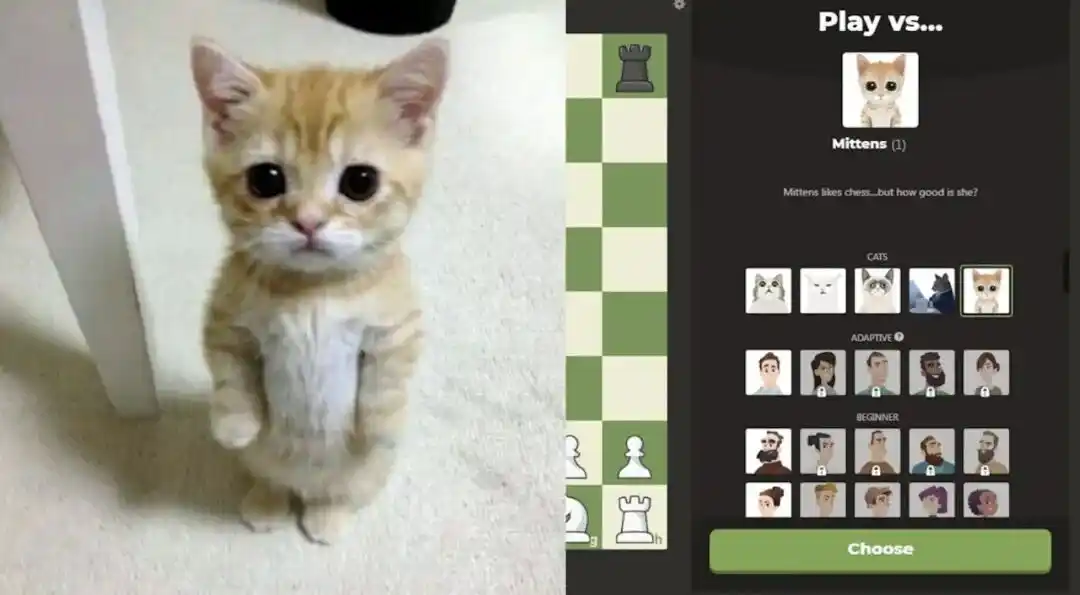
Chess.com's chess AI Mittens the cat is "cute and quiet" but a master at chess | Image source: Chess.com

This cat went viral on social media, with "I got beaten by a cat" becoming a global meme. The same year, a cheating scandal involving young player Hans Niemann made headlines in major news outlets, pushing chess into a broader public view.

A key phenomenon Allebest described was—after each wave receded, the user baseline was significantly higher than the previous one.

This wasn't a flash-in-the-pan traffic spike but step-like growth. The baseline after the 2020 surge, the baseline after the 2023 surge—each was higher than the last.

Why could the chess site retain people after each traffic explosion? Because chess isn't just something that was "recommended"; people discovered it was genuinely fun.

This leads to a more fundamental question.

Winning Isn't the Goal; Playing Is

In the podcast, Allebest said a widely quoted line—People want to acquire human skills, even if machines far surpass humans at that thing; people appreciate outstanding human artistry, even if machines can do it better.

This statement is good but can be taken a step further.

A machine's logic for playing chess is purely instrumental.

For Stockfish or any chess engine, every move is a means to an end—winning. It has no "experience." It doesn't feel excitement when conceiving a brilliant move mid-game, doesn't feel frustration when checkmated, doesn't have an "aha!" moment during post-game analysis.

Winning is just winning, merely a change in strings of numbers.

But humans playing chess is a completely different matter.

An amateur player spending 10 minutes on a blitz game on Chess.com doesn't care at all how Stockfish would rate their moves. They care about that little thrill of "I saw a tactical combination my opponent didn't," the heart-pounding tension during time pressure, the curiosity to analyze the game after a loss to figure out "which move was actually wrong."

These things are the entire meaning of the game itself, unrelated to winning or losing. Put more succinctly—the reward of the game is playing the game itself.

And the existence of AI precisely amplifies this purity.

IBM's Deep Blue defeating chess master Kasparov over 30 years ago | Image source: Britannica

Before Deep Blue defeated Kasparov, the chess world was shrouded in a heroic narrative. Who was the world's best? Could humanity preserve its dignity? The chess championship matches between the US and USSR during the Cold War were even imbued with ideological weight.

The act of "winning" was overloaded with too much meaning.

But when AI completely ended the question of "who is the strongest," a strange liberation occurred.

Since humans can never beat machines, human vs. human matches are no longer about "competing for the strongest," but return to the game's most primitive state—I play a game with you simply for fun.

Once the anxiety about winning and losing is removed, the pure joy of the game is released.

Simultaneously, AI's role in the chess ecosystem is increasingly becoming like "infrastructure."

Chess.com is using AI as a "coach in your pocket"—analyzing your recent games, telling you which areas need improvement, and even allowing conversation with the AI coach. Previously, improving your game meant hiring a human coach; now, you have a teaching system ready on your phone. AI is also used for anti-cheating—analyzing move patterns to judge if a player is using engine assistance.

Even AI products like the Mittens Bot have themselves become "content" attracting new users.

AI didn't kill chess; it became a tool for more people to fall in love with chess.

Go: The Silent Mirror

Unfortunately, the same story has not repeated itself in the world of Go.

Three years after AlphaGo defeated Lee Sedol, Lee Sedol announced his retirement.

He said the paradigm shift brought by AI meant the end of Go's "art," and he could no longer find joy in it. The "joseki" (standard patterns) accumulated over two thousand years in Go, standard moves regarded as truth by generations of players, were proven by AI to be mere solidified biases. The "san-san invasion," once considered "rude" and forbidden to teach children, quickly became standard practice for professional players after AlphaGo used it without hesitation.

A deeper change occurred at the cultural level of professional Go.

Before AI, professional players had distinctive styles; fans could identify who was playing just by looking at the game record. Go was thus seen as an art. After AI, everyone is memorizing AI moves, competing to see who has a higher "AI agreement rate." The stories in Go commentary disappeared, replaced by win-rate graphs and agreement rate data.
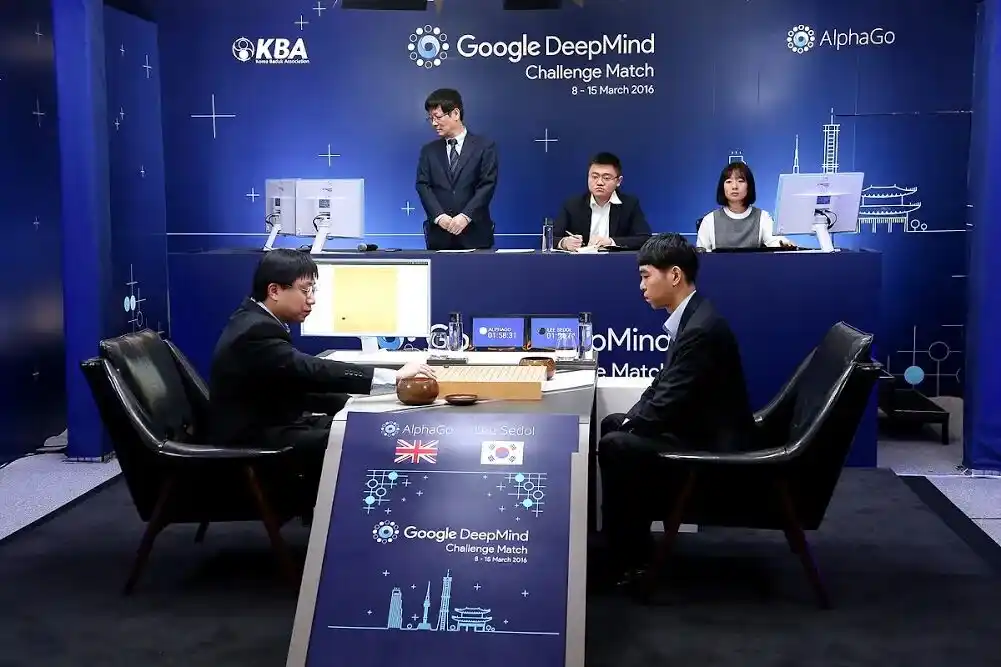
10 years ago, Google's AlphaGo defeated the then-top Korean player Lee Sedol, almost breaking Go's "backbone" | Image source: Google

Korean Go journalist Ahn Sung-moon said something poignant—"Heroic figures are no longer created; we only hear about who ranks in what position."

Similarly crushed by AI, chess is booming, while Go has experienced a "collapse of meaning" at the professional level.

The root cause isn't the difference in the games' complexity but in their community structures.

Chess in the Western world was already a popular game—old men playing in parks, school clubs, speed chess in pubs, with a base of hundreds of millions of amateur players who "just like playing." No matter how strong AI gets, it doesn't affect this group's motivation.

Go's positioning in East Asia is completely different. It's part of the "Four Arts" (qin, qi, shu, hua), an elite accomplishment and educational tool. Chinese children learning Go often follow the same logic as learning the piano—parent-driven, grading/ranking exams, with utilitarian purposes first.

When a game's users are primarily "there for the result," and AI destroys the meaning of that result, the game loses its support.

The popularity of Ke Jie and Zhan Ying on Bilibili did bring traffic to Go. But honestly, the audience is more watching the players' personal charm and "abstract" interactions than watching Go itself.

This is "the influencer-ization of players," not "the popularization of Go."

Tens of millions of games happen daily on Chess.com; that's real "people playing chess." The barrage frenzy in Go livestreams is closer to entertainment consumption.

This article isn't meant to praise chess and disparage Go, but to see some fundamental questions through Chess.com's success.

In an era where AI will crush more and more human skills, a question worth pondering repeatedly is—What is our motivation for doing something? Is it to win, or to play?

Those things where "the process itself is the reward"—chess, playing music, writing, painting, running, cooking—perhaps won't die out because AI is stronger. Instead, they might become purer once the pressure to "win" is lifted.

And those things we were only doing "for the result," AI will indeed take them away. In a sense, AI *should* take them away.

Chess's prosperity in the AI era tells us that humans won't stop doing something just because machines are better.

What truly determines whether something survives is never "who does it better," but "what humans are actually enjoying when they do it."

This article is from the WeChat public account "GeekPark" (ID: geekpark), author: Techno King, editor: Jing Yu


Crypto di tendenza

Domande pertinenti

QAccording to the article, how did the chess platform Chess.com manage to thrive despite AI surpassing humans in chess?

AChess.com thrived by transforming AI into an infrastructure tool that enhances the user experience, such as offering an AI coach, anti-cheating analysis, and engaging AI bots like Mittens. Crucially, the article argues that once AI removed the pressure of 'winning' from human competition, players returned to enjoying the game for its intrinsic, playful rewards rather than the outcome.

QWhat key difference does the article highlight between the impact of AI on the international chess community and the Go community?

AThe article highlights that the international chess community, with a large base of amateur players who play for enjoyment, has grown in popularity. In contrast, the Go community, particularly in East Asia, was more focused on elite mastery, ranking, and artistic tradition. AI's dominance eroded the 'meaning' and artistic narratives in professional Go, leading to a crisis of purpose among top players, while chess's amateur base remained motivated by the fun of playing itself.

QWhat was the significance of the Netflix series 'The Queen's Gambit' and the Mittens AI bot for Chess.com's growth?

A'The Queen's Gambit' and the Mittens AI bot were pivotal events that provided massive, viral exposure for chess. The TV series sparked global interest during the COVID-19 lockdowns, while the Mittens bot, a cute but brutally strong AI cat, became a social media meme. Each event led to a surge in users, and importantly, each surge left Chess.com's user base at a permanently higher level than before.

QHow does the article describe the fundamental difference between how AI and humans approach a game like chess?

AThe article states that AI approaches chess with a purely instrumental, goal-oriented logic where every move is a means to the single end of winning. Humans, however, play for the experience itself—the excitement of a clever tactic, the tension of a time scramble, the curiosity in analysis after a loss. For humans, the reward is in the act of playing, not just the final result.

QWhat broader conclusion does the article draw about human activities in the age of AI from the story of chess's resurgence?

AThe article concludes that activities whose primary reward is the process itself—like playing games, making art, or cooking—will not die out because AI can do them 'better.' Instead, they may become more pure and enjoyable once the pressure to be the 'best' is removed. Activities pursued purely for an external result, however, are more likely to be taken over by AI, which the article suggests is a natural and acceptable progression.

Letture associate

Claude's Watermark Has Been Cracked, Gaining 11k Stars, But Installation Is Refused

The article discusses the controversy surrounding Anthropic's implementation of a hidden watermark in all text generated by its AI, Claude. This policy, based on Google DeepMind's SynthID-Text technique, embeds a statistical signature by making inconsequential word choices. The watermark applies globally, even to human-written text lightly edited by Claude, sparking user backlash over issues of ownership and the creation of an "AI content second-class citizen" status. In response, an open-source tool called "watermarks-remover" (originally "remove-claude-marks") was released on GitHub, quickly gaining 11k stars. It works on three levels: removing invisible Unicode characters, using an agent to rewrite text and break statistical patterns, and stripping metadata from various file formats. Notably, Claude itself refused to install this removal tool as an Agent Skill, a task ultimately completed by another AI model, GLM 5.2. The article points out the irony that the removal code may have been written by Claude. The piece frames this as an ongoing battle between watermarking for traceability against misinformation and the desire for unmarked, owned content from paying users. It questions the practicality of mandatory technical markings when AI-generated text becomes indistinguishable from human writing, suggesting the open-source community's rapid development of countermeasures will continually outpace regulatory efforts.

marsbit1 h fa

Claude's Watermark Has Been Cracked, Gaining 11k Stars, But Installation Is Refused

marsbit1 h fa

SafePal Leaks Data of Nearly 40,000 Hardware Wallet Buyers: Private Keys Intact, Yet Danger Moves Closer to the Physical

Hardware wallet manufacturer SafePal has disclosed a data breach affecting approximately 39,798 customers who placed orders between March 2025 and April 2026. The leak exposed personal information including names, email addresses, phone numbers, physical delivery addresses, and purchase records. The company confirmed that private keys, recovery phrases, wallet passwords, and financial details were not compromised, as the cold storage systems operate in an isolated environment separate from the e-commerce servers. However, the breach poses significant risks beyond digital theft. Attackers now possess a high-value list of confirmed hardware wallet owners, effectively marking them as likely holders of substantial cryptocurrency. This enables highly targeted social engineering attacks, such as phishing emails referencing real order details, fake hardware deliveries, or phone scams impersonating SafePal support. The company has already identified and taken down over 30 related phishing sites. A critical aspect of the incident is the delayed disclosure timeline. SafePal acknowledged receiving initial user reports of phishing attempts in May but treated them as isolated. A full investigation began in July, with a public announcement not made until August, leaving users exposed for approximately three months. Furthermore, a configuration error prevented a data-purge routine from deleting old order information as intended, potentially increasing the scope of the leaked data. The incident highlights a structural paradox in the hardware wallet industry: while the devices are designed to secure private keys offline, the necessary e-commerce process collects sensitive personal data that, if leaked, makes the user a target. This mirrors a similar breach suffered by Ledger in 2020. Affected users are advised to be extremely vigilant. They should verify if they are impacted via SafePal's dedicated page, treat all unsolicited communications (emails, calls, physical mail) referencing SafePal as suspicious, and never share recovery phrases. Users who may have entered sensitive information on a phishing site must create a new wallet immediately. The breach underscores that in cryptocurrency security, the most vulnerable link is often the human user, not the cryptographic technology.

marsbit1 h fa

SafePal Leaks Data of Nearly 40,000 Hardware Wallet Buyers: Private Keys Intact, Yet Danger Moves Closer to the Physical

marsbit1 h fa

Exiting Top Ten Shareholders of Kweichow Moutai, 'Long-term Capital' Portfolio Adjustments Revealed: National Social Security Fund Enters 12 New Stocks, Invests in Hard Tech Mthreads

With the ongoing release of semi-annual reports, the second-quarter investment moves of long-term institutional investors like the National Social Security Fund (NSSF) and insurance capital are becoming clear. Central Huijin Asset Management and China Securities Finance Corp., often referred to as the "national team," are no longer among the top ten shareholders of Kweichow Moutai. Data shows that as of August 14th, the NSSF held positions in 33 A-share companies, with a total portfolio value exceeding 11 billion yuan. It added 12 new stocks in Q2, spanning sectors like chemicals, food & beverage, and semiconductors. The NSSF maintains its stable investment style, favoring companies with solid performance and attractive valuations. Apart from exiting Moutai, Huijin and China Securities Finance also left the top ten shareholder lists of companies like Ping An Bank and Dahua Technology. Insurance capital heavily invested in 41 companies in Q2, with a total holding value over 26 billion yuan. They showed a continued preference for cyclical sectors like non-ferrous metals and chemicals, as well as high-dividend-yield stocks. Analysts note that these long-term funds act as market stabilizers and investment bellwethers. Their presence is reshaping the market ecology, steering focus towards fundamental corporate value and away from speculative trading. A notable move was the NSSF's new investment in Moore Threads, a loss-making but leading domestic GPU design company listed on the STAR Market, indicating interest in hard technology sectors. Looking ahead, analysts expect long-term capital to continue a dual-strategy: maintaining a foundation in high-dividend-value stocks while gradually increasing exposure to growth areas aligned with industrial upgrading, such as advanced manufacturing and tech self-sufficiency. The market's recovery is seen as gaining a firmer footing after recent adjustments.

marsbit1 h fa

Exiting Top Ten Shareholders of Kweichow Moutai, 'Long-term Capital' Portfolio Adjustments Revealed: National Social Security Fund Enters 12 New Stocks, Invests in Hard Tech Mthreads

marsbit1 h fa

Data of 54,000 wallet users leaked, Clarity odds just 10%: Hodler’s Digest, Aug. 16

Galaxy Digital has slashed the odds of the CLARITY Act passing in 2026 from 75% to just 10%, citing limited Senate session days. If it fails, the SEC and CFTC plan to issue their own crypto rules, though an SEC meeting was abruptly cancelled. High-profile meetings at the White House are planned to discuss the bill. Amid growing hack fears, crypto companies are urging AI labs to grant developers early access to advanced AI models for cybersecurity, following a $116M Coldcard wallet theft. Data breaches at Trezor and SafePal have exposed over 54,000 users' personal information. The CFTC is clashing with states over regulating prediction markets like Kalshi, ordering it to ignore a New York restraining order to maintain a national market, while a Washington state judge ruled against it. The Ethereum Foundation is revising its post-quantum plan, moving away from the Poseidon hash function, and scoping its next major upgrade, Hegotá, for next year. Tether received its first full clean audit opinion from KPMG, showing reserves exceeding liabilities by $6.814 billion. Marketwise, major cryptos saw weekly declines. Predictions include a possible Bitcoin bottom in October, while analysts dispute the feasibility of BTC reaching $1M by 2030. Glassnode notes Bitcoin is in its longest capitulation phase since FTX's collapse. Three men were charged for an alleged Bitcoin kidnapping plot in Missouri.

cointelegraph2 h fa

Data of 54,000 wallet users leaked, Clarity odds just 10%: Hodler’s Digest, Aug. 16

cointelegraph2 h fa

50 Billion, Sichuan Brothers Have Struck It Rich

A new king of Sichuan stocks has emerged. This week, Chengdu Chaochun Applied Materials Co., Ltd. (Chaochun Yingcai) debuted on the ChiNext board, with its stock price surging over 700% intraday and its market value exceeding 50 billion yuan. Opening at 450 yuan per share, it surpassed New Easun to become the highest-priced stock in Sichuan's A-share market. This marks the success of a 21-year entrepreneurial journey by brothers Chai Jie and Chai Lin. Younger brother Chai Jie founded the company in 2005 in Chengdu, initially focusing on特种陶瓷. Elder brother Chai Lin, an expert in精密光学 and特种涂层, joined in 2008 to lead R&D. Facing a market monopolized by giants like KoMiCo and TOCALO, the company persisted. A breakthrough came in 2011 when its products entered the supply chain of AMEC (中微公司), a major domestic etching equipment maker. By 2020, its components reached the technical threshold for supporting 5nm process etching equipment. Revenue grew from 169 million yuan in 2023 to 496 million yuan in 2025, with semiconductor coating parts accounting for over 95% of sales. The IPO created significant wealth. The Chai brothers, holding a combined 46.88% stake, saw their paper wealth reach approximately 24 billion yuan. It also became the most profitable ChiNext IPO this year for retail investors. Employees benefited through two layers of持股平台, covering over 200 core technical and business staff. Early investors like SDIC Venture Capital, AMEC, and BYD (which invested 126.9 million yuan and now has a paper gain exceeding 1.8 billion yuan) also reaped substantial returns. The company represents a wave of tech leaders choosing to build their businesses in their hometown of Sichuan. Examples include New Easun in optoelectronics and Baili Tianheng in biopharmaceuticals. This trend shows that inland cities like Chengdu, with talent and industrial patience, can incubate specialized leaders that break foreign monopolies, offering an alternative model to the coastal hubs.

marsbit3 h fa

50 Billion, Sichuan Brothers Have Struck It Rich

marsbit3 h fa

Trading

Spot

Articoli Popolari

Come comprare PEOPLE

Benvenuto in HTX.com! Abbiamo reso l'acquisto di ConstitutionDAO (PEOPLE) semplice e conveniente. Segui la nostra guida passo passo per intraprendere il tuo viaggio nel mondo delle criptovalute.Step 1: Crea il tuo Account HTXUsa la tua email o numero di telefono per registrarti il tuo account gratuito su HTX. Vivi un'esperienza facile e sblocca tutte le funzionalità,Crea il mio accountStep 2: Vai in Acquista crypto e seleziona il tuo metodo di pagamentoCarta di credito/debito: utilizza la tua Visa o Mastercard per acquistare immediatamente ConstitutionDAOPEOPLE.Bilancio: Usa i fondi dal bilancio del tuo account HTX per fare trading senza problemi.Terze parti: abbiamo aggiunto metodi di pagamento molto utilizzati come Google Pay e Apple Pay per maggiore comodità.P2P: Fai trading direttamente con altri utenti HTX.Over-the-Counter (OTC): Offriamo servizi su misura e tassi di cambio competitivi per i trader.Step 3: Conserva ConstitutionDAO (PEOPLE)Dopo aver acquistato ConstitutionDAO (PEOPLE), conserva nel tuo account HTX. In alternativa, puoi inviare tramite trasferimento blockchain o scambiare per altre criptovalute.Step 4: Scambia ConstitutionDAO (PEOPLE)Scambia facilmente ConstitutionDAO (PEOPLE) nel mercato spot di HTX. Accedi al tuo account, seleziona la tua coppia di trading, esegui le tue operazioni e monitora in tempo reale. Offriamo un'esperienza user-friendly sia per chi ha appena iniziato che per i trader più esperti.

642 Totale visualizzazioniPubblicato il 2024.12.12Aggiornato il 2026.06.02

Come comprare PEOPLE

Discussioni

Benvenuto nella Community HTX. Qui puoi rimanere informato sugli ultimi sviluppi della piattaforma e accedere ad approfondimenti esperti sul mercato. Le opinioni degli utenti sul prezzo di PEOPLE PEOPLE sono presentate come di seguito.

活动图片