Duan Yongping Makes First Investment in Crypto Company: Why Circle?

链捕手Pubblicato 2026-05-20Pubblicato ultima volta 2026-05-20

Introduzione

Duan Yongping, a renowned Chinese investor known as the "Chinese Buffett," has made his first investment in the cryptocurrency space through his family office, H&H International Investment LLC. According to a recent 13F filing, the firm acquired a position in stablecoin issuer Circle (CRCL), valued at approximately $19.08 million. While this amount represents only 0.2% of Duan's total portfolio, the move is symbolically significant. Historically cautious towards Web3 and crypto assets, Duan's investment philosophy aligns with traditional value investing principles—emphasizing understandable business models, strong moats, and stable cash flows. Most crypto projects have not met these criteria. Circle, however, stands apart. Its core business revolves around issuing the USDC stablecoin and generating interest income from its reserve assets, primarily U.S. Treasuries. This model resembles a money market fund or digital dollar bank, providing predictable revenue. Circle's Q1 2026 financials showed strong growth: revenue reached $694 million (up 20% year-on-year), with 94% from reserve interest, and adjusted EBITDA was $151 million (up 24%). USDC circulation grew 28% to $77 billion. Duan's investment signals a shift: stablecoin infrastructure like Circle's is becoming legible to traditional value investors. It represents a bridge between crypto and mainstream finance, underscored by Circle's recent $222 million pre-sale for its Arc layer-1 blockchain, backed by major firms like...

Circle Author: Hu Tao, ChainCatcher

H&H International Investment LLC, the family wealth management firm of renowned investor Duan Yongping, often referred to as the "Chinese Buffett," recently filed its Q1 13F holdings report with the U.S. SEC for the period ending March 31, 2026.

According to the report, the total market value of Duan Yongping's investment portfolio grew significantly from $17.49 billion last quarter to $20.004 billion. While continuing to hold heavy positions in Apple (AAPL), Berkshire Hathaway (BRK.B), and NVIDIA (NVDA), a new name has drawn the joint attention of both the crypto industry and value investors: stablecoin giant Circle (NYSE: CRCL).

Although the initial purchase amount of $19.08 million represents only 0.2% of Duan Yongping's vast portfolio, the signal it sends is highly symbolic. For a veteran value investor who has always invested only in businesses that are "understandable, have a moat, and generate good cash flow," the logic behind buying Circle is worth pondering.

From Exclusion to Acceptance

It is well known that Duan Yongping is one of China's most successful entrepreneur-investors and one of the very few Chinese investors who have truly practiced Buffett-style value investing long-term with great success.

However, Duan Yongping has long maintained a cautious attitude towards blockchain and Web3. Over the past few years, he has rarely publicly participated in the Web3 frenzy and has not frequently discussed concepts like NFTs, DeFi, or public blockchains as some tech investors have. He has also shown no significant interest in Bitcoin during its multiple boom-and-bust cycles.

This is actually not surprising. Duan Yongping's core investment framework is essentially closer to the Buffett system: it emphasizes long-term cash flow, understandability of the business model, brand and channel moats, and management quality. He particularly favors companies with strong consumer mindshare, high free cash flow, and long-term compounding ability, such as Apple, Kweichow Moutai, and Berkshire Hathaway.

However, most crypto projects in the past have found it difficult to meet these criteria.

Many Web3 projects have been highly dependent on token price movements, with fragile business models and unsustainable cash flows; the industry has long been accompanied by regulatory uncertainty, governance chaos, and cyclical bubbles. These characteristics are almost inherently at odds with the "certainty" emphasized by traditional value investors.

But Circle is an exception. Compared to many crypto projects that rely on "storytelling" or speculation to sustain valuations, Circle is more like a typical financial infrastructure company.

Why Circle?

Circle's core business is not "speculating on crypto," but issuing the stablecoin USDC and earning interest income through reserve assets like U.S. Treasuries. Its profit model is actually closer to that of a money market fund, a payment clearing platform, or even a "digital dollar bank."

This also means its revenue source is highly predictable. And Circle's latest Q1 2026 earnings report further reinforces this point.

The report shows that Circle's total Q1 revenue reached $694 million, a 20% year-on-year increase, with 94% coming from reserve interest income; adjusted EBITDA reached $151 million, a 24% year-on-year increase.

More crucially, its core business metrics are still expanding rapidly: USDC circulation reached $77 billion, up 28% year-on-year; USDC on-chain transaction volume reached $21.5 trillion, a staggering 263% year-on-year surge.

This means Circle has formed a relatively complete "stablecoin interest machine." Under the U.S. high-interest-rate cycle, the interest income generated from USDC reserves is growing rapidly, making Circle one of the few large companies in the crypto industry that truly has stable cash flow and can sustain profitability.
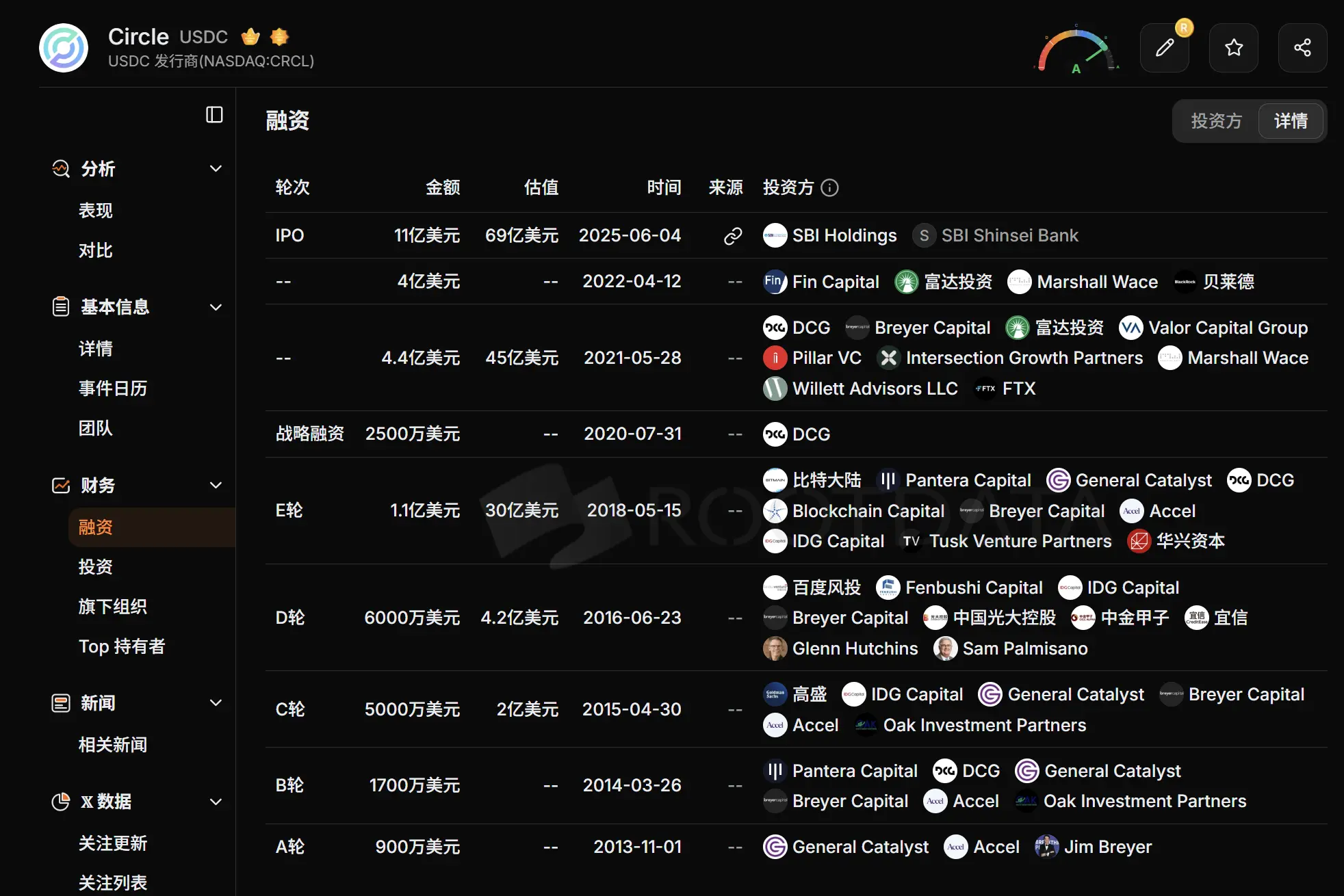
Circle's Financing History Source: RootData

For an investor like Duan Yongping who emphasizes the "essence of business," Circle has finally begun to take on a "understandable" form.

At the end of April, Circle also announced that its Layer 1 network, Arc, completed a token pre-sale financing round of $222 million, valuing it at $3 billion. a16z led a $75 million investment, with participation from more than ten institutions including BlackRock, Apollo Funds, Intercontinental Exchange (ICE), Standard Chartered Ventures, ARK Invest, and Bullish.

The expansion into the public chain network and the issuance of a native token have further opened the ceiling for Circle's business, and its stock price has risen accordingly. In May, Circle's stock price surged nearly 3 times from its yearly low ($50), briefly breaking through $140, and has since retreated slightly to around $111.

Traditional Finance is Increasingly Accepting Crypto Assets

Today, more and more crypto companies are attempting IPOs. From exchanges and stablecoin issuers to on-chain payment and custody infrastructure, many crypto enterprises are actively entering traditional capital markets, hoping to gain more stable financing channels, a broader institutional shareholder base, and stronger regulatory legitimacy.

At the same time, traditional financial giants are also entering the crypto space at an unprecedented pace. Whether it's BlackRock promoting Bitcoin ETFs, traditional banks exploring stablecoin settlement and on-chain asset custody, or payment institutions integrating with the USDC network, it essentially illustrates one thing:

The crypto industry is no longer just an independently existing "alternative market," but is beginning to integrate deeply with the global financial system.

In this process, stablecoin companies like Circle are becoming the bridge most easily understood and accepted by traditional capital.

The significance of Duan Yongping's purchase of Circle lies precisely here. It may not mean he is fully bullish on Web3, nor does it mean the value investing system is embracing all crypto assets. But at the very least, it shows that stablecoins and the on-chain dollar system have begun to enter the "circle of competence" of some traditional top-tier investors.

From a broader perspective, Circle is just one of the pioneers being "translated" by traditional mainstream capital from the crypto industry. As regulatory frameworks gradually become clearer, infrastructure matures, and profit models are continuously validated, more crypto-native enterprises like Circle will likely enter the view of traditional capital markets in the future.

Domande pertinenti

QWhat is the significance of Duan Yongping's first investment in a crypto company, Circle, according to the article?

AThe article states that while the investment amount is small relative to his portfolio (0.2%), it is highly symbolic. It signifies that a traditional, Buffett-style value investor, who emphasizes investing in understandable businesses with strong moats and good cash flow, has found a crypto company (Circle) that fits his investment criteria. This reflects a potential bridge between traditional finance and the crypto sector.

QWhy did Duan Yongping historically avoid most crypto investments, and how is Circle an exception?

ADuan Yongping avoided most crypto investments because they often did not meet his value investing criteria: they lacked predictable long-term cash flows, had fragile business models dependent on token prices, and operated in a space with high regulatory uncertainty. Circle is an exception because its core business model, issuing the stablecoin USDC and earning interest from reserve assets, is more akin to a financial infrastructure company or a 'digital dollar bank' with predictable and profitable cash flows.

QWhat are the key financial metrics from Circle's latest quarterly report that likely made it attractive to a value investor?

ACircle's Q1 report showed total revenue of $694 million (up 20% YoY), with 94% coming from reserve interest income. Adjusted EBITDA was $151 million (up 24% YoY). Key operational metrics also grew: USDC circulation reached $77 billion (up 28% YoY) and USDC on-chain transaction volume surged to $21.5 trillion (up 263% YoY), demonstrating a scalable and profitable 'stablecoin interest machine'.

QHow does Circle's recent funding round for its Layer 1 network, Arc, relate to its business prospects and stock performance?

AIn late April, Circle announced a $222 million token pre-sale for its Layer 1 network Arc, valuing it at $3 billion, with backing from major firms like a16z, BlackRock, and Apollo. This expansion into a blockchain network and native token opens up new growth avenues for Circle, increasing its business ceiling. Subsequently, Circle's stock price rose significantly in May, nearly tripling from its yearly low to briefly surpass $140.

QWhat broader trend in the finance industry does Duan Yongping's investment in Circle represent?

AIt represents the increasing integration of the crypto industry with the traditional financial system. More crypto companies are seeking IPOs for legitimacy and funding, while traditional finance giants like BlackRock are entering the crypto space (e.g., via Bitcoin ETFs). In this context, stablecoin companies like Circle, which function as financial infrastructure, are becoming the most understandable and acceptable bridge for traditional capital, signaling a wider acceptance of certain crypto-native business models.

Letture associate

Cryptocurrency Asset Recovery: A Lucrative, Low-Profile Business

Summary: The article explores the growing business of cryptocurrency asset recovery, highlighting it as a quiet but profitable niche. While many assume recovery involves dramatic hacking or theft cases, the most common issues are everyday operational errors: sending crypto to the wrong blockchain network, forgetting transaction memos/Tags, hardware wallet failures, incorrect seed phrase backups, and frozen centralized exchange accounts. As cryptocurrency adoption expands to less technical users, the volume of such costly mistakes increases. This creates a genuine, recurring demand for professional recovery services. The article notes a paradox: while the technology emphasizes user-controlled assets, the complexity often necessitates expert intermediaries, similar to traditional financial services. However, the field is fraught with risks, including middlemen and secondary scammers who prey on desperate users. Truly professional teams avoid promising guaranteed results, instead focusing on diagnosing the specific problem—whether it's a technical wallet issue, an exchange compliance matter, or an unsolvable private key loss. The author concludes by noting the professionalization of this market and announces a partnership with a specialized recovery team, offering readers a preliminary assessment for issues like wrong-chain deposits, lost access, or frozen accounts, while emphasizing ethical practices and realistic expectations.

marsbit35 min fa

Cryptocurrency Asset Recovery: A Lucrative, Low-Profile Business

marsbit35 min fa

Cryptocurrency Asset Recovery: A Lucrative, Under-the-Radar Business

Cryptocurrency Asset Recovery: A Lucrative, Low-Key Business The article discusses the burgeoning business of cryptocurrency asset recovery, driven by common yet often crippling user errors rather than sensational hacking incidents. Key problem areas include selecting the wrong blockchain for a deposit, omitting required memos/tags when sending to exchanges, physical wallet device failures, errors in backing up or modifying seed phrases, and issues with frozen accounts or withdrawals on centralized exchanges. As cryptocurrency adoption grows among mainstream users—including retail investors and businesses—these operational mistakes increase. The decentralized nature of crypto places full responsibility for asset security on users, who may lack the technical expertise to navigate complex chains, wallets, and protocols. Even centralized exchanges, while offering some support, often present users with cumbersome, non-intuitive processes for resolving issues. This creates a persistent and growing demand for professional recovery services. However, the field is rife with risks, including middlemen without real expertise and outright scammers who promise guaranteed recovery, request sensitive information like private keys, or charge advance "fees." Legitimate service providers typically avoid absolute guarantees, as recovery feasibility depends heavily on the specific technical or administrative circumstances of each case. The business is evolving from an informal market into a professional one requiring a combination of technical analysis, exchange/platform communication, and legal/compliance knowledge. The article concludes by noting the author's partnership with a professional recovery team, offering preliminary assessments for issues like incorrect deposits, wallet access problems, or exchange account freezes, with an emphasis on realistic evaluation over promises.

链捕手41 min fa

Cryptocurrency Asset Recovery: A Lucrative, Under-the-Radar Business

链捕手41 min fa

YC Partner: How to Build a Self-Evolving AI-Native Company

YC Partner Tom Blomfield argues that the future lies in building AI-native companies designed as self-evolving systems, not just applying AI to traditional, hierarchical "Roman legion" structures. The core idea is to extract and codify all organizational knowledge—scattered across emails, Slack, documents, and human minds—into a central, AI-readable "company brain." This enables the creation of recursive AI loops that sense changes (from emails, support tickets, data), make decisions, execute via tools, and learn from feedback, all with minimal human intervention. YC exemplifies this with an agent that monitors failed queries, autonomously diagnoses the issue (e.g., needing a new database or index), writes code, submits it for review, and deploys fixes—optimizing the company while founders sleep. This shift redefines organizational structure: the bottleneck becomes token usage and context quality, not headcount. Middle management for coordination is largely obsolete. The critical human roles are individual contributors (ICs) and those handling high-risk, real-world judgments at the system's edge. Key steps include recording all organizational activity for AI, creating self-improving artifacts (like an AI-generated, living handbook), and treating internal software as temporary and disposable, while preserving valuable business context and data. The fundamental question for founders is whether to build their company as this new type of intelligent, self-optimizing system from the start.

marsbit46 min fa

YC Partner: How to Build a Self-Evolving AI-Native Company

marsbit46 min fa

Trading

Spot
Futures
活动图片