Uniswap v4 Hook Analysis: Architecture Design, Common Vulnerabilities, and Protection Practices

marsbitPubblicato 2026-06-22Pubblicato ultima volta 2026-06-22

Introduzione

Uniswap v4's Hook mechanism is a major innovation, enabling custom logic injection into liquidity pool lifecycle events like swaps and liquidity provisioning. This transforms the AMM into programmable infrastructure, shifting the security model from protocol-level to pool-level, as each pool's safety now depends on its bound Hook contract. The core architecture revolves around the singleton PoolManager contract, which manages all pools via a flash accounting system. State changes are tracked in transient storage and must be settled by the end of a transaction. Hook contracts are permanently bound to pools via a PoolKey, with their permissions encoded directly into their address via specific low-order bits. This design introduces unique security considerations and challenges for future upgrades. Key vulnerabilities and best practices identified include: - **Access Control Gaps:** Early versions of the BaseHook abstract contract only protect `unlockCallback()`, leaving other lifecycle functions (`beforeSwap`, `afterSwap`, etc.) exposed unless explicitly secured by developers. - **Unrestricted Pool Binding:** The `initialize()` function does not validate if a Hook "consents" to a new pool. Hooks must implement their own whitelisting in `beforeInitialize` to prevent unauthorized pool creation. - **Async/Custom Curve Hooks:** These high-risk Hooks can completely replace Uniswap's swap logic. Their security depends entirely on their own implementation, as they operate outside the...

Since the mainnet launch of Uniswap v4, the Hook mechanism has become one of the most-discussed innovations in DeFi. The memecoin launchpad Flaunch on Base leverages Hooks to achieve fixed presale pricing and automatic listing and liquidation mechanisms; the liquidity protocol Bunni v2 uses Hooks to build programmable liquidity and restaking models; tokens like SATO, uPEG (Unipeg), and Slonks, which revolve around Hook-based gameplay, have also seen tens-of-times price surges in short periods this year.

On the flip side of the Hook ecosystem's prosperity, attacks targeting Hook implementation flaws have also increased significantly. This article will start with the Hook mechanism in Uniswap v4, gradually analyze its core call stack, and help project teams understand potential vulnerabilities.

Uniswap v4 Hook Security

1. Introduction

The most significant architectural change in Uniswap v4 compared to v3 is the introduction of the Hook mechanism: it allows developers to attach custom contracts to lifecycle events of liquidity pools, injecting arbitrary logic at nodes such as swap, add/remove liquidity, and initialization.

Key changes in v4 are as follows:

- Singleton Pattern: All pool states are centrally managed by a single PoolManager contract, no longer deploying separate contracts for each pool.

- Flash Accounting: Intermediate balance changes during a transaction are recorded only in transient storage, with final settlement occurring only at the end of the transaction.

- Hook Mechanism: Each pool can be bound to a Hook contract. The PoolManager will call back to this contract at key nodes (beforeInitialize, beforeSwap, afterAddLiquidity, etc.).

- Hook Immutability: Once a pool is initialized, the bound Hook address is permanently fixed (The Hook address bound to a pool cannot be changed, but whether the Hook contract itself is upgradeable depends on its implementation).
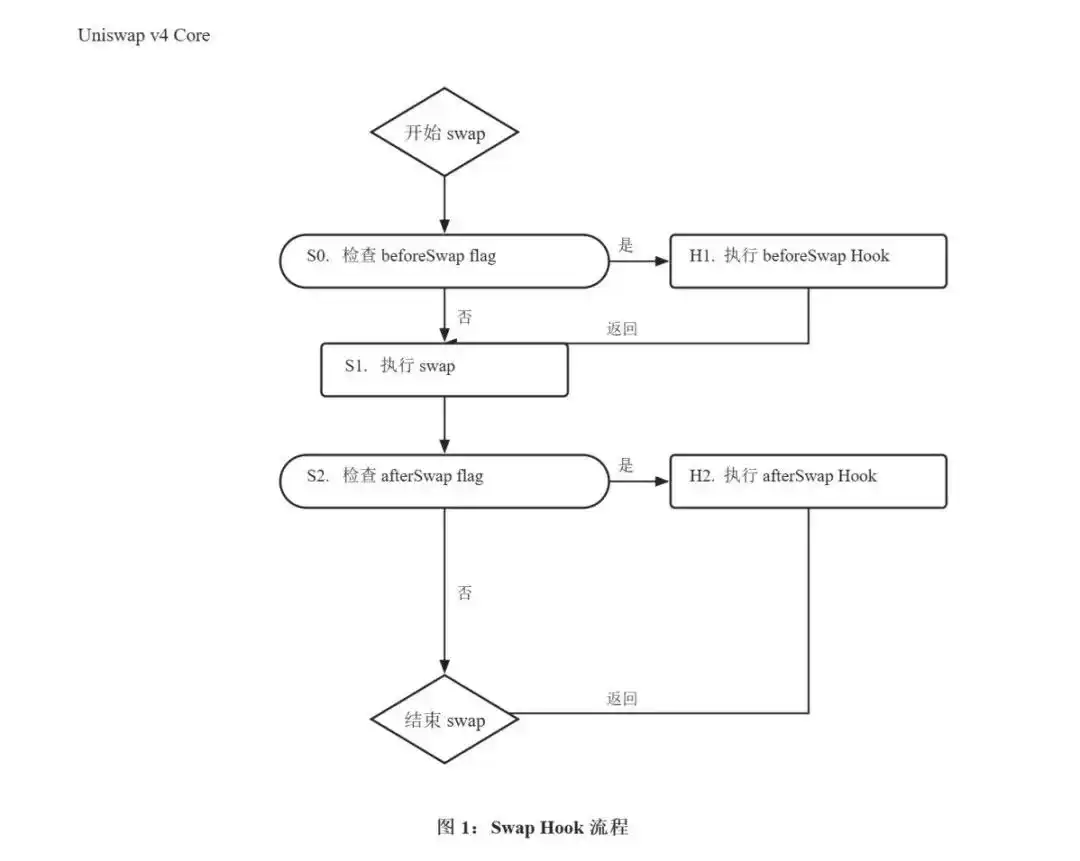
In the v3 era, developers only needed to trust the Uniswap protocol itself; in the v4 era, the security of each pool depends on the Hook it's bound to. Hooks expand AMM from a fixed financial primitive to a programmable financial infrastructure, but the security model has also fragmented from "protocol-level" to "pool-level."

2. Hook Architecture

2.1 PoolManager and the unlock/callback Model

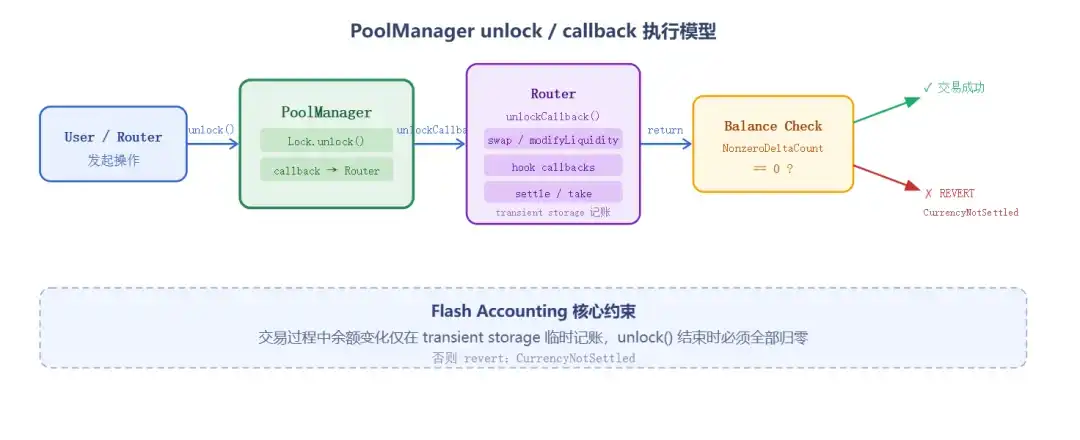
The core contract of v4 is the singleton PoolManager. Any operation that changes a pool's state (swap, add/remove liquidity) must first call PoolManager.unlock() to obtain one-time callback permission, then perform the specific action within unlockCallback(). At the end of the entire process, the PoolManager will verify whether the ledger balances:
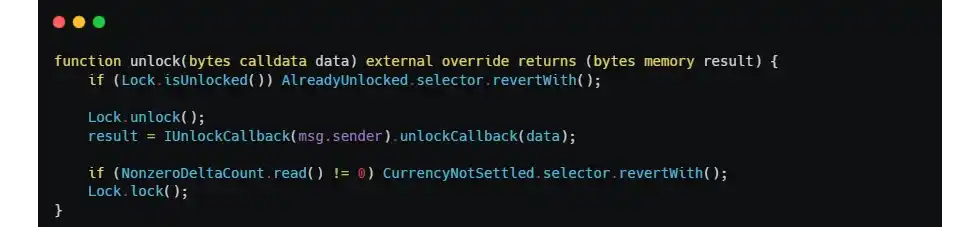
If NonzeroDeltaCount != 0, it directly reverts. This is the core constraint of v4's flash accounting. Any Hook can temporarily unbalance the accounts during execution but must settle itself before the transaction ends; otherwise, the entire transaction rolls back.

Each pool is uniquely identified by a PoolKey structure, which includes a hooks field:

PoolId is calculated as keccak256(PoolKey), so different hook addresses will result in different pools. This also means the PoolManager does not verify whether a Hook address has been used for other pools; the same Hook contract can be bound to multiple pools simultaneously.
2.2 Hook Permission Bits Encoded in the Address

A counterintuitive design in v4 is: Hook permissions are not determined by a variable inside the contract but by the deployment address of the Hook contract.

The PoolManager checks the lower 14 bits of the Hook address to determine if the Hook needs to be called at a certain lifecycle point:

For example, BEFORE_SWAP_FLAG = 1 << 7. If bit 7 of the Hook address is 1, the PoolManager will call the Hook's beforeSwap() before a swap; otherwise, even if the Hook contract implements beforeSwap(), it will never be called by the PoolManager.

This means the Hook must be deployed via CREATE2 + salt to calculate an address where the lower bits exactly match the target permissions. Uniswap officially provides the HookMiner tool for this purpose:
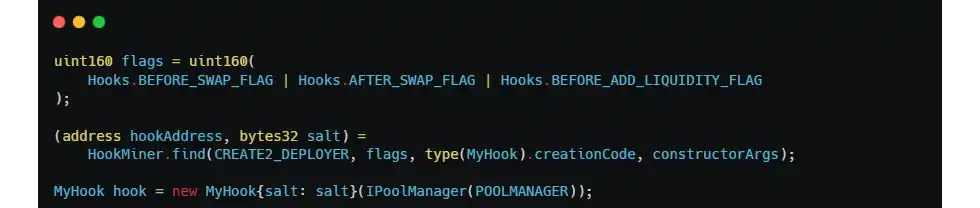
Mismatches between permission bits and function implementation can lead to two types of issues:

(1) A hook function is implemented, but the address does not encode the corresponding permission bit—The PoolManager will never call that function, rendering the logic useless.

(2) The address encodes a permission bit, but the hook does not implement the corresponding function—The PoolManager may revert during the callback (causing DoS) or fail on return value verification, preventing the related operation from executing.

This is also a natural obstacle to Hook upgrades: If a Hook is upgradable via a proxy, the deployment address remains unchanged during upgrades, so post-upgrade, only existing hook function implementations can be modified, not new hook types added. To reserve future extensibility, all possible permission bits must be pre-mined during initial deployment.

2.3 BaseHook and a Commonly Overlooked Access Control Trap

The BaseHook abstract contract provided by earlier versions of the Uniswap v4 periphery allows developers to inherit it for custom Hook implementation. One important role of BaseHook is to provide the onlyPoolManager modifier for the unlockCallback() function:

However—here lies a design trap that is very easy to overlook—early versions of BaseHook only added onlyPoolManager to unlockCallback, providing no protection for other hook callback functions (beforeSwap, afterSwap, beforeAddLiquidity, etc.). Access control for these functions must be explicitly added by the Hook developer.

3. Hook Lifecycle Code Walkthrough

Using an exact-input swap as an example, the following analyzes the complete call stack from when a user initiates a transaction to settlement.

3.1 Pool Initialization and Hook Binding

Anyone can call PoolManager.initialize() to create a new pool:
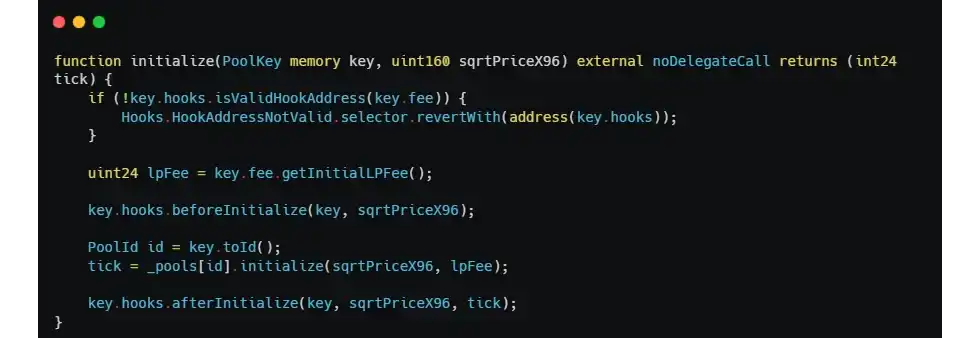
isValidHookAddress only checks the compatibility of the address permission bits with the fee field. It does not verify whether the Hook is already used in other pools, nor does it check if the Hook "wants" to accept this PoolKey. If the Hook design does not include whitelisting or single-pool binding logic in beforeInitialize, anyone can construct a new pool using the same Hook but with an arbitrary token pair, triggering all subsequent callbacks of the Hook.

3.2 beforeSwap and BeforeSwapDelta

The swap process entry is PoolManager.swap(). Before executing the core swap logic, it calls Hooks.beforeSwap():
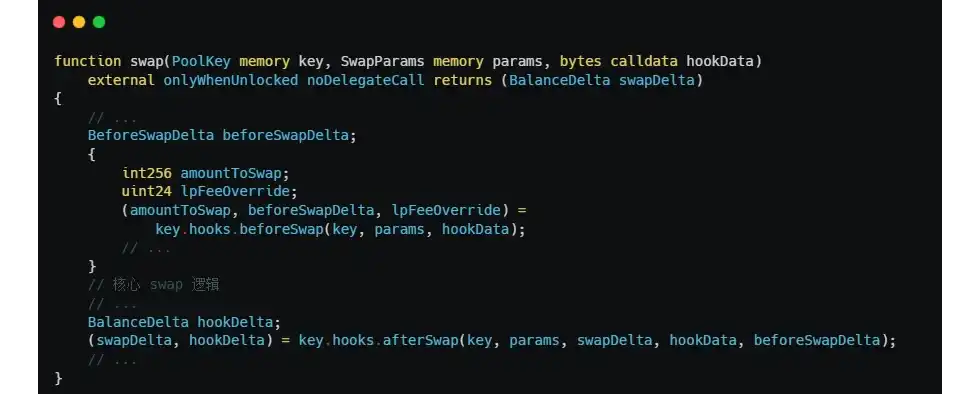
The return value of beforeSwap is a triple (bytes4, BeforeSwapDelta, uint24):

- bytes4: Must equal IHooks.beforeSwap.selector, otherwise PoolManager directly reverts.

- BeforeSwapDelta: The delta adjustments for the specified token and unspecified token that the Hook makes for this swap.

- uint24: Dynamic LP fee override value (only effective when the pool has dynamic fees enabled).

BeforeSwapDelta is an alias for int256, with the high 128 bits being the delta for the specified token (the token the user specified the amount for) and the low 128 bits being the delta for the unspecified token:
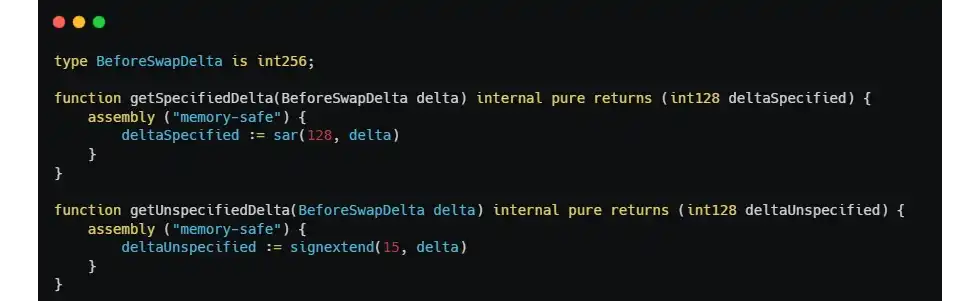
Note that the semantic of BeforeSwapDelta is: the Hook should return a positive value for collecting fees and a negative value for refunding tokens. Developers can easily get the sign wrong. Simultaneously, the correspondence between specified and unspecified depends on params.zeroForOne and the sign of amountSpecified. Slight carelessness in writing can lead to token misplacement.

The PoolManager directly adds the specifiedDelta returned by beforeSwap to the amountToSwap:

This line implies a crucial semantic: the Hook can intercept the swap amount. When hookDeltaSpecified equals -params.amountSpecified, amountToSwap directly becomes zero, meaning the Hook completely takes over this swap—this is the so-called Async Hook or Custom Curve Hook.

Async Hooks are the highest-risk design pattern in v4: they essentially replace Uniswap's swap logic with the Hook's own logic. If the Hook has vulnerabilities or is malicious itself, user funds are no longer constrained by Uniswap's native pricing logic but rely primarily on the correctness of the Hook's own implementation.

3.3 Delta Settlement and NonzeroDeltaCount

The deltas returned by beforeSwap and afterSwap do not immediately trigger transfers but are recorded in the PoolManager's internal ledger:
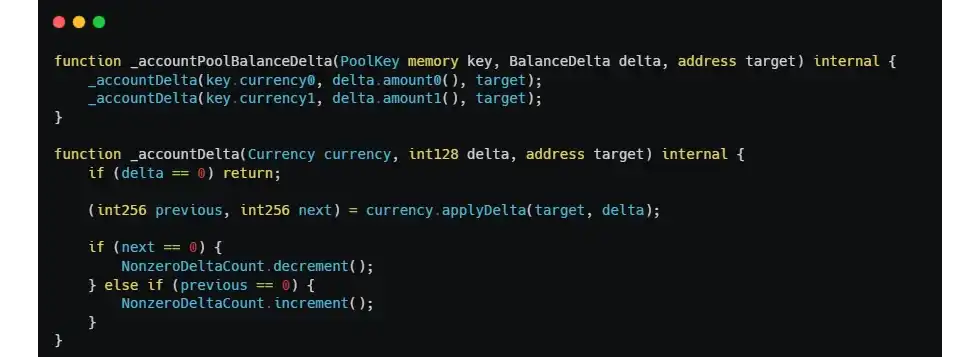
Whenever the cumulative delta for a token changes from zero to non-zero, NonzeroDeltaCount increments; when it returns to zero, it decrements. As mentioned in 2.1, if NonzeroDeltaCount != 0 at the end of unlock(), the entire transaction reverts.

The Hook balances its delta through two actions: settle() (transferring to the PoolManager) and take() (taking from the PoolManager):

The security semantics brought by this mechanism are clear: everyone must eventually balance the accounts. However, it only guarantees "account conservation," not "account correctness." If the Hook returns a maliciously constructed delta in beforeSwap, the PoolManager will faithfully account for this delta. As long as it's eventually settled and balanced, the transaction succeeds—even if this means the Hook can, by forging business states, cause the system to incorrectly believe an attacker has certain asset rights, which the PoolManager cannot recognize as an error at the business level.

A previous security incident involving Cork Protocol was due to a vulnerability in its Hook, and it had been audited by four firms before the attack. In retrospect, we found:

- Three of the four audits did not include the CorkHook contract in their scope.

- The only firm that audited CorkHook identified some code issues and submitted improvement suggestions but did not fully cover access control problems.

- Another auditor explicitly suggested in their report: "an interesting follow-up engagement would be to prove the invariants for the CorkHook functions that are being invoked by different components verified within the scope of this engagement." This suggestion appears highly pertinent in hindsight.

This exposes a new blind spot in audits in the v4 Hook era: the explosion in protocol complexity makes scope definition itself a security decision. The interaction chain between Hooks and other protocol contracts is very long. Auditing the Hook contract alone is insufficient to discover cross-contract combinatorial issues; conversely, auditing peripheral contracts while excluding the Hook from scope misses the largest attack surface in the v4 era.

4. Reflections

Looking at the protocol mechanisms alongside the Cork attack post-mortem, several core points of the v4 Hook security model can be summarized:

(1) If Hook callback functions rely on the calling context provided by PoolManager, they should explicitly restrict calls to only PoolManager. BaseHook does not do this for developers. This is the design trap in v4 that most easily conflicts with general contract auditing experience.

(2) The binding relationship between a Hook and a pool is not restricted by PoolManager. Developers must implement pool whitelisting or single-pool binding in beforeInitialize themselves.

(3) The permission bits of the Hook address must strictly match the function implementation. The calculated address should pre-include all permission bits that might be needed in the future.

(4) Async / Custom Curve Hooks are essentially completely custom swap implementations. They have no Uniswap protocol-level protection and must be audited to the standard of "fully autonomous financial contracts."

(5) "Conservation" in delta accounting does not equal "correctness." NonzeroDeltaCount == 0 only guarantees the final ledger is balanced, not that the ledger's content hasn't been maliciously manipulated.

(6) Token type confusion across markets is a new type of attack surface in the v4 era. When a protocol allows users to create markets, semantic validation of tokens is mandatory and cannot rely solely on interface checks.

Each Hook is an independent trust domain, and the security of each pool is determined by the Hook it's bound to. Therefore, the complexity of Hook security audits is no longer "auditing one piece of code" but "auditing a complete sub-protocol"—this change signifies a methodological upgrade for both project teams and auditors.

View Original Text

Crypto di tendenza

Domande pertinenti

QWhat is the core architectural change introduced in Uniswap v4, and what key security implication does it create?

AThe core architectural change introduced in Uniswap v4 is the Hook mechanism. This allows developers to attach custom logic to key pool lifecycle events like swaps and liquidity changes. The key security implication is a shift from a 'protocol-level' security model in v3, where users trusted the Uniswap protocol itself, to a 'pool-level' security model in v4. The security of each liquidity pool becomes dependent on the security of the specific Hook contract it is bound to.

QHow does Uniswap v4's flash accounting model enforce security, and what is its main constraint?

AUniswap v4's flash accounting model records intermediate balance changes in transient storage during a transaction and only performs final settlement at the transaction's end. It enforces security by requiring the account ledger to be balanced before the transaction concludes. The main constraint is that the `NonzeroDeltaCount` must be zero at the end of a transaction (specifically after `PoolManager.unlock()`); if it is not zero, the entire transaction reverts.

QWhat determines which callback functions (e.g., `beforeSwap`) on a Hook contract are actually invoked by the PoolManager?

AThe invocation of a Hook's callback functions is determined by the last 14 bits (the permission bits) of the Hook contract's deployment address. The PoolManager checks these bits against predefined flags (e.g., `BEFORE_SWAP_FLAG`). If the corresponding bit for a function is set to 1 in the address, the PoolManager will call that function. This permission is fixed at deployment via CREATE2 and cannot be changed later through an upgrade.

QWhat is a significant security oversight in the early version of the BaseHook abstract contract provided by Uniswap v4 periphery?

AA significant security oversight in the early version of the BaseHook abstract contract was that it only protected the `unlockCallback()` function with an `onlyPoolManager` modifier. It did not apply any access control to other critical hook callback functions like `beforeSwap`, `afterSwap`, `beforeAddLiquidity`, etc. This meant developers had to manually and explicitly add access control checks to these functions to prevent unauthorized calls, creating a major security trap if overlooked.

QWhat is an 'Async Hook' or 'Custom Curve Hook' in Uniswap v4, and why is it considered high-risk?

AAn 'Async Hook' or 'Custom Curve Hook' in Uniswap v4 is a Hook design pattern where the Hook's `beforeSwap` function returns a `hookDeltaSpecified` value that cancels out the user's requested swap amount (e.g., `-params.amountSpecified`). This effectively sets the `amountToSwap` to zero, allowing the Hook's own custom logic to completely take over and execute the swap. It is considered high-risk because it replaces Uniswap's native, battle-tested AMM pricing and swap logic. The security of user funds then depends entirely on the correctness and security of the custom Hook implementation, which may have vulnerabilities or be malicious.

Letture associate

Report Interpretation: J.P. Morgan Details Micron's Pre-Earnings Sentiment, Current Hardware Sector Dynamics

Morgan Stanley analyst Joshua Meyers' report (June 21, 2026) highlights key trends in the hardware and semiconductor sector ahead of Micron's earnings. The core takeaways are: 1. **Micron & Memory:** Memory remains a high-conviction long theme, driven by strong AI demand and rising ASPs. However, investor focus is shifting to the sustainability of Micron's >80% gross margins and the specifics of potential new long-term supply agreements (SCAs). 2. **Hardware Supply Chain:** AI-related demand for servers, networking, and storage remains robust, but company performance is diverging. Celestica (CLS) shows improved margin confidence, Western Digital and Seagate benefit from pricing, Fabrinet (FN) sees predictable AI optics growth, and Teradyne (TER) anticipates a new Google customer. 3. **AI Capex & WFE Forecasts:** JPMorgan increased its Wafer Fab Equipment (WFE) market growth forecasts to 28% in 2026 and 29% in 2027. AI infrastructure financing is evolving, with higher project-level debt reducing constraints on capex expansion. The report signals that while the AI-driven hardware cycle is strong, the market is entering a phase focused on execution verification (e.g., Micron's SCA details, Fabrinet's ramp with Amazon) and valuation sustainability. Key near-term signals include Micron's guidance, Arista Networks' outlook, and the pace of demand normalization post potential tariff-related pull-ins.

marsbit1 h fa

Report Interpretation: J.P. Morgan Details Micron's Pre-Earnings Sentiment, Current Hardware Sector Dynamics

marsbit1 h fa

Research Report Analysis: The Fed's New Chair's Debut – New Leader, But Same Script?

Report Analysis: Federal Reserve's New Chair Debut – A New Captain, But the Same Script? Morgan Stanley's chief global economist Seth B. Carpenter analyzes the first FOMC meeting under new Fed Chair Kevin Warsh in a June 21 report. Warsh deliberately avoided providing forward guidance on interest rates, aligning with his philosophy. However, market expectations for a rate hike this year were reinforced. Key signals lie elsewhere: inflation may fall more than expected, and quantitative tightening (QT) could be more aggressive than anticipated. The FOMC's "dot plot" suggests only one rate hike in 2026. Carpenter argues that if inflation undershoots forecasts, the logic for even a single hike weakens, especially as projections indicate potential rate cuts in 2027. On QT, Warsh's stance is clear. Carpenter notes that measures like halving the Treasury's account balance could shrink the Fed's balance sheet by around $500 billion with minimal market impact. Combined with adjustments to reserve interest and liquidity rules, the ultimate QT scale may exceed expectations, though its market effect might be less disruptive unless the Fed actively sells Mortgage-Backed Securities (MBS). While Warsh initiated a review of the Fed's policy framework, the 2% inflation target remains intact for now. The report concludes that the market may be overestimating the significance of reduced forward guidance and the near-term rate hike risk, while potentially underestimating the scope and manageable nature of the coming balance sheet reduction. The key debates will hinge on upcoming core PCE data, the specifics of the QT path, and the framework review's findings.

marsbit1 h fa

Research Report Analysis: The Fed's New Chair's Debut – New Leader, But Same Script?

marsbit1 h fa

Critical Game Week: BTC Retracement Confirmation vs. HYPE Support Battle | Guest Analysis

This weekly analysis outlines a critical juncture for BTC and HYPE markets, focusing on key price level confirmations. **BTC Analysis:** BTC is at a pivotal point after a five-wave rally from the June 5th low of $59,100. The price has broken below a short-term rising channel's lower boundary, with the current move seen as a pullback to test this breakdown. Failure to reclaim this level could lead to a retest of the $59,000-$60,000 support zone. The core scenario hinges on this channel retest outcome. * **Key Levels:** Resistance at $64,500-$65,000 (channel boundary) and $69,500-$70,500. Support at $59,000-$60,000 and $55,000. * **Strategy:** A core bearish stance is maintained (20% short from last week), with short-term plans for tactical trades. Three detailed contingency plans (A/B/C) are provided for short positions on resistance tests or breakdowns, emphasizing strict stop-loss discipline. **HYPE Analysis:** HYPE shows strong momentum but is currently in a corrective phase after hitting a new high of $76.94. The price is retesting the crucial $64-$66 support area. * **Key Levels:** Resistance near $77 and $80-$82. Support at $64-$66 and $52-$54. * **Strategy:** The short-term approach is "buy on dips, avoid chasing rallies." A long position is considered only if clear stabilization signals appear at the $64-$66 or deeper $52-$54 support zones, with tight risk controls. **General Risk Management:** A standardized trailing stop-loss protocol is emphasized: set initial stop, breakeven at +1% profit, then trail stops upward to lock in gains. *Disclaimer: All analysis is presented as a personal trading framework, not investment advice. Market conditions are complex and require dynamic adjustment.*

marsbit2 h fa

Critical Game Week: BTC Retracement Confirmation vs. HYPE Support Battle | Guest Analysis

marsbit2 h fa

Research Report Interpretation: Citi Attends AWS Summit, Bullish on Cloud Business Acceleration but Data Governance Remains Key Variable

Citi analyst Tyler Radke's team attended the AWS New York Summit (June 17-18), engaging with over 10 clients and partners. In a June 19 report, they highlighted the summit's focus on scaling agent AI for enterprise deployment. Citi maintains a "Buy" rating on Amazon, forecasting AWS revenue growth to accelerate to 37% in FY27 from 30% in FY26, noting this estimate may be conservative. Key takeaways: 1. **AWS Strategy Shift:** AWS is moving from proof-of-concepts to scalable deployment. New offerings like AWS Context (building enterprise knowledge graphs), Amazon Quick (cross-application AI assistant), and security tool Continuum address core enterprise pain points for AI adoption. 2. **Data Infrastructure Beneficiaries:** Data infrastructure companies like Snowflake, Elastic, Oracle, and ClickHouse are seen as direct beneficiaries of scaling AI workloads, as evidenced by strong growth and use cases presented. 3. **Critical Role of Data Governance:** As AI agents scale from hundreds to thousands, effective data governance becomes the key variable for deploying AI in core business processes. AWS Context represents AWS's strategic extension from providing compute/models to offering a data governance infrastructure layer. The report emphasizes that without solving data governance, AI will remain confined to pilot projects. The investment thesis focuses on AWS revenue acceleration and data infrastructure vendors' growth, while monitoring signals like AWS's quarterly revenue growth, Bedrock AgentCore task volume, and pricing impacts on companies like Elastic.

marsbit2 h fa

Research Report Interpretation: Citi Attends AWS Summit, Bullish on Cloud Business Acceleration but Data Governance Remains Key Variable

marsbit2 h fa

Trading

Spot
Futures

Articoli Popolari

Come comprare ONE

Benvenuto in HTX.com! Abbiamo reso l'acquisto di Harmony (ONE) semplice e conveniente. Segui la nostra guida passo passo per intraprendere il tuo viaggio nel mondo delle criptovalute.Step 1: Crea il tuo Account HTXUsa la tua email o numero di telefono per registrarti il tuo account gratuito su HTX. Vivi un'esperienza facile e sblocca tutte le funzionalità,Crea il mio accountStep 2: Vai in Acquista crypto e seleziona il tuo metodo di pagamentoCarta di credito/debito: utilizza la tua Visa o Mastercard per acquistare immediatamente HarmonyONE.Bilancio: Usa i fondi dal bilancio del tuo account HTX per fare trading senza problemi.Terze parti: abbiamo aggiunto metodi di pagamento molto utilizzati come Google Pay e Apple Pay per maggiore comodità.P2P: Fai trading direttamente con altri utenti HTX.Over-the-Counter (OTC): Offriamo servizi su misura e tassi di cambio competitivi per i trader.Step 3: Conserva Harmony (ONE)Dopo aver acquistato Harmony (ONE), conserva nel tuo account HTX. In alternativa, puoi inviare tramite trasferimento blockchain o scambiare per altre criptovalute.Step 4: Scambia Harmony (ONE)Scambia facilmente Harmony (ONE) nel mercato spot di HTX. Accedi al tuo account, seleziona la tua coppia di trading, esegui le tue operazioni e monitora in tempo reale. Offriamo un'esperienza user-friendly sia per chi ha appena iniziato che per i trader più esperti.

327 Totale visualizzazioniPubblicato il 2024.12.12Aggiornato il 2026.06.02

Come comprare ONE

Discussioni

Benvenuto nella Community HTX. Qui puoi rimanere informato sugli ultimi sviluppi della piattaforma e accedere ad approfondimenti esperti sul mercato. Le opinioni degli utenti sul prezzo di ONE ONE sono presentate come di seguito.

活动图片