From Hyperliquid to Solana: How an ICO Promise of 'Chain Switching' Shakes Investor Trust?

比推Pubblicato 2026-01-19Pubblicato ultima volta 2026-01-19

Introduzione

In a controversial move, the digital collectibles platform Trove announced its sudden migration from Hyperliquid to Solana on January 19, citing a liquidity partner’s decision to liquidate a significant HYPE position. This shift contradicts earlier ICO promises that emphasized Hyperliquid integration and HYPE token backing, triggering backlash from investors who now demand refunds. The ICO, which initially raised over $11.5 million, faced scrutiny after the team briefly prolonged the fundraising period, causing speculative spikes on prediction market Polymarket. Investigations revealed that Trove had transferred $45,000 from its angel round directly into prediction markets, and allegations emerged that the team offered paid promotions to influencers. Community trust eroded further as Trove proceeded with token generation and distribution plans without addressing refund requests, despite the fundamental change in platform and tokenomics. The incident highlights risks in crypto investing, especially around anonymous teams, opaque fund management, and unilateral post-ICO changes.

Author: Sanqing, Foresight News

Original Title: Trove Raises Tens of Millions Then 'Switcheroo', Suspected of Misusing Funds and Manipulating Prediction Markets


On January 19, unwise, a team member of the digital collectibles contract platform Trove, tweeted that Trove would migrate to Solana. The member stated that this was because the liquidity partner supporting its Hyperliquid path chose to liquidate its 500,000 HYPE position. Subsequently, the HYPE purchase address disclosed on its ICO page began selling.
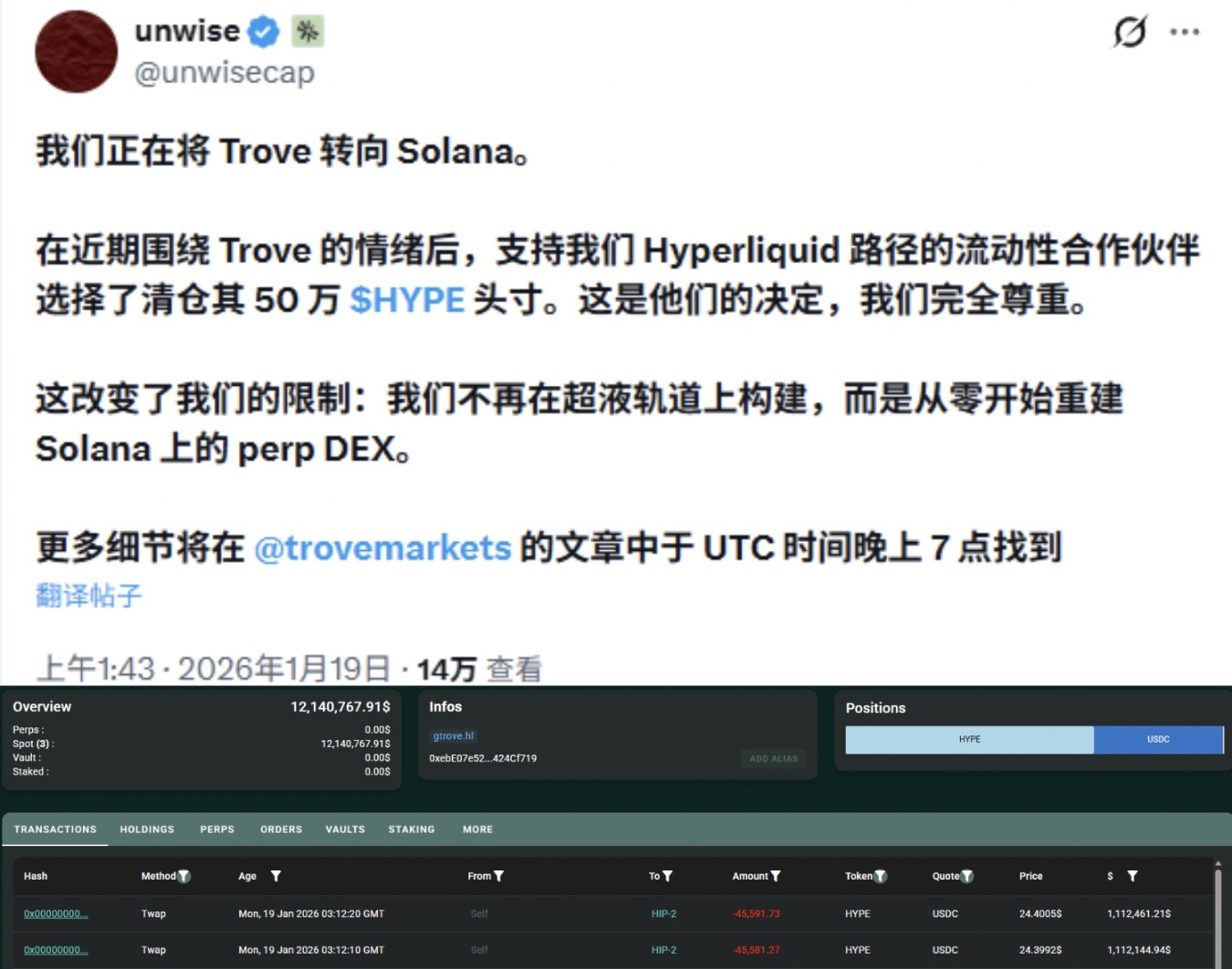
unwise's tweet (top), Trove-associated address HYPE transaction record (bottom) | Source: X (top, translated), HypurrScan (bottom)

Previously, Trove repeatedly mentioned that it had raised $20 million, would launch a token on Hyperliquid, and would build its digital collectibles contract platform based on HIP-3. Based on this public information, it completed an ICO with a $20 million FDV, selling 12.5% of the total supply.

ICO Flip-Flopping, Transferring Raised Funds to Prediction Markets

The Trove ICO was originally scheduled to start on January 9 at 1:00 and end on January 12 at 1:00.

On January 12, the project team announced it had raised over $11.5 million and extended the ICO by 5 days until January 16 at 1:00. 42 minutes later, they posted again revoking this decision and stated the ICO would end as originally scheduled.

Affected by this, the probabilities on Polymarket for the Trove ICO total raising over 15M, 20M, 25M, and 30M all sharply increased from near zero to 40% – 80% within a short time.

On January 17, on-chain detective ZachXBT tweeted that Trove had directly moved $45,000 from its Trove angel round financing into prediction markets on January 11. Trove team member unwise replied, attributing the operation to TJR (an English crypto KOL).
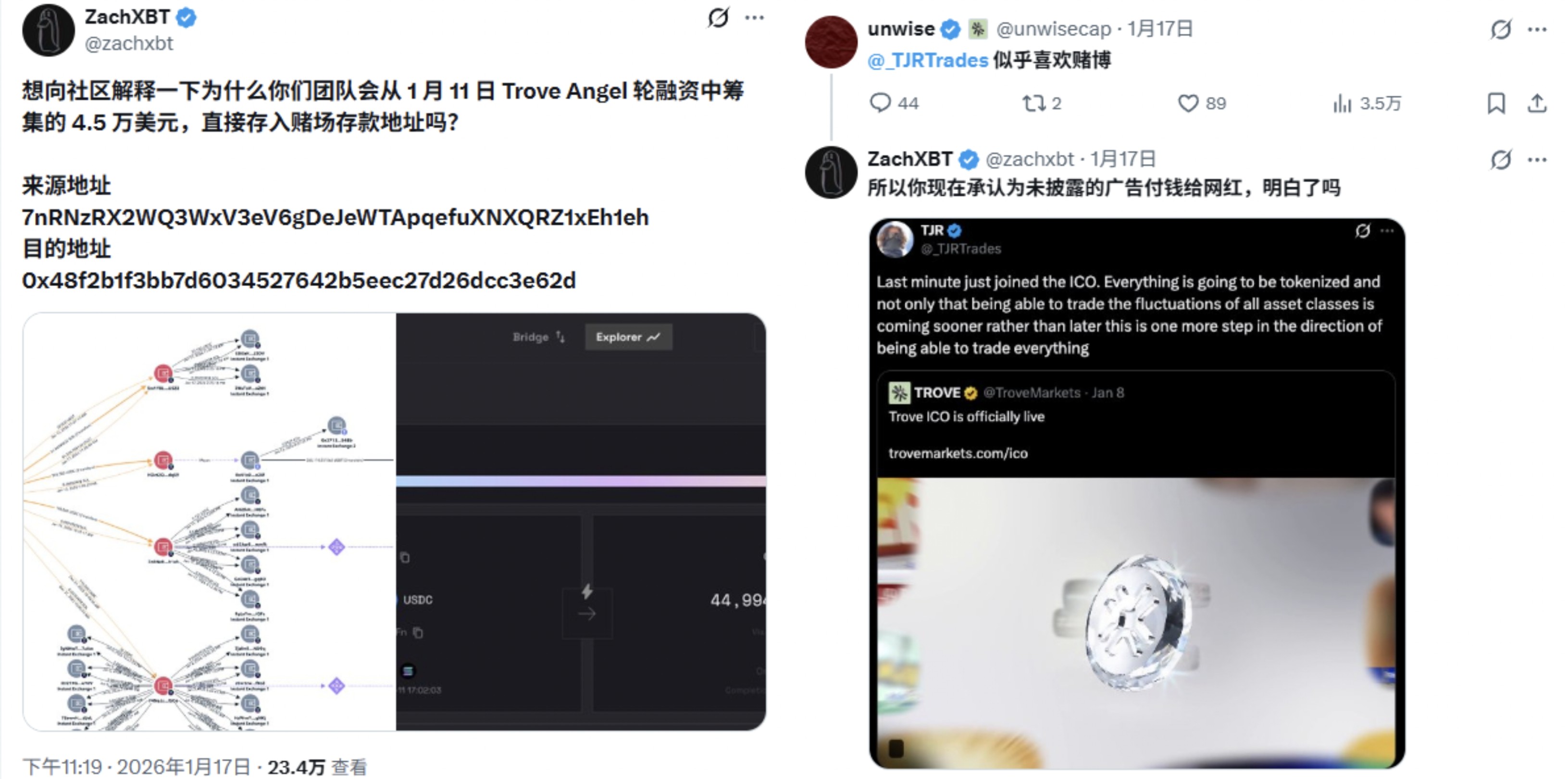
Source: ZachXBT and uniwise tweets (translated)

Furthermore, according to crypto KOL hrithik, they received multiple messages from the Trove team promising additional compensation for promoting their ICO bids and posts.
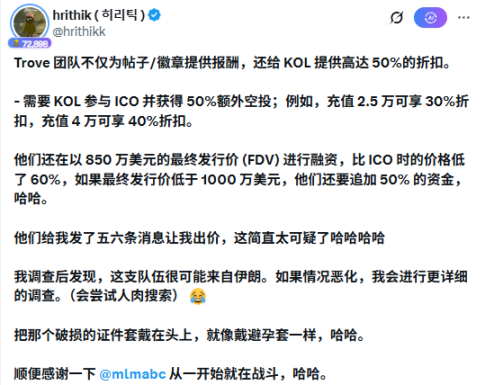
Source: hrithik tweet (translated)

Community feedback on the ICO changes and Polymarket activities included criticism that the extension decision increased uncertainty and damaged trust.
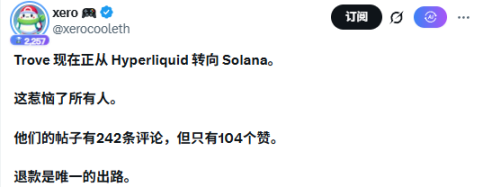
Source: xero tweet (translated)

Regarding Polymarket, users accused the team of manipulation and non-disclosure, turning a previously promising ICO into demands for refunds, with some calling it insider trading, leading to a shift in sentiment from excitement to caution.
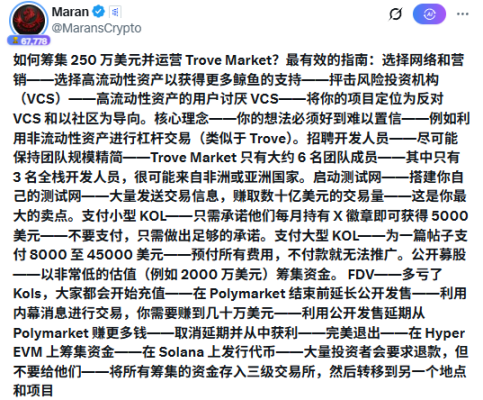
Source: Maran tweet (translated)

Violating ICO Public Information, Temporarily Migrating to Solana

Previously, Trove repeatedly stated on its official Twitter that it had purchased HYPE tokens, would build its digital collectibles contract platform based on HIP-3, and had launched a test website.
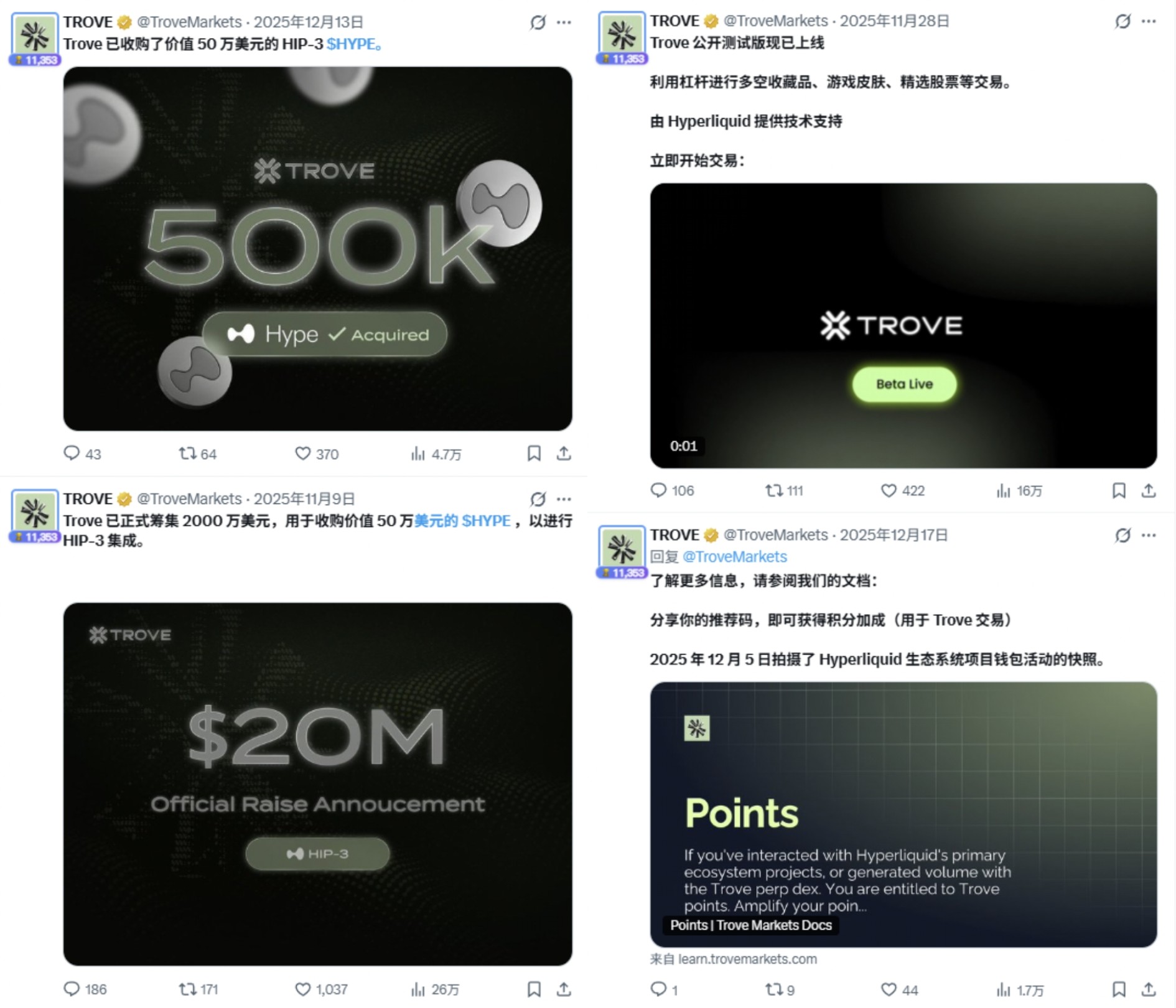
Source: TROVE tweet (translated)

During its ICO, it did not make any changes to this related information.
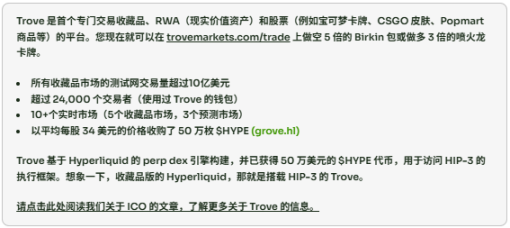
Trove related information | Source: Trove ICO page (translated)

The community strongly opposed the migration to Solana, viewing the shift as a deviation from the initial Hyperliquid promise. Some participants demanded full refunds, stating it no longer aligned with the investment logic.
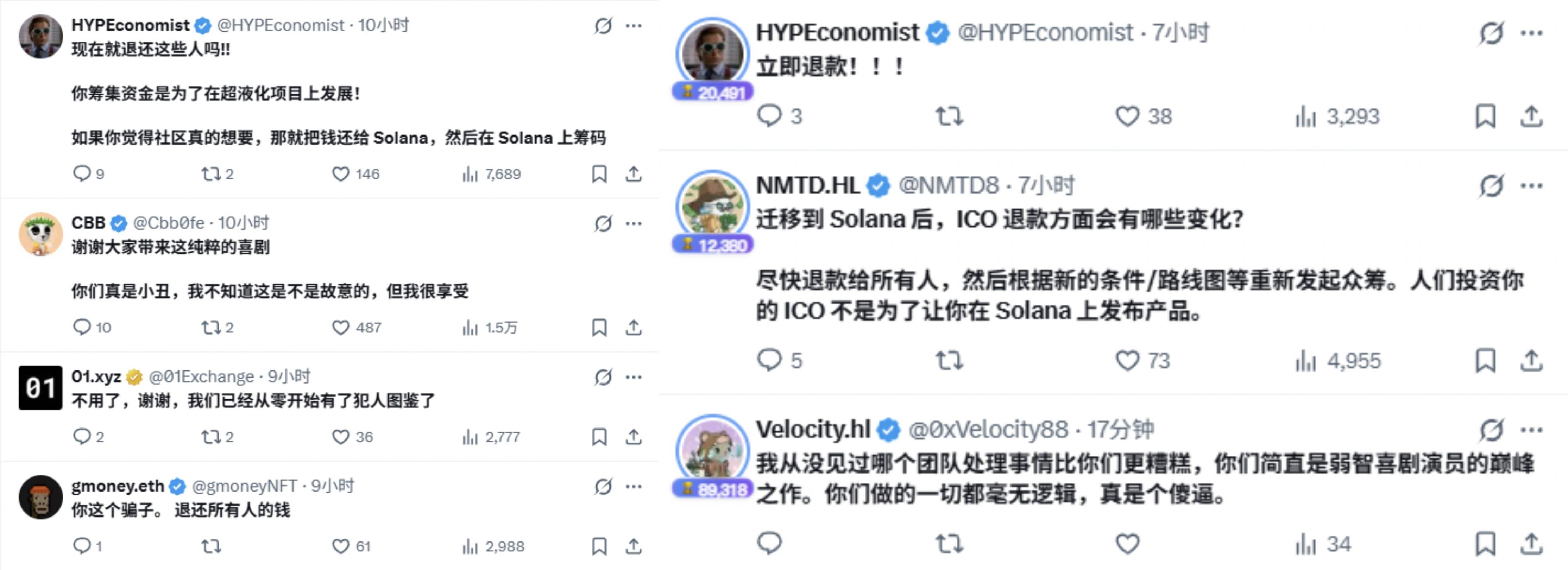
Source: unwise (left) and Trove official Twitter reply (right), translated
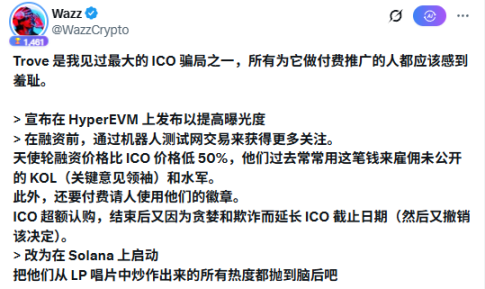
Source: Wazz tweet (translated)

As of now, Trove has not responded to related refund requests. It stated that TGE will occur on January 20 at 00:00, followed by ICO token distribution and oversubscription refunds.
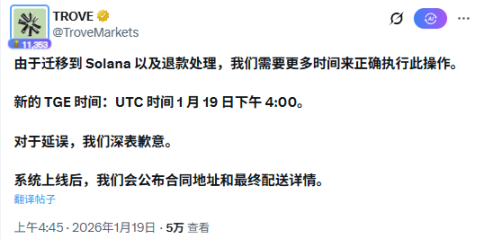
Source: Trove official Twitter (translated)

The Boundary Between ICO Promises and Investor Protection

The changes in Trove's actual execution have deviated from the core path, technical dependencies, and liquidity promises publicly during the ICO. These are major substantive changes, not mere technical optimizations or iterations.
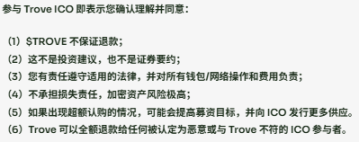
Source: Trove ICO page (translated)

This behavior of诱导 (inducing) first and switching later changes the essence of the investment target; the initial investment logic should be invalidated. Investors'诉求 (demands) for refunds to protect their rights should receive broad support.

The crypto investment environment is highly speculative and uncertain. Participants must carefully review project whitepapers, on-chain fund flows, team track records, etc., before deciding, and specifically evaluate the project team's communication transparency, timeliness, and compensation mechanisms for any major changes.

Investors need to be especially vigilant towards project parties with non-public team information, high anonymity, or those with delayed communication after changes.


Twitter:https://twitter.com/BitpushNewsCN

Bitpush TG Discussion Group:https://t.me/BitPushCommunity

Bitpush TG Subscription: https://t.me/bitpush

Original link:https://www.bitpush.news/articles/7604143

Domande pertinenti

QWhat was the main reason given by the Trove team for migrating from Hyperliquid to Solana?

AThe Trove team member unwise stated that the migration was due to their liquidity partner liquidating its 500,000 HYPE position, which was a key support for their Hyperliquid path.

QHow much funding did Trove claim to have raised during its ICO, and what percentage of the total token supply was sold?

ATrove claimed to have raised $20 million at a $200 million fully diluted valuation (FDV) and sold 12.5% of the total token supply in its ICO.

QWhat controversial action did Trove take regarding the ICO timeline, and how did it affect the Polymarket prediction market?

ATrove initially extended the ICO by 5 days on January 12 but reversed the decision 42 minutes later. This caused short-term spikes in probabilities on Polymarket for various fundraising milestones (15M, 20M, 25M, 30M) from near zero to 40-80%.

QWhat allegation did ZachXBT make about Trove's use of funds, and how did the team respond?

AZachXBT alleged that Trove transferred $45,000 from its angel funding round directly into a prediction market on January 11. The Trove team member unwise responded by attributing the action to TJR, an English crypto KOL.

QHow did the community react to Trove's decision to migrate to Solana, and what did many investors demand?

AThe community strongly opposed the migration, viewing it as a deviation from the initial Hyperliquid promise. Many investors demanded full refunds, arguing that the investment logic was no longer valid.

Letture associate

Is CRCL Expensive Now? Calculating Circle's Stock Price Using the DCF Valuation Model

**Title: Is CRCL Expensive Now? A DCF Valuation Analysis of Circle's Stock** **Summary:** This analysis uses a discounted cash flow (DCF) model to estimate the fair value of Circle (CRCL) stock, focusing on its USDC stablecoin business. Key assumptions include: USDC circulation of $70 billion by end-2025, growing at an average annual rate of 15% from 2026 to 2035; a 2.5% average benchmark interest rate; 38% gross margin; fixed operating costs of $500 million in 2025, increasing 10% annually; 24% effective tax rate; 10% discount rate; and a terminal PE multiple of 20. The fully diluted share count is 275 million. The model calculates EBITDA as interest income (USDC circulation × interest rate × margin) minus fixed costs. Free cash flow (FCF) is derived after taxes. The present value of explicit FCF (2026–2035) is $2.282 billion, and the terminal value (2035 FCF × 20) discounted to 2026 is $7.138 billion. The total enterprise value (EV) is $9.42 billion, implying a fair stock price of $34.25 per share as of January 2026. Sensitivity analysis shows that if USDC growth averages 20% annually, the fair value rises to ~$62 per share, suggesting potential margin of safety at current prices (around $62 in early February 2026). However, short-term volatility, forced sellers, and leverage risks are highlighted. The model is conservative, excluding other revenue streams (e.g., Circle’s emerging products like Arc chain) and emphasizing USDC’s growth and competitive sustainability as key variables. Historical USDC growth (2020–2025 CAGR ~76%) is noted but not assumed to continue. The conclusion underscores the need for evidence-based conviction to withstand market noise. *Note: This is a thought experiment, not investment advice.*

marsbit57 min fa

Is CRCL Expensive Now? Calculating Circle's Stock Price Using the DCF Valuation Model

marsbit57 min fa

Trading

Spot
Futures
活动图片