Aave founder under scrutiny for $10M token purchase amid governance drama

cointelegraphPubblicato 2025-12-24Pubblicato ultima volta 2025-12-24

Introduzione

Aave founder Stani Kulechov faces criticism for purchasing $10 million worth of AAVE tokens, with allegations that the move was intended to increase his voting power in a key governance proposal. Critics, including DeFi strategist Robert Mullins, claim the purchase could be used to vote against token holders' interests, highlighting concerns about governance attacks and the concentration of voting power. The controversy arises amid a heated vote on reclaiming control of Aave's brand assets through a DAO structure. Critics argue the proposal was rushed and note that a small group of large holders controls over 58% of the voting power, raising questions about the fairness of token-based governance.

Aave founder Stani Kulechov is facing scrutiny over his recent $10 million purchase of AAVE tokens, with some in the crypto community claiming it was used to boost his voting power in a key governance proposal.

In a Wednesday post on X, Robert Mullins, a decentralized finance (DeFi) strategist and liquidity specialist, argued that the purchase was meant to increase Kulechov’s “voting power in anticipation to vote for a proposal directly against the token holders best interests.”

He added: “This is a clear example of tokens not being equipped to adequately disincentivize governance attacks.”

Prominent crypto user Sisyphus echoed those concerns, claiming that Kulechov might have sold “millions of dollars” worth of Aave (AAVE) tokens between 2021 and 2025, questioning the economic rationale behind the move.

The controversy comes as Aave token holders debate how governance power is exercised within one of DeFi’s largest protocols, with critics arguing that large token purchases can materially influence voting outcomes on high-stakes proposals. The dispute has reignited concerns about whether token-based governance adequately protects minority holders when founders or early insiders retain significant economic leverage.
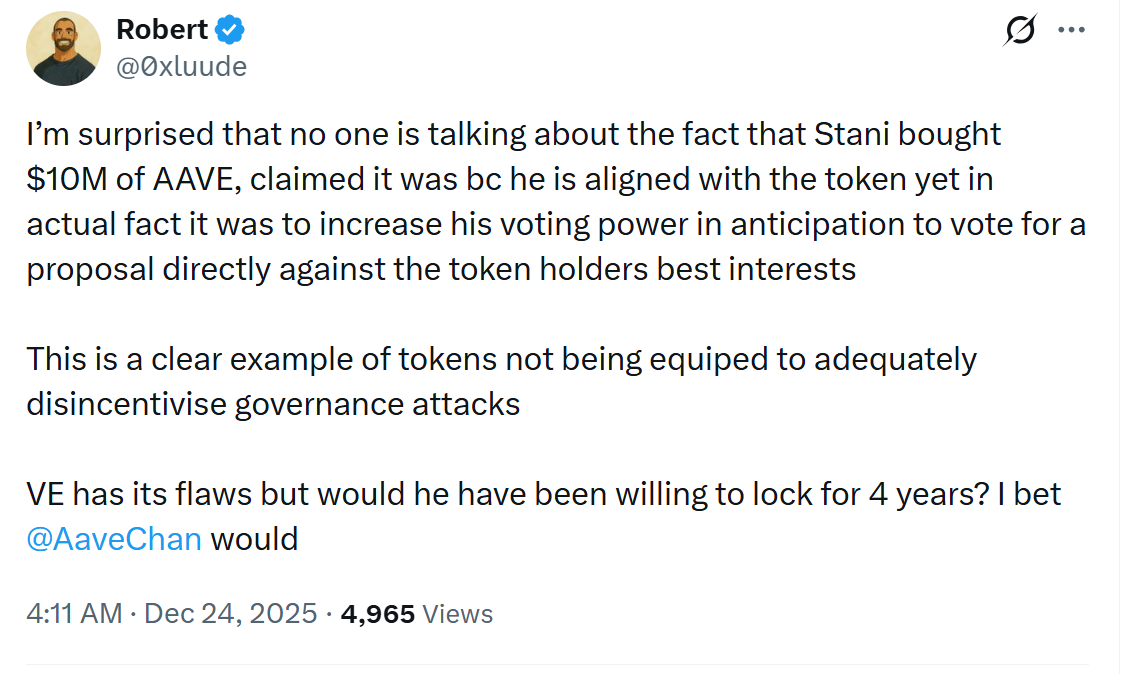
Robert Mullins questions Kulechov’s motive behind recent purchase. Source: Robert Mullins

Aave governance vote sparks backlash

As Cointelegraph reported, Aave’s governance vote has triggered a backlash after a proposal on reclaiming control of the protocol’s brand assets was pushed to a snapshot vote despite ongoing debate.

The proposal asks whether AAVE token holders should regain ownership of domains, social accounts and intellectual property through a DAO-controlled legal structure.

Several stakeholders disputed that decision, arguing that the proposal was escalated prematurely.

Former Aave Labs CTO Ernesto Boado, listed as the proposal’s author, said the vote escalated without his consent and broke community trust.

Related: Aave founder outlines 2026 ‘master plan’ after end to SEC probe

Voting power concentration in Aave DAO

Samuel McCulloch of USD.ai pointed out the concentration of voting power. In an X post, he described the Aave vote as “silly,” adding that a small group of large holders accounted for about half of the total voting weight.

Snapshot data from the Aave DAO shows that the top three voters alone control more than 58% of the entire vote. The top voter, 0xEA0C...6B5A, holds 27.06% of the voting power (333k AAVE), while the second-largest voter, aci.eth, controls 18.53% (228k AAVE).

Cointelegraph reached out to Kulechov for comment, but did not receive a response by publication.

Magazine: Bitcoin whale Metaplanet ‘underwater’ but eyeing more BTC: Asia Express

Domande pertinenti

QWhy is Aave founder Stani Kulechov facing scrutiny for his recent token purchase?

AStani Kulechov is facing scrutiny because some in the crypto community claim his $10 million purchase of AAVE tokens was used to boost his voting power in a key governance proposal, potentially acting against token holders' best interests.

QWhat specific governance proposal has caused controversy in the Aave community?

AThe controversial proposal asks whether AAVE token holders should regain ownership of the protocol's brand assets, including domains, social accounts, and intellectual property, through a DAO-controlled legal structure.

QHow concentrated is the voting power in the Aave DAO according to the article?

AVoting power in Aave DAO is highly concentrated, with the top three voters controlling more than 58% of the total voting weight, and the top single voter holding 27.06% of the voting power.

QWhat criticism did Robert Mullins raise about Kulechov's token purchase?

ARobert Mullins argued that Kulechov's purchase was meant to increase his voting power to vote for a proposal that goes against token holders' best interests, calling it a clear example of tokens not being equipped to disincentivize governance attacks.

QWhat concern has this controversy reignited about token-based governance systems?

AThe controversy has reignited concerns about whether token-based governance adequately protects minority holders when founders or early insiders retain significant economic leverage and can influence voting outcomes through large token purchases.

Letture associate

IOSG|A Tale of Two Cities: A Cultural Perspective on BNB Chain and Base

IOSG's article "A Tale of Two Chains: BNB Chain and Base from a Cultural Perspective" explores the cultural and strategic differences between BNB Chain and Base, framing them as distinct "cities" within the crypto ecosystem. BNB Chain is portrayed as a bustling, efficiency-driven port city, closely tied to Binance. It serves users primarily from emerging markets (e.g., Southeast Asia, the Middle East) who prioritize low gas fees, fast transactions, and quick access to new financial opportunities. Its culture is pragmatic, focused on scalability, high application density, and leveraging Binance's massive user base for rapid ecosystem growth. In contrast, Base is characterized as a new city built with Ethereum’s values, attracting developers, creators, and institutional users from Western markets. It emphasizes compliance, long-term building, developer-friendly tools, and cultural alignment with Ethereum’s decentralized ethos. Base users care deeply about technical design, community, and sustainable ecosystem development. Both chains represent exchange-led vertical integration strategies: Binance uses BNB Chain to create a seamless, closed-loop user experience from exchange to chain, while Coinbase leverages Base to offer a trusted, compliant environment with strong developer support. The article concludes that these chains are not in direct competition but serve different user needs and cultural contexts. BNB Chain excels at scaling Web3 for mass adoption, while Base focuses on mature, sustainable infrastructure. The future will likely see both models coexist, with users fluidly moving between ecosystems.

深潮31 min fa

IOSG|A Tale of Two Cities: A Cultural Perspective on BNB Chain and Base

深潮31 min fa

Trading

Spot
Futures

Discussioni

Benvenuto nella Community HTX. Qui puoi rimanere informato sugli ultimi sviluppi della piattaforma e accedere ad approfondimenti esperti sul mercato. Le opinioni degli utenti sul prezzo di AAVE AAVE sono presentate come di seguito.

活动图片