The Blockchain Industry Enters a Phase of Mass Adoption and Efficiency

cryptonews.ruPubblicato 2026-07-31Pubblicato ultima volta 2026-07-31

Introduzione

In Q2 2026, the blockchain industry demonstrated a divergence between market sentiment and fundamental network growth. While on-chain activity surged, network fee revenues declined due to protocol designs making block space cheaper and more abundant. Ethereum saw institutional staking reach an all-time high of 40.2 million ETH. Despite processing nearly double the transactions per second, its network revenue fell 51% YoY to $64 million, with staker yields driven primarily by consensus rewards. Solana processed nearly 10 billion transactions, but its economic value also dropped to $51 million due to reduced congestion. Notably, its real-world asset (RWA) sector boomed, with tokenized stock trading volume growing 2,479x YoY to $3.32 billion in June 2026. Hyperliquid emerged as an outlier, generating $175 million in revenue with 32% of its $652 billion trading volume from non-crypto markets like commodities. Avalanche saw transaction growth but a sharp drop in fee revenue, while focusing on sovereign L1s for enterprise use. The NEAR Protocol ecosystem shifted from gas-intensive apps to Intents-based trading and introduced a novel feature allowing users to pay for AI services via staked tokens. The Tempo network, backed by Stripe and Paradigm, processed $386 million in stablecoin transfers, including $30 million for contractor payouts by Deel. The report concludes that the industry is transitioning from high-fee speculation to a phase of mass adoption and infrastructure efficienc...

The second quarter of 2026 revealed a surprising divergence between market sentiment and the fundamental metrics of blockchain networks.

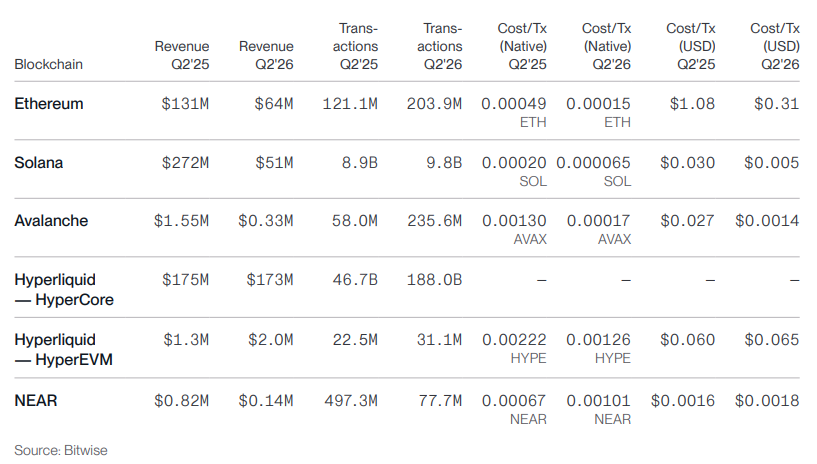
According to a large-scale study by Bitwise, the blockchain space has become cheaper, on-chain activity has increased, and fee revenue has fallen. The decline in revenue was driven mainly by protocol design, as networks made block space more accessible and capacious.

The divergence between revenue and activity is the key theme of the quarter. While fees were falling, usage was growing, noted Bitwise researchers.
Ethereum: Institutional Inflow and Lower Fees

Let's start with the smart contract flagship. Active staking in the Ethereum network reached an all-time high of 40.2 million ETH, representing 33% of the total supply. The growth of this metric is driven by an inflow of institutional funds.

Thanks to an increased gas limit, the network processed 26 transactions per second, almost double the rate from a year earlier. However, despite this growth in activity, network revenue fell to $64 million, down 51% year-over-year.

Staker yield was 2.84%, with the overwhelming majority coming from consensus rewards, not transaction fees. Data aggregated by the Allium analytics platform clearly shows that the Pectra and Fusaka updates created an oversupply of blob space, crashing fees almost to zero.

Solana: Resilience of Activity and Asset Tokenization

A similar picture is observed in the Solana ecosystem. The network processed approximately 10 billion non-vote transactions, exceeding any quarter of the previous year. Nevertheless, the real economic value fell to $51 million due to reduced network congestion. The share of staked coins remains one of the highest in the market — 68% of the supply (427 million SOL), providing a yield of about 6.25%. The real-world tokenized asset sector deserves particular attention.

The trading volume of tokenized stocks on Solana grew 2,479 times compared to the previous year, reaching $3.32 billion in June 2026, facilitated by the listing of SpaceX and the launch of trading in Micron shares on the Backpack Securities platform, with data confirmed by Blockworks Research reports.

If there is a category that could become the driver of the next growth phase on Solana, then real-world assets, especially trading tokenized stocks, seem like the perfect candidate, emphasized Bitwise analysts.

Hyperliquid and Avalanche: New Development Vectors

Moving to specialized networks, it's worth highlighting the success of Hyperliquid. While traditional networks were losing revenue, Hyperliquid generated $175 million in revenue in the second quarter. An impressive factor was diversification: markets not related to cryptocurrencies (such as commodities and indices) accounted for 32% of the total trading volume of $652 billion.

The Avalanche network, despite a fourfold increase in the number of transactions on the C-Chain (to 236 million), conversely faced a sharp drop in fee revenue to 42 thousand $AVAX. Avalanche's staking yield, according to on-chain monitoring of the P-Chain, stabilized at 6.3%, while the network is actively developing the direction of sovereign Layer 1 networks for corporate needs, such as infrastructure for FIFA World Cup tickets.

$NEAR and Tempo: Transformation of Use Models

The $NEAR ecosystem underwent a significant transformation. Gas usage fell by 81% compared to the first quarter of 2025, mainly due to the outflow of activity from the Kai-Ching application. However, it was replaced by Intents, which became a new growth point with a trading volume of $1.9 to $2.7 billion per month.

Yesterday, the $NEAR Protocol team announced the launch of a feature for paying for AI services via staking. The new option allows users to pay fees for confidential computations and continuous agent operation without linking a bank card. It is enough to lock $NEAR tokens in staking.

The frozen funds are automatically converted into computational credits, the volume of which is recalculated monthly and directly depends on the amount of staked tokens. At the same time, the assets themselves are not spent and can be returned to the user at any time after withdrawal from staking.

The service can be used for all 43 models presented on the $NEAR AI platform, including solutions from Anthropic, OpenAI, Google, and other leading developers.

Finally, the emergence of the Tempo network, supported by Stripe and Paradigm, demonstrated real corporate adoption. Launched in March 2026, the network processed $386 billion in stablecoin transfers, with the Deel platform using it to pay $30 million to its contractors. This statistic, analyzed by specialists via Dune Analytics dashboards, proves the demand for inexpensive and fast payment solutions.

The Bitwise report confirms that the blockchain industry is transitioning from an era of high fees and speculative hype to a phase of mass adoption and infrastructure efficiency. Now, cheap block space stimulates transaction growth and opens doors for institutional players.

end-content

Domande pertinenti

QWhat is the main theme of Q2 2026 in the blockchain industry according to the Bitwise report?

AThe main theme is the divergence between network revenue and on-chain activity. While transaction fees fell, network usage and activity increased significantly.

QHow did Ethereum's staking and network throughput change in Q2 2026, and what impact did this have on network revenue?

AActive staking on Ethereum reached an all-time high of 40.2 million ETH. Network throughput nearly doubled to 26 transactions per second. However, network revenue fell by 51% year-over-year to $64 million, largely due to protocol upgrades (Pectra, Fusaka) that made block/block space cheaper and more abundant.

QWhat asset class is highlighted as a potential growth driver for the Solana ecosystem, and what evidence supports this?

ATokenized real-world assets (RWAs), particularly tokenized stocks, are highlighted as a potential growth driver. The trading volume for tokenized stocks on Solana grew 2479x year-over-year, reaching $3.32 billion in June 2026, driven by listings like SpaceX and Micron on Backpack Securities.

QWhat is a key innovation announced by the NEAR Protocol team regarding payments for AI services?

ANEAR Protocol announced a feature allowing users to pay for AI services via staking. Users can lock NEAR tokens in a staking contract, which are automatically converted into computational credits used to pay for services from models on NEAR AI without spending the underlying assets, which remain returnable.

QWhat does the Bitwise report conclude about the current phase of the blockchain industry?

AThe report concludes that the blockchain industry is transitioning from an era of high fees and speculative hype to a phase of mass adoption and infrastructural efficiency, where cheaper block space is driving transaction growth and opening doors for institutional players.

Letture associate

Stocks Fell Even More Violently Than Crypto, Where Did the Money Go?

From June to late July 2026, global stock markets, particularly technology and semiconductor stocks, experienced severe declines, with South Korea's KOSPI index facing historic circuit breakers and shedding 40% from its June peak. Key catalysts included SK Hynix's earnings miss despite record profits and competitive pressures from China's CXMT IPO. A global forced deleveraging event unfolded, devastating highly leveraged instruments like the 2x leveraged SK Hynix ETF, which lost over 80% of its value. Surprisingly, Bitcoin showed relative stability during this period, rising roughly 15% from its July low. The article clarifies this wasn't due to an inflow of equity flight capital but because Bitcoin had already undergone a significant correction in May and June, with U.S. spot Bitcoin ETFs seeing record outflows. True safe-haven flows went to gold, severing Bitcoin's short-term "digital gold" narrative. The sell-off is characterized not as an AI story collapse but a liquidity-driven清算 of crowded leveraged positions, potentially halfway through according to some analysts. For substantial capital to return to Bitcoin, the article cites necessary conditions: eased global liquidity pressure, a soft-landing Fed rate cut, and regulatory clarity from the stalled U.S. CLARITY Act. The conclusion is that Bitcoin is not a current safe haven but a pre-cleared asset. Its decoupling from tech stocks highlights its potential future role as a non-correlated asset for institutional portfolios, positioning it favorably for when global capital reallocates post-crisis.

marsbit1 h fa

Stocks Fell Even More Violently Than Crypto, Where Did the Money Go?

marsbit1 h fa

Trading

Spot
活动图片