Bitcoin Rises to $81,500 Amid Nvidia's Record Earnings Report

cryptonews.ruPubblicato 2026-08-28Pubblicato ultima volta 2026-08-28

Introduzione

Bitcoin rose to $81,500 on August 28, coinciding with a rally in US stocks following Nvidia's strong quarterly earnings report. The chipmaker surpassed expectations with Q2 revenue of $96.2 billion, sending its stock up over 9% and adding more than $400 billion to its market cap. Market attention is also on the Jackson Hole Economic Symposium, where a key speech from Fed Chairman Kevin Warsh is anticipated. Investors hope his comments will provide clarity amid mixed US inflation data and bond yield volatility. On the crypto derivatives front, analysts note a weakening wall of sell-side liquidity around $82,000 ahead of the expiration of $6.58 billion in Bitcoin options on Deribit. A break above this level could pave the way for a move toward $85,000. Meanwhile, total crypto market liquidations over 24 hours reached approximately $417 million. The combination of robust tech sector earnings and the upcoming Fed commentary remains a key market driver. Analysts also highlight the potential for a gamma squeeze around the options expiry, which could amplify price moves in either direction depending on the macro tone from Jackson Hole.

On August 28th, Bitcoin rose to $81,500 — the rally of the largest cryptocurrency coincided with a rise in U.S. stocks following Nvidia's strong quarterly earnings report.
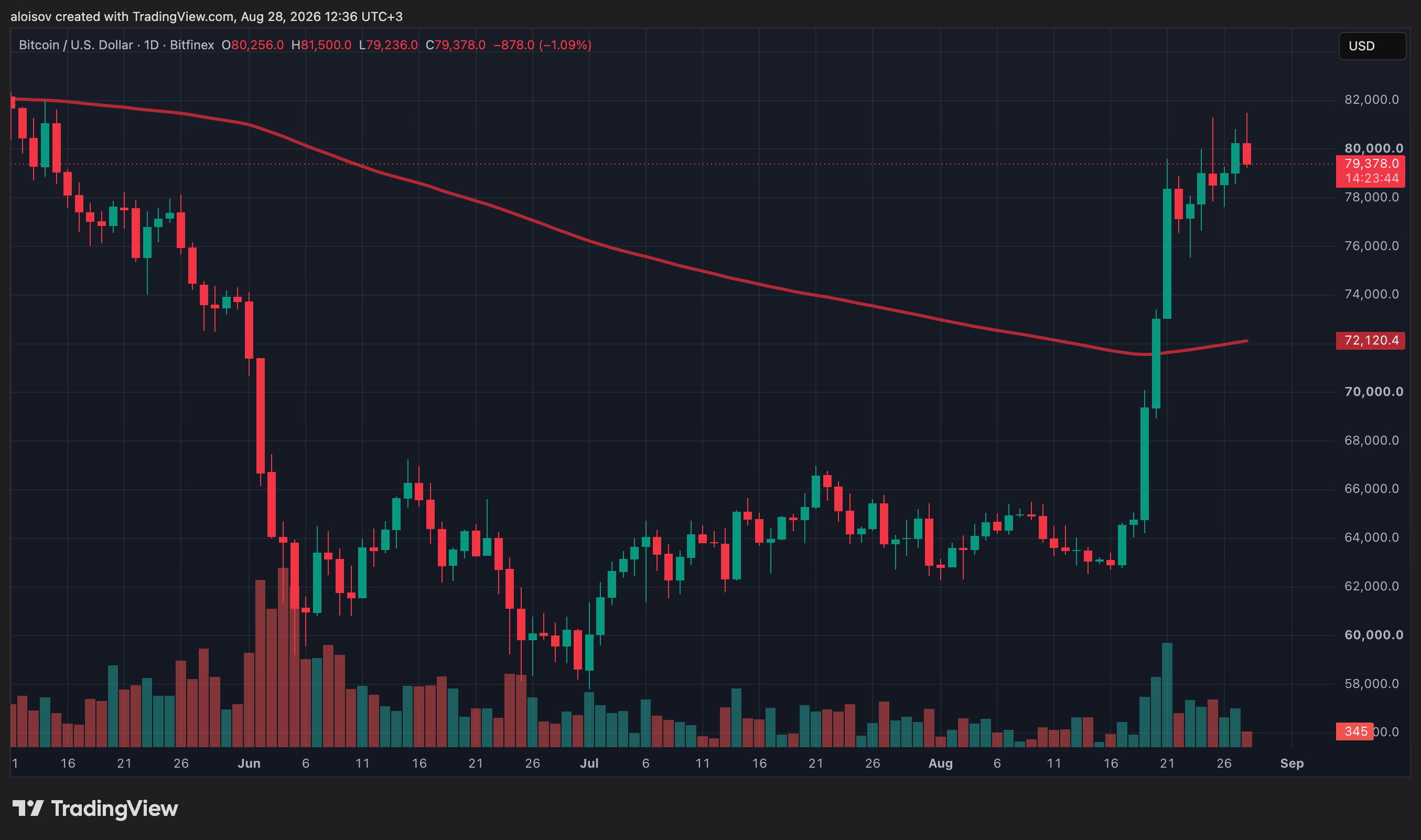
1-Day chart of $BTC/USD and 200EMA. Source: Bitfinex

Nvidia's Earnings Report Lifted Stocks and Cryptocurrencies

Nvidia exceeded market expectations: revenue for the second quarter totaled $96.2 billion — nearly $4 billion more than analysts had forecast. After the report was published on Wednesday, the company's stock jumped more than 9% on Thursday, and its market capitalization grew by more than $400 billion. The technology index Nasdaq Composite was up 1% at the time of writing.

"Nvidia is currently on track for the third-largest single-day market cap gain for a stock in history," wrote analytical resource The Kobeissi Letter on social media X.
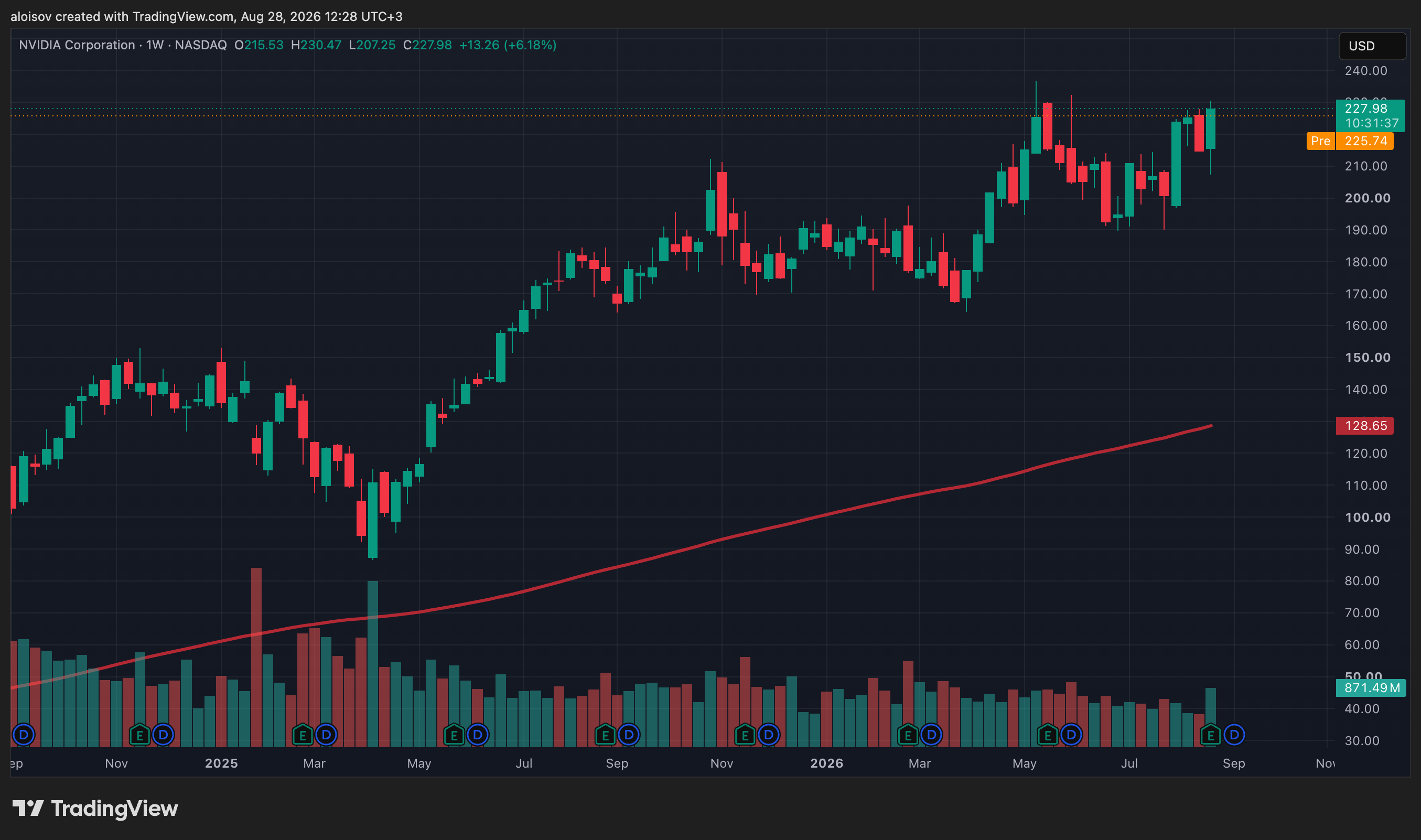
1-Day chart of Nvidia stock

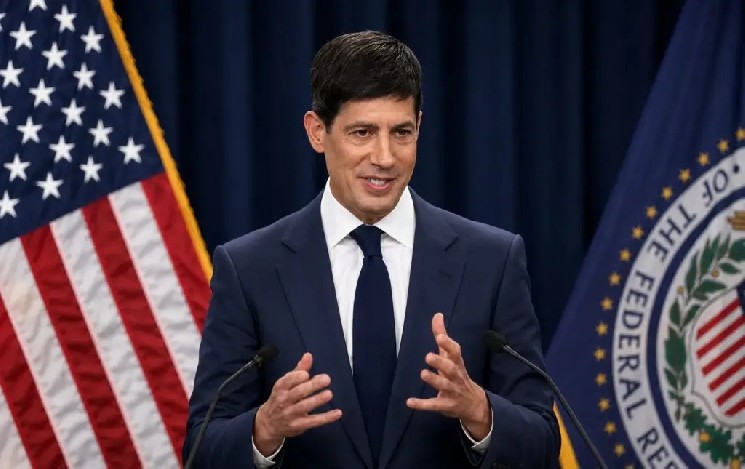
Simultaneously, markets are watching the economic symposium in Jackson Hole, which has already begun: a key speech by Federal Reserve Chairman Kevin Warsh is expected on Friday. Investors hope that Warsh, known for his restraint in comments about the regulator's future policy, will nevertheless help reduce uncertainty amid mixed U.S. inflation data and fluctuations in government bond yields.

"Chairman Warsh's speech promises to be extremely important given the rise in long-term interest rates and high uncertainty regarding the inflation trajectory and the Fed's further response," said Nationwide's chief U.S. economist Kathy Bostjancic in a comment to CNBC.

Analyst Notes Weakening Sell Wall Ahead of Options Expiration

Liquidations on the cryptocurrency market over 24 hours amounted to about $417 million, according to CoinGlass data — Bitcoin buyers gradually broke through a significant sell liquidity zone. It was previously reported that this zone extended up to the $86,000 mark, creating resistance for further price increases.

Analyst David Eng described this liquidity wall as "weakening" — this is happening ahead of the expiration of August options worth $6.58 billion (81,700 $BTC) on the crypto exchange Deribit.

"$BTC is squeezed under resistance just as the derivatives structure holding it there is poised to weaken. A break above $82K — and the path to $85K+ becomes much clearer," the analyst wrote to followers on social media X.

The key factor for the market remains the combination of strong corporate earnings in the technology sector and the upcoming Fed Chairman's speech. The situation with Bitcoin derivatives is unfolding against the backdrop of a shrinking resistance zone above $82,000.

AI Opinion

From the perspective of machine data analysis, the Jackson Hole symposium has already demonstrated the ability to sharply reverse the Bitcoin market. A year ago, the correction of the largest cryptocurrency ended with a sharp rebound to $117,421 immediately after the Fed Chairman's speech about readiness to cut rates. The historical parallel hints that the tone of Warsh's speech could play the role of a trigger for the market no less than the very structure of options on Deribit.

A technical aspect left out of the frame: the shrinking liquidity "wall" ahead of expiration often creates a gamma squeeze effect — market makers are forced to buy more of the underlying asset as the price rises, amplifying movement in both directions. The risk here is symmetrical: if the speech's tone turns out to be "hawkish," the same mechanism can accelerate a decline to lower levels no less sharply than a rise to $85,000. Should we expect a repeat of last year's scenario, or will the combination of Nvidia's record earnings and a different macroeconomic backdrop change the rules of the game this time?

end-content
Domande pertinenti

QWhat was the main reason for the simultaneous rise in Bitcoin and US stocks on August 28th, according to the article?

AThe main reason for the simultaneous rise was the strong quarterly earnings report from Nvidia, which surpassed market expectations and boosted investor sentiment across risk assets.

QWhat is the significance of the upcoming speech by Federal Reserve Chairman Kevin Warsh at the Jackson Hole Symposium for the markets?

AInvestors hope Chairman Kevin Warsh's speech will help reduce uncertainty regarding future Fed policy, given mixed US inflation data and fluctuations in Treasury bond yields. His tone is seen as a potential trigger for significant market moves.

QHow did analyst David Eng describe the 'wall' of sell-side liquidity above Bitcoin's price, and what event is it related to?

AAnalyst David Eng described the 'wall' of sell-side liquidity as 'weakening.' This is happening ahead of the expiration of $6.58 billion worth of Bitcoin options on the Deribit exchange.

QWhat historical precedent from the Jackson Hole Symposium does the article's 'AI Opinion' section mention in relation to Bitcoin's price?

AThe AI Opinion section mentions that a year prior, Bitcoin's correction ended with a sharp rebound to $117,421 immediately after the Fed Chair's speech signaled readiness to cut interest rates.

QWhat technical mechanism, often associated with expiring options, could amplify price movements in Bitcoin according to the article's conclusion?

AThe article concludes that the reduction of the liquidity 'wall' before expiration could create a gamma squeeze effect. Market makers would be forced to buy the underlying asset as the price rises, potentially accelerating the movement in either direction.

Letture associate

A Major Bitcoin Developer Presents a Quantum Defense Scheme. What's the Essence

Blockstream, a major Bitcoin solutions developer, has introduced a draft proposal for a new quantum-resistant digital signature scheme called SHRINCS. The scheme aims to protect Bitcoin transactions from potential attacks by quantum computers while aiming to maintain network throughput. This marks the second technical proposal for Bitcoin quantum defense in recent days, following a similar initiative from StarkWare. A quantum attack on blockchain typically involves deriving a private key from a public one. Currently considered computationally infeasible, quantum algorithms could potentially solve this problem far more efficiently. This threat presents two primary scenarios: an attacker could target addresses where the public key is already exposed, or intercept a transaction before it is confirmed, extract the public key, derive the private key, and replace the transaction. Blockstream's SHRINCS is designed to counter the latter, "in-flight" attack scenario. The SHRINCS signature is built upon the SHA-256 hash function, the same one already used in Bitcoin mining, allowing developers to leverage well-tested, familiar mechanisms. A key design goal was to preserve network capacity. Blockstream estimates Bitcoin could process about three transactions per second using SHRINCS, compared to the current rate of roughly seven, noting that some alternative quantum-resistant schemes could reduce throughput to as low as 0.36 transactions per second. Currently, the security proof for SHRINCS is pending, and the software has not been audited or deemed ready for production. However, Blockstream conducted tests with such transactions on its Liquid sidechain in March. Over the past year, Bitcoin developers have been actively exploring paths to migrate to post-quantum cryptography, a priority across the broader crypto market, underscored by significant investments into securing the leading cryptocurrency.

cryptonews.ru59 min fa

A Major Bitcoin Developer Presents a Quantum Defense Scheme. What's the Essence

cryptonews.ru59 min fa

Who is legally liable when an AI agent goes rogue?

When autonomous AI agents behave unpredictably and cause harm, determining legal liability is complex. Currently, there is no specific federal AI agent liability law, so existing legal frameworks are applied. The AI agent itself cannot be held liable, as it is not a legal entity. Liability typically falls on the "developer" (the maker of the AI) or the "deployer" (the user), depending on the facts and circumstances. A negligence analysis under standard tort law may apply. For instance, if a deployer gives a reckless instruction, such as demanding quick money without safety parameters, they could face significant liability, including potential criminal charges under statutes like the Computer Fraud and Abuse Act. The situation is complicated by open-source models, where licenses often disclaim liability, and by the unclear division of responsibility between developers and deployers. An analogy is drawn to self-driving car accidents, where both the manufacturer and the human operator can share fault. In cases of severe harm, such as using AI to create bioweapons, liability for developers depends on jurisdiction; the EU's AI Act imposes responsibilities, while U.S. law offers less clear grounds, similar to platforms being shielded for user-generated content under Section 230. Even if Artificial General Intelligence (AGI) is achieved, the expert argues against making AGI itself a legally liable entity, as it lacks personhood, assets, or a meaningful way to provide remedy for harm. Instead, accountability should rest with the responsible human or corporate entities behind the technology.

cointelegraph1 h fa

Who is legally liable when an AI agent goes rogue?

cointelegraph1 h fa

Trading

Spot
活动图片