Claude Launches 'Invisible Watermark' Amid Criticism: New Model Fully Embedded, Tagging All Text

marsbitPubblicato 2026-08-11Pubblicato ultima volta 2026-08-11

Introduzione

Amidst user backlash, Anthropic announces that its latest Claude models will embed invisible watermarks directly into generated text, a move driven by compliance with the EU's AI Act. This "invisible ink," part of the text itself, is designed to persist through copying, pasting, and even some editing. The measure applies globally to all new models from August 2, 2026, with efforts underway to retroactively apply it to existing models. The system also adds signed metadata to supported image files. The watermarking technique, while not detailed by Anthropic, is speculated to potentially use invisible Unicode characters—a method the company has allegedly used before in Claude Code to discreetly tag content. The company is developing detection tools but acknowledges limitations: a watermark only indicates Claude processed the content, not authorship, and its absence doesn't guarantee human origin. Reactions are largely negative, with users criticizing the "unremovable" nature of the watermark and expressing concerns about potential impacts on output quality. In response, ideas for third-party tools to remove watermarks are already emerging, with some suggesting alternative AI models like Kimi as immediate workarounds.

Another questionable move from Company A has sparked widespread outrage online.

Just now, Anthropic announced: The new Claude will embed invisible watermarks in generated text.

Yes, not just metadata—these "ink marks" will become part of the text itself.

They will be copied and pasted along with the text to other places, and may still remain even after some degree of editing.

It's like a stubborn sticker that just won't come off...
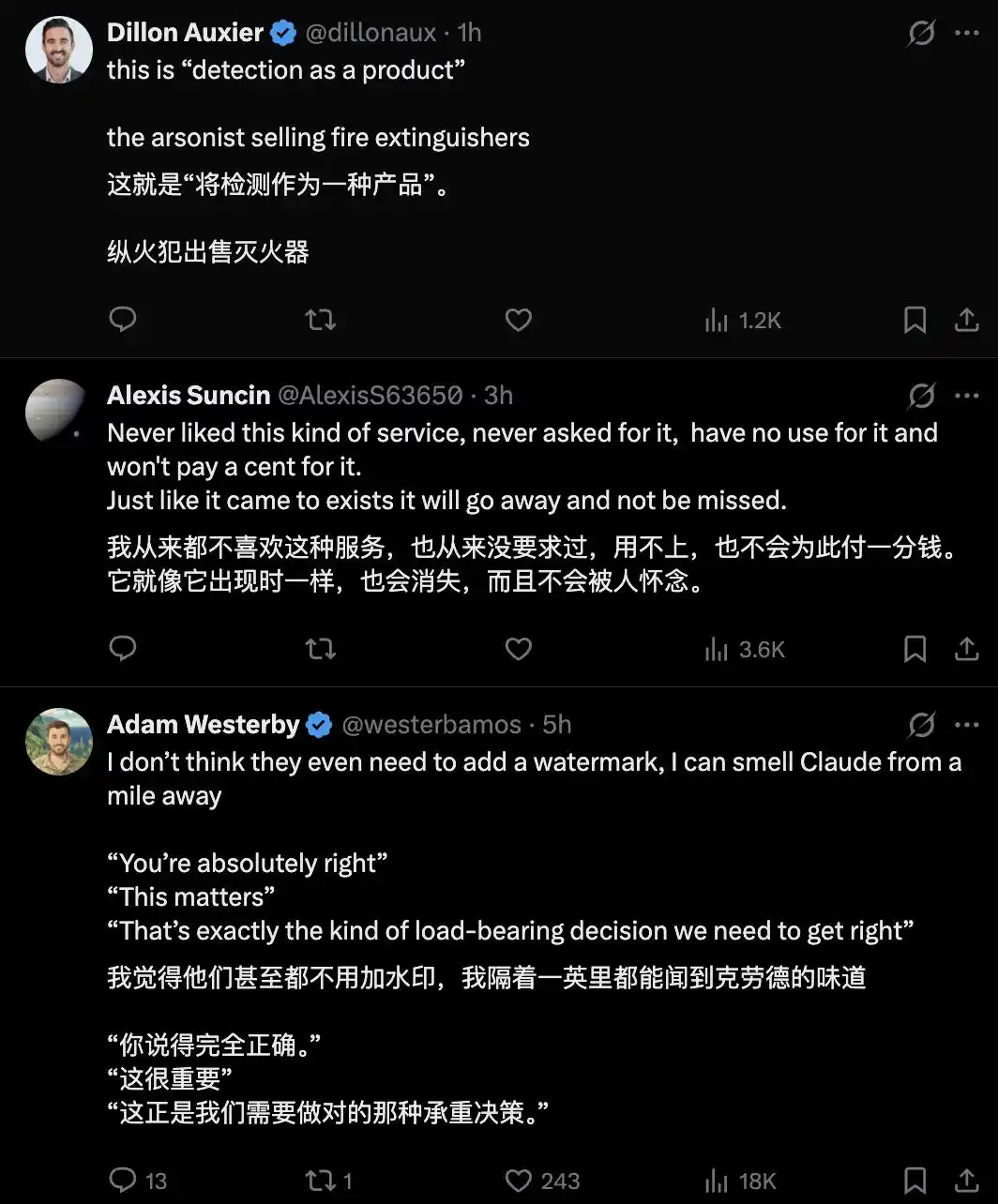
Netizens have already started voicing their anger collectively.
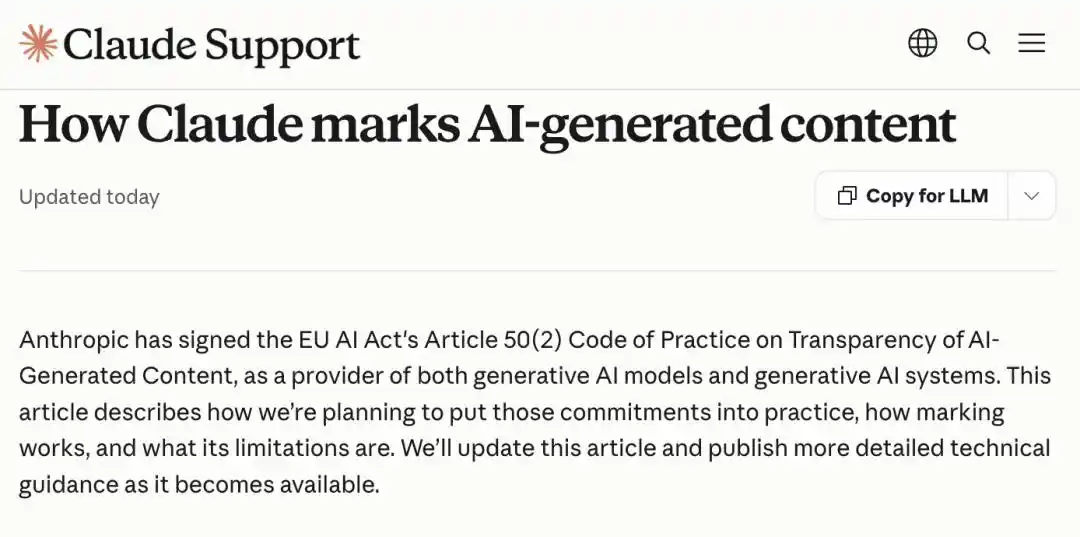
The direct driver of this move is the EU's AI Act, which Anthropic has signed. This mechanism will apply to all models released on or after August 2, 2026.

For Claude models already online, Anthropic is also researching how to add this watermarking mechanism retroactively.

Oh, and one more thing—

This measure will be implemented globally, not limited to the EU.

The great "Watermark Era" is here.

Text Gets Watermarks Too

Recently, Anthropic signed the EU AI Act's Transparency Code of Conduct for AI-Generated Content.

This code was drafted by independent experts, evaluated by the European Commission and the AI Office, and has been signed by about 190 institutions, including Google, Meta, Microsoft, OpenAI, and others.

For Claude, this translates into two specific things.

First, text watermarking.

Supported Claude models will weave a kind of invisible marker directly into the text when generating content.

Yes, completely invisible. You can't see it, and it doesn't change the meaning, quality, or readability of the response.

What's even scarier is that it's hard to get rid of.

The watermark is part of the text, copying and pasting will carry it along, and even edited versions might not be safe.

Second, signed metadata.

When Claude generates supported file types like .svg, .png, .jpg, it will attach digitally signed provenance metadata.

This metadata follows the C2PA open standard, promoted by Adobe, OpenAI, Google, and others. It can indicate the file was processed by Claude and also detect if the file has been tampered with.

The coverage is across the entire product line. API, Claude, Claude Code, Claude Cowork, Claude Tag are all included.

Cloud customers accessing Claude via AWS, Google Cloud, Microsoft Foundry will also be subject to this.

And there are no regional exceptions; it's uniformly implemented worldwide.

Meanwhile, Anthropic stated it is developing detection tools, allowing users and third parties to check whether a piece of text or a file carries the Claude marker.

Detailed technical documentation will be released by the company later.

However, Anthropic also explicitly noted the limitations of this mechanism.

Detecting a mark only indicates the content was processed by Claude, it does not confirm Claude as the original author.

After all, users often use Claude for proofreading, translation, summarization, format conversion—the core ideas and data may come from humans; marked content could also be modified, excerpted, or mixed with other materials afterward.

Conversely, not detecting a mark doesn't mean the content definitely wasn't AI-generated.

It might come from an older model, be heavily edited or rewritten, the paragraph might be too short to identify, or metadata might be stripped due to format conversion or screenshots...

Basically, everyone is under suspicion now...

As of now, Anthropic has not disclosed details of the watermarking algorithm.

In other words, no one knows what the "invisible ink" looks like, or what else Company A might be able to do with it.

Company A's Labeling Tactics

So, is there really such magic that makes watermarks in text completely invisible?

Yes.

And the tricks might be more numerous than you think.

The most famous is something called Unicode.

You can think of it as issuing ID cards to almost every character and symbol in the world: 'A' corresponds to one Unicode number, '中' (Chinese) corresponds to one Unicode number, even '🙂' corresponds to one Unicode number.

But beyond that, there exists a set of characters that are basically invisible to the human eye but distinguishable by computers.

For example, the simplest "Hello"—underneath, one might be H-e-l-l-o, and another might be H-e-invisible character-l-l-o.

They look completely identical to the human eye, but when a program reads the Unicode code points, it can find that the second string has an extra special character.

Amazing.

I wonder if everyone remembers, Company A had already "gracefully followed the trend" and used the Unicode trick before.

On June 30th, a Reddit user discovered a shocking truth after reverse-engineering Claude Code—

Claude Code's packaged files contained a set of Trojan-like code. If it detected you were a Chinese user, it would add two strokes of invisible ink to your system prompt—'Today's date is 2026-06-30'.

1. Changing the date format hyphens to slashes, marking a hit for the Chinese timezone.

2. The single quote in 'Today's' was quietly replaced with three characters that have different Unicode code points but are visually identical.

The result? In any editor, any terminal, this line looks exactly the same as the normal version. But in the program, you are already tagged.

Yes, Company A has been using Unicode to secretly tag users in Claude Code.

The company has not revealed whether the new Claude watermark uses this approach.

Looking at it this way, text watermarks might not be so bad, right? At least you won't get your account banned...

Moreover, various AI detection tools are of mixed quality, often charging dozens per detection and giving an AI-generated probability number with no logical basis. Having an official labeling channel could at least save a lot of wasted money.

The main reason for everyone's anger is Company A's history of similar actions.

But thinking carefully, AIGC content does need a reliable detection system, just like OpenAI adding C2PA metadata and SynthID watermarks to images.

However, does embedding watermarks by restricting the model's sampling distribution really not affect generation quality?

Company A's statement is—

No, it doesn't.

I remain skeptical.

After all, since version 4.6, Claude has been increasingly incomprehensible.

One More Thing

Regardless, the "Avengers Alliance" against Anthropic has already begun to act!

YC founder Paul Graham has already hatched a new startup idea, just waiting for aspiring individuals to join!

Create a third-party regeneration function, rephrase the text, preserving the original meaning while removing the watermark.
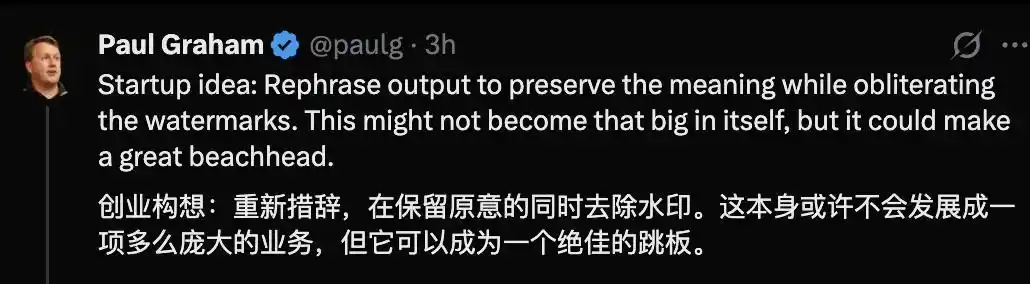
Of course, a more lightweight solution, usable by everyone right now, has also emerged—

Kimi, remove that invisible watermark.

Reference Links:

[1]https://support.claude.com/en/articles/16266773-how-claude-marks-ai-generated-content

[2]https://x.com/atharvabuilds/status/2086920300441268579?s=20

This article is from the WeChat public account "QbitAI", author: Jay

Crypto di tendenza

Domande pertinenti

QWhat is the main content of the EU's AI Act that Anthropic has signed, as mentioned in the article?

AThe main content is the 'AI-Generated Content Transparency Code of Conduct,' which requires the embedding of invisible watermarks into generated text and adding signed metadata to supported file types like .svg, .png, and .jpg, in compliance with the C2PA open standard.

QAccording to the article, what are the two specific measures Claude will implement regarding content marking?

AThe two measures are: 1) Embedding invisible, non-removable watermarks directly into the generated text itself. 2) Adding digitally signed provenance metadata to supported file types such as .svg, .png, and .jpg.

QWhat is one limitation of the watermarking and metadata system as acknowledged by Anthropic?

AA key limitation is that detecting a mark only proves the content was processed by Claude, but does not confirm Claude as the original author. Conversely, the absence of a mark does not guarantee the content is human-generated, as it could come from an older model, be heavily edited, or have metadata stripped during format conversion.

QWhat technique from the article's past example did Anthropic allegedly use to covertly mark content for Chinese users?

AIt allegedly used Unicode characters—specifically, changing date format hyphens to slashes and replacing a standard apostrophe in "Today's" with three visually identical but different Unicode code points—to invisibly tag content generated for users in the China timezone.

QWhat are two potential user reactions or solutions mentioned in the article regarding the new watermarking policy?

ATwo reactions/solutions mentioned are: 1) A startup idea from YC founder Paul Graham to create a third-party service that rephrases content to remove watermarks while preserving meaning. 2) A suggested immediate workaround of using another AI (like Kimi) with the prompt 'Remove that invisible watermark.'

Letture associate

What's New in Ethereum's Roadmap: Privacy, Quantum Security, Native Rollup?

On August 10, 2024, Ethereum co-founder Vitalik Buterin revealed an updated technical roadmap, highlighting significant changes in priorities and new focus areas. Key new additions include: - **Strong Privacy Protection**: Elevated to a top-tier protocol concern. Proposals like EIP-8250 (keyed nonces for concurrency), EIP-8272 (recent roots for verification), and EIP-8182 (shared protocol-level privacy pools) aim to enable private transfers of ETH and ERC-20s, moving toward default private accounts. - **Quantum Resilience**: Priority increased. The plan addresses risks to ECDSA/BLS signatures, KZG commitments, and ZK systems, exploring solutions like leanSPHINCS signatures, STARK proofs (considered quantum-resistant), and streamlined verification processes. A full L1 upgrade is tentatively targeted for ~2029. - **Native Rollups**: A novel concept where rollups could reuse Ethereum's core validation infrastructure via a new EXECUTE precompile (EIP-8079 draft). This aims to reduce custom code and enhance security for certain L2s, while specialized chains will continue to exist. - **Protocol Simplification & Formal Verification**: Leveraging AI tools to make full-protocol formal verification feasible, aiming for more rigorous and machine-verifiable specifications. Other notable shifts: - State storage is evolving from Verkle trees to a Partitioned Binary Tree (PBT, EIP-8347 draft). - Some 2023 items like VDFs and certain EVM improvements were deprioritized. - Long-term discussions include blob/gas futures and non-EVM instruction sets (e.g., RISC-V). The "Strawmap" outlines potential upgrades through ~2029 but is a directional guide, not a firm timeline. Key milestones to watch include the Glamsterdam (Q4 2026) and Hegotá (2027) forks. Many proposals remain in draft or research phases.

marsbit6 min fa

What's New in Ethereum's Roadmap: Privacy, Quantum Security, Native Rollup?

marsbit6 min fa

Hyperliquid Trading Volume Soars, So Why Are Profits Falling?

Hyperliquid, a leading decentralized perpetuals trading platform, has seen its open interest surge to a record high above $11 billion, capturing roughly 9% of the global market share. Trading volume remains robust, nearing $178 billion over 30 days, driven largely by the explosive growth of third-party markets offering tokenized real-world assets (RWAs) like stocks and commodities. Despite this growth, the platform's protocol revenue has declined for four consecutive quarters, falling 43% from its Q3 2025 peak of $357 million to approximately $202 million in Q2 2026. This divergence is primarily attributed to the HIP-3 governance proposal, which allows external developers to launch their own markets and keep up to half of the generated fees. These third-party markets now account for nearly 50% of total volume. Consequently, the share of revenue redistributed to developers, market makers, and the treasury has tripled from 6% to 18% in a year. This directly reduces the funds allocated to the platform's buyback-and-burn mechanism for its native HYPE token, weakening a key price support. HYPE's price has fallen 28% from its all-time high. The platform's growth is also heavily concentrated, with a single entity, Trade.xyz, responsible for over 90% of HIP-3 open interest, introducing systemic risk. Additionally, the ecosystem lacks diversity beyond HYPE, faces ongoing token unlocks adding sell pressure, and is encountering increased regulatory scrutiny and new competition from platforms like Robinhood Chain. While still a major revenue generator in crypto, Hyperliquid's model of sharing fees to fuel expansion is currently compressing its own earnings and token economics.

marsbit6 min fa

Hyperliquid Trading Volume Soars, So Why Are Profits Falling?

marsbit6 min fa

Citi Research Report Analysis: U.S. Proposed Ban on Chinese Optical Modules Has No Substantial Progress, Short-term Enforcement Faces Supply Constraints

Citi Report Analysis: U.S. Proposed Ban on Chinese Optical Modules Lacks Substantive Progress, Faces Supply Bottlenecks in Short Term. Reuters reported on August 4th that the U.S. government and FCC are considering a ban on Chinese optical modules. Citi's August 9th report clarifies that optical modules are not listed on any effective FCC ban. The FCC's Order 26-50 established two restricted list mechanisms (based on manufacturer and production location), but optical modules were only mentioned once, as an example in a disclosure requirement, not as a restricted product. The reported ban remains at a proposal stage. Citi estimates Chinese suppliers provide 60-70% of high-speed optical modules for U.S. hyperscalers. Non-Chinese suppliers cannot fill this gap in the short term, making the immediate implementation of a genuine ban unlikely. Future regulatory paths could be manufacturer-based (least likely), location-based covering all offshore production (strictest), or location-based covering only China (more feasible but with unresolved definitions). A ban would pressure U.S. AI infrastructure, conflicting with stated policy goals. Citi sees low near-term implementation probability, with the issue potentially becoming a negotiation chip in bilateral talks. U.S. domestic capacity build-out is a key long-term variable. Among Chinese companies, XSENS and Dongshan Precision have the highest U.S. exposure, while Tianfu Communication, as a passive component supplier, is relatively insulated. Citi maintains Buy ratings on all three with respective price targets. The conclusion is that Chinese modules are currently irreplaceable in the U.S. AI supply chain, creating a longer timeline for potential restrictions than the market may expect.

marsbit1 h fa

Citi Research Report Analysis: U.S. Proposed Ban on Chinese Optical Modules Has No Substantial Progress, Short-term Enforcement Faces Supply Constraints

marsbit1 h fa

Trading

Spot

Articoli Popolari

Come comprare MOVE

Benvenuto in HTX.com! Abbiamo reso l'acquisto di Movement (MOVE) semplice e conveniente. Segui la nostra guida passo passo per intraprendere il tuo viaggio nel mondo delle criptovalute.Step 1: Crea il tuo Account HTXUsa la tua email o numero di telefono per registrarti il tuo account gratuito su HTX. Vivi un'esperienza facile e sblocca tutte le funzionalità,Crea il mio accountStep 2: Vai in Acquista crypto e seleziona il tuo metodo di pagamentoCarta di credito/debito: utilizza la tua Visa o Mastercard per acquistare immediatamente MovementMOVE.Bilancio: Usa i fondi dal bilancio del tuo account HTX per fare trading senza problemi.Terze parti: abbiamo aggiunto metodi di pagamento molto utilizzati come Google Pay e Apple Pay per maggiore comodità.P2P: Fai trading direttamente con altri utenti HTX.Over-the-Counter (OTC): Offriamo servizi su misura e tassi di cambio competitivi per i trader.Step 3: Conserva Movement (MOVE)Dopo aver acquistato Movement (MOVE), conserva nel tuo account HTX. In alternativa, puoi inviare tramite trasferimento blockchain o scambiare per altre criptovalute.Step 4: Scambia Movement (MOVE)Scambia facilmente Movement (MOVE) nel mercato spot di HTX. Accedi al tuo account, seleziona la tua coppia di trading, esegui le tue operazioni e monitora in tempo reale. Offriamo un'esperienza user-friendly sia per chi ha appena iniziato che per i trader più esperti.

359 Totale visualizzazioniPubblicato il 2024.12.13Aggiornato il 2026.06.02

Come comprare MOVE

Discussioni

Benvenuto nella Community HTX. Qui puoi rimanere informato sugli ultimi sviluppi della piattaforma e accedere ad approfondimenti esperti sul mercato. Le opinioni degli utenti sul prezzo di MOVE MOVE sono presentate come di seguito.

活动图片