From Stanford Labs to Silicon Valley Streets: How OpenMind Solves the 'Last Mile' Problem of the Machine Economy?

marsbitPubblicato 2026-03-02Pubblicato ultima volta 2026-03-02

Introduzione

OpenMind, a Silicon Valley robotics infrastructure company, is tackling the "last mile" problem in the machine economy by developing foundational technologies that enable robots to become autonomous economic agents. Its core contributions include OM1, an open-source, AI-native operating system that gives robots advanced perception, memory, and decision-making capabilities, and FABRIC, a decentralized protocol providing on-chain identity, secure collaboration, and automated USDC-based payment settlement for machines. Backed by a team from Stanford, Google DeepMind, and other leading institutions, and having raised $20M from investors like Pantera Capital and Sequoia China, OpenMind is already deploying real-world solutions. Key milestones include a pilot with Circle where robots autonomously navigate to and pay for charging, and the BrainPack—a plug-and-play compute module that upgrades existing robots with advanced AI and crypto-economic functions. By building an open ecosystem akin to "Android for robots," OpenMind aims to solve the industry's fragmentation and lack of economic interoperability, positioning itself as a pioneering infrastructure project at the intersection of robotics, AI, and crypto.

Author: momo, ChainCatcher

On February 27, Binance Alpha and Binance Futures Market listed Fabric Protocol (ROBO), with its 24-hour trading volume exceeding 140 million in the first two days. Additionally, ROBO was subsequently listed on spot or futures markets of several major exchanges including OKX, Coinbase, Kraken, Bybit, Gate.io, HTX, etc., becoming one of the first batch of new projects to enter mainstream liquidity channels after the Spring Festival holiday resumption, sparking extensive attention and discussion.

In a phase where the overall crypto market is returning to rationality, few new tokens can sustain discussion热度. ROBO had already formed strong expectations before TGE, was oversubscribed on Kaito, and its热度 further amplified after listing. Clearly, it's not just a short-term effect of exchange listings.

The key lies more in its fundamentals. OpenMind, one of the core contributing teams of the Fabric Foundation, is a Silicon Valley company focused on robotics infrastructure. Unlike common projects that remain conceptual, it切入 a direction with greater industrial certainty: one end is the global tech主线 of embodied AI and robotics, the other end is the machine economy framework carried by on-chain identity, collaboration, and settlement networks.

It attempts to solve not a single-point application, but the more fundamental, harder-to-replace infrastructure problems that have long existed in the process of large-scale robot deployment: system fragmentation, inefficient collaboration, and lack of economic capabilities.

Furthermore, while many projects are still in the whitepaper and vision stage, OpenMind's products have already begun real-world deployment, installed in robotic devices around the world. It can be said that OpenMind is currently a rare, even unique, robotics infrastructure project in the related crypto market. Precisely because of this, ROBO更像 a fundamental industry sample that can be dissected, rather than a short-term sentiment-driven trading opportunity.

Next, let's look specifically at the team background, core products, and deployment progress: What exactly is OpenMind doing? Is its scaling path proven? And can this robotics × Crypto infrastructure logic truly open up new growth space?

I. The Composite Team from Stanford and Google DeepMind

Unlike most projects starting from the Crypto community and then adding hype narratives, OpenMind's team background更像 a typical Silicon Valley robotics/AI startup.

Founder Jan Liphardt is a professor of bioengineering at Stanford University, long engaged in AI, biocomputing, and distributed systems research, having received research grants from NIH, NSF, NCI, and the US Department of Energy.

CTO Boyuan Chen comes from MIT CSAIL and previously worked on cutting-edge AI and robotics research at Google DeepMind, with core capabilities focused on reinforcement learning and embodied AI systems.

The advisory layer also consists mainly of academic and industrial technical leaders, including former Willow Garage CEO and key promoter of the ROS ecosystem Steve Cousins, University of Oxford blockchain researcher Bill Roscoe, and Imperial College London safe AI professor Alessio Lomuscio.

Overall, this is a composite team from top academic institutions and the front lines of Silicon Valley tech—a "research派 + engineering派" blend. Their tech stack covers robotics, AI, and Crypto等多个前沿交叉领域, understanding both underlying algorithms and system architecture, and having truly worked with complex hardware and real-world deployment.

Precisely because of this明显偏 hard tech infrastructure capability structure, OpenMind from the start更像 building a long-term technical foundation, not a short-cycle project围绕 concepts讲故事. This is likely also a key reason for its continued support from top-tier capital.

According to RootData, in August 2025, OpenMind completed a $20 million funding round led by Pantera Capital, with participation from Ribbit Capital, Sequoia China, Coinbase Ventures, Digital Currency Group, Lightspeed Faction, Anagram, Primitive Ventures, Amber Group, and others. The investors span deep tech, fintech, and crypto infrastructure.

Why could OpenMind secure collective bets from头部 capital of both Web2 and Web3? When such a group from the forefront of research and engineering starts a company together, what structural pain points in the robotics industry did they see? And why use blockchain protocols to重构 the underlying infrastructure of this track?

II. Solving the 'Last Mile' Problem of the Machine Economy

Simply put, if we compare today's robotics industry to the smartphone era over a decade ago, what OpenMind wants to do is essentially build an "Android" system for robots.

In the past two years, robots have truly moved out of the lab. Tesla has sent humanoid robots into factories for production line testing, Unitree's quadruped robots have begun shipping at scale, and Boston Dynamics is also accelerating commercial deployment. Robots are moving from demonstration prototypes to warehousing, manufacturing, inspection, and even consumer scenarios, gradually becoming new productivity infrastructure.

But as deployment numbers scale, problems emerge, and the robotics industry begins to face issues similar to the "山寨机 era": system fragmentation, closed ecosystems, and lack of interoperability.

Founder Jan Liphardt mentioned in a previous ChainCatcher interview that, on one hand, there are over 150 robot hardware manufacturers globally, each building their own systems and ecosystems, almost every one wanting to be the iPhone of robots. The result is the same capabilities being repeatedly developed and adapted, applications难以复用, ecosystems remain fragmented,始终 lacking a universal base like Android. On the other hand, mainstream software systems still focus on motion control and navigation. Robots can work but have no identity, cannot automatically settle income, cannot establish credit, and更无法 participate in real-world collaboration and transactions.

In other words, they look like humans with hands and feet, but lack a unified brain and neural network like humans, making it difficult for them to become economic agents capable of independent decision-making, continuous learning, and mutual collaboration.

From OpenMind's perspective, what robots lack is never more hardware, but an infrastructure layer that simultaneously connects devices, applications, and the network, both unifying system capabilities like Android to carry the application ecosystem, and赋予 robots identity, collaboration, and settlement capabilities, allowing them to truly integrate into the real-world economic system. Only then can robots evolve from tools into participants that can perceive, learn, collaborate, and create value. This is precisely the starting point of OpenMind's venture.

After two years of refinement, OpenMind has built two core products: the open-source robot operating system OM1 + the decentralized collaboration network FABRIC. The former solves单体智能, the latter solves群体协作.

1. OM1: Giving Robots a Real "Brain"

If today's robots are still at the stage of being able to move, what OM1 does is make them start to understand and think.

OM1 is essentially an open-source, AI-native robot operating system. Unlike traditional ROS, which only handles motion control and navigation, it integrates perception, memory, reasoning, and action into a unified framework, giving robots a complete decision-making loop similar to humans.

Simply understood, it's four steps: See the world, Remember information, Think about tasks, Execute actions. The implementation is driven by large models and multimodal models. For example, cameras, lidar, voice, and other sensors handle perception; a long-term memory system saves environment and history; mainstream LLMs handle planning and reasoning; which are then converted into specific control commands to complete actions.
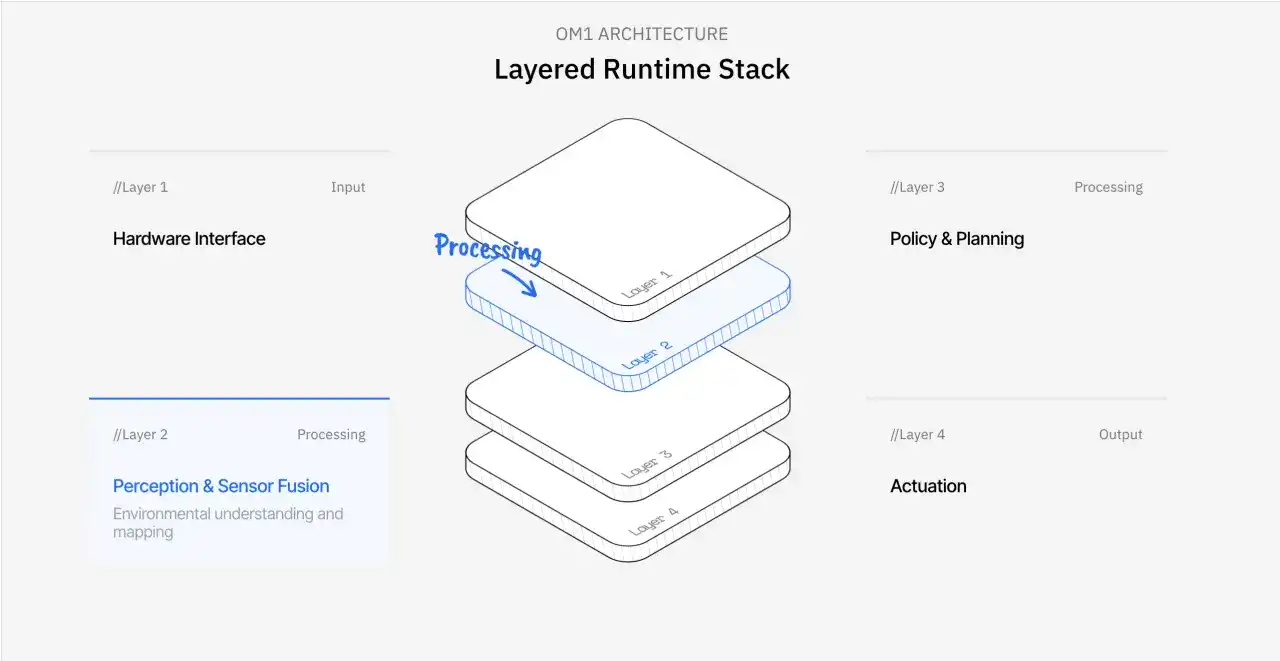
This gives robots真正的 "natural language interaction + autonomous decision-making" capabilities for the first time, rather than just being preset script executors.

The highlight of OM1 is its openness and generality. Its hardware-agnostic design allows developers don't need to rewrite code for each robot type. It currently supports various forms like the Unitree G1 humanoid robot, quadruped robots, etc. Software-wise, it integrates mainstream LLMs like GPT-4o, Gemini, equipped with functions like lidar, SLAM navigation, voice interaction, etc. The team will prioritize technical integration with Unitree, Agibot, UBTECH, Dobot, Cloudminds, Accelerated Evolution, Jueji Power, Zhongqing.

Furthermore, OM1's AI-native architecture supports plug-and-play integration of mainstream models, enabling natural interaction. Its modular structure, like an App Store, facilitates skill expansion.

OM1 released its Beta version in September 2025, is open-sourced on GitHub (MIT license), attracting thousands of global developers to contribute and test, and has been adapted to various robot forms including Unitree, DEEP Robotics, Dobot, and UBTECH, beginning the phase of real device deployment.

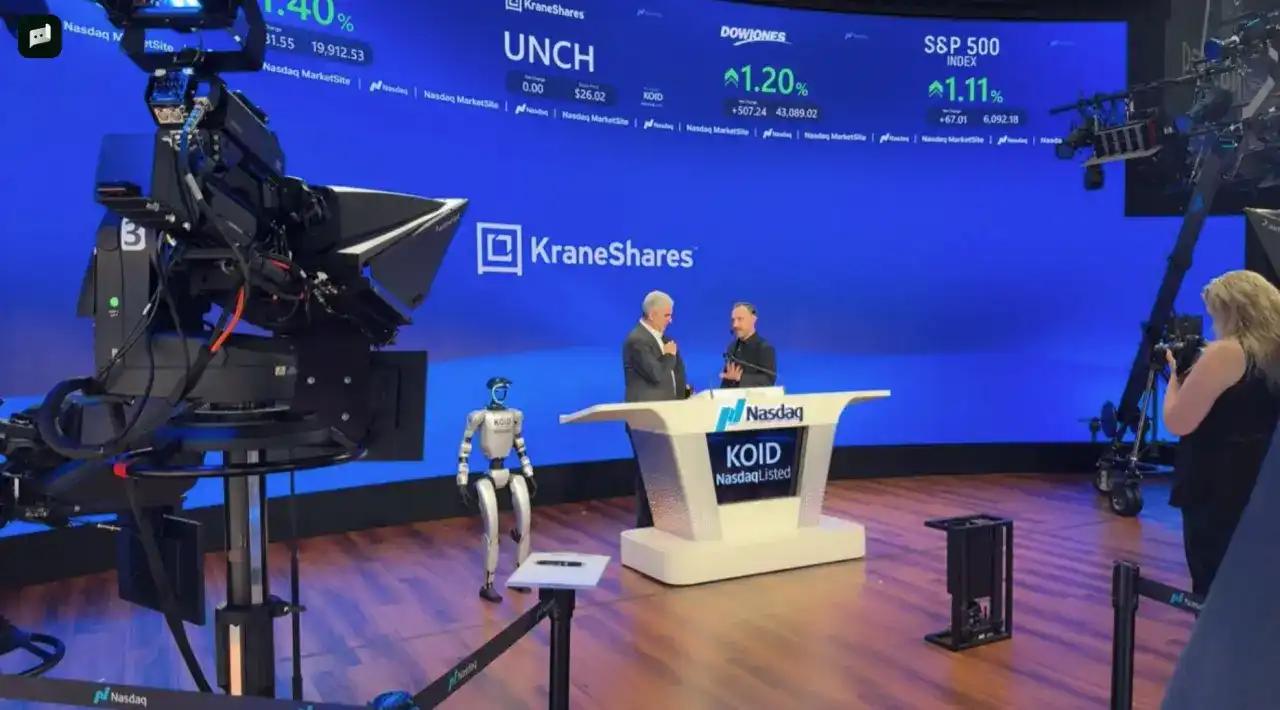
It is worth mentioning that at the ETF listing ceremony hosted by Nasdaq and launched by KraneShares, OpenMind's humanoid robot equipped with the OM1 operating system appeared on site and participated in the listing启动仪式.
Overall, OM1更像 a "universal brain + application platform" for robots. This model essentially replicates the successful path of Android当年: unify the base, reduce development costs to attract developers, and form an application ecosystem.

2. FABRIC: The Network Layer Letting Robots "Know" and "Collaborate" with Each Other

But a brain alone is not enough. In the real world, robots rarely operate alone. They need cross-manufacturer coordination, information sharing, task分配, and even automated settlement.

The problem is, traditional robot systems are mostly closed networks. Once跨品牌 or跨平台, collaboration almost has to start from scratch.

This is why, beyond OM1, OpenMind also built the Fabric Protocol (FABRIC).

If OM1 solves whether I am smart enough, FABRIC solves how I securely cooperate with other robots. FABRIC is essentially a decentralized collaboration and trust network. It assigns an on-chain identity to each robot, allowing devices to be identified, build credit, record behavior, and automatically complete task settlement.

In other words, robots are no longer just tools executing commands, but economic nodes with identity and accounts.

In this network, robots can share skills, synchronize experiences, call each other's capabilities, and even complete automated stablecoin micropayments and incentive distribution. From a Web3 perspective, it's closer to the identity layer + trust layer + collaboration layer between machines.

III. From Vision to Reality: OpenMind's Actual Deployment Progress

After talking so much about protocols, networks, and visions, the only真正关键 question is: Are these things actually running?

In the crypto industry, we've seen too many projects that issue coins first and then look for落地场景. Whitepapers are grand, demo videos are炫, but products remain in the testnet stage, with almost no real deployment in the real world.

The reason OpenMind has attracted so much attention this time is perhaps because its path is the opposite: it推进 TGE after OM1 and FABRIC were already running in real robots.

Currently, the two most representative pieces of落地成果 are: 1) the USDC automatic payment charging network launched in cooperation with Circle; 2) the BrainPack robot intelligence module sold to developers and hardware manufacturers.

1. Letting Robots Pay for Charging Themselves for the First Time

Last December, OpenMind announced a cooperation with Circle, deploying the world's first "USDC Robot Self-Charging Point" in Silicon Valley.

Simply put, robots can pay by themselves. When battery is low, it automatically navigates to the charging station, identifies the location, completes the USDC payment, then charges and continues working, all without human intervention.

It sounds small, but the significance is huge. This should be the first time robots possess autonomous consumption capability. They are no longer just managed devices, but begin to resemble economic agents.

2. Equipping Robots with a Universal Brain "BrainPack"

At the same time, OpenMind launched BrainPack and配套 robot solutions, aiming to help a larger scale of robots solve the problem of insufficient intelligence.

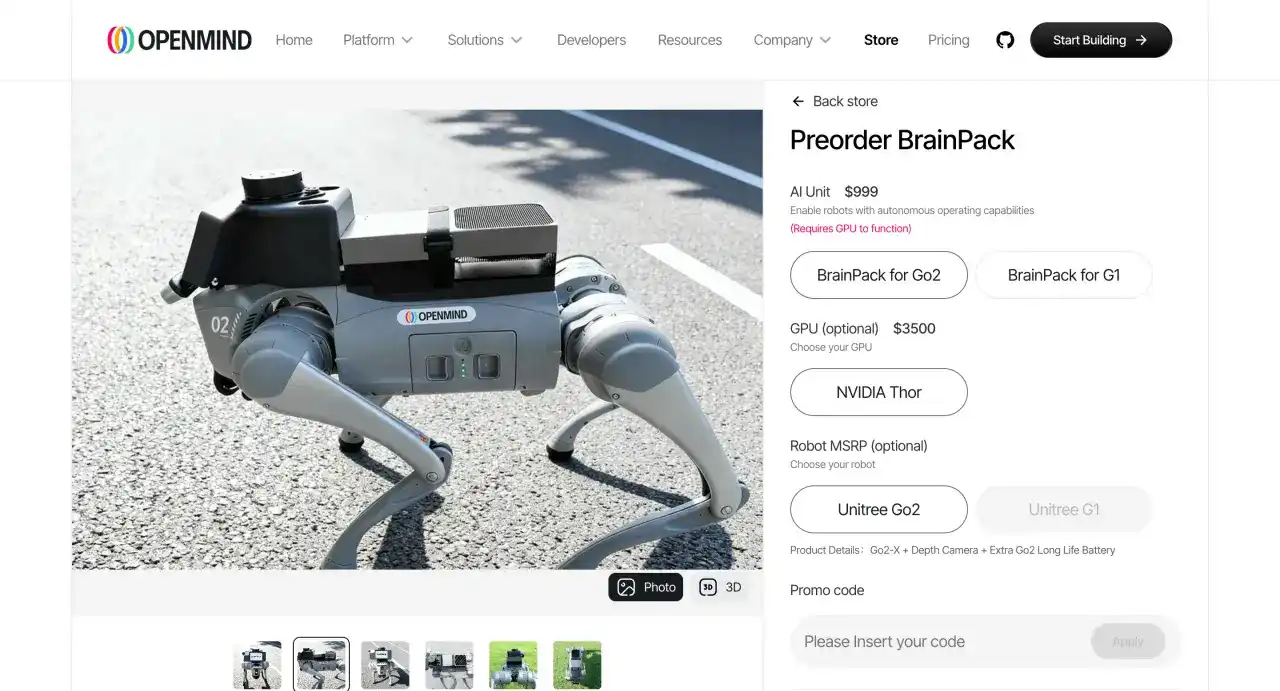
It is essentially a plug-and-play computing backpack, a module about the size of a backpack, integrating high-performance computing, sensors, and software. It can be directly installed on third-party robots. Once installed, ordinary robots immediately gain perception, mapping, planning, memory, and the complete autonomous capabilities like the aforementioned USDC payment-based self-charging management, edge inference, etc.

For example, it can help robots achieve real-time 3D mapping, object recognition/annotation, privacy-preserving vision (automatically blurring faces), and other operations.

Its core hardware is based on NVIDIA Jetson Thor and runs the self-developed OM1 system and FABRIC protocol, supporting ROS2, JetPack 7.05, etc. You can understand it as installing an Android system-level brain for the robot. No need to rebuild hardware or wait for the next generation of robots; old equipment is directly upgraded to AI-native robots.

BrainPack announced specific robot dog products last November. According to the official pre-sale page, the deposit is $999. It supports bundled Unitree robot packages. The first batch of complete deliveries is expected around Q1 2026. Although currently in the pre-order stage, some developers and labs have received beta or early delivery versions.
3.配套 App Store: Beginning to Form an Ecosystem

While hardware is being delivered, OpenMind is also building another key piece of the puzzle—the application ecosystem—launching a robot version of the App Store.

The logic is simple, just like we download Apps on our phones, developers can develop skills and applications for robots, and users can install them on their devices with one click.

Currently, the first batch of applications for quadruped and humanoid robots has been launched. Although still in the early stages, the significance of this step is that OpenMind is not just selling hardware or systems, but attempting to establish a sustainably scalable developer platform.

As more and more robots connect to OM1 + FABRIC, coupled with application distribution capabilities, the entire network truly gains scale effects.

Conclusion: Will OpenMind Drive the "Robotics+Crypto" Concept Heat?

In recent years, the market has just experienced a wave of AI + Crypto热潮. But most projects are essentially "computing power narrative + token model", with a layer still separating the chain from the real world. The special thing about OpenMind is that it is the first to truly embed Crypto into robots, this kind of physical world productivity tool.

From the industry side, OpenMind is already doing something more long-term: education and ecosystem. They jointly with Unitree Robotics' largest distributor in the US, RobotShop (Robostore), launched complete humanoid robot education courses and solutions, currently serving over 100 research and education institutions, including Harvard University, Massachusetts Institute of Technology, Stanford University, and other top universities. This may lay a good foundation for the future ecosystem and network effects of its machine economy, as well as卡位 in the "robotics + Crypto" track.

Perhaps precisely because of this, many people started to seriously pay attention to the robotics+Crypto infrastructure track through OpenMind.

Of course, for OpenMind, deployment speed is more important than concept热度. If viewed more rationally, OpenMind's advantages are very clear:

First, the team: top academic background + robotics/AI/blockchain交叉 capabilities. This kind of composite team from various fields is not common in Crypto projects.

Second, track卡位. In the加密 field, there are almost no similar projects truly深耕 "robotics infrastructure". It is the leader and seed player in this direction. When the market starts talking about "embodied AI + Web3", capital and attention will naturally集中 on it first.

Third,落地 rhythm. OM1, FABRIC, USDC self-charging points, BrainPack, App Store—these are not roadmaps, but products that have already begun delivery. This makes it更像 a technology company building long-term infrastructure, rather than a narrative-driven token project.

Of course, challenges also exist. The robotics industry itself is a hard tech track with heavy assets and long cycles. Hardware deployment is slow, costs are high, and commercialization paths are complex. It cannot replicate the exponential expansion of pure software protocols. At the same time, whether跨厂商 standards can truly be unified, whether the developer ecosystem can take off, and whether the machine economy truly forms a closed loop all still need time to verify.

In other words, OpenMind faces a marathon requiring patience and sustained effort.

Domande pertinenti

QWhat is the core problem that OpenMind is trying to solve in the robotics industry?

AOpenMind is tackling the fundamental infrastructure problems hindering the large-scale adoption of robots: systemic fragmentation, inefficient collaboration, and a lack of economic capabilities. It aims to create a unified operating system and a decentralized collaboration network to allow robots from different manufacturers to work together, share information, and perform automated transactions.

QWhat are the two core products developed by OpenMind and what are their respective functions?

AOpenMind has developed two core products: 1) OM1: An open-source, AI-native robot operating system that serves as a 'general brain' for individual robots, enabling perception, memory, reasoning, and action. 2) FABRIC Protocol: A decentralized collaboration and trust network that provides robots with on-chain identities, allowing them to be recognized, build credit, record behavior, and perform automated task settlement, enabling machine-to-machine collaboration and micro-payments.

QWhat was the significance of OpenMind's collaboration with Circle in December?

AThe collaboration with Circle led to the deployment of the world's first 'USDC robot self-charging point' in Silicon Valley. This allows robots to autonomously navigate to a charging station, identify their location, complete a USDC payment, and charge themselves without human intervention. This is significant as it marks one of the first instances of robots acting as independent economic agents capable of autonomous consumption.

QWhat is the purpose of the BrainPack hardware module launched by OpenMind?

ABrainPack is a plug-and-play 'computing backpack' module designed to upgrade existing third-party robots. It integrates high-performance computing, sensors, and software (including the OM1 OS and FABRIC protocol) to instantly grant ordinary robots advanced capabilities such as perception, mapping, planning, memory, autonomous charging management with USDC payments, and edge inference, effectively giving them a generic 'Android-like' AI brain.

QHow does OpenMind's approach to the 'robot economy' differ from typical AI + Crypto projects?

AUnlike many AI + Crypto projects that focus primarily on 'compute narrative + tokenomics' with a disconnect from the physical world, OpenMind embeds crypto (specifically its FABRIC protocol and stablecoins like USDC) directly into physical robots—the productivity tools of the real world. It provides the essential layers of identity, trust, and settlement, enabling robots to become verifiable economic participants that can collaborate and transact autonomously, thus bridging the gap between blockchain and real-world physical assets and actions.

Letture associate

Markets Close on Weekends, Risks Never Stop: RWA is Rewriting the Market Clock

On February 28, 2026, a U.S.-Israel airstrike on Iran during a weekend exposed critical vulnerabilities in traditional financial markets. By targeting a weekend—when major exchanges like CME were closed—the attack deliberately suppressed immediate panic-driven selling in stocks and forex, granting authorities a 48-hour window to manage fallout. However, capital swiftly migrated to crypto markets, where gold tokens like XAUT and PAXG on Ethereum saw surging activity, enabling continuous price discovery and hedging absent in traditional systems. This event underscored how Real World Asset (RWA) tokenization is reshaping global financial infrastructure. Unlike traditional T+1/T+2 settlements and limited trading hours, RWAs offer 24/7 liquidity, atomic settlements, and real-time risk management. During the attack, crypto-based gold tokens effectively became price oracles, leading traditional markets upon Monday’s open and allowing arbitrageurs to capitalize on cross-market disparities. The incident highlights RWAs' core value: expanding liquidity across time and reducing systemic gaps. As geopolitical and macroeconomic risks grow, the ability to trade and hedge instantaneously via blockchain—without reliance on legacy clearinghouses or banking hours—becomes a critical advantage. This shift may accelerate institutional adoption of tokenized assets (e.g., bonds, commodities) and hybrid TradFi-DeFi strategies, ultimately redefining global market hours and liquidity access.

比推20 min fa

Markets Close on Weekends, Risks Never Stop: RWA is Rewriting the Market Clock

比推20 min fa

MegaETH Co-founder: The 48 Hours Escaping Dubai Made Me Rethink the Entire Crypto World

MegaETH co-founder shares a personal reflection after fleeing Dubai amid regional tensions, using the experience to critique the current state of the crypto industry. Witnessing missile defense systems in action provided a new perspective on technology’s dual role: it amplifies civilization’s trajectory, acting as a lever rather than a fundamental upgrade. In healthy cycles, tech enhances productivity and collaboration, as early internet forums did. In decline, it becomes a weapon of attention or control. The author argues crypto was meant to be a parallel system—a way to rearchitect finance with fewer borders, lower collaboration costs, and flexible exit mechanisms. Instead, the pursuit of legitimacy led to integration with traditional power structures, sidelining foundational ideals like undercollateralized loans, pension structures, and cross-border savings. Stablecoins, while functional, often just repackage sovereign currency rather than create independent monetary systems. The author calls for honesty: backend integration isn’t reinvention. The disappointment in crypto stems not from price volatility, but from misaligned priorities—choosing attention and valuation over structurally meaningful, albeit “boring,” innovations. The conclusion urges the community to reclaim its agency: build tools for real sovereignty, not amplification of insecurity. Avoid cowardice, sharpen the blade, and forge a parallel system through verification and conviction. QED.

marsbit21 min fa

MegaETH Co-founder: The 48 Hours Escaping Dubai Made Me Rethink the Entire Crypto World

marsbit21 min fa

Trading

Spot
Futures

Articoli Popolari

Cosa è BNB WHALES

Comprendere le Balene BNB: Un Approfondimento nel Paesaggio delle Cryptovalute Introduzione alle Balene BNB Nel vibrante mondo delle criptovalute, emergono regolarmente nuovi progetti, spesso promettendo soluzioni innovative ed esperienze uniche. Uno di questi progetti è Balene BNB, lanciato nel 2023 e costruito sulla BNB Smart Chain (BEP20). Balene BNB si propone di stabilire una presenza distintiva all'interno dell'ecosistema delle criptovalute, concentrandosi sulla creazione di una piattaforma coinvolgente che unisce i benefici della tecnologia blockchain con interazioni sociali e di gioco. Questo articolo mira a esplorare più a fondo Balene BNB, analizzando i suoi componenti principali, meccaniche e traiettoria di sviluppo. Cosa sono le Balene BNB? Le Balene BNB sono un'iniziativa criptovalutaria che cerca di fornire una gamma diversificata di funzionalità e opportunità per i propri utenti nel crescente ambiente del Web3. Utilizzando lo standard BEP20, il progetto opera con un'offerta totale di token di 100 trilioni (100.000.000.000.000.000). Nonostante questa cifra significativa, è interessante notare che attualmente non ci sono token in circolazione, indicando che il progetto potrebbe essere ancora nelle sue fasi iniziali di sviluppo. Il principale obiettivo delle Balene BNB è creare una piattaforma in cui gli utenti possano partecipare a varie attività interattive beneficiando della sicurezza e della trasparenza offerte dalla tecnologia blockchain. Promuovendo un ambiente unico e coinvolgente, Balene BNB punta a costruire una comunità forte di utenti che sono coinvolti nel progetto e nel suo sviluppo. Chi è il Creatore delle Balene BNB? L'identità del creatore delle Balene BNB rimane non divulgata al momento, presentando una sfida per coloro che cercano di capire i principi fondanti e le intuizioni visionarie del progetto. Questa assenza di informazioni disponibili pubblicamente riguardo alla leadership del progetto può sollevare domande tra i potenziali investitori e utenti sulla sua governance e struttura di responsabilità. Chi sono gli Investitori delle Balene BNB? Con l'evoluzione delle Balene BNB, le informazioni riguardanti investitori specifici o supporto da fondazioni di investimento non sono attualmente disponibili. La documentazione ufficiale del progetto, incluso il suo whitepaper, non divulga né sostenitori finanziari individuali né istituzionali. La mancanza di trasparenza in questo senso può talvolta sollevare interrogativi sulla legittimità e sostenibilità dei nuovi progetti all'interno dell'ecosistema delle criptovalute. Come Funzionano le Balene BNB? Le Balene BNB operano sulla BNB Smart Chain utilizzando lo standard BEP20, noto per la sua efficienza e basse commissioni di transazione, attirando una varietà di sviluppatori e progetti. L'aspetto unico delle Balene BNB risiede nella sua attenzione alla creazione di una piattaforma guidata dalla comunità. Sebbene i dettagli operativi precisi siano scarsi, il progetto enfatizza l'interazione e il coinvolgimento, potenzialmente incorporando elementi gamificati nelle sue offerte. L'enfasi sulla comunità è fondamentale, poiché si allinea con le tendenze prevalenti nel campo delle criptovalute, dove il contributo e la partecipazione degli utenti spesso determinano il successo di un progetto. Ulteriori innovazioni potrebbero essere previste, ma attualmente, i meccanismi specifici e le funzionalità che differenziano Balene BNB da altre iniziative crittografiche devono ancora essere completamente chiariti. Senza informazioni dettagliate riguardo alla sua funzionalità, è difficile valutare in modo completo i differenziali del progetto. Timeline delle Balene BNB Lo sviluppo delle Balene BNB si è svolto attraverso tappe chiave, segnando il suo percorso nel panorama delle criptovalute. Di seguito è riportata una cronologia di eventi significativi riguardanti il progetto: 2023: Lancio delle Balene BNB, segnando l'ingresso del progetto nel mercato. 2023: Pubblicazione del whitepaper del progetto, che delinea gli obiettivi generali e il framework operativo. In Corso: Le Balene BNB continuano a sviluppare le proprie funzionalità, puntando a costruire una base utenti solida e ad espandere le proprie offerte. Punti Chiave sulle Balene BNB Piattaforma: BNB Smart Chain (BEP20) Offerta Totale: 100 trilioni di token (100.000.000.000.000.000) Offerta Circolante: 0 token (indicando una fase nascente) Obiettivo del Progetto: Favorire una piattaforma di criptovalute coinvolgente per l'interazione e la costruzione di comunità. Creatore: Sconosciuto Investitori: Non divulgati Stato Operativo: Attivo con sviluppo e espansione in corso Conclusione Nel mentre le Balene BNB navigano nel competitivo panorama delle criptovalute, offrono uno sguardo sul potenziale dei progetti guidati dalla comunità costruiti sulle fondamenta della tecnologia blockchain. Concentrandosi sul coinvolgimento e sull'interazione, l'iniziativa si pone all'avanguardia dell'innovazione nel campo del Web3. Tuttavia, il successo del progetto dipenderà alla fine dalla chiarezza delle sue meccaniche operative, dalla divulgazione della sua governance e dalla creazione di una solida comunità di utenti. Per potenziali utenti e investitori, le Balene BNB rappresentano un caso studio nella natura in evoluzione dei progetti di criptovalute—una che illustra sia le emozionanti possibilità che le complessità associate a nuove iniziative. Con il paesaggio che continua a evolversi, sarà essenziale monitorare i progressi delle Balene BNB e il loro impatto sull'ecosistema più ampio delle criptovalute.

279 Totale visualizzazioniPubblicato il 2024.04.05Aggiornato il 2024.12.03

Cosa è BNB WHALES

Come comprare BNB

Benvenuto in HTX.com! Abbiamo reso l'acquisto di Binance Coin (BNB) semplice e conveniente. Segui la nostra guida passo passo per intraprendere il tuo viaggio nel mondo delle criptovalute.Step 1: Crea il tuo Account HTXUsa la tua email o numero di telefono per registrarti il tuo account gratuito su HTX. Vivi un'esperienza facile e sblocca tutte le funzionalità,Crea il mio accountStep 2: Vai in Acquista crypto e seleziona il tuo metodo di pagamentoCarta di credito/debito: utilizza la tua Visa o Mastercard per acquistare immediatamente Binance CoinBNB.Bilancio: Usa i fondi dal bilancio del tuo account HTX per fare trading senza problemi.Terze parti: abbiamo aggiunto metodi di pagamento molto utilizzati come Google Pay e Apple Pay per maggiore comodità.P2P: Fai trading direttamente con altri utenti HTX.Over-the-Counter (OTC): Offriamo servizi su misura e tassi di cambio competitivi per i trader.Step 3: Conserva Binance Coin (BNB)Dopo aver acquistato Binance Coin (BNB), conserva nel tuo account HTX. In alternativa, puoi inviare tramite trasferimento blockchain o scambiare per altre criptovalute.Step 4: Scambia Binance Coin (BNB)Scambia facilmente Binance Coin (BNB) nel mercato spot di HTX. Accedi al tuo account, seleziona la tua coppia di trading, esegui le tue operazioni e monitora in tempo reale. Offriamo un'esperienza user-friendly sia per chi ha appena iniziato che per i trader più esperti.

828 Totale visualizzazioniPubblicato il 2024.12.12Aggiornato il 2025.03.21

Come comprare BNB

Cosa è BNB CARD

Comprendere BNB Card: Rivoluzionare l'Identità Digitale in Web3 Nel panorama in rapida evoluzione della tecnologia blockchain e delle criptovalute, la BNB Card o $BNBCARD si distingue come un progetto notevole. Questo token meme utilitario guidato dalla comunità sfrutta la BNB Smart Chain (BSC), mirando a integrare la cultura meme con soluzioni innovative per l'identità digitale. Man mano che sempre più utenti si immergono nei regni della decentralizzazione, è fondamentale analizzare cosa offre BNB Card, le sue sfumature operative e il suo potenziale impatto sul mercato. Cos'è BNB Card ($BNBCARD)? Alla sua essenza, BNB Card rappresenta un token meme con una sostanziale utilità. È progettato per dare potere agli utenti consentendo la creazione di carte d'identità digitali personalizzate che sono sia espressive che funzionali. Il progetto racchiude diverse caratteristiche chiave: Carte d'Identità Personalizzabili: Gli utenti hanno la possibilità di progettare carte d'identità digitali a tema Binance, fornendo loro una piattaforma per l'auto-espressione e un'interazione comunitaria migliorata. Struttura Decentralizzata: Sviluppata sulla BSC, BNB Card enfatizza attributi chiave come sicurezza, trasparenza e sovranità degli utenti. La natura decentralizzata della struttura consente transazioni che sono sia efficienti che sicure. Modello Centrato sulla Comunità: L'enfasi sulla partecipazione di base piuttosto che su modelli finanziari guidati da laboratori crea un ambiente coinvolgente per i suoi utenti. Sfruttando la viralità intrinseca della cultura meme, BNB Card promuove un robusto movimento comunitario. L'obiettivo primario di BNB Card è democratizzare gli strumenti di identità digitale in Web3, offrendo soluzioni accessibili che avvantaggiano gli utenti senza i vincoli tipicamente associati ai sistemi di gestione dell'identità tradizionali. Creatore e Investitori Quando si esplora l'identità dietro BNB Card, è importante notare che nessun singolo creatore è esplicitamente accreditato. Invece, il progetto sembra essere guidato dalla comunità, suggerendo uno sforzo collettivo ispirato al concetto della “Early Builder Card” di Binance. Questo approccio allo sviluppo organico è comune tra i progetti all'interno dello spettro dei token meme, dove lo sviluppo è spesso influenzato dalla passione della comunità piuttosto che da un'autorità centrale. In termini di investimento, l'assenza di sostenitori istituzionali pubblicamente dichiarati evidenzia ulteriormente la base comunitaria del progetto. Esso prospera grazie al supporto organico della comunità, riflettendo una caratteristica abituale dei progetti guidati dai meme che spesso coinvolgono il loro pubblico attraverso canali social piuttosto che percorsi di investimento formali. Come Funziona BNB Card impiega diversi meccanismi che delineano il suo funzionamento e spirito innovativo: Utilità del Token: Il token BNBCARD consente agli utenti di accedere a un insieme di strumenti per la creazione di ID, fornendo anche una piattaforma per la governance comunitaria. Il token funge da elemento centrale che abilita queste funzionalità. Integrazione Blockchain: Utilizzando la BSC, BNB Card garantisce compatibilità con applicazioni basate su Ethereum Virtual Machine (EVM). Questa integrazione offre agli utenti i vantaggi di basse commissioni di transazione migliorando l'accessibilità. Ecosistema Fai-da-te (DIY): Centrale nell'appeal di BNB Card è il suo approccio fai-da-te (DIY) alla generazione di carte d'identità digitali. Questo elemento partecipativo incoraggia gli utenti a impegnarsi nell'espressione creativa, promuovendo una cultura inclusiva che prospera sulla contribuzione e collaborazione. Cronologia La cronologia è fondamentale per comprendere la traiettoria di BNB Card. I traguardi importanti nella storia del progetto includono: 18 marzo 2025: BNB Card è stata quotata su LBank, segnando un passo significativo nel suo percorso di scambio e aprendo porte per liquidità e accessibilità per gli utenti. 19 marzo 2025: Un momento cruciale si è verificato quando il token ha registrato un aumento astronomico del 26.000% in 24 ore, attirando l'attenzione per il suo potenziale e l'entusiasmo della comunità. Sviluppi in Corso: Il progetto sta continuamente espandendo le sue partnership con scambi decentralizzati (DEX) come PancakeSwap, migliorando ulteriormente la liquidità e il coinvolgimento degli utenti. Innovazione e Differenziazione Comprendere cosa distingue BNB Card richiede un'esplorazione più profonda del suo framework innovativo: Ibrido Meme-Utilità: BNB Card fonde con successo il fascino giocoso della cultura meme con applicazioni pratiche nella gestione dell'identità digitale. Questo approccio di nicchia si rivolge efficacemente a un ampio pubblico, attirando sia utenti esperti di tecnologia che quelli nuovi nel mondo delle criptovalute. Governance Decentralizzata: Operare senza controllo centralizzato consente al progetto di sfruttare direttamente il contributo della comunità. Il processo decisionale collettivo sostenuto dal coinvolgimento della comunità dà potere agli utenti, assicurando che le loro voci contribuiscano allo sviluppo e alla direzione del progetto. Scalabilità: BNB Card può beneficiare enormemente dagli aggiornamenti della roadmap 2025 per la BNB Chain, che includono miglioramenti come l'aumento della velocità delle transazioni e l'integrazione di strumenti di intelligenza artificiale. Questi miglioramenti posizionano il progetto in modo vantaggioso all'interno di un ambiente altamente competitivo. Conclusione BNB Card è emblematica di una nuova ondata di soluzioni per l'identità digitale all'interno dell'ecosistema Web3. Fondendo divertimento, coinvolgimento della comunità e utilità pratica, invita gli utenti a partecipare attivamente nella definizione delle loro persone digitali. Mentre il progetto naviga nel dinamico panorama delle criptovalute, il suo successo dipenderà probabilmente dal mantenimento di un forte supporto della comunità mentre si adatta ai progressi tecnologici e alle esigenze degli utenti. L'integrazione della decentralizzazione con la cultura meme non serve solo come mezzo per il coinvolgimento guidato dagli utenti, ma anche come base per la narrazione in evoluzione riguardante l'identità digitale nell'era della blockchain. In sintesi, BNB Card non solo esemplifica la convergenza di creatività e utilità all'interno dello spazio crypto, ma sottolinea anche l'importanza della comunità nel guidare il futuro delle tecnologie decentralizzate.

230 Totale visualizzazioniPubblicato il 2025.03.26Aggiornato il 2025.03.26

Cosa è BNB CARD

Discussioni

Benvenuto nella Community HTX. Qui puoi rimanere informato sugli ultimi sviluppi della piattaforma e accedere ad approfondimenti esperti sul mercato. Le opinioni degli utenti sul prezzo di BNB BNB sono presentate come di seguito.

活动图片