Weekly Token Unlocks: H Unlocks Tokens Worth Tens of Millions of Dollars

marsbitPubblicato 2026-03-21Pubblicato ultima volta 2026-03-21

Introduzione

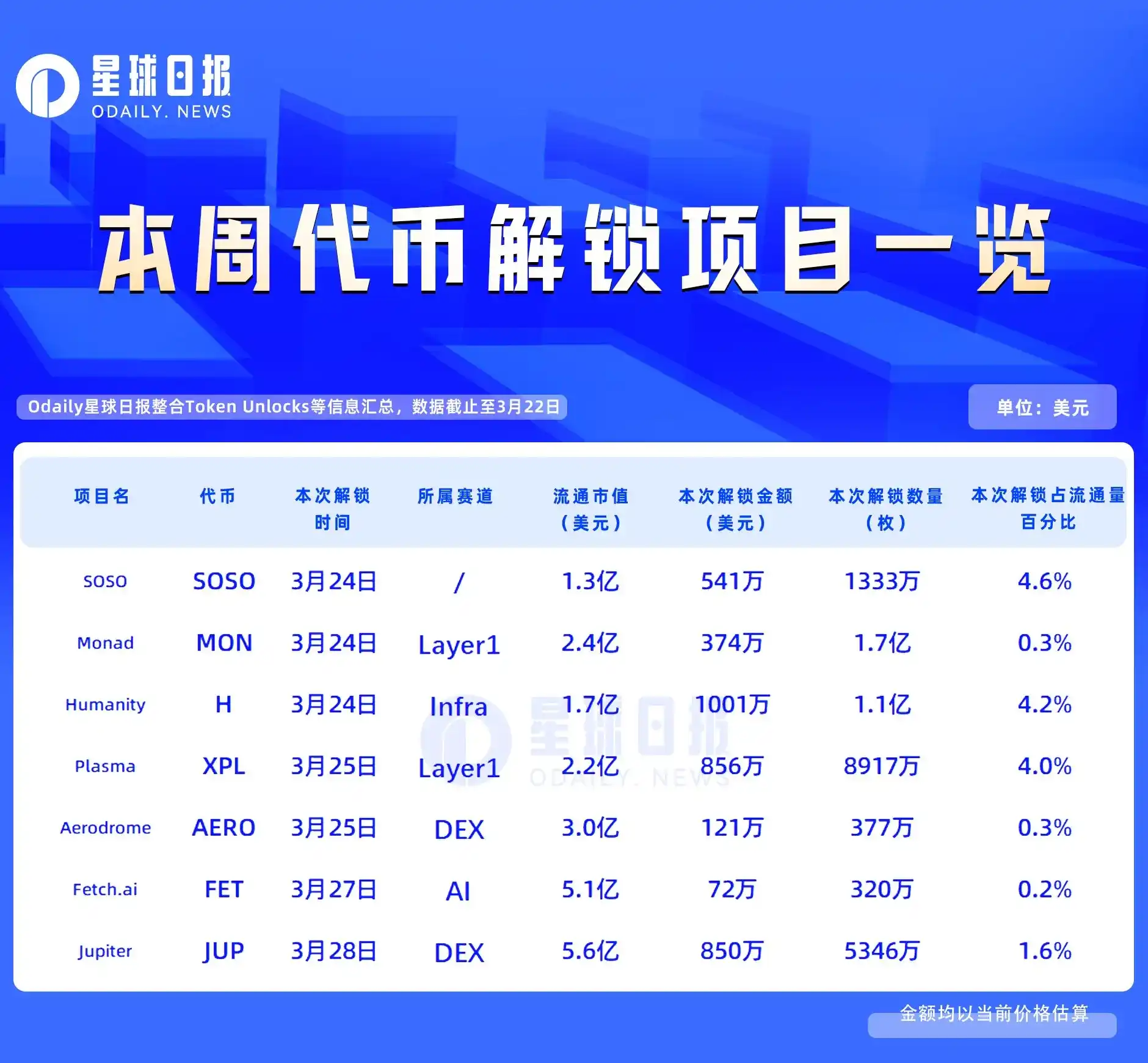
This week's major token unlocks feature three projects releasing significant value. SoSoValue, an AI-powered crypto investment research platform, will unlock 13.33 million tokens valued at approximately $5.41 million. Humanity Protocol, an anti-Sybil blockchain network for human identity verification, is set to unlock 110 million tokens worth about $10.01 million. Plasma, a Layer 1 blockchain designed for global stablecoin payments, will unlock 89.17 million tokens valued at around $8.56 million. Combined, these unlocks represent over $24 million in value entering the market.

SoSoValue

Project Twitter: https://x.com/SoSoValueCrypto

Project Website: https://sosovalue.com/

This Unlock Amount: 13.33 million tokens

This Unlock Value: Approximately $5.41 million

SoSoValue is an AI-driven investment research platform that combines the efficiency of CeFi with the transparency of DeFi, dedicated to addressing challenges like information overload and cross-chain asset management in the cryptocurrency market.

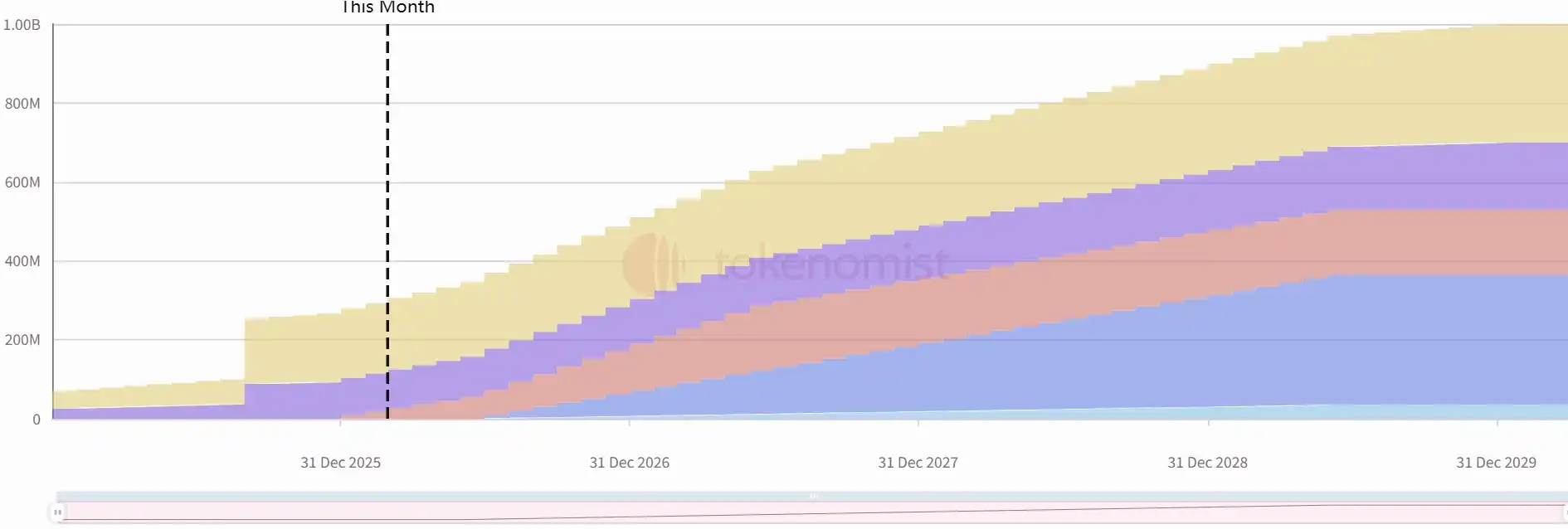
Specific release curve is as follows:
Humanity

Project Twitter: https://x.com/Humanityprot/

Project Website: https://www.humanity.org/

This Unlock Amount: 110 million tokens

This Unlock Value: Approximately $10.01 million

Humanity Protocol is a Sybil-resistant blockchain network that provides developers with a unique human identity verification mechanism and gives users complete ownership of their data and identity.

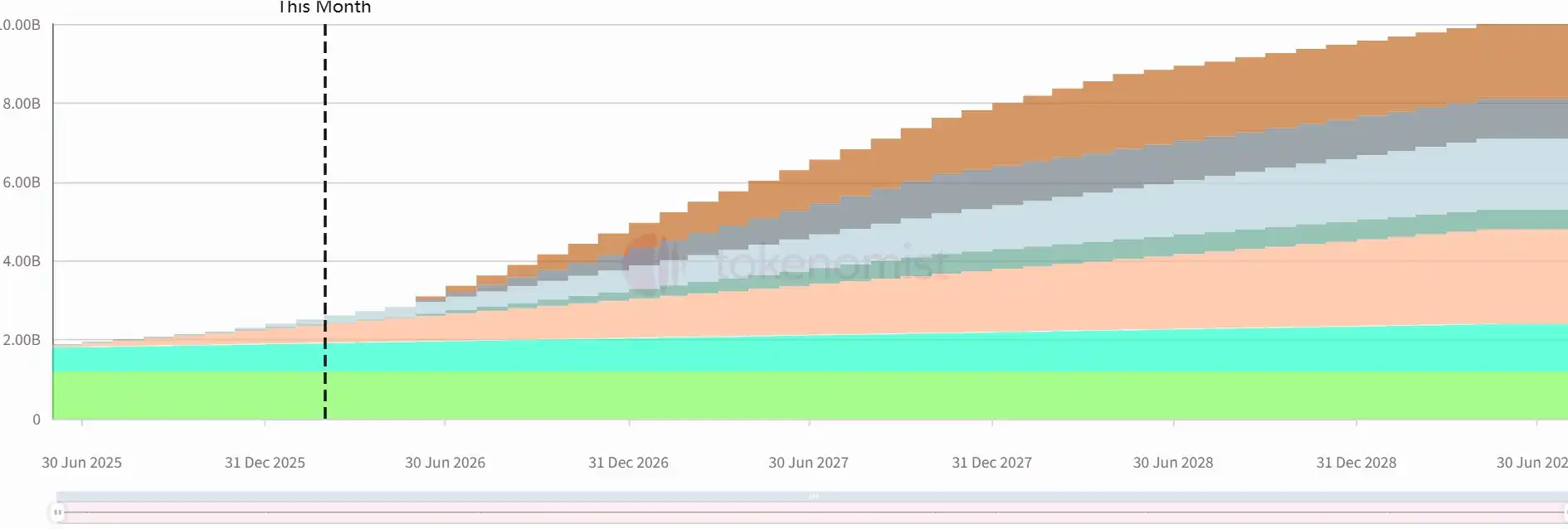
Specific release curve is as follows:
Plasma

Project Twitter: https://x.com/Plasma

Project Website: https://www.plasma.to/

This Unlock Amount: 89.17 million tokens

This Unlock Value: Approximately $8.56 million

Plasma is a Layer 1 blockchain built specifically for global stablecoin payments. It combines high throughput, stablecoin-native functionality, and full EVM compatibility, providing the foundational infrastructure for developers to build the next generation of payment and financial applications. It also supports customizable gas tokens, zero-fee USDT transfers, and private payments.

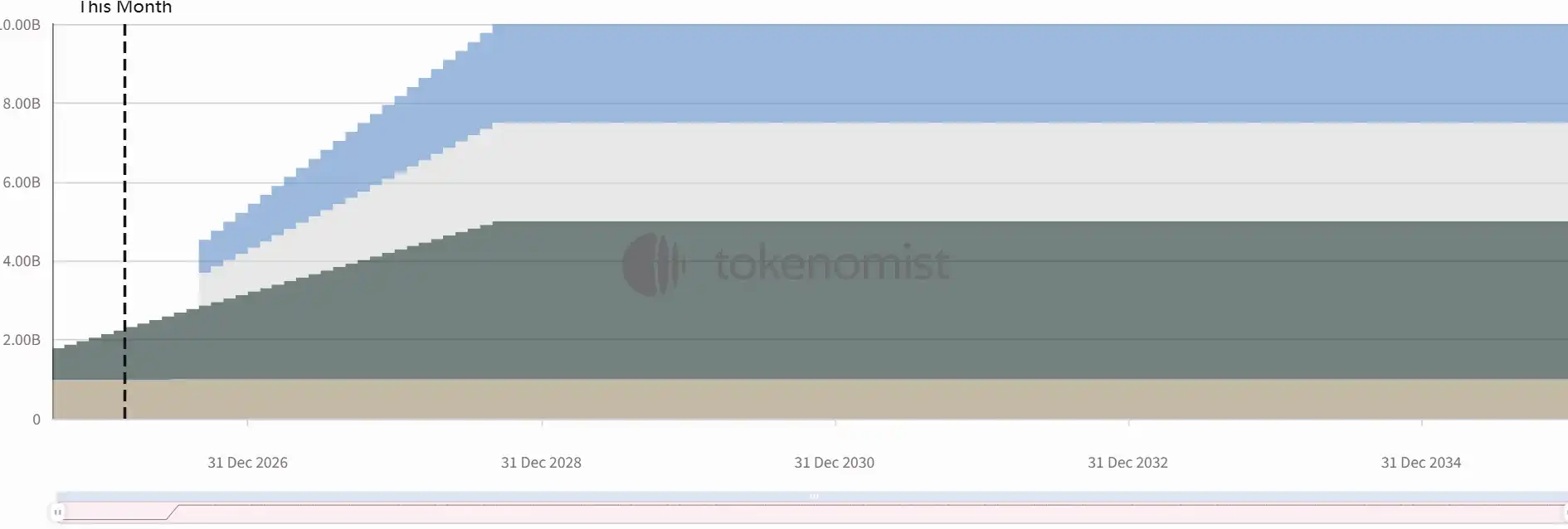
Specific release curve is as follows:
Domande pertinenti

QWhat is the total value of tokens being unlocked for Humanity Protocol this week?

AThe total value of tokens being unlocked for Humanity Protocol this week is approximately $10.01 million.

QWhich project is described as an AI-driven investment research platform combining CeFi efficiency with DeFi transparency?

ASoSoValue is described as an AI-driven investment research platform that combines CeFi efficiency with DeFi transparency.

QWhat is the primary purpose of the Plasma blockchain network?

AThe primary purpose of the Plasma blockchain is to serve as a Layer 1 blockchain built for global stablecoin payments, offering high throughput, stablecoin-native features, and full EVM compatibility.

QHow many tokens will be unlocked for the SoSoValue project?

A13.33 million tokens will be unlocked for the SoSoValue project.

QWhat unique mechanism does Humanity Protocol provide for developers?

AHumanity Protocol provides a unique human identity verification mechanism for developers, giving users complete ownership of their data and identity.

Letture associate

The 4 Truths and Fee Traps Behind Polymarket's LP Market Making Incentives

Polymarket, a prediction market platform, has recently shifted its focus to incentivizing liquidity providers (LPs) to address its core issue of low liquidity. While most markets remain free, it now charges a taker fee on specific markets like crypto price movements and select sports events. This fee, highest near 50% probability, funds new LP reward programs. There are two primary reward systems: one pays LPs when their limit orders are executed (maker rewards), and another rewards simply for placing orders within a set spread to provide liquidity, even if they don't get filled. A third mechanism allows anyone to sponsor additional incentives for specific markets. A positive view argues this structure values genuine liquidity over mere trading volume, making fees earned and rewards received a potential key, anti-sybil metric for a future POLY token airdrop. It rewards users who improve market depth and stability. A contrasting, negative view claims the LP program is a "trap." Critics argue that professional market makers avoid it due to insider trading risks and that most LPs are actually losing money due to hidden "LP wear and tear" (impermanent loss), only participating based on speculation of a valuable airdrop. They warn that if Polymarket expands fees to fund these unsustainable rewards, it could lose its competitive edge of zero fees and better odds compared to traditional sportsbooks. Proposed solutions include a fixed fee only on profits, using a native POLY pool for liquidity, or charging for premium products like parlays instead of core markets.

marsbit2 h fa

The 4 Truths and Fee Traps Behind Polymarket's LP Market Making Incentives

marsbit2 h fa

The 4 Truths Behind Polymarket's LP Market-Making Incentives and the Fee Trap

Polymarket, a prediction market platform, has recently shifted its incentive structure towards rewarding Liquidity Providers (LPs) to solve its core problem of low market depth. While most markets remain free, it now charges a taker fee on specific markets (all Crypto markets, NCAAB basketball, and Serie A football) to fund new LP reward programs. The fee is calculated on a symmetric curve, highest near 50% probability. The platform has introduced two main incentive systems: one rewards LPs whose limit orders are executed (Maker Incentives), and another rewards LPs simply for providing resting liquidity, even if orders aren't filled (Liquidity Incentives). A third system allows anyone to sponsor additional rewards for specific markets. A key argument is that the fees paid and rewards earned could be a strong anti-sybil metric for a potential POLY token airdrop, valuing genuine liquidity provision over mere trading volume. However, a counter viewpoint argues the LP program is a potential trap. Critics claim that the displayed ROI for LPs is misleading as it doesn't account for "LP wear and tear"—losses from filled orders that can't be easily exited. They state professional market makers avoid it due to insider trading risks and that the model of subsidizing liquidity with massive daily rewards is unsustainable. The concern is that widespread fee implementation could erase Polymarket's competitive edge over traditional betting platforms. Proposed solutions include a fixed fee on profits only, using a POLY token for native liquidity, and charging for premium products like parlays instead of core markets.

Odaily星球日报2 h fa

The 4 Truths Behind Polymarket's LP Market-Making Incentives and the Fee Trap

Odaily星球日报2 h fa

Understanding x402 and MPP: Two Approaches to Agent Payments

Stripe's MPP and x402 represent two competing approaches to enabling machine-to-machine payments, both leveraging the long-dormant HTTP 402 status code ("Payment Required"). x402, led by Coinbase, is a minimalist protocol that embeds payment directly into HTTP requests. It requires no accounts, API keys, or intermediaries. A server returns a 402 response with payment details; the client pays on-chain and resubmits the request with a proof. It's open-source, chain-agnostic (currently supporting Base, Polygon, Solana), and designed for open, permissionless systems. However, current usage is low, with small microtransactions. MPP, developed by Stripe and Tempo, is a full-stack solution built for high-frequency agent transactions. Its core innovation is sessions, allowing an agent to pre-authorize a spending limit and make numerous micro-payments within it without repeated on-chain transactions. It runs on the Tempo blockchain, optimized for high throughput and sub-second confirmations. Crucially, it integrates with Stripe's existing compliance, risk, and fiat infrastructure, including support for credit cards via Shared Payment Tokens (SPTs). While x402 offers simplicity and decentralization, MPP provides scalability and enterprise-grade features. Stripe supports both, aiming to capture agent payment flows regardless of the underlying protocol. The ecosystem is still experimental, but major players like Google, Visa, and Anthropic are involved. The choice depends on the use case: x402 for open, long-tail applications, and MPP for commercial, high-volume scenarios.

marsbit2 h fa

Understanding x402 and MPP: Two Approaches to Agent Payments

marsbit2 h fa

Trading

Spot
Futures
活动图片