Ethereum Block Space Futures Market ETHGas Aims to Become a Real-Time Execution Layer?

marsbitPubblicato 2026-01-03Pubblicato ultima volta 2026-01-03

Introduzione

Ethereum block space futures market ETHGas has raised $12 million in a funding round led by Polychain Capital, with participation from several other investors. The platform aims to address Ethereum's gas fee volatility by allowing users to lock in future gas costs through futures contracts, making expenses predictable for DApps and L2 solutions. A key feature is its Blockspace auction market, where validators and block builders can auction space in upcoming blocks, ensuring transaction inclusion and execution efficiency. ETHGas ultimately envisions a "Real-Time Ethereum" by guaranteeing transaction execution in subsequent blocks. However, challenges include potential increased costs for retail users due to institutional dominance in auctions, and risks of market manipulation through futures trading. The platform plans to mitigate these issues to avoid undermining its core goals.

Author: Eric, Foresight News

On December 17, the block space futures market ETHGas announced the completion of a $12 million funding round, led by Polychain Capital, with participation from Stake Capital, BlueYard Capital, Lafayette Macro Advisors, SIG DT, and Amber Group. Founder Kevin Lepsoe revealed that ETHGas had completed an undisclosed Pre-Seed funding round of approximately $5 million in mid-2024.

Lepsoe also stated that Ethereum validators, block builders, and relay nodes have committed around $800 million to support market and product development, not in cash investments but by providing liquidity to the ETHGas market in the form of Ethereum block space.

Although the project is defined as a block space futures market, its true vision is to achieve "Real-Time Ethereum."

The Order of Blocks

Ethereum co-founder Vitalik Buterin proposed the concept of a Gas futures market earlier this month, aiming to address the issue of Ethereum Gas volatility. Similar to the logic of commodity futures in traditional markets, locking in future Gas costs through futures would make Gas expenses predictable and controllable.

This would allow DApps to lock in Gas costs before events such as users claiming token airdrops and design activities to subsidize users. L2s could also purchase futures when Gas fees are lower to stabilize the cost of bundling and submitting data to L1, making transaction costs on L2s stable and predictable. This would serve businesses that require pre-calculated costs, such as tokenized U.S. stocks.

According to the documentation, ETHGas will also launch a no-code tool called Open Gas specifically for DApps to help them provide Gas subsidy programs. This tool will allow users to claim the Gas fees they consumed on the ETHGas platform after using a DApp.

Developing a Gas futures market is not particularly challenging, as it essentially requires building a sufficiently liquid on-chain futures trading market. ETHGas's "killer feature" is its block space auction market.
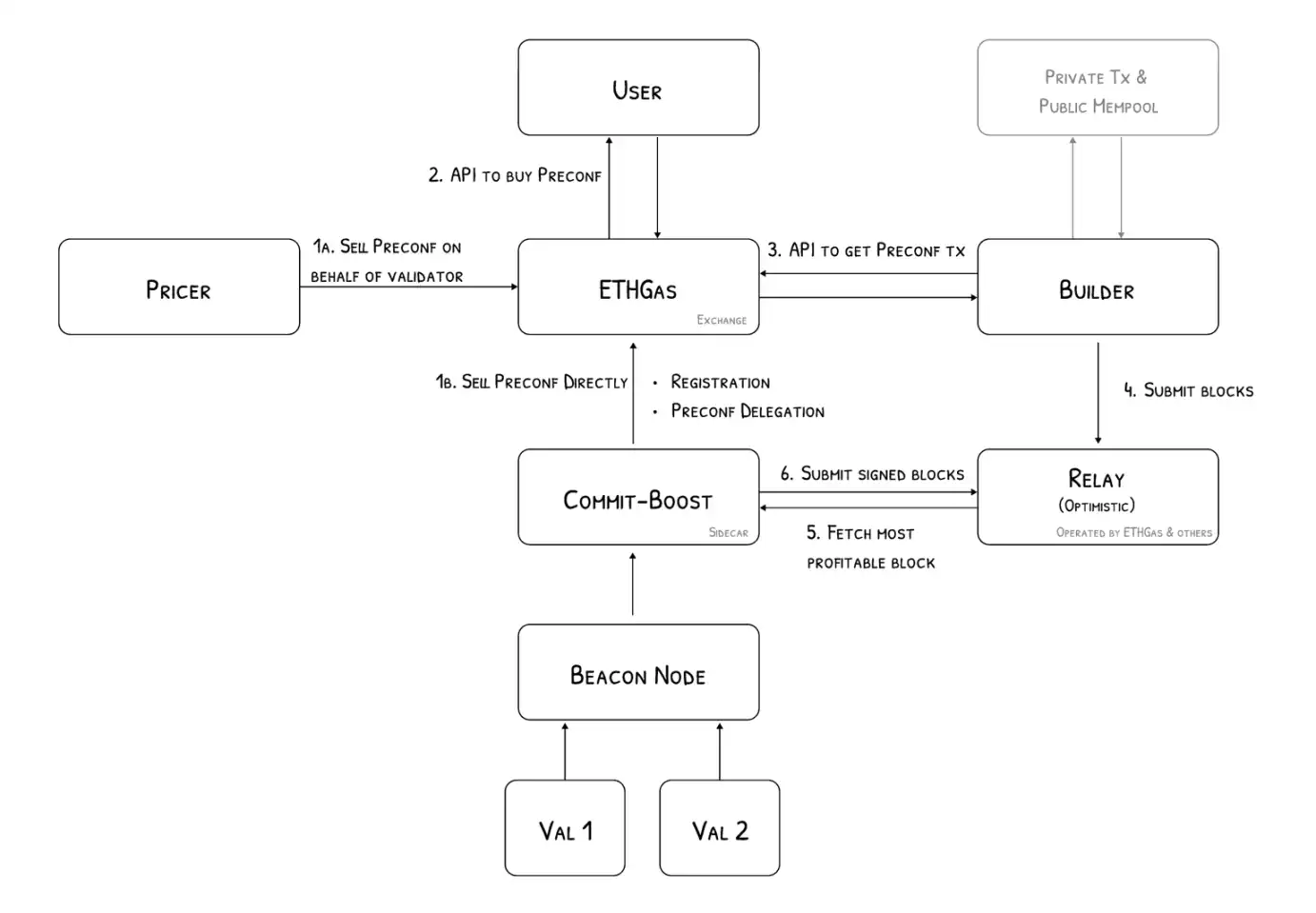
This auction market, named Blockspace, allows Ethereum validators, block builders, and relay nodes to auction space in subsequent blocks, ensuring that bidders' transactions are included in the next block and guaranteeing the execution efficiency of those transactions. Additionally, bidders can even purchase an entire block to include only their own transactions or transactions they provide for others.

Comparing transactions to packages, guaranteeing block inclusion is like ensuring a package is loaded onto a transport plane, while guaranteeing transaction execution is like ensuring the package is delivered to the intended recipient on time. Purchasing an entire block is akin to chartering an entire plane to transport one's packages, but with the option to sublet the extra space to other packages.

ETHGas's ultimate goal is to achieve "real-time transactions" on Ethereum through Blockspace. This "real-time transaction" can only be in quotes because the completion of transactions on the Ethereum mainnet must wait for the block to be finalized. However, if a transaction can be guaranteed to be included in the next block, it can, in a way, be considered "already completed." ETHGas can be understood as an execution layer on top of Ethereum, but how real-time transactions will be reflected on the front end remains to be seen as ETHGas provides answers.

ETHGas aims to create an orderly block space, as opposed to the current system of chaotic bidding for block space with numerous uncontrollable MEV transactions. By offering predictable returns to attract infrastructure operators to join Blockspace and create sufficient liquidity for real-time transactions, the resulting efficiency improvements will attract various DApps. DApps, in turn, will attract users through Open Gas, and users will bring more transaction volume into the ETHGas network, thereby increasing the returns for infrastructure operators and forming a positive cycle.

Challenges Beneath the Ideal Vision

For a DApp about to conduct a token airdrop, it could estimate the number of transactions for claiming the airdrop, pre-book n blocks after a specific time, and provide a Gas subsidy program, thereby achieving a budget-controlled and network-congestion-free token claim event.

Although such visions are ideal, allowing block space to be auctioned may lead to many foreseeable issues.

First, if institutional users can auction block space without restrictions, they might purchase entire blocks in large quantities and resell them to retail users. While this would ensure stable and predictable returns for validators, it could increase transaction costs for retail users. In this scenario, retail users lack the technical capability to compete with institutional users, and even if they could participate in auctions or use futures markets to hedge against rising Gas fees, it would essentially raise their transaction costs.

Additionally, the futures market could become a tool for market manipulation. For example, large players could deliberately create a high volume of on-chain transactions to drive up Gas fees and profit from the futures market, but this could increase transaction costs for other users on the Ethereum mainnet. Moreover, as DApp operators are aware of the specific timing of events that could cause a surge in transactions, they could profit from operations in the futures market in advance, turning the futures market into an arbitrage playground for those with informational advantages and causing unpredictable losses for ordinary users who simply use the market for hedging.

The birth of a new trading market inevitably creates arbitrage opportunities due to information asymmetry, potentially undermining the very problems the market aims to solve. For ETHGas, balancing this issue and preventing a "positive cycle" from turning into a "death spiral" may require some necessary restrictions.

Domande pertinenti

QWhat is the main vision of ETHGas, despite being defined as a block space futures market?

AThe main vision of ETHGas is to achieve 'Real-Time Ethereum' by creating an orderly block space and acting as an execution layer on top of Ethereum.

QWho led the $12 million funding round for ETHGas announced on December 17th?

AThe $12 million funding round was led by Polychain Capital.

QWhat is the purpose of the Blockspace auction market introduced by ETHGas?

AThe Blockspace auction market allows validators, block builders, and relay nodes to auction space in future blocks, guaranteeing that a bidder's transaction will be included in the next block and ensuring its efficiency. It can also be used to auction an entire block.

QWhat potential problem does the article identify with allowing unlimited block space auctions?

AUnlimited auctions could allow institutional users to outbid散户 (retail users) and potentially resell block space to them, ultimately increasing transaction costs for ordinary users and creating an unlevel playing field.

QWhat tool is ETHGas developing specifically for DApps, and what is its function?

AETHGas is developing a zero-code tool called Open Gas, which is designed to help DApps provide gas subsidy programs, allowing users to claim the gas fees they spent after using the DApp on the ETHGas platform.

Letture associate

Bitcoin Continues to Plunge, Focus on Whether MSTR Is Forced to Sell

Bitcoin is undergoing a severe stress test as its price falls below key psychological levels, approaching the cost basis of major institutional holders like MicroStrategy. The cryptocurrency dropped below $80,000 over the weekend, hitting its lowest point since April 7, 2025, and has declined over 30% recently amid thin liquidity. Despite the sell-off, MicroStrategy’s Executive Chairman Michael Saylor signaled intentions to continue accumulating Bitcoin, even as the company raised the dividend on its perpetual preferred shares to 11.25% to attract capital. However, analysts warn that high dividend costs could strain cash flow if Bitcoin’s price remains stagnant or falls below its cost basis. The market is highly institutionalized, with MicroStrategy and 11 spot Bitcoin ETFs holding approximately 10% of Bitcoin’s circulating supply. These institutions face combined unrealized losses of around $7 billion, with an average acquisition cost of $85,360 per Bitcoin. Spot Bitcoin ETFs have seen net outflows for 10 consecutive days, exacerbating downward pressure. MicroStrategy holds 712,647 Bitcoin at an average cost of $76,037. With Bitcoin hovering near $78,000, its unrealized gains have narrowed to less than 3%. The company’s aggressive financing strategies, including high-yield debt, highlight both its commitment and the risks of its Bitcoin-centric strategy. Macro strategist Jim Bianco notes that Bitcoin faces a "narrative exhaustion," as the "institutional adoption" story has been fully priced and may now be reversing. Without new sustained buying interest, institutional holdings—once a support—could become a major source of selling pressure. The key question is where the next wave of buyers will emerge at current price levels.

比推35 min fa

Bitcoin Continues to Plunge, Focus on Whether MSTR Is Forced to Sell

比推35 min fa

Trading

Spot
Futures

Articoli Popolari

Cosa è USAT

I. Introduzione al ProgettoUSA₮ è la stablecoin regolamentata negli Stati Uniti da Tether, supportata dal dollaro, sviluppata specificamente per operare all'interno del nuovo quadro federale delle stablecoin degli Stati Uniti stabilito dalla GENIUS Act. L'emittente di USA₮ è Anchorage Digital Bank, N.A., il primo emittente di stablecoin regolamentato a livello federale negli Stati Uniti.II. Informazioni sul Token1) Informazioni di BaseNome del token: USAT (USAT)III. Link CorrelatiSito web: https://usat.io/Esploratori:https://etherscan.io/token/0x07041776f5007ACa2A54844F50503a18A72A8b68Social:https://twitter.com/usatNota: L'introduzione al progetto proviene dai materiali pubblicati o forniti dal team ufficiale del progetto, che è solo a scopo di riferimento e non costituisce consulenza per gli investimenti. HTX non si assume responsabilità per eventuali perdite dirette o indirette risultanti.

134 Totale visualizzazioniPubblicato il 2026.01.27Aggiornato il 2026.01.27

Come comprare USAT

Benvenuto in HTX.com! Abbiamo reso l'acquisto di USAT (USAT) semplice e conveniente. Segui la nostra guida passo passo per intraprendere il tuo viaggio nel mondo delle criptovalute.Step 1: Crea il tuo Account HTXUsa la tua email o numero di telefono per registrarti il tuo account gratuito su HTX. Vivi un'esperienza facile e sblocca tutte le funzionalità,Crea il mio accountStep 2: Vai in Acquista crypto e seleziona il tuo metodo di pagamentoCarta di credito/debito: utilizza la tua Visa o Mastercard per acquistare immediatamente USATUSAT.Bilancio: Usa i fondi dal bilancio del tuo account HTX per fare trading senza problemi.Terze parti: abbiamo aggiunto metodi di pagamento molto utilizzati come Google Pay e Apple Pay per maggiore comodità.P2P: Fai trading direttamente con altri utenti HTX.Over-the-Counter (OTC): Offriamo servizi su misura e tassi di cambio competitivi per i trader.Step 3: Conserva USAT (USAT)Dopo aver acquistato USAT (USAT), conserva nel tuo account HTX. In alternativa, puoi inviare tramite trasferimento blockchain o scambiare per altre criptovalute.Step 4: Scambia USAT (USAT)Scambia facilmente USAT (USAT) nel mercato spot di HTX. Accedi al tuo account, seleziona la tua coppia di trading, esegui le tue operazioni e monitora in tempo reale. Offriamo un'esperienza user-friendly sia per chi ha appena iniziato che per i trader più esperti.

70 Totale visualizzazioniPubblicato il 2026.01.27Aggiornato il 2026.01.27

Come comprare BIRB

Benvenuto in HTX.com! Abbiamo reso l'acquisto di Moonbirds (BIRB) semplice e conveniente. Segui la nostra guida passo passo per intraprendere il tuo viaggio nel mondo delle criptovalute.Step 1: Crea il tuo Account HTXUsa la tua email o numero di telefono per registrarti il tuo account gratuito su HTX. Vivi un'esperienza facile e sblocca tutte le funzionalità,Crea il mio accountStep 2: Vai in Acquista crypto e seleziona il tuo metodo di pagamentoCarta di credito/debito: utilizza la tua Visa o Mastercard per acquistare immediatamente MoonbirdsBIRB.Bilancio: Usa i fondi dal bilancio del tuo account HTX per fare trading senza problemi.Terze parti: abbiamo aggiunto metodi di pagamento molto utilizzati come Google Pay e Apple Pay per maggiore comodità.P2P: Fai trading direttamente con altri utenti HTX.Over-the-Counter (OTC): Offriamo servizi su misura e tassi di cambio competitivi per i trader.Step 3: Conserva Moonbirds (BIRB)Dopo aver acquistato Moonbirds (BIRB), conserva nel tuo account HTX. In alternativa, puoi inviare tramite trasferimento blockchain o scambiare per altre criptovalute.Step 4: Scambia Moonbirds (BIRB)Scambia facilmente Moonbirds (BIRB) nel mercato spot di HTX. Accedi al tuo account, seleziona la tua coppia di trading, esegui le tue operazioni e monitora in tempo reale. Offriamo un'esperienza user-friendly sia per chi ha appena iniziato che per i trader più esperti.

87 Totale visualizzazioniPubblicato il 2026.01.28Aggiornato il 2026.01.28

Discussioni

Benvenuto nella Community HTX. Qui puoi rimanere informato sugli ultimi sviluppi della piattaforma e accedere ad approfondimenti esperti sul mercato. Le opinioni degli utenti sul prezzo di A A sono presentate come di seguito.

活动图片