Securitize hires former PayPal exec as US tokenization gains traction

cointelegraphPubblicato 2025-12-09Pubblicato ultima volta 2025-12-09

Introduzione

Securitize, a major tokenization platform, has hired former PayPal executive Jerome Roche as its new general counsel to strengthen its push for tokenized equity in the US. Roche previously led PayPal’s expansion into digital assets, including the PYUSD stablecoin. The company emphasized that tokenized securities are already accessible to US investors, countering the perception that such offerings are primarily available abroad. CEO Carlos Domingo stated that Securitize operates within a clear US regulatory framework using SEC-approved infrastructure, enabling fully compliant access to onchain securities. This development follows Securitize’s recent regulatory approval in the EU and signals growing acceptance of tokenization in the US, further evidenced by the SEC ending its investigation into rival platform Ondo Finance.

Major tokenization platform Securitize has doubled down on its push to bring tokenized equity to US investors, naming a former PayPal executive as its new general counsel.

Securitize on Tuesday announced the appointment of ex-PayPal executive Jerome Roche, who led the company’s expansion into digital asset projects, including the PayPal USD (PYUSD) stablecoin.

Securitize also said its tokenized securities are already available to US investors, challenging the notion that most issuers prefer to offer such products abroad due to local stock access.

“There’s been a perception that tokenized securities must be offered primarily outside the US, but our experience shows the opposite,” Securitize CEO Carlos Domingo told Cointelegraph.

“Clear regulatory path” for tokenized stocks in the US

According to Securitize, operating real-world asset (RWA) tokenization offerings inside the US regulatory perimeter is “not only possible, but scalable, at institutional quality.”

“We’ve demonstrated that there is a clear regulatory path for issuers to natively tokenize assets for US investors,” Domingo said.

“These are not synthetic representations, or derivatives, but real securities onchain,” the CEO said, adding:

“We operate using SEC-regulated infrastructure, including a registered transfer agent broker-dealer, and fund admin, which allows US investors to access and legally hold tokenized securities in a fully compliant framework.”

Securitize’s optimistic outlook on the US tokenization comes days after the platform obtained regulatory approval to operate as an investment company and a trading ánd settlement system in the European Union on Nov. 26. According to the company, the approval positioned it as one of the first operators for regulated digital securities infrastructure in both the US and EU.
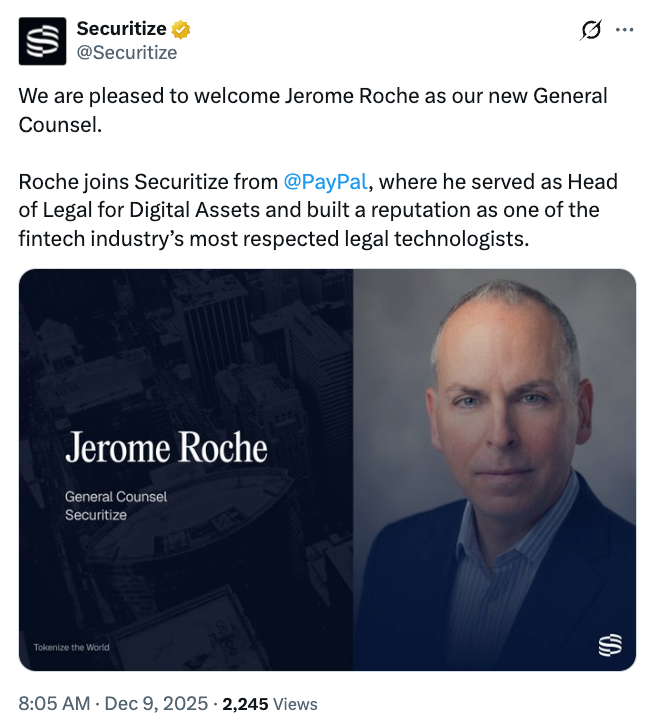
Source: Securitize

“For the first time, modern ledger technology is giving us the ability to record ownership, settle transactions, and move value in ways that are fundamentally better than the fragmented systems we’ve inherited,” Securitize’s newly appointed general counsel, Roche, said in the announcement.

“Innovation only works when it fits squarely within the guardrails of applicable law,” he added, underscoring Securitize’s global push for regulated tokenized securities.

Related: US Treasurys lead tokenization wave as CoinShares predicts 2026 growth

Securitize’s news is another sign of the US warming to tokenization. On Monday, the Securities and Exchange Commission dropped its investigation into rival tokenization platform Ondo Finance.

Ondo said the decision marks a new chapter for tokenized securities in the US, where they are poised to become a “core part of the capital markets.”

Magazine: When privacy and AML laws conflict: Crypto projects’ impossible choice


Letture associate

The Silver Crisis: When the Paper System Begins to Fail

Silver Crisis: When the Paper System Begins to Fail In December, silver became the standout performer in the precious metals market, surging from $40 to over $60 per ounce, hitting a historic high of $64.28 on December 12 before experiencing sharp declines. Year-to-date, silver rose nearly 110%, far outpacing gold’s 60% gain. The rally appears justified by fundamental factors: expectations of Fed rate cuts, strong industrial demand from solar, EV, and AI sectors, and declining global inventories. However, the surge lacks stability. Unlike gold, which is backed by central bank purchases, silver has almost no official reserves, making it an isolated asset with low market depth and high volatility. The real driver behind the price spike is a futures squeeze. The market structure shifted into prolonged futures premium (contango), indicating either extreme bullish sentiment or deliberate market manipulation. Physical delivery demands surged on exchanges like COMEX and LBMA, exposing the fragility of the paper silver system—where paper claims vastly exceed actual physical silver. JPMorgan, a key player historically accused of silver market manipulation, now controls nearly 43% of COMEX silver inventories and acts as the custodian for major silver ETFs. Its influence over physical supply and delivery eligibility adds to market instability. The situation reflects a broader loss of confidence in financialized assets. Investors and central banks are increasingly shifting toward physical holdings, moving away from paper claims. This trend, coupled with declining Western gold and silver inventories and rising Asian demand, signals a structural shift in monetary and commodity markets. In essence, the rules of the game are changing. When the music stops, those holding physical metal will have a chair—everyone else may be left standing.

marsbit1 h fa

The Silver Crisis: When the Paper System Begins to Fail

marsbit1 h fa

Trading

Spot
Futures
活动图片