On Tuesday evening, Boston Fed President Susan Collins posted an article on the Boston Fed website: If evidence of sustained disinflation does not emerge, "I believe it would be appropriate to tighten policy sooner rather than later."
Richmond Fed President Tom Barkin, asked about U.S. public debt exceeding $40 trillion at an event in Charlotte, North Carolina, said: There will be a reckoning for this, and no one can tell you when.
IMF Managing Director Kristalina Georgieva told reporters in Washington: All countries need to address their fiscal issues, and central banks must focus on price stability like a laser.
At 10 a.m. the same day, the Conference Board released the August Consumer Confidence Index: 89.4, the lowest in seven months.
What exactly did the officials say?
Let's look at Collins's original words first, because the wording contains nuance.
She supports temporarily holding rates steady, but this support is conditional: "Maintaining the current target range for the federal funds rate will require persistent evidence that inflation is indeed declining." If that evidence does not materialize, "I believe it would be appropriate to tighten policy sooner rather than later to ensure we achieve price stability within a reasonable timeframe."
She said recent inflation data was "mildly encouraging," but monthly readings are volatile, and "it remains to be seen whether recent improvements can be sustained."
A more significant statement was: Inflation has been above target for over five years; the Fed cannot wait forever. She is concerned that a persistent deviation from the target could alter consumer expectations, and once expectations change, the target itself becomes harder to achieve.
Collins is not a voting member this year. But this is not her stance alone—at the July meeting, the Fed held rates steady for the fifth consecutive time, yet three officials dissented, advocating for a 25-basis-point hike, and two non-voting members also expressed support for a hike. The policy rate now stands in the 3.5% to 3.75% range, unchanged since last December.
Barkin's "reckoning" comment is worth quoting in full: "As things progress, there will be a reckoning for this. No one can tell you when. We are the global currency, have the rule of law—all these are reasons people keep buying our debt. But, you know, at some point, people stop buying your debt, and that's the external risk."
He told reporters afterward that the July rate decision was a "tough choice." The reason for waiting is practical: two more months of data will be available before the next meeting on September 15-16. "So far, we've gotten one full set of data, we'll get another full set, and see what we learn."
What exactly is pushing up inflation?
This is the key to the whole article because it determines whether a rate hike would be effective.
First, let's see where the line has gone. The Fed's most-watched inflation gauge is the PCE price index. When Trump took office in January 2025, it was 2.5%; before the Iran war began on February 28 this year, it was 2.8%; it surged to 4.1% in May; and fell back to 3.7% in June. The policy target is 2%.
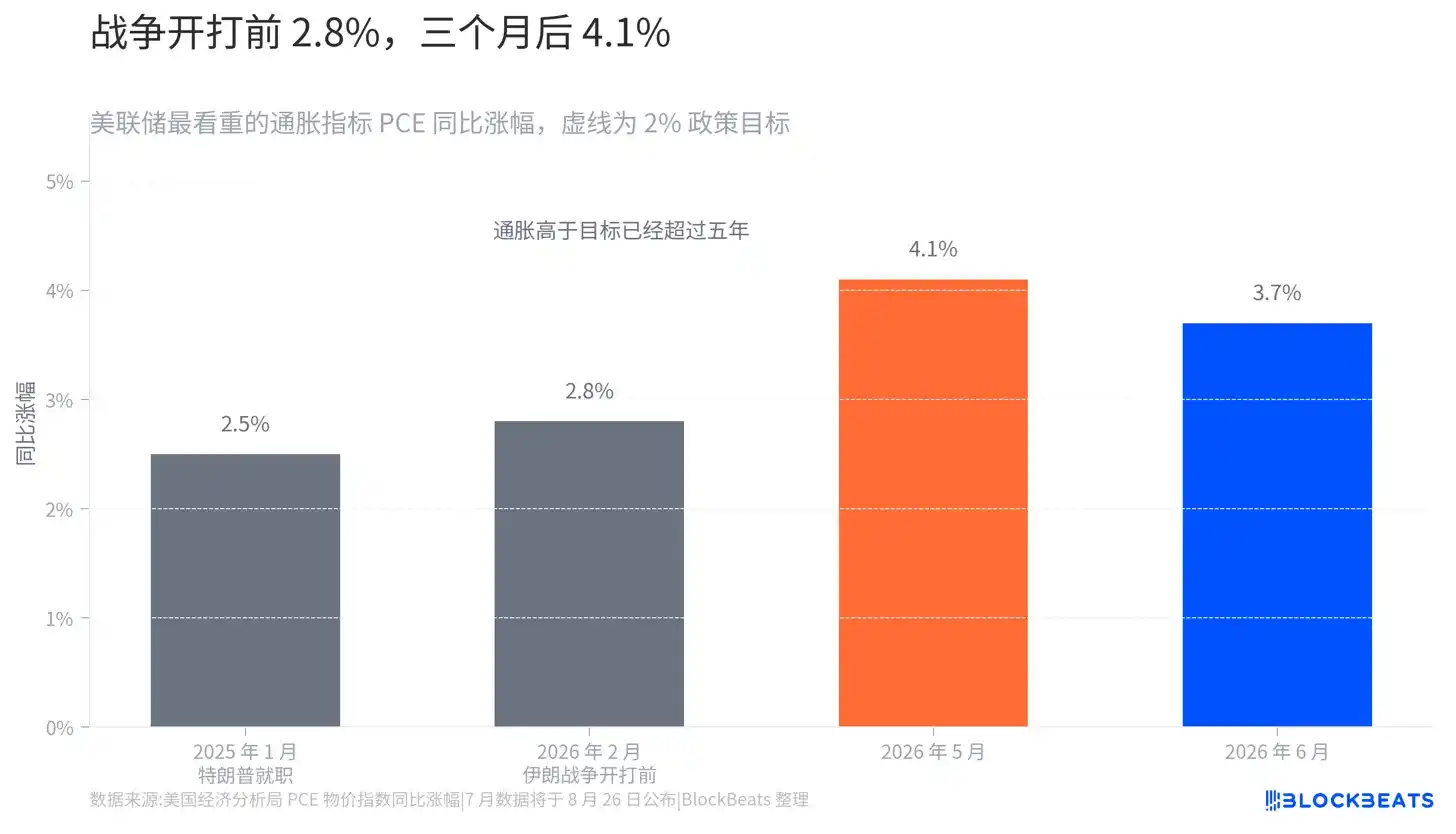
The Fed officials themselves listed three reasons: Trump administration import tariffs, oil price increases due to the Iran war, and the current massive AI investment.
Of the three, Collins believes the first two are receding. She judges that the pass-through of earlier tariffs is largely complete, and the inflationary impact of rising oil prices should also begin to fade.
But the third one is something she named herself in the article:
"Regarding the stronger-than-expected economic activity, I would note that AI construction appears to be putting upward pressure on core goods inflation."
Laying out these three factors reveals the awkwardness of the rate hike tool.
The transmission path for rate hikes is only one: increase the cost of borrowing → suppress demand → prices fall as demand falls. It treats the "too much money" part of "too much money, too few goods."
But tariffs are set by policy; rate hikes can't change that. The transit situation in the Strait of Hormuz is determined by the Middle East situation; rate hikes can't change that either. As for AI construction, that $730 billion in data center spending, those orders scrambling for electricity, transformers, and memory, are happening in an environment where interest rates are already not low. Their sensitivity to funding costs is far lower than that of ordinary corporate investment.
IMF Managing Director Georgieva provided the clearest framework for this chaos.
She said the global economy has withstood pressure so far largely thanks to the surge in AI investment. The energy shock from the closure of the Strait of Hormuz was also less severe than initially feared, thanks to countries tapping oil and gas reserves, increased non-Gulf energy supply, falling energy demand, the rise of renewable capacity, and some regions returning to coal.
But she said uncertainty remains high, evidence lying in two places: rising bond yields and stalled disinflation. She said in a recent interview: "We are squarely in a tug-of-war. Negative supply shocks from the Middle East, positive demand shocks from AI."
This is precisely the Fed's predicament. One end of the rope is pulling up prices, the other is pulling up growth, and it only has a hammer to smash demand.
Georgieva's risk list also includes: shrinking oil and gas reserves as the Northern Hemisphere enters winter, a strong El Niño that could exacerbate food insecurity, and the impact of AI on financial stability. Her concluding remark left no room for complacency: "All of this does not allow for complacency, and that's my core message. We're not doing poorly, but that shouldn't be a reason to say, 'OK, everything is going well, easily.'"
In July, the IMF largely maintained its 2026 global growth forecast at 3% but raised its global consumer price forecast, mainly due to energy and food.
In other words, the three walls on the supply side are beyond the reach of the interest rate hammer. The only thing it can smash is demand.
And on the demand side, the strain is already showing.
Consumers are already feeling the strain
The August Consumer Confidence Index is 89.4, down 0.8 points from the revised 90.2 in July, hitting a seven-month low and below economists' expectations of 90.2.
Breaking it down, the data is split.
Assessment of the present situation is improving: the Present Situation Index rose 6.8 points to 121.2, the first improvement in four months. Employment perceptions are also improving—the proportion saying jobs are "plentiful" rose from 24.4% to 27%. The difference between those saying jobs are plentiful and those saying jobs are hard to get rose to 7.5%, the first increase in three months (the July reading was the lowest in over five years).
Assessment of the future is collapsing: the Expectations Index fell 5.8 points to 68.2, the lowest since January, a drop of 7.8%. Only 14.6% expect more jobs in the next six months, down from 16.4% last month.
The summary from Dana Peterson, Chief Economist at The Conference Board, is: "Consumers are more pessimistic about business conditions and the labor market for the next six months."
One number explains why. The survey's collection period was August 3-16, during which the U.S. average gas price stayed above $4 per gallon—due to renewed U.S.-Iran tensions pushing up oil prices. Consumers themselves expect inflation to accelerate to 5.8% over the next 12 months; in July, their expectation was 5.6%.
Other corroborating evidence points in the same direction: July U.S. retail sales posted the largest drop in over a year; the July job market unexpectedly stalled, with employers cutting a net 23,000 jobs, and the Labor Department also revised down May and June employment figures by 103,000; the unemployment rate fell to 4.1%, but for the wrong reason—several thousand people simply left the labor force, so there was less competition. The University of Michigan's Consumer Sentiment Index also fell in August for the first time in three months.
After five years of high inflation, Americans' patience is running thin. And the midterm elections are less than 70 days away.
Friday preview: Two things to watch next
First is the release of July PCE data. Economists surveyed by Reuters expect core PCE year-on-year at 3.3%, unchanged from the previous month; The Wall Street Journal survey expects headline PCE at 3.6%. Whichever measure, it remains well above the 2% target.
Then comes Jackson Hole on Friday. Kevin Warsh will deliver his first major speech as Fed Chair. He faces criticism for—not having frankly stated his views on the economy. Georgieva will also attend Jackson Hole for the first time this week.
Market pricing is currently contradictory: futures show about a 75% probability of a December hike, while IG's Chris Beauchamp says the probability of a September hold "remains firmly around 60%" and believes this speech won't change much—because Warsh prefers to be "tight-lipped."
There is one thing that has already given an answer. Gold is near $4,660, approaching a three-month high, up over 7% in a week.