Exodus, MoonPay to roll out stablecoin in early 2026, joining gold rush

cointelegraphPubblicato 2025-12-17Pubblicato ultima volta 2025-12-17

Introduzione

Digital asset platform Exodus has partnered with payments infrastructure company MoonPay to launch a U.S. dollar-backed stablecoin, planned for release in early 2026. The yet-unnamed stablecoin will be issued and managed by MoonPay using the M0 infrastructure platform. It aims to simplify digital dollar transactions for everyday consumers by integrating with Exodus Pay, allowing users to spend and send money without needing deep crypto knowledge while maintaining self-custody. This move is part of a broader industry trend, as banks and crypto firms rush to offer stablecoins following the passage of the GENIUS Act in July, which established a clear U.S. regulatory framework for fiat-backed stablecoins. The new entrant will compete in a market currently dominated by Tether (USDT), which holds a 60% market share, and Circle's USDC, which holds 25%. Together, these two stablecoins represent 85% of the total $310 billion market.

Digital asset platform Exodus has partnered with MoonPay to launch a US dollar-backed stablecoin for everyday payments.

The Exodus Movement, which is also behind a popular crypto wallet, announced on Tuesday that its fully reserved dollar stablecoin is planned for launch in early 2026. The stablecoin will be issued and managed by MoonPay and developed using M0.

M0 is a stablecoin infrastructure platform that allows companies to build, issue, and manage their own custom stablecoins, and MoonPay is a leading crypto payments platform and fiat on-ramp.

The new stablecoin, which was not named, aims to make digital dollar transactions simple for consumers without requiring crypto knowledge, as it will integrate into Exodus Pay, allowing users to spend and send money while maintaining self-custody.

“Stablecoins are quickly becoming the simplest way for people to hold and move dollars onchain, but the experience still needs to meet the expectations set by today’s consumer apps,” said JP Richardson, co-founder and CEO of Exodus.

The stablecoin gold rush continues

MoonPay launched its enterprise stablecoin business in November to issue and manage digital dollars across multiple blockchains while integrating with M0’s open infrastructure.

“Enterprises want stablecoins that are programmable, interoperable and tailored to a specific product experience,” said Luca Prosperi, co-founder and CEO of M0.

Related: US banks could soon issue stablecoins under FDIC plan to implement GENIUS Act

Banks and crypto firms have rushed to offer their own stablecoins this year, spurred by the passage of the GENIUS Act in July, which introduced a clear federal regulatory framework for fiat-backed stablecoins in the United States.

The Trump family DeFi platform, World Liberty Financial, launched the USD1 stablecoin in March, global payments platform Stripe introduced stablecoin-based accounts to clients in over 100 countries in May, and Tether announced a regulatory-compliant stablecoin called USAT in September.

Two stablecoin players dominate the sector

The new Exodus and MoonPay stablecoin is entering a crowded market still dominated by two primary players.

Tether (USDT) remains the biggest stablecoin issuer with a market share of around 60% and a circulating supply of $186 billion, while Circle’s USDC is second with a 25% share and $78 billion market cap.

These two alone comprise 85% of the total stablecoin market capitalization, which is over $310 billion, according to CoinGecko.
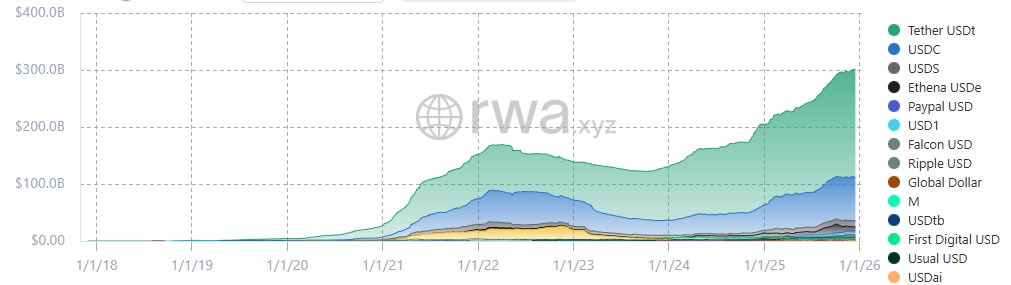
USDT and USDC still dominate stablecoin markets. Source: RWA.xyz

Magazine: Do Kwon sentenced to 15 years, Bitcoin’s ‘choppy dance’: Hodler’s Digest

Letture associate

Cathie Wood's Remarks Spark Rare Reputation Crisis for Binance and CZ

Wood's comments on a recent program, where she linked Bitcoin's decline to a $28 billion deleveraging event caused by a Binance software glitch on October 10, have sparked widespread criticism against Binance and its founder Changpeng Zhao (CZ) on social media platform X. Many KOLs are labeling CZ a "scammer," accusing him of a "collapsed public image" and facing a "backlash of influence." The criticism primarily focuses on the "1011 event," where Bitcoin and other cryptocurrencies crashed, resulting in over $500 billion wiped from the global crypto market cap and more than $19 billion in leveraged positions liquidated. Mainstream opinion holds that Binance's abnormal liquidation mechanism was closely related to the incident, and the exchange later modified the price charts for some tokens. Due to Wood's significant influence in both traditional finance and crypto, her remarks reignited painful memories of the 1011 event among investors, further aggravating sentiment in the already sluggish market. Early critics, including Leonidas, co-founder of Zap/Ord.io, and trader Anglio, sharply condemned CZ, calling him the "biggest fraud in human history" and blaming him for the massive liquidations. The backlash, initially concentrated in English-language circles, eventually spread to Chinese communities on X, where influential figures also began criticizing Binance. OKX founder Star Xu commented that the incident caused real and lasting damage to the industry, urging leading companies to focus on strengthening infrastructure and building trust. In response, CZ and Binance co-founder He Yi dismissed the criticisms as organized attacks and competitive smear campaigns. CZ pointed to coordinated negative posts, while He Yi framed the discussions as part of broader structural changes and industry conflicts. Some KOLs supported this view, suggesting Wood’s statements might reflect Western capital interests. However, deflecting blame entirely onto competitors and "water army" attacks has further damaged user sentiment. In a bear market, investors often seek outlets for frustration, and as the industry's largest beneficiary, CZ has become a target for accumulated discontent over issues like token listing quality and ecosystem development. Yet, reducing him to the "industry's biggest scammer" overlooks market cycles, investor responsibility, and platform scale, which may not be entirely fair. In the end, in this still-wild industry marked by high volatility and strong cycles, there is no pure "savior" nor perpetual "demon."

marsbit10 min fa

Cathie Wood's Remarks Spark Rare Reputation Crisis for Binance and CZ

marsbit10 min fa

Trading

Spot
Futures
活动图片