Blockchain trial on Canton Network tests collateral reuse with tokenized US Treasurys

cointelegraphPubblicato 2025-12-09Pubblicato ultima volta 2025-12-09

Introduzione

Digital Asset and a group of major financial institutions have successfully conducted a second round of onchain US Treasury financing trials on the Canton Network. The test introduced real-time collateral reuse using tokenized US Treasurys and expanded the use of multiple stablecoins, including USDC, to enhance onchain liquidity. This innovation bypasses traditional operational delays associated with rehypothecation. Participants included Bank of America, Citadel Securities, Cumberland DRW, Virtu Financial, Société Générale, Tradeweb, Circle, Brale, and M1X Global. The Canton Network, a blockchain built for institutional finance, continues to grow in the tokenized real-world assets (RWA) space, with over $370 billion represented onchain, leading the market significantly.

Digital Asset and a group of financial institutions have completed a second round of onchain US Treasury financing on the Canton Network, introducing real-time collateral reuse and expanding the number of stablecoins involved.

Five transactions were executed in the newest phase, building on the July pilot, which first demonstrated that US Treasurys and the USDC (USDC) stablecoin could be combined to finance and settle transactions on the blockchain.

In the latest trial, the companies used multiple stablecoins to finance positions against tokenized US Treasurys, widening the pool of onchain liquidity available for financing transactions.

The trial showed that tokenized US Treasurys could be passed between counterparties and reused as collateral in real-time, sidestepping the operational delays that typically accompany rehypothecation in traditional finance.

The effort brought together Bank of America, Citadel Securities, Cumberland DRW, Virtu Financial, Société Générale, Tradeweb, Circle, Brale and M1X Global, which are all a part of the Canton Network’s Industry Working Group.

Kelly Mathieson, chief business development officer at Digital Asset — the company behind the Canton Network — said in a statement that the test was “part of a thoughtful progression toward a new market model.”

Justin Peterson, chief technology officer of Tradeweb, added that “demonstrating real-time collateral reuse and expanded stablecoin liquidity isn’t just a technical achievement — it’s a blueprint for what the future of institutional finance can look like.”

Related: ‘We refused to do an ICO’: The truth behind Canton’s tokenomics

Canton Network expands footprint in tokenized RWAs

The Canton Network, a layer-1 blockchain built for institutional finance, has been expanding its presence across the tokenization sector this year.

On Dec. 4, its developer Digital Asset secured roughly $50 million in strategic backing from BNY, iCapital, Nasdaq and S&P Global. The new funding followed a $135 million raise earlier this year and is intended to support the network’s scaling efforts.

In October, asset manager Franklin Templeton said it would migrate its Benji Investments platform — which tokenizes shares of the firm’s flagship US money market fund — to the Canton Network.

Data from RWA.xyz also shows the Canton Network now leads the market for tokenized real-world assets by a wide margin, with more than $370 billion represented onchain, far outpacing popular networks such as Ethereum, Polygon, Solana and other public chains.
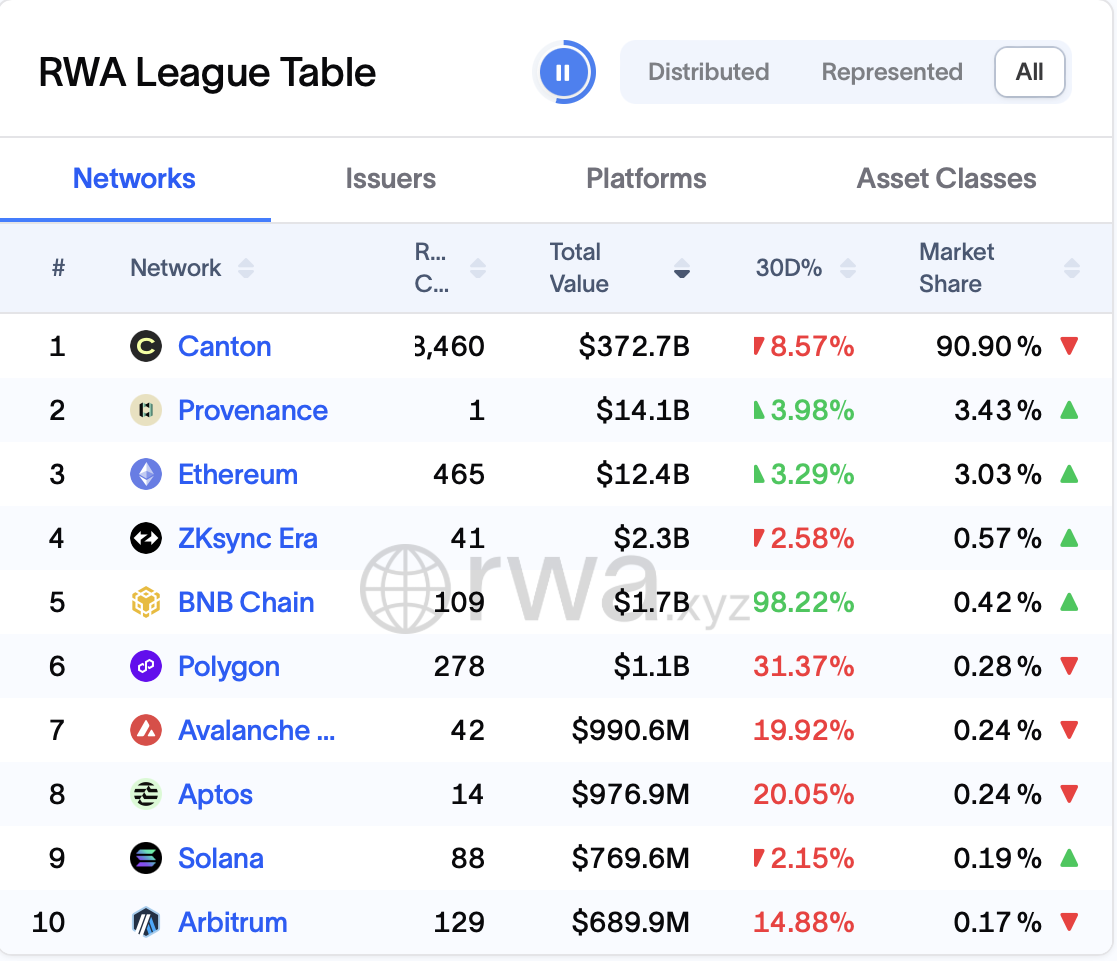
Top blockchains for RWA. Source: RWA.xyz

Magazine: 6 reasons Jack Dorsey is definitely Satoshi... and 5 reasons he’s not

Letture associate

Digital Asset Vaults Lose Their Luster: Twenty One's Stock Plunges 20% on First Trading Day

Twenty One Capital, a Bitcoin-focused treasury company backed by Tether and SoftBank, saw its shares plunge approximately 20% on its first day of trading on the New York Stock Exchange. The sharp decline reflects investor skepticism toward the valuation and business model of Bitcoin treasury companies amid a significant cryptocurrency market downturn. The company, led by 31-year-old CEO Jack Mallers, holds around 43,500 BTC. However, Bitcoin holdings have fallen over 25% since October’s all-time high near $126,000, putting pressure on the "digital asset treasury" (DAT) model. Despite its large Bitcoin reserve and strong backers, investors remain cautious due to unclear revenue paths and heavy reliance on Bitcoin’s volatile price. Twenty One went public via a merger with SPAC Cantor Equity. Unlike traditional companies, its valuation is almost entirely tied to its Bitcoin holdings, using metrics like "Bitcoin per Share" (BPS). Yet, the firm has not detailed how it will generate sustainable profits beyond holding Bitcoin. The sell-off reflects broader pressures on crypto-linked stocks. Other Bitcoin-heavy companies like Metaplanet, Trump Media, and Empery Digital also face millions in unrealized losses and falling share prices as Bitcoin corrects. The debut underscores high volatility and valuation risks in crypto investing. Despite innovation and institutional support, long-term viability requires transparent business models and clear profitability strategies—lessons even high-profile crypto firms must heed.

cointelegraph_中文43 min fa

Digital Asset Vaults Lose Their Luster: Twenty One's Stock Plunges 20% on First Trading Day

cointelegraph_中文43 min fa

Trading

Spot
Futures
活动图片