XRP Ledger DEX Metrics Flash Strong Growth As Activity Touches New Key Levels

bitcoinistPubblicato 2026-01-31Pubblicato ultima volta 2026-01-31

Introduzione

The XRP Ledger's decentralized exchange (DEX) activity has surged to a 13-month high, with its 14-day moving average of transactions reaching approximately 1.014 million, breaking previous records. This growth reflects sustained user engagement and increased liquidity, signaling deeper adoption beyond speculative spikes. The milestone coincides with the rollout of the new Lending Protocol (XLS-66), which introduces institutional-grade credit capabilities to the network, including fixed-term, fixed-rate, and uncollateralized loans held in risk-isolated vaults. The protocol has already gained institutional support, with companies like Evernorth backing it to transition a $100 billion market into a yield-bearing ecosystem, further establishing the XRP Ledger as a growing hub for decentralized finance.

Even years after its inception, the XRP Ledger, one of the leading networks in the crypto space, continues to attract robust adoption and real-world usage. With thousands of transactions being conducted on the leading network’s DEX on a daily basis, it has now reached a historical level that marks its growing role in decentralized trading.

Decentralized Trading On XRP Ledger Accelerates

XRP is experiencing heightened interest not just in buying activity from traders; the XRP Ledger has been seeing significant usage over the past few weeks. While adoption has increased toward the network, the Ledger’s Decentralized Exchange (DEX) activity is breaking past prior highs.

Xaif Crypto, a market expert and investor on the X platform, reported that the Ledger DEX activity has surged to new levels. Specifically, data shows that the activity recently reached a 13-month high, signaling a sharp uptick in on-chain trading across the network.

As more liquidity and transactions move over XRPL’s native DEX infrastructure, the increase is indicative of increasing user involvement. Sustained growth in DEX activity frequently indicates deeper adoption and expanding use cases, in contrast to brief spikes caused solely by speculation.

According to the chart shared by the expert, the number of transactions on the 14-day MA rose to approximately 1.014 million, breaking the ceiling that held throughout all of 2025. With this level of DEX transactions, the XRP Ledger is becoming a more active center for decentralized trade within the larger cryptocurrency ecosystem.
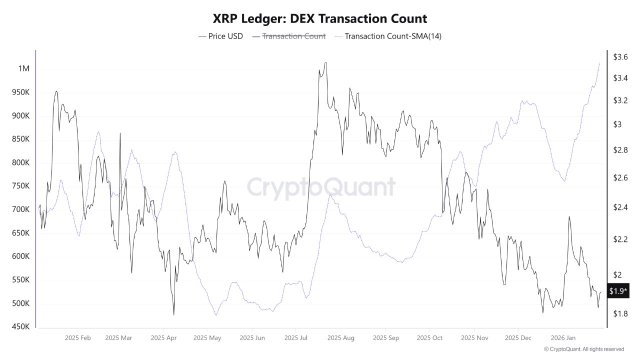
Source: Chart from Xaif Crypto on X

Xaif Crypto stated that this massive transaction count is not just a mere spike; it signals sustained momentum for the Ledger. Currently, the network is witnessing a fresh wave of liquidity and real user engagement. As a result, the expert declares that the Ledger is heating up in 2026.

This milestone comes as the XRP Ledger rolls out a new Lending Protocol (XLS-66), which is attracting institutional-grade credit to the network. With the new Lending Protocol, the Ledger is now evolving into a full financial layer with Rippled 3.1.0.

The protocol includes the ability to create loans on the Ledger, with loan brokers being able to generate fixed-term and fixed-rate, uncollateralized loans. These loans are predictable for professional use.

In addition, these loans are held in a Single Asset Vault, allowing risk-isolated liquidity. Another feature is the off-chain underwriting for uncollateralized options. It boasts native efficiency, which offers low-cost lending without a middleman or intermediaries. In the meantime, Decentralized Finance (DeFi) on the Ledger has just undergone a boost.

The Lending Protocol Gains Institutional Support

Following its historical launch a few days ago, the new XRP Lending Protocol is now experiencing significant support from institutional-level investors. One of the earliest companies to interact with the new protocol is Evernorth, a leading public treasury company.

According to BankXRP, the company is backing the native lending protocol to help transition a $100 billion market cap into a productive, yield-bearing ecosystem. These kinds of moves are an indication that the future of institutional DeFi is becoming native-driven.

XRP trading at $1.75 on the 1D chart | Source: XRPUSDT on Tradingview.com

Domande pertinenti

QWhat key milestone did the XRP Ledger DEX recently achieve according to the article?

AThe XRP Ledger DEX activity recently reached a 13-month high, with the number of transactions on the 14-day moving average rising to approximately 1.014 million, breaking the ceiling that held throughout all of 2025.

QWho reported the surge in XRP Ledger DEX activity and on which platform?

AThe surge was reported by Xaif Crypto, a market expert and investor, on the X platform.

QWhat major new protocol has the XRP Ledger recently rolled out that is attracting institutional interest?

AThe XRP Ledger has rolled out a new Lending Protocol (XLS-66), which is attracting institutional-grade credit to the network.

QWhat is one of the key features of the new XRP Lending Protocol mentioned in the article?

AOne key feature is the ability to create fixed-term and fixed-rate, uncollateralized loans that are held in a Single Asset Vault, allowing for risk-isolated liquidity.

QWhich company was mentioned as one of the earliest institutional supporters of the new XRP Lending Protocol?

AEvernorth, a leading public treasury company, was one of the earliest companies to interact with and back the new XRP Lending Protocol.

Letture associate

Tether Hires Big Four Auditor, USDT Enters Verifiable Stage for the First Time

Tether, the issuer of USDT, has hired Big Four firm KPMG to conduct a full financial audit of its $127 billion reserves. This marks a significant shift for the controversial stablecoin, moving it into a verifiable financial framework for the first time. Unlike previous attestations, which only confirmed reserves at a point in time, a GAAP-based audit will examine asset origins, internal controls, and financial reliability over time. This development is seen as more impactful than pending legislation, as institutional adoption relies on audited financials rather than regulatory promises. If KPMG issues an unqualified opinion, Tether’s credibility could be fundamentally upgraded, pressuring other stablecoin issuers without Big Four audits to follow suit. The move may accelerate institutional adoption by pensions, corporates, and payment firms, while reshaping the stablecoin landscape. Despite years of regulatory scrutiny and skepticism, Tether has maintained dominance due to its global liquidity and accessibility. An audit could reposition USDT from a contested asset to a verifiable financial instrument, reducing counterparty risk and encouraging broader use in digital infrastructure. The outcome of the audit will be critical: a clean opinion may validate the entire asset class, while a qualified one could introduce new challenges. The industry is watching closely, as this audit could signal a new phase of institutional acceptance for stablecoins.

marsbit1 h fa

Tether Hires Big Four Auditor, USDT Enters Verifiable Stage for the First Time

marsbit1 h fa

1 Dollar Return Rate Only 43%, Why Are 87% of Polymarket Users Losing Money?

In the prediction market Polymarket, analysis of 72.1 million trades reveals that 87% of wallets lose money, while only 13% consistently profit. The key difference lies in the application of game theory and mathematical strategies, not luck. Five core formulas separate winners from losers: 1. **Expected Value (EV)**: Winners calculate EV to identify undervalued contracts, while most traders rely on intuition. Makers (limit order placers) profit by waiting for positive EV opportunities, while takers (market buyers) lose ~1.12% per trade on average. 2. **Mispricing**: Low-probability contracts (e.g., priced at 1¢) are systematically overpriced, with actual win rates as low as 0.43% (a -57% deviation). High-probability contracts are often undervalued. Takers overpay for "cheap" lottery-like bets, while makers capture this inefficiency. 3. **Kelly Criterion**: Used for optimal position sizing. It maximizes long-term growth but is often applied fractionally (e.g., 1/2 or 1/4 Kelly) to reduce volatility. 4. **Bayesian Updating**: Profitable traders adjust probabilities rationally as new information emerges, unlike emotional overreactions or inertia from others. 5. **Nash Equilibrium**: The market structure evolves with participant behavior. In emotional markets (e.g., sports, entertainment), mispricing creates opportunities for contrarian strategies. As professional market makers enter, spreads tighten, and inefficiencies shrink. The conclusion: Persistent losses stem from emotional trading, overpaying for low-probability bets, and neglecting mathematical discipline. The winning minority uses these formulas to exploit market biases systematically.

Odaily星球日报1 h fa

1 Dollar Return Rate Only 43%, Why Are 87% of Polymarket Users Losing Money?

Odaily星球日报1 h fa

The Time of Machines: When Agents Consume Stablecoins

"The Age of Machines: When Agents Consume Stablecoins" explores the convergence of AI and cryptocurrency, focusing on the emerging narrative of AI agents as economic actors. The author argues that while AI is rapidly advancing into production and consumption, crypto, particularly stablecoins, is struggling to find its role beyond financialization. The piece begins by reflecting on how AI-powered bots are evolving from nuisances to become autonomous economic entities, potentially even developing a "dislike" for humans. This shift creates a sense of desperation in the crypto community, which is now trying to prove its value to AI by promoting stablecoins as the preferred medium of exchange for agents. A core tension is highlighted: AI is mastering both production and the new "relations of production" by replacing human labor, while crypto remains confined to a narrow financial role. Previous attempts by crypto to capture AI use cases—through decentralized storage, compute, or GPU lending—have largely failed. The author warns that compliant, bank-issued stablecoins on networks like Canton could ultimately prevail over native crypto stablecoins. The emergence of payment protocols for machines, like Stripe's MPP, is noted, but these efforts are seen as integrating machines into the existing traditional financial system rather than creating a new crypto-native one. The crypto industry's strategy of selling stablecoins to AI based on technical merits like cheapness and speed is portrayed as a weak, last-resort effort. The article then pivots to a more promising path for crypto: leveraging volatility. The true potential lies in AI agent economy's ability to generate massive, 24/7 consumption that far surpasses human limits. This creates a new battlefield for crypto—not by providing utility to AI, but by creating speculative assets (Crypto Tokens) that capture the value and FOMO generated by the AI boom (AI Tokens). The ultimate goal should be converting the immense economic activity of AI agents into liquidity for crypto assets. The conclusion states that while Circle's vision of agents using stablecoins offers a story of infinite users to the market, crypto's real strength is its position as a financial laboratory on the frontier, thriving on ambiguity and speculation. The future of the convergence depends on crypto creating volatility and wealth effects from the stable foundation of agent-driven consumption, ultimately completing the cycle from AI Token back to Crypto Token.

marsbit1 h fa

The Time of Machines: When Agents Consume Stablecoins

marsbit1 h fa

$20 for a Face: The Underground Business of Crypto KYC

Crypto KYC Bypass: A $20 Underground Industry Despite stringent KYC (Know Your Customer) requirements from major crypto exchanges, a thriving underground market exists to bypass these checks for as low as $20. Users often face geo-blocks or lengthy verifications, preventing access to services. This has fueled demand for illicit KYC services. Reports indicate over 500,000 participants in underground KYC markets, with more than 1 million listings selling verified profiles from platforms like Coinbase and Kraken. These accounts often include real personal data, sometimes without the original owners' knowledge. Fraud techniques have evolved, including deepfake attacks (up 2000% in three years), screen-based spoofing, and AI-generated fake documents. The virtual currency sector is the primary target, accounting for over 78% of KYC attacks. An investigation into a Telegram-based KYC vendor revealed a TRON address with over $59,000 in USDT from 600 transactions over two years, all eventually transferred to an OKX hot wallet. An interview with a KYC service provider, "Maoli," who operates in Chinese-speaking regions, detailed the process: clients pay for accounts verified by "foreigners" recruited globally, often from lower-income regions, who perform the KYC steps for a small fee. These accounts are sold with warnings against holding large funds due to fraud risks and potential reclaiming by the original identity owners. Maoli described the business as a "three-way win": users gain access, exchanges get user numbers, and he profits. However, this ignores the victims of identity theft whose data is used without consent. The KYC system, while intended for security, functions as a permeable barrier, with a vast shadow economy ensuring access for those willing to pay.

marsbit1 h fa

$20 for a Face: The Underground Business of Crypto KYC

marsbit1 h fa

Trading

Spot
Futures

Articoli Popolari

Come comprare T

Benvenuto in HTX.com! Abbiamo reso l'acquisto di Threshold Network Token (T) semplice e conveniente. Segui la nostra guida passo passo per intraprendere il tuo viaggio nel mondo delle criptovalute.Step 1: Crea il tuo Account HTXUsa la tua email o numero di telefono per registrarti il tuo account gratuito su HTX. Vivi un'esperienza facile e sblocca tutte le funzionalità,Crea il mio accountStep 2: Vai in Acquista crypto e seleziona il tuo metodo di pagamentoCarta di credito/debito: utilizza la tua Visa o Mastercard per acquistare immediatamente Threshold Network TokenT.Bilancio: Usa i fondi dal bilancio del tuo account HTX per fare trading senza problemi.Terze parti: abbiamo aggiunto metodi di pagamento molto utilizzati come Google Pay e Apple Pay per maggiore comodità.P2P: Fai trading direttamente con altri utenti HTX.Over-the-Counter (OTC): Offriamo servizi su misura e tassi di cambio competitivi per i trader.Step 3: Conserva Threshold Network Token (T)Dopo aver acquistato Threshold Network Token (T), conserva nel tuo account HTX. In alternativa, puoi inviare tramite trasferimento blockchain o scambiare per altre criptovalute.Step 4: Scambia Threshold Network Token (T)Scambia facilmente Threshold Network Token (T) nel mercato spot di HTX. Accedi al tuo account, seleziona la tua coppia di trading, esegui le tue operazioni e monitora in tempo reale. Offriamo un'esperienza user-friendly sia per chi ha appena iniziato che per i trader più esperti.

234 Totale visualizzazioniPubblicato il 2024.12.10Aggiornato il 2025.03.21

Come comprare T

Discussioni

Benvenuto nella Community HTX. Qui puoi rimanere informato sugli ultimi sviluppi della piattaforma e accedere ad approfondimenti esperti sul mercato. Le opinioni degli utenti sul prezzo di T T sono presentate come di seguito.

活动图片