Polygon deploys Madhugiri hard fork, aims for 33% throughput boost

cointelegraphPubblicato 2025-12-09Pubblicato ultima volta 2025-12-09

Introduzione

Polygon has deployed the Madhugiri hard fork, targeting a 33% increase in network throughput and reducing block consensus time to one second. The upgrade includes support for three Fusaka Ethereum Improvement Proposals (EIP-7823, EIP-7825, EIP-7883), which improve efficiency and security by limiting gas consumption for heavy mathematical operations. It also introduces a new transaction type for Ethereum-Polygon bridge traffic and adds flexibility for future upgrades. This enhancement aims to better support high-frequency use cases like stablecoins and real-world asset (RWA) tokenization. The hard fork follows the recent Heimdall 2.0 upgrade, which significantly reduced finality times, despite a brief disruption in September due to a bug that was later resolved.

Blockchain network Polygon has rolled out its latest protocol upgrade, known as the Madhugiri hard fork, which aims to achieve a 33% increase in network throughput and reduce block consensus time to one second.

Polygon core developer Krishang Shah said on X that the update includes support for three Fusaka Ethereum Improvement Proposals, specifically EIP-7823, EIP-7825 and EIP-7883. These EIPs make heavy mathematical operations more efficient and secure by limiting the amount of gas they consume.

They also prevent single transactions from consuming excessive computing power, helping the network run more smoothly and predictably.

The upgrade introduces a new transaction type for Ethereum to Polygon bridge traffic and adds a built-in flexibility feature for future upgrades. Polygon previously said that the update makes throughput increases as easy as “flipping a few switches.”

“We are also decreasing the consensus time to 1 second, so blocks can now be announced in 1 second if ready, instead of waiting the full 2 seconds,” Shah wrote.
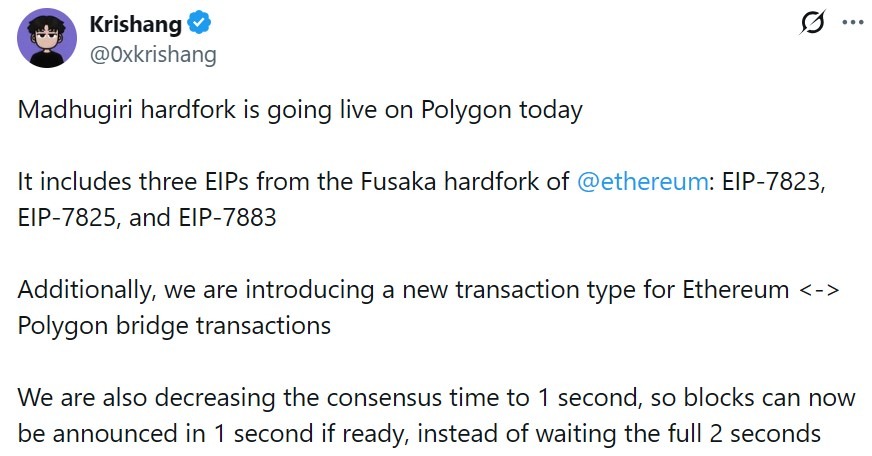
Source: Krishang Shah

New update reinforces Polygon for stablecoins and RWAs

With Madhugiri now live, Polygon aims to reinforce its infrastructure while materially improving its performance. These are prerequisites for high-frequency and high-trust use cases, such as real-world asset (RWA) tokenization and stablecoins.

Aishwary Gupta, the global head of payments and RWAs at Polygon Labs, previously forecasted a “stablecoin supercycle.”

Gupta said there will be a surge of “at least 100,000 stablecoins” in the next five years. However, he said this would not only be about minting tokens and must have a corresponding utility like yield.

Gupta also advocated for more transparency and accountability in the RWA sector. He previously argued that RWA numbers are meaningless if the assets cannot be audited, settled or traded.

“When transparency and accountability are established, RWAs will reach even greater heights, unlocking trillions in institutional capital,” he wrote.

Related: Polygon co-founder mulls resurrecting MATIC a year after POL rebrand

Hard fork follows major Heimdall upgrade

The upgrade comes on the heels of rapid prior improvements. On July 10, Polygon deployed Heimdall 2.0, dubbed by Polygon Foundation CEO Sandeep Nailwal as the network’s “most technically complex” hard fork since its launch.

The update reduced transaction finality times from one to two minutes to roughly five seconds.

However, on Sept. 10, the network experienced a significant disruption when a bug caused finality delays of 10 to 15 minutes, affecting validator sync, remote procedure call services and third-party tooling. Despite this, the team assured the community that blocks were still running.

On Sept. 11, the Polygon Foundation announced that the consensus and finality functions had been restored through a hard fork. With the update, nodes were no longer stuck, while checkpoints and milestones were finalized as expected.

Magazine: Ethereum’s Fusaka fork explained for dummies: What the hell is PeerDAS?

Letture associate

Circle's Second Growth Curve: After the $222 Million ARC Financing, CRCL or ARC?

Circle, the issuer of USDC, announced that its new public blockchain Arc completed a $222 million private sale for its native token ARC, with the network's fully diluted valuation reaching $3 billion. The funding round was led by a16z crypto, with participation from major institutions including BlackRock, Apollo, and ICE. The article explains Circle's rationale for building its own L1 blockchain, Arc. Existing chains like Ethereum and Solana are seen as lacking native support for large-scale institutional needs, such as regulatory compliance, predictable transaction costs, and asset issuance/redemption workflows. Arc is designed to fill this gap as a foundational layer for the on-chain economy, moving beyond Circle's reliance on USDC reserve interest for revenue. It details the dual-token model of Arc: USDC serves as the stable gas token for predictable transactions, while ARC is the network's native asset used for staking in the planned transition to Proof-of-Stake, governance, and aligning long-term incentives among participants. ARC's total supply is 10 billion, with 60% allocated to ecosystem development, 25% to Circle, and 15% to a long-term reserve. All protocol fees are converted to ARC, with portions burned and distributed to stakers. The piece contrasts the value proposition of Circle's public stock (CRCL) and the ARC token. CRCL captures the company's core cash flows from USDC interest and other business lines. ARC captures the growth potential of the Arc network itself. While legally separate, network success benefits both: it drives USDC usage for Circle and increases the value of its 25% ARC holding. Finally, it outlines participation avenues for retail users, primarily through the Arc House community and testnet activities, while noting the competitive landscape with projects like Canton Network and Plasma. The article concludes that Arc's success hinges on attracting real institutional activity post-mainnet launch, scheduled for Summer 2026.

链捕手2 h fa

Circle's Second Growth Curve: After the $222 Million ARC Financing, CRCL or ARC?

链捕手2 h fa

From Gas Limit to Keyed Nonces: How to Understand the Next Stage of Ethereum's Scalability?

From Gas Limits to Keyed Nonces: Understanding the Next Phase of Ethereum Scalability This article explores how recent Ethereum developments focus on moving complexity away from end-users, wallets, and DApps to the protocol layer. It discusses the consensus around significantly increasing the Gas Limit to 200 million, a change aimed at reducing fees and improving network capacity. However, it emphasizes that this increase is part of a holistic approach that includes mechanisms like enshrined Proposer-Builder Separation (ePBS) and Block-Level Access Lists to manage state growth and maintain node decentralization. The piece also delves into Keyed Nonces (EIP-8250), a proposed upgrade to Ethereum's transaction ordering. It explains how moving from a single, linear nonce queue per account to multiple independent nonce domains ("channels") can enable parallel transaction streams for different use cases. This is particularly crucial for privacy protocols and smart wallets, reducing transaction conflicts and unlocking new design possibilities. Ultimately, the article argues that these technical upgrades—alongside native account abstraction and cross-L2 interoperability—are converging towards a singular goal: enhancing the overall user experience. This means making on-chain interactions smoother, safer, and more cohesive, with wallets serving as the critical interface translating complex protocol improvements into intuitive user actions.

marsbit3 h fa

From Gas Limit to Keyed Nonces: How to Understand the Next Stage of Ethereum's Scalability?

marsbit3 h fa

Trading

Spot
Futures
活动图片