Shiba Inu lead developer Kaal Dhairya published a year-end letter on Dec. 29 describing what he called the most difficult period in the project’s history, outlining post-hack recovery steps, law-enforcement engagement, and a proposed on-chain claims system meant to track repayment to affected users.
Shiba Inu’s Team Year-End Letter
“This year — especially the last few months — has been the hardest period in Shiba Inu’s history,” Dhairya wrote. “The hack happened. The leadership that was supposed to be here and help us through this difficult time — isn’t. They left, without accountability, and without looking back. I stayed.”
Dhairya said he is not writing as Shiba Inu’s “official ‘leader,’” but argued the community deserves a direct update on what has been done, what is still unresolved, and what changes internally. He described the team working “around the clock — all-nighters, weekends, holidays,” and positioned the letter as an accountability-driven reset focused on repayment and core infrastructure.
Addressing claims that the team failed to file official complaints, Dhairya said a formal process is underway and pushed back on demands for public proof. “I have personally been interviewed by not one, not two, but three federal agents,” he wrote. “I passed on everything I have — all the information, all the OSINT, all the details we gathered during and after the incident. The official process is happening. It has been happening.”
He declined to share a complaint ID and said he would not continue “defending” the response to opportunistic critics, arguing some are “looking to sell their snake oil and keep extracting from you.”
Dhairya said “the technical recovery is largely complete,” detailing changes made after the hack. He wrote that the Plasma Bridge is back online with new safeguards, including “blacklisting, 7-day withdrawal delays, and hardened contracts,” and said more than 100 critical contracts have been moved to hardware custody. Hexens reviewed “every major change,” he added, and the checkpoint system is functioning again.
He also flagged a longer-term architecture change: “We’re also decoupling the bridge from the validators,” describing it as foundational work intended to enable decentralization of Shibarium. Even with that, he cautioned that malicious validators remain a risk and decentralizing the chain “won’t be easy.” Dhairya drew a hard distinction between restoring infrastructure and repaying users. “But technical recovery is not the same as making people whole,” he wrote.
SOU: ‘Shib Owes You’ Claims Via NFT
To address repayment, Dhairya introduced SOU (“Shib Owes You”), a system he stressed is “not live yet” and likely to attract scammers pretending otherwise. Under the proposal, every affected user receives an “SOU NFT” that records what the ecosystem owes them as an on-chain claim on Ethereum.
“This isn’t a promise in a database somewhere,” Dhairya wrote. “It’s cryptographic proof that you own a claim, recorded permanently on the Ethereum blockchain where no one can manipulate it or make it disappear.”
Each SOU tracks a principal amount that declines as payouts occur or donations are applied, with progress visible “in real time” and verifiable. Dhairya said SOUs can be “merged, split, or transferred,” including the option to sell a claim for liquidity on supported marketplaces. He added that the system’s components—“minting, payouts, donations, transfers”—have been audited by Hexens.
Dhairya argued the system only works if cash flow is routed into it, and said that should be treated as an obligation for ecosystem participants, particularly those controlling official distribution channels. “For SOU to function — for affected users to actually get made whole — revenue has to flow into the system,” he wrote. “That means everyone who benefits from the Shiba Inu ecosystem needs to contribute back. Not optionally. As an obligation.”
He said he will pause or sunset projects that are not generating revenue or reaching break-even, and prioritize initiatives that can fund repayment. “Revenue flows to SOU. SOU pays back affected users. If a project doesn’t fit that chain, it waits,” Dhairya wrote. He also previewed potentially contentious changes, including revisiting tokenomics and restructuring or merging systems to redirect value “back to the network and to the users who were affected.”
In closing, Dhairya said he has personally committed significant time and funds to keep the ecosystem running, but cannot do so indefinitely. “I cannot keep doing this forever,” he wrote, calling for others to step up if they believe Shib should be “a decentralized network” rather than “a meme” or “a pump.”
“The year ahead won’t be about hype,” Dhairya added. “It will be about repair, focus, and building something that can actually last.”
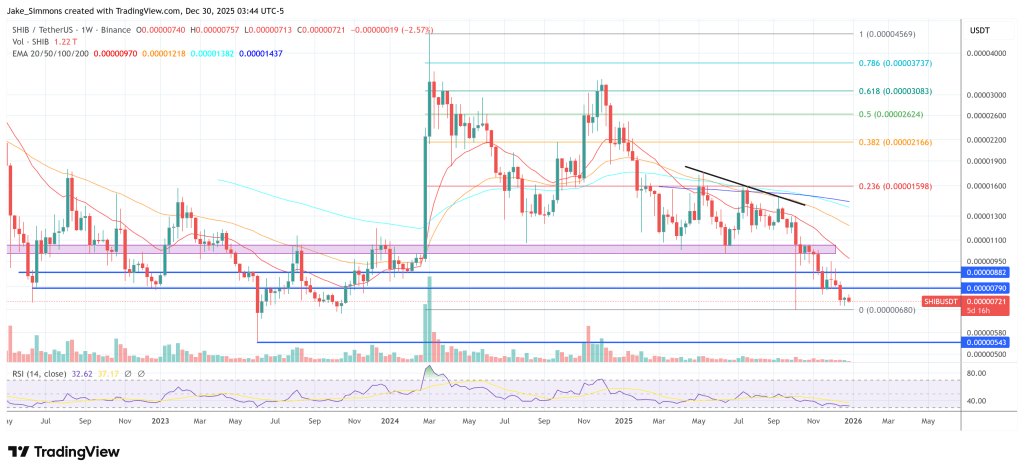
At press time, Shiba Inu traded at $0.00000721.