Airdrop Weekly Report|Polymarket Officially Announces No Airdrop Snapshot Yet; Jupiter Initiates Vote to Cancel 2026 Jupuary Airdrop (2.9-2.22)

marsbitPubblicato 2026-02-22Pubblicato ultima volta 2026-02-22

Introduzione

Odaily Planet Daily's Airdrop Roundup (Feb 9 - Feb 22, 2026) covers key airdrop opportunities and major news. Several projects opened claims or registrations: - **Espresso**, a global sequencing layer, opened claims for its ESP token (current price: $0.075). It has raised $60M. - **Open Mind**, a decentralized AI architecture for robots, opened registration for its ROBO airdrop. It raised $20M in 2025. - **Puffpaw**, a dePIN project for e-cigarettes, opened airdrop registration for Genesis NFT holders and Discord OGs. It raised $6M. - **SoDEX**, a trading chain from SoSoValue, opened claims for SOSO tokens ($0.39) for its testnet contributors. SoSoValue has raised $19.15M. Key airdrop news: - **Polymarket** officials confirmed that a token airdrop snapshot has **not yet been taken**. - **Jupiter DAO** began a vote on canceling the 2026 "Jupuary" airdrop to prevent token dilution. The proposal suggests returning 700M JUP to the treasury. - Hong Kong legislator **Duncan Chiu** suggested airdropping stablecoins as consumer vouchers to promote their use after the first issuer licenses are expected to be granted in March.

Original | Odaily Planet Daily (@OdailyChina)

Author|Golem(@web 3_golem)
Odaily Planet Daily has compiled a list of airdrop claimable projects from February 9, 2026, to February 22, 2026, along with important airdrop news during this period. For details, please see the main text.

Espresso

Project and Airdrop Eligibility Introduction

Espresso is a global confirmation layer. The project announced the opening of airdrop claims on February 12. Users who previously completed the airdrop eligibility registration can claim.

Funding Status

Espresso has raised a total of $60 million. On March 7, 2022, it completed a $32 million seed round led by Electric Capital and Greylock, with participation from Coinbase Ventures, Sequoia Capital, Blockchain Capital, etc. On March 21, 2024, it completed a $28 million Series B round led by a16z, with participation from Arbitrum, StarkWare, and Guy Zyskind, among others.

Claim Period and Link

Claim Period: February 12, 2026 - Ongoing

Link: https://claim.espresso.foundation/

Price

According to CoinGecko data, the current price of ESP is 0.075 USDT.

Open Mind

Project and Airdrop Eligibility Introduction

Open Mind is a decentralized AI architecture for intelligent, secure, and governable robots. The project's foundation, Fabric Foundation, announced the opening of ROBO airdrop registration and eligibility review on February 21.

Funding Status

Open Mind completed a $20 million funding round on August 4, 2025, led by Pantera Capital, with participation from Coinbase Ventures, Sequoia China, DCG, etc.

Registration Period and Link

Registration Period: February 21, 2026 - February 24, 2026

Link: https://eligible.fabric.foundation/

Price

Not yet listed.

Puffpaw

Project and Airdrop Eligibility Introduction

Puffpaw is a dePIN project aiming to bring e-cigarettes on-chain. The project announced the opening of airdrop registration on February 10. Wallet addresses that burned the Genesis NFT and Discord OGs are eligible to register.

Funding Status

Puffpaw completed a $6 million seed round on September 5, 2024, led by Lemniscap, with participation from Spartan Group, Hypersphere Ventures, Volt Capital, Folius Ventures, Karatage, etc.

Registration Period and Link

Registration Period: February 10, 2026 - February 23, 2026

Link: https://www.puffpaw.xyz/airdrop/registration

Price

Not yet listed.

SoDEX

Project and Airdrop Eligibility Introduction

SoDEX is a high-performance trading chain incubated by SoSoValue. SoDEX supports on-chain order book trading for spot and derivative markets, built on ValueChain, a proprietary Layer 1 blockchain developed internally by SoSoValue. The project announced the opening of airdrop claims on February 13. SoDEX testnet contributors are eligible for the SOSO token airdrop.

Funding Status

SoSoValue has raised a total of $19.15 million. On June 23, 2024, it completed a $4.15 million seed round with participation from Sequoia China, GSR, Alumni Ventures, etc. On January 8, 2025, it completed a $15 million funding round led by Sequoia China, Mirana Ventures, SafePal, and SmallSpark.

Claim Period and Link

Claim Period: February 13, 2026 - Ongoing

Link: https://testnet.sodex.com/points

Price

According to CoinGecko data, the current price of SOSO is 0.39 USDT.

Important Airdrop News

  • Polymarket Head of Markets: Token Airdrop Snapshot Has Not Been Taken Yet

On February 13, in response to a user question asking if the (airdrop) snapshot had already been taken, Polymarket Head of Markets William LeGate responded, "Not yet (No)." Additionally, another Polymarket official, Mustafa, had stated that the POLY token airdrop is part of the next phase plan.

  • Jupiter DAO Initiates Vote on Jupuary Airdrop, May Return 700 Million JUP to Treasury

On February 17, Jupiter DAO began a governance vote on a proposal for "zero net emissions" of JUP tokens, which will last until February 22. The proposal aims to avoid further token dilution and improve JUP's current price performance, which is at a historical low, by canceling the 2026 Jupuary airdrop event.

The vote has two options: Option one is to proceed with the Jupuary airdrop as originally planned, launching the airdrop checker and distributing 200 million JUP about a week after the vote ends, while continuing the existing team distribution and Mercurial incentive programs. Option two is to indefinitely postpone the Jupuary airdrop, return the prepared 700 million tokens to the community cold multi-signature wallet, and pause the emission of the team's reserve allocation. If option two passes, Jupiter will use balance sheet funds to buy back tokens released into the market to offset the selling pressure from Mercurial holders.

  • Wu Jiezhuang: Hong Kong to Issue First Batch of Stablecoin Issuer Licenses in March, Suggests Promoting Use via Airdrops

On February 19, Hong Kong Legislative Council member Wu Jiezhuang stated on the program "Finance CHAT" that Hong Kong is expected to issue the first batch of stablecoin issuer licenses in March. He suggested that after the institutions receive their licenses, the government could distribute consumption vouchers in the form of stablecoins to eligible citizens for spending at local small and medium-sized enterprises to promote the use of stablecoins in Hong Kong.

Wu Jiezhuang pointed out that this move could draw on the experience of promoting electronic payments through previous e-voucher programs, using stablecoin usage scenarios to boost the local economy and enhance Hong Kong's positioning in the development of Web3 and digital assets. He stated that the related administrative costs could be borne by the licensed institutions.

Domande pertinenti

QWhat is the main purpose of the Espresso project and who were the lead investors in its funding rounds?

AEspresso is a global confirmation layer. It raised $32 million in a seed round led by Electric Capital and Greylock in March 2022, and $28 million in a Series B round led by a16z in March 2024.

QWhat did the Jupiter DAO governance vote propose regarding the Jupuary airdrop and what were the two options?

AThe Jupiter DAO governance vote proposed to cancel the 2026 Jupuary airdrop to avoid further token dilution. Option 1 was to proceed with the airdrop plan, distributing 200 million JUP. Option 2 was to indefinitely postpone the airdrop, return 700 million JUP to the community treasury, and use balance sheet funds to buy back tokens to offset selling pressure.

QAccording to the article, what was the official statement from Polymarket regarding the airdrop snapshot?

APolymarket's Head of Markets, William LeGate, stated that no airdrop snapshot had been taken yet. An official, Mustafa, also mentioned that the POLY token airdrop is planned for the next phase.

QWhat unique suggestion did Hong Kong legislator Wu Jiezhuang make regarding the issuance of stablecoin licenses?

AWu Jiezhuang suggested that after the first batch of stablecoin issuer licenses are granted in March, the government could airdrop stablecoin-based consumption vouchers to eligible citizens for use at local small and medium-sized enterprises to promote the adoption of stablecoins.

QWhich two mentioned projects have not yet launched their tokens and are currently in the registration phase for their airdrop?

AThe two projects that have not yet launched their tokens and are in the airdrop registration phase are Open Mind (ROBO token) and Puffpaw.

Letture associate

BlackRock and Citadel Are Aggressively 'Sweeping Goods': What Fundamental Changes Have Occurred in the Logic of TradFi Entering DeFi?

Traditional finance (TradFi) giants like BlackRock, Citadel Securities, and Apollo Global Management are now directly purchasing DeFi governance tokens (UNI, ZRO, MORPHO), signaling a strategic shift beyond mere equity investments or pilot programs. This move is primarily about securing access to and aligning with the infrastructure they plan to use for tokenizing and distributing their products on-chain, rather than making broad portfolio bets on DeFi assets. Key drivers include improved custody/operational infrastructure and greater regulatory clarity, such as the upcoming repeal of SAB 121 and potential market structure legislation like the CLARITY Act. While this represents a structural change in institutional engagement, the token price impact has been muted due to weak market conditions and a lack of direct value capture mechanisms for most tokens. For governance tokens to function more like strategic equity, clearer value accrual (e.g., fee switches), reduced VC selling pressure, and enhanced regulatory certainty are needed. Concerns about governance centralisation exist, but increased professional participation could improve oversight. More TradFi firms, particularly those building tokenized products (e.g., Fidelity, Franklin Templeton), are expected to follow, focusing on blue-chip protocols in stablecoins, RWAs, and trading infrastructure.

marsbit11 min fa

BlackRock and Citadel Are Aggressively 'Sweeping Goods': What Fundamental Changes Have Occurred in the Logic of TradFi Entering DeFi?

marsbit11 min fa

Two Paths, One Destination

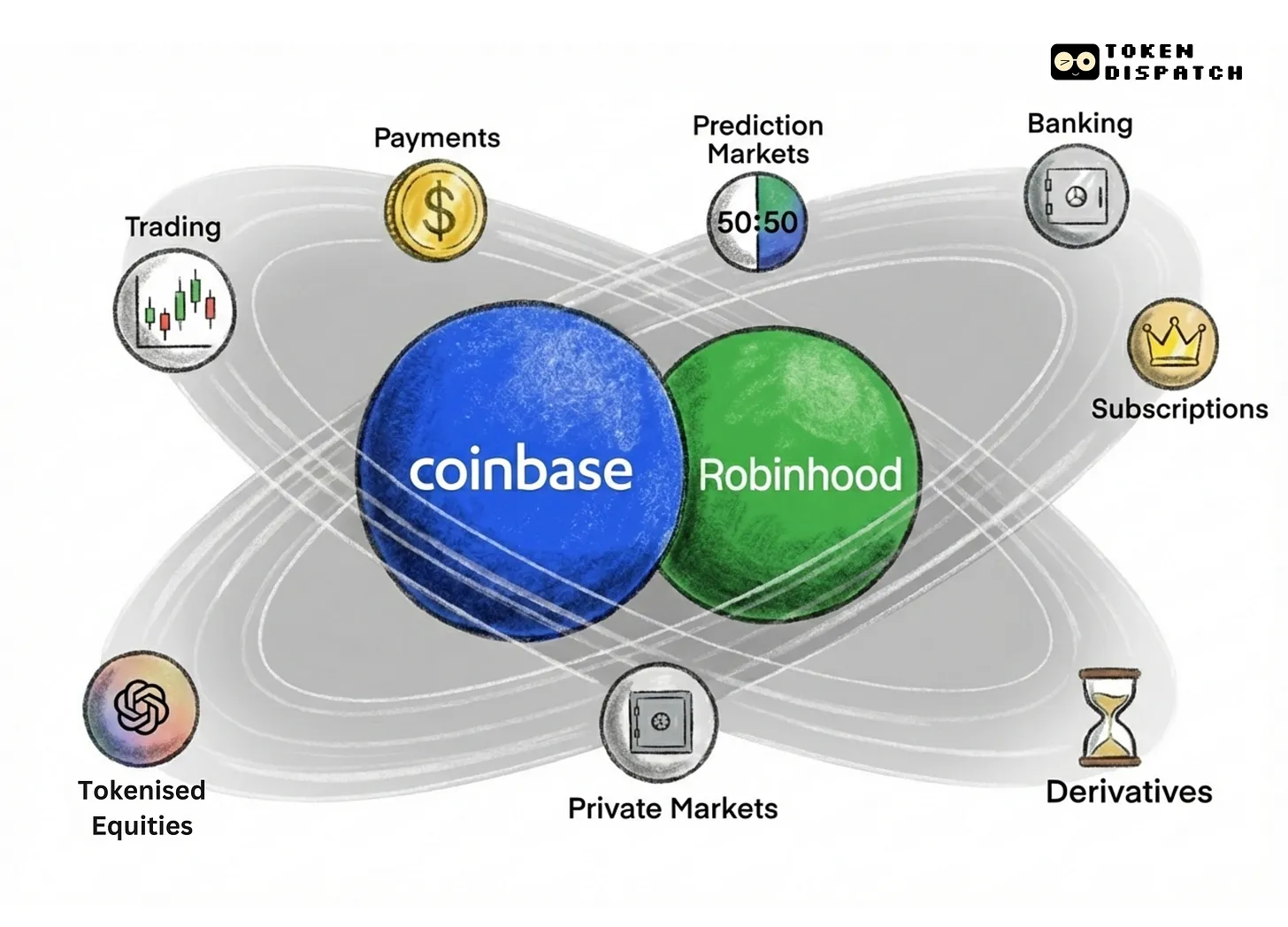
Coinbase and Robinhood, despite recent earnings misses, are undergoing significant transformations that diverge from simplistic narratives tied to crypto performance. Both are systematically diversifying their revenue streams to reduce cyclical dependency. Coinbase’s subscription and service revenue reached $2.8B in 2025, 5.5x its 2021 peak. It now holds 12% of global crypto assets and is expanding into derivatives (via the Deribit acquisition), prediction markets, and institutional services, partnering with major banks and asset managers like BlackRock. Its long-term goal is to become a foundational settlement layer for on-chain finance. Robinhood’s growth is highlighted by a 27% YoY increase in ARPU to $191, driven largely by its prediction markets—its fastest-growing product line, generating $300M in annualized revenue. Other key drivers include options trading and subscription services. The company is also expanding into banking and private market access through Robinhood Ventures, aiming to capture a share of generational wealth transfer. Though they started from opposite ends—Coinbase in crypto, Robinhood in traditional equities—both are converging toward the same vision: a financial super-app for retail users. They are now competing directly in emerging areas like prediction markets, tokenization, and private market access, with the goal of deepening user financial integration and becoming indispensable platforms.

marsbit20 min fa

Two Paths, One Destination

marsbit20 min fa

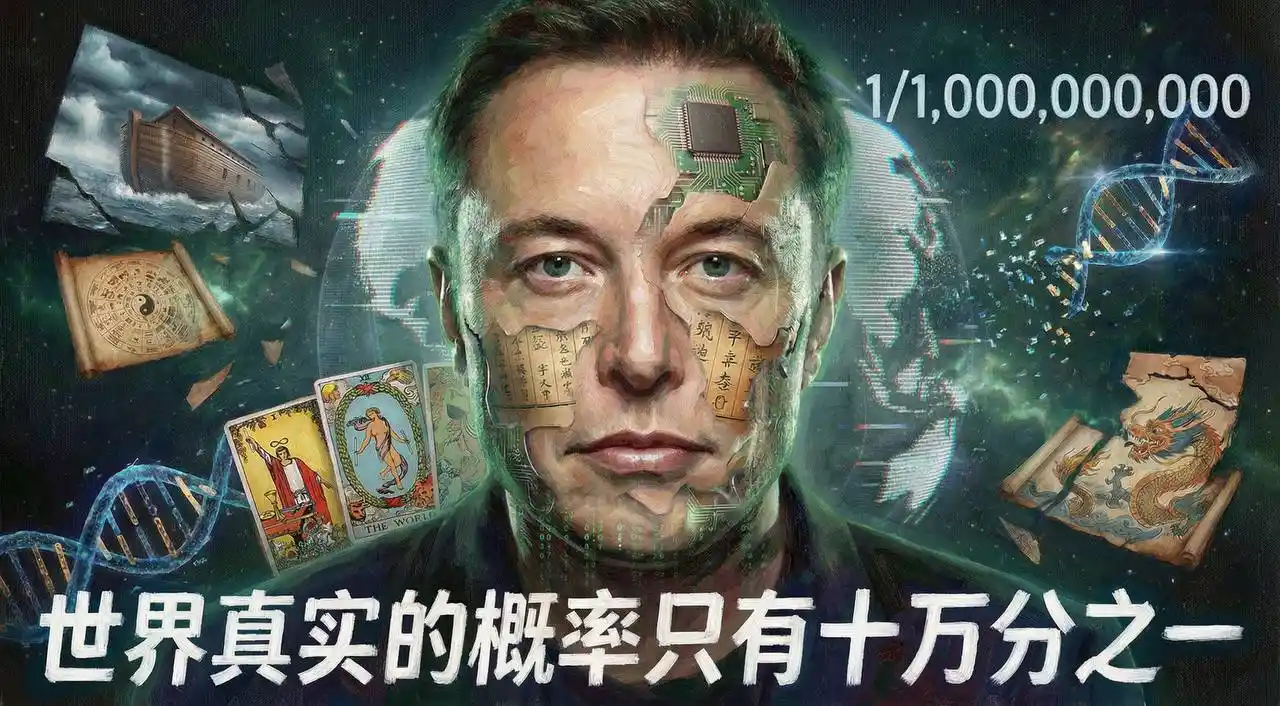
I Finally Understand Why Musk Is Convinced We Live in a 'Simulated World'

The author, an investor and entrepreneur, describes their initial skepticism towards Elon Musk's simulation theory—the idea that the probability we live in base reality is only one in a billion. Their perspective shifted after two personal experiences with seemingly inexplicable accuracy in predictions. First, a fortune-teller using traditional Chinese astrology consistently and accurately predicted investment outcomes and obstacles over more than a dozen instances. Second, a close friend, a highly educated Tarot card reader, provided remarkably precise and consistent readings across different methods. The friend explained that Tarot practice is like having "database access permissions" to a vast informational field—a metaphor that resonated deeply with the author. This led the author to reexamine the world through a programmer’s lens. They note several “coincidences” that align with the simulation hypothesis: - **Junk DNA**: The 98% of non-coding DNA resembles legacy code or commented-out functions in software. - **The Great Flood Myths**: Shared global flood narratives and the sharp drop in human lifespans afterward mirror a system reset or version update. - **Cosmic Limits**: The Big Bang resembles a system boot-up, the speed of light a CPU frequency limit, and déjà vu a caching error. The author concludes that viewing reality as a simulation makes these phenomena coherent. Rather than leading to nihilism, this perspective is liberating: although one’s “character settings” may be predetermined, the subjective experience of love, joy, and achievement remains real. The goal is to live fully within one’s own version, striving to reach one’s potential. The essay ends on an optimistic note: with tools like Web3 and AI, humanity may be transitioning from passive “players” to active “advanced players” capable of exploring and even altering the rules of the simulated world. The emphasis is not on proving the theory but on engaging meaningfully within the system.

marsbit28 min fa

I Finally Understand Why Musk Is Convinced We Live in a 'Simulated World'

marsbit28 min fa

Trading

Spot
Futures
活动图片