Kelp DAO's $400 Million Bad Debt Was Covered, But at a $12 Billion Cost to Aave

marsbitPubblicato 2026-05-26Pubblicato ultima volta 2026-05-26

Introduzione

On May 26th, Kelp DAO successfully transferred its final batch of rsETH, completing the 37-day process of fully backing rsETH 1:1 after a security incident. However, the resolution came at a significant cost to Aave. The protocol's TVL plummeted by over $12 billion in the following month. Furthermore, a separate legal battle over 30,766 frozen ETH continues in court, posing ongoing reputational risk. The recovery was enabled by an unprecedented, one-time coalition dubbed "DeFi United," involving major contributions from Aave's founder, treasury, Consensys, Mantle, and others. Despite this, the event triggered a major outflow of funds, with whales like Justin Sun moving capital to competitors like Spark. Aave's path to regaining its position relies heavily on the successful execution of its multi-pronged strategy. Its new V4 protocol, designed for open, heterogeneous asset markets, faces delays due to internal governance disputes. Meanwhile, the V3 version remains the core revenue generator, and the permissioned Horizon fork is targeting institutional RWA (Real-World Assets) growth—a segment less impacted by the rsETH incident but dependent on traditional finance adoption timelines. The key takeaway is that while the immediate bad debt was covered, Aave paid a steep price in lost trust and capital. Recovering market share depends on accelerating V4's rollout and advancing its institutional RWA offerings, both of which face external and internal hurdles. The "DeFi United" sa...

Original Author: Sanqing, Foresight News

On May 26, Kelp DAO transferred the final batch of 20,373.72 rsETH to the LayerZero OFT Adapter, while Aave simultaneously announced that rsETH and all affected markets had returned to normal. In 37 days, the full replenishment of 116,500 rsETH was completed.
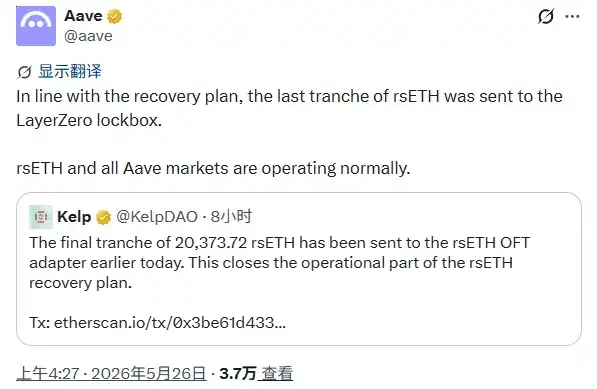
However, this only means rsETH is once again backed 1:1; it does not mean Aave's books are cleared. The 30,766 ETH frozen by the Arbitrum Security Council is still stuck in the U.S. District Court for the Southern District of New York, with ownership undecided. The TVL lost by Aave hasn't returned along with rsETH.

The Bill Extends Beyond the TVL Column

According to DefiLlama data, Aave's TVL was $26.396 billion on April 18, the day of the incident; on May 25, it was $14.181 billion. The amount that hasn't returned after a month exceeds $12 billion.

The more difficult part lies ahead. The U.S. District Court for the Southern District of New York will hold a hearing on June 5 regarding the ownership of the 30,766 ETH frozen by the Arbitrum Security Council. Both Aave LLC and Gerstein Harrow had submitted supplemental briefs by May 22. The judge previously modified the restraining notice on May 8 to allow fund transfers, but the substantive ruling is still pending confirmation on June 5.

Gerstein Harrow represents families of North Korean terrorism victims, holding an unexecuted judgment of $877 million. Regardless of the outcome, this lawsuit consumes Aave's brand.

This time, DeFi United was able to form because multiple parties were willing to provide backing: Stani Kulechov contributed 5,000 ETH from his own pocket, Consensys and Joseph Lubin committed up to 30,000 ETH, the Aave treasury allocated up to 25,000 ETH, plus a credit line of up to 30,000 ETH provided by Mantle and support from multiple parties like Lido and Ether.fi.

The scale of community mobilization was unprecedented, but Aave exhausted this one-time-only card. If another upstream contamination event occurs, assembling a similar list may not be possible again.

For example, after the incident, Sun Yuchen moved approximately $174 million (including 65,854 ETH and some stablecoins) from Aave to Spark, with cumulative deposits in Spark exceeding $1.3 billion. Whales voted with their feet, and funds have already migrated.

The Openness of V4 is Being Slowed Down by Governance

Aave has more than just V4 as a countermeasure card, but V4 is the most crucial one.

V4 was already launched on the Ethereum mainnet on March 30, with a Hub-and-Spoke architecture and three initial Liquidity Hubs. Aave Labs promised "security-first growth," with deposit limits gradually increasing. Deposits surpassed $10 million on April 8, crossed $50 million on May 9, and total deposits reached $86.13 million on May 26, with active borrowing positions at $27.77 million.
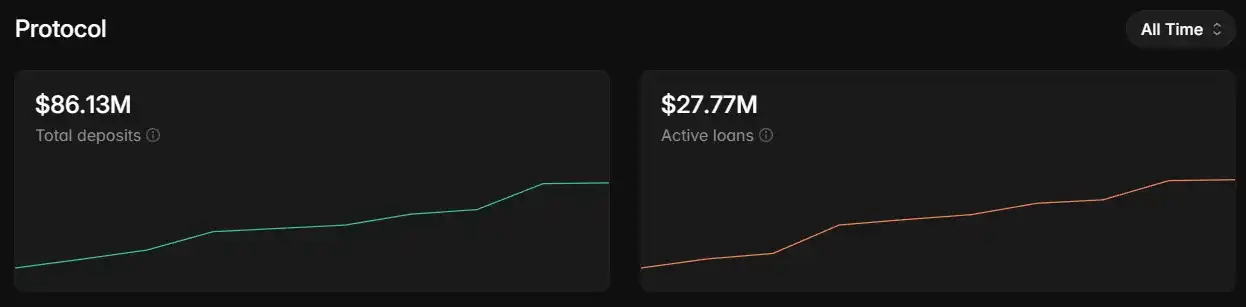
This pacing was a responsible design choice before rsETH; after rsETH, it became a stress test. Aave was handling a $200 million bad debt on V3 while slowly expanding limits on V4.

More challenging is that V4 also faces internal friction from its own governance layer. In February 2026, Aave Labs submitted a strategic proposal bundling product revenue, service provider incentives, the V4 growth engine, and brand/legal custody, requesting representatives to vote on four different risk dimensions at once.

Marc Zeller, founder of the Aave Chan Initiative, publicly questioned whether it was appropriate to bundle such a massive funding request with strategic approval. This governance dispute continued to ferment around the V4 launch, with each delay allowing competitors to eat away a bit more market share.

V4's advantage is the openness of the Spoke design—anyone can build a Spoke, and those meeting conditions can connect to a Liquidity Hub as a credit line. This is also why Babylon Labs chose to connect its Trustless Bitcoin Vaults to V4 rather than others. But the speed at which this openness materializes depends on whether the governance layer can keep up with the pace.

More Than Just V4: Aave is Fighting Three Battles

Aave V3 remains the cash cow. With annualized revenue exceeding $100 million, and $14.1 billion TVL primarily on V3. The "Aave will win" proposal positions V3 as in a "stable maintenance" phase, with Stani publicly committing to no forced migration and no deadline.

V4 and V3 will run in parallel for at least 24 to 36 months, with V4 being an additive complement layer, taking on heterogeneous scenarios that V3 cannot accommodate. Horizon is an independent, permissioned V3 fork specifically designed for institutional RWA.

Each of the three layers is capturing different increments. V4 captures new scenarios that V3's risk architecture cannot accommodate, with an added task after rsETH: giving funds that have migrated to Morpho and Spark a reason to return to Aave. Horizon captures traditional finance RWA flows, completely separate from V3 and V4 pools.

Horizon Market officially launched in August 2025, a permissioned V3 instance deployed by Aave, allowing institutions to use tokenized government bonds, corporate bonds, and money market funds as collateral to borrow stablecoins like USDC, GHO, and RLUSD.
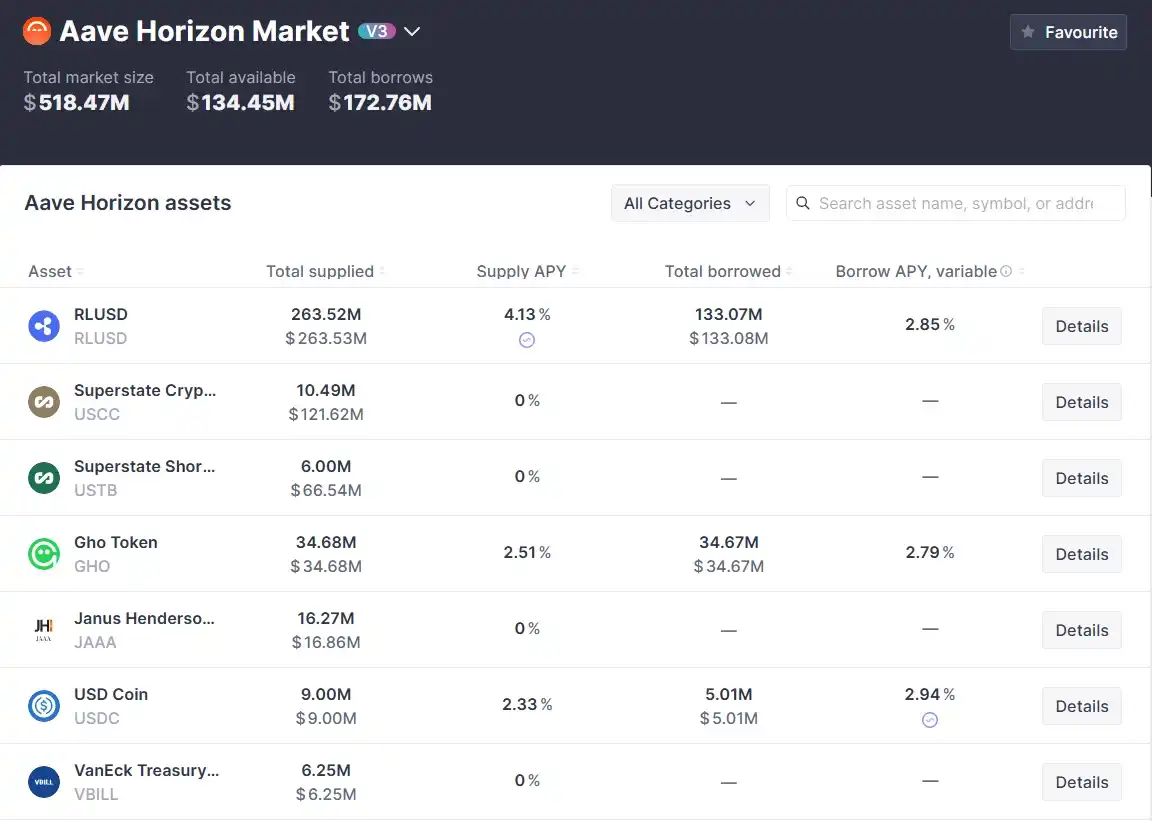
As of May 26, it has accumulated over $500 million in net deposits, aiming to surpass $1 billion by the end of 2026, with partners including BlackRock, Franklin Templeton, Circle, Ripple, and VanEck.

This route diverges from Morpho's vault management model. Morpho uses third-party institutions like Steakhouse and Gauntlet to curate vaults, capturing lending flows from retail institutions like Coinbase. Aave uses Horizon to directly connect with traditional finance asset managers for RWA.

The two paths target different institutional customer profiles. Morpho serves fintech companies that use on-chain lending as a tool, while Aave serves asset managers that treat the chain as an issuance venue.

The fund migration after the rsETH event primarily affected the first type of client. The migration cost is higher and the reaction slower for the second type. The compliance framework, KYC processes, and asset access audits Aave has accumulated on Horizon are not easily replicable by Morpho in the short term after the event.

This is the only incremental line for Aave not directly impacted by the rsETH event, but its growth depends on the pace at which traditional finance integrates with DeFi.

No Second DeFi United

Aave remains the largest protocol in the lending market, with $14.1 billion TVL still nearly double that of Morpho. The deployment depth accumulated over years is unmatched in the short term.

But the bill left by rsETH isn't on the balance sheet; it's in the column for institutions' default preference for lending protocols. Spark's TVL grew from $3.727 billion to $5.3 billion in a month; Morpho slowly climbed back to pre-incident levels after hitting bottom on April 21. These numbers won't automatically reverse and flow back just because Aave's markets have recovered.

The speed at which V4 delivers on heterogeneous scenarios, plus the progress of Horizon on institutional RWA, will determine whether Aave can recapture the lost market share. But the former is stuck in governance friction, and the latter depends on traditional finance's own integration pace. And for both these things, Aave can only wait.

DeFi United is not a permanent institution; it was a one-time mobilization.

Domande pertinenti

QWhat was the final action taken by Kelp DAO regarding the rsETH tokens, and how did Aave respond?

AOn May 26th, Kelp DAO transferred the final batch of 20,373.72 rsETH tokens to the LayerZero OFT Adapter. Simultaneously, Aave announced that the rsETH market and all affected markets had returned to normal.

QAccording to DeFiLlama data, what was the financial impact on Aave's TVL in the month following the rsETH incident on April 18th?

AAccording to DeFiLlama data, Aave's TVL on April 18th was $26.396 billion. By May 25th, it had fallen to $14.181 billion. This represents a loss exceeding $12 billion in TVL over approximately one month.

QWhat major upcoming legal event is mentioned regarding the frozen 30,766 ETH, and who is the opposing party in this case?

AThe U.S. District Court for the Southern District of New York will hold a hearing on June 5th to determine the ownership of the 30,766 ETH frozen by the Arbitrum Security Council. The opposing party is the law firm Gerstein Harrow, representing families of victims of North Korean terrorism who are seeking to collect on an $877 million judgment.

QWhat are the three core product layers or 'battles' that Aave is currently engaged in, as outlined in the article?

AAave is currently operating on three fronts: 1) Aave V3, the primary cash cow and stable maintenance layer with the majority of TVL. 2) Aave V4, the new hub-and-spoke architecture designed for new, heterogeneous lending scenarios. 3) Horizon, a separate, permissioned fork of V3 designed specifically for institutional Real-World Assets (RWA).

QWhat does the article suggest is a key challenge for the success of Aave V4, despite its technical advantages?

AThe article suggests that a key challenge for Aave V4's success is governance infighting and delays within Aave's own governance layer. The speed at which V4's promised openness can be realized depends on the governance process keeping pace, which has been slowed by internal disputes over strategic proposals.

Letture associate

From Mining Pool to Mars: Why Is Wang Chun in the SpaceX Cockpit?

Title: From Mining Pool to Mars: Why Wang Chun is in the SpaceX Cockpit? When SpaceX announced that Wang Chun, co-founder of F2Pool, would command the first commercial crewed interplanetary mission, many were shocked. Why would a Bitcoin mining pool founder be on a Mars mission roster? However, understanding Wang Chun's journey over the past decade and the deepening ties between the crypto industry and SpaceX reveals this is not accidental, but an inevitable result of a new era taking shape. Today's Mars plan is no longer just a space engineering project; it is evolving into a civilization-upgrading experiment driven by global tech capital, AI, computing power, energy, and the crypto economy. Wang Chun stands precisely at the intersection of these forces. Part 1: From F2Pool to SpaceX – Wang Chun's Leap F2Pool, founded when Bitcoin was still niche, is one of the earliest large-scale mining pools and once held a significant share of global Bitcoin hash rate. Wang Chun belongs to the first generation of Chinese Bitcoin advocates and infrastructure builders—idealists and engineers who believed in a new value network independent of traditional finance. Miners like him built the hardware, energy, and computing power foundational to decentralized networks. This aligns with the long-term, high-engineering, future-oriented vision required for space civilization. Elon Musk’s space endeavors value such long-term builders over mere capital players, which explains Wang Chun's entry into the SpaceX ecosystem. Part 2: Why Crypto and SpaceX Are Growing Closer The core of global tech competition is shifting from internet applications to next-generation infrastructure. Both crypto and SpaceX are part of this. SpaceX's goal is to drastically reduce space access costs. If successful, it could enable orbital servers, space-based energy, global satellite internet, and Martian bases. These new frontiers will require new payment systems, value networks, and global financial architectures. Cryptocurrencies, inherently global and trustless, are poised to become key to off-planet economies. Moreover, crypto and SpaceX share a high-risk, long-termist ethos—believing in ambitious, world-changing goals despite early skepticism. Part 3: Human Spaceflight Enters the Commercial Era Space exploration, long dominated by state actors, is now being transformed by commercial entities like SpaceX. Wang Chun's involvement signifies that future deep-space participants may include not just career astronauts, but also entrepreneurs, engineers, and AI researchers. This mirrors the Age of Exploration, where commercial capital eventually drove global expansion. Wang Chun has emphasized that Mars colonization must not be delayed for future generations, countering a potential over-focus on nearer-term, commercial lunar projects. His presence symbolizes how new capital, technical communities, and idealists from the crypto world are now entering the interstellar age. In summary, the true significance is not an individual's journey to Mars, but the shift in the driving force of human civilization expansion from state machinery to tech companies, AI systems, and global technology capital. Wang Chun's path—from mining pool to Mars, from the Bitcoin network to starships—may be a preview of technological civilization's evolution in the coming decades.

marsbit1 h fa

From Mining Pool to Mars: Why Is Wang Chun in the SpaceX Cockpit?

marsbit1 h fa

Trading

Spot
Futures

Articoli Popolari

Come comprare DAO

Benvenuto in HTX.com! Abbiamo reso l'acquisto di DAO Maker (DAO) semplice e conveniente. Segui la nostra guida passo passo per intraprendere il tuo viaggio nel mondo delle criptovalute.Step 1: Crea il tuo Account HTXUsa la tua email o numero di telefono per registrarti il tuo account gratuito su HTX. Vivi un'esperienza facile e sblocca tutte le funzionalità,Crea il mio accountStep 2: Vai in Acquista crypto e seleziona il tuo metodo di pagamentoCarta di credito/debito: utilizza la tua Visa o Mastercard per acquistare immediatamente DAO MakerDAO.Bilancio: Usa i fondi dal bilancio del tuo account HTX per fare trading senza problemi.Terze parti: abbiamo aggiunto metodi di pagamento molto utilizzati come Google Pay e Apple Pay per maggiore comodità.P2P: Fai trading direttamente con altri utenti HTX.Over-the-Counter (OTC): Offriamo servizi su misura e tassi di cambio competitivi per i trader.Step 3: Conserva DAO Maker (DAO)Dopo aver acquistato DAO Maker (DAO), conserva nel tuo account HTX. In alternativa, puoi inviare tramite trasferimento blockchain o scambiare per altre criptovalute.Step 4: Scambia DAO Maker (DAO)Scambia facilmente DAO Maker (DAO) nel mercato spot di HTX. Accedi al tuo account, seleziona la tua coppia di trading, esegui le tue operazioni e monitora in tempo reale. Offriamo un'esperienza user-friendly sia per chi ha appena iniziato che per i trader più esperti.

153 Totale visualizzazioniPubblicato il 2024.12.11Aggiornato il 2025.03.21

Come comprare DAO

Discussioni

Benvenuto nella Community HTX. Qui puoi rimanere informato sugli ultimi sviluppi della piattaforma e accedere ad approfondimenti esperti sul mercato. Le opinioni degli utenti sul prezzo di DAO DAO sono presentate come di seguito.

活动图片