Privacy Coin Crisis of Confidence! ZEC Plunges Over 56% in a Single Day

链捕手Pubblicato 2026-06-05Pubblicato ultima volta 2026-06-05

Introduzione

Zcash (ZEC), a leading privacy-focused cryptocurrency, experienced a severe crash on June 5th, plummeting over 56% in a single day and erasing nearly two months of gains. The flash crash was triggered by the disclosure of a critical zero-knowledge proof vulnerability within Zcash's Orchard privacy pool, which had existed since the pool's launch in May 2022. The flaw theoretically allowed an attacker to forge unlimited ZEC undetectably due to the pool's privacy features. The vulnerability was discovered on May 29th by independent security researcher Taylor Hornby during a proactive audit commissioned by Shielded Labs, utilizing AI-assisted analysis. The Zcash development team responded swiftly, implementing an emergency soft fork to disable Orchard transactions on June 2nd and executing a permanent hard fork fix (NU6.2) on June 3rd. Despite the technical fix, a major crisis of confidence emerged. The core issue is that Orchard's privacy design makes it cryptographically impossible to prove whether the vulnerability was exploited over the past four years, casting permanent doubt on the historical supply integrity of ZEC. While Shielded Labs argues exploitation was unlikely, the inability to provide definitive proof has severely damaged market trust. This sentiment was exacerbated when BitMEX co-founder Arthur Hayes, a prominent ZEC supporter, announced he was selling his entire position. He stated that privacy assets require "perfect security" rather than "probable safety." ...

Author: Zhou, ChainCatcher

On June 5th, the leading privacy coin ZEC experienced a maximum intraday drop exceeding 56%, erasing nearly two months of gains, with its market cap shedding approximately $5 billion at one point.

Data shows that the total ZEC contract liquidations across all platforms reached about $100 million in the past 24 hours, with long position liquidations exceeding $76 million, second only to BTC and ETH in liquidation volume.
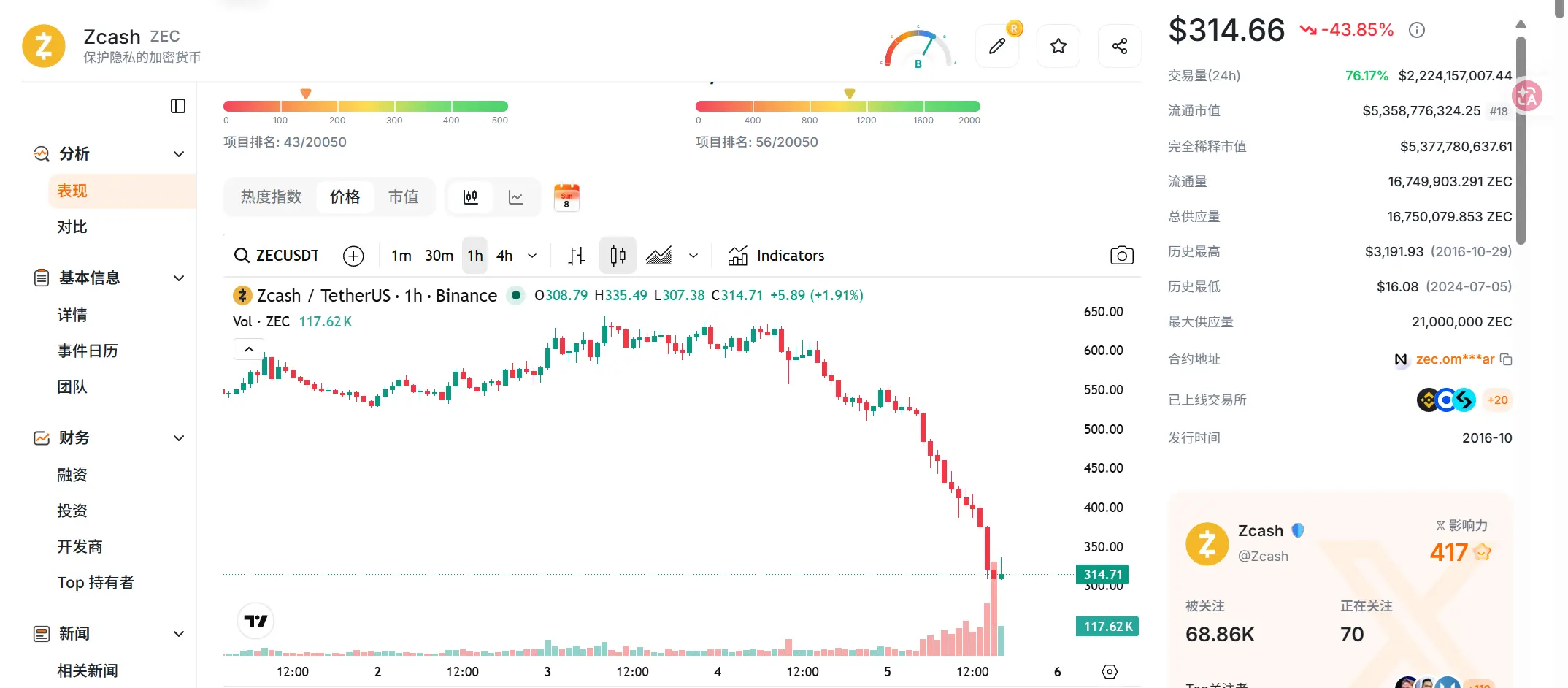
Image Source: RootData

The crash was triggered by a zero-knowledge proof vulnerability that had been latent for four years in Zcash's latest privacy transaction pool, Orchard. Theoretically, it allowed attackers to forge infinite ZEC under privacy protection, making detection extremely difficult.

The good news is the vulnerability was permanently fixed via a hard fork on June 3rd. The bad news is, due to the privacy features of the Orchard pool, no one can cryptographically prove that this vulnerability was never exploited over the past four years, leading to market doubts about ZEC's supply integrity during that period.

BitMEX co-founder Arthur Hayes announced he had liquidated all his ZEC holdings, on-chain whales profited handsomely from short positions, and market confidence was visibly shaken.

How the Vulnerability Arose and Was Discovered

The Orchard pool is Zcash's third-generation privacy transaction layer launched in May 2022. Due to insufficiently strict constraint conditions on one circuit element, attackers could input false values in elliptic curve multiplication operations yet still pass circuit verification, thereby generating unlimited forged ZEC within the pool. Because of Orchard's inherent privacy design, this forgery would leave no detectable on-chain trace.

The vulnerability was discovered by independent security researcher Taylor Hornby on May 29th. In April this year, the Zcash ecosystem independent security organization Shielded Labs had commissioned him to conduct a targeted security audit of the Zcash protocol, aiming to find potential vulnerabilities before attackers.

On May 28th, Anthropic released the Claude Opus 4.8 model. The next day, Hornby integrated it into his customized AI audit framework to conduct targeted analysis of the Orchard circuit, pinpointing the vulnerability that very day. He wrote a complete exploit program in a local test environment, verifying the technical feasibility of infinite minting. That evening, he responsibly disclosed the issue to the Zcash Open Developer Laboratory (ZODL).

ZODL engineers confirmed the vulnerability within hours and immediately activated emergency procedures. In the early hours of June 2nd, Zcash pushed an emergency soft fork via Zebra 4.5.3, temporarily disabling all Orchard transactions. On June 3rd, at 12:05 Beijing time, the mainnet completed the NU6.2 hard fork at block height 3,364,600, deploying the patched circuit and permanently closing the vulnerability.

From discovery to hard fork completion took about five days. The Zcash Foundation stated this was only the second time in Zcash's history since its 2016 launch that a protocol upgrade was triggered by a security issue. No known exploits occurred throughout the process, network total supply safeguarding mechanisms confirmed the total supply remained intact, and user privacy along with Sapling and transparent transactions were unaffected.
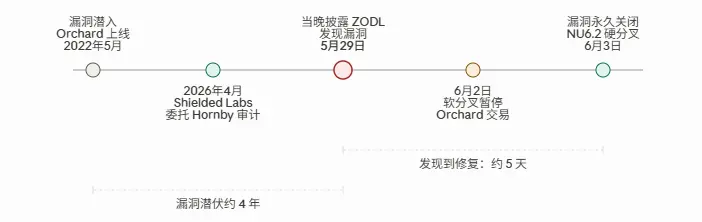
Image Source: Claude

After the Fix, Doubts Remain

Due to Orchard's privacy design, if an attacker never transfers forged tokens to the transparent pool, no existing mechanism can detect anomalies on-chain. This means the conclusion of an 'intact total supply' is based on currently observable data, not strict cryptographic proof. The vulnerability has existed since May 2022, and no one can rule out the possibility it was exploited over the past four years.

Shielded Labs believes the likelihood of exploitation is low, citing three reasons: the fact it remained undiscovered for four years indicates an extremely high technical barrier; its discovery resulted from a proactive targeted audit, not a passive exposure; and the short window from discovery to fix gave attackers very limited time to exploit. However, this very explanation itself shows the problem cannot be completely disproven.

To address this gap, Shielded Labs is collaborating with various developers to explore a new network upgrade proposal. The plan is to deploy a new privacy pool and enforce mandatory turnstile accounting scrutiny for all tokens migrating out of Orchard, allowing anyone to publicly verify supply integrity. The specific proposal is expected to be announced next week and will still need to go through community governance processes.

Crypto investor Simon Dedic pointed out that this event reveals two concurrent shifts in perception: privacy is not always an advantage; it can also be a risk in protocol design. The involvement of AI tools means vulnerabilities of similar scale can now be discovered with a lower barrier to entry, increasing the security audit pressure faced by the entire crypto industry.

On-chain analyst Haotian described the core issue of this event as 'unclearable.' Even if Shielded Labs introduces a new turnstile audit scheme, it can only prove the current supply is less than the total amount that entered the pool, still failing to cover potential historical hidden depreciation. He also noted the inherent contradiction between verifiable supply and privacy black boxes is a structural dilemma ZEC struggles to circumvent.

Concentrated Release of Market Panic

Although the technical crisis has passed, the market has not fully digested the true nature of the vulnerability.

This morning, Zcash founder Zooko Wilcox, Shielded Labs, and Taylor Hornby jointly published a detailed article comprehensively disclosing the exploitability of the vulnerability, the technical feasibility of infinite ZEC forgery, and the fact that 'cryptographic proof of historical non-exploitation is impossible' due to Orchard's privacy features, which truly ignited market panic.

On the same day, Arthur Hayes announced liquidating all his ZEC holdings, stating that while the probability of malicious minting is extremely low, it cannot be formally excluded at the cryptographic level. The value proposition of the privacy narrative demands 'perfect security,' not 'probable safety.' Hayes also indicated he might consider buying back at lower prices if subsequent assumptions are disproven.

Hayes was previously one of ZEC's most prominent public supporters, even listing it as his second-largest personal holding. He once stated ZEC should reach 10% of BTC's price, with the current rally 'having plenty of upside left.' His public departure now inevitably impacts market sentiment.

The combination of these two events caused ZEC's price to plummet rapidly. According to on-chain analyst monitoring, when ZEC fell below $400, the leveraged short position opened at $626.47 by 'insider whale' Garrett Jin resulted in floating profits reaching tens of millions of dollars.

However, some hold the view that the sharp price drop was not solely driven by the vulnerability. Crypto KOL OzLion pointed out that ZEC's previous rally already showed signs of large capital involvement. The vulnerability news might have merely provided an exit timing, with a massive influx of spot sell-offs on the day being a more direct price driver. He lamented that a 'strong-consensus blue-chip' with a $12 billion market cap losing $6 billion in a single day shows that building consensus in the crypto world is difficult, breaking it is easy, and repairing it is an even longer process.

Crypto di tendenza

Domande pertinenti

QWhat was the main event that triggered the price crash of ZEC on June 5th?

AThe main trigger was the public disclosure of a zero-knowledge proof vulnerability in the Orchard privacy pool, which theoretically allowed unlimited undetectable minting of ZEC for four years, severely damaging market confidence.

QWhat is the core dilemma highlighted by the ZEC incident regarding privacy features?

AThe incident highlights the inherent contradiction between verifiable supply integrity and the privacy features of 'black box' systems. While privacy is a core value proposition, it creates a scenario where past exploits or supply inflation cannot be cryptographically proven or disproven, undermining trust.

QHow did Arthur Hayes' actions impact the market following the vulnerability disclosure?

AArthur Hayes, a prominent public supporter of ZEC, announced he was liquidating his entire ZEC holdings. He stated that while the probability of malicious minting was low, it couldn't be cryptographically ruled out, and 'perfect security' is required for a privacy narrative. His departure significantly impacted market sentiment and contributed to the sell-off.

QWhat was the role of AI in the discovery and handling of the Zcash vulnerability?

ASecurity researcher Taylor Hornby integrated the newly released Claude Opus 4.8 AI model into a customized audit framework. This AI-assisted analysis targeted the Orchard circuit and located the critical vulnerability within a single day on May 29th, demonstrating how AI tools can lower the barrier for discovering complex vulnerabilities.

QWhat measures are being proposed to address the trust issue after the ZEC vulnerability was fixed?

AShielded Labs is exploring a new network upgrade proposal. The plan involves deploying a new privacy pool and implementing a mandatory 'revolving door' accounting review for all funds migrating out of the Orchard pool. This would allow public verification of supply integrity going forward, though it cannot retroactively prove the historical supply was untouched.

Letture associate

The Semiconductor Industry's Most Obscure Chokepoint Material: It Has Multiplied in Price Unnoticed, and China Just Banned Its Export

"Helium: The Silent Choke Point in Semiconductors" Helium, despite being the universe's second most abundant element, is critically scarce on Earth. It cannot be synthesized artificially and escapes Earth's gravity once released, making it a non-renewable resource. Yet, it is indispensable for advanced semiconductor manufacturing, requiring ultra-high purity (99.9999%) for processes like wafer etching, leak detection, and thermal management in lithography tools, with no viable substitutes. This low-profile resource, whose price has doubled unnoticed, suddenly gained attention when China imposed an export ban on July 10th. The ban is a response to a severe global shortage triggered months earlier. In March, missile attacks damaged the world's largest helium production hub in Qatar's Ras Laffan, halting a third of global supply with repairs expected to take 3-5 years. Concurrently, Russia tightened export controls, and the US sold off its federal helium reserve. Approximately 200 specialized transport containers, each worth ~$1 million, were stranded with perishable cargo. Global spot prices skyrocketed, and chipmakers like TSMC warned of potential impacts. China, which imports over 84% of its helium (primarily from Qatar and Russia), faces a severe squeeze. Despite being helium-poor, China has developed domestic extraction technology over five years, processing byproduct gases from LNG plants to produce ultra-pure helium. Domestic output, while still only covering less than 20% of demand, enabled the recent export ban aimed at securing domestic supply for its own expanding chip industry. The industry now faces "Helium Shortage 5.0." With key global sources constrained for years, this invisible gas—once wasted on party balloons—has become a critical, geopolitically charged bottleneck for chips, healthcare (MRI machines), and beyond, forcing the world to finally treat it as the finite strategic resource it is.

marsbit33 min fa

The Semiconductor Industry's Most Obscure Chokepoint Material: It Has Multiplied in Price Unnoticed, and China Just Banned Its Export

marsbit33 min fa

Early Investor of Unitree Bets on a Brain-Computer Interface Company

"Wabo Technologies, a brain-computer interface (BCI) startup, has secured new funding from Vertex Ventures (under Temasek), Hongtai Fund, Chengdu Future Industry Fund, and Huifengda Capital. Vertex Ventures is known for its early bet on Unitree Robotics. Inspired by the sci-fi film "Avatar," founder Zhang Xingzhi has pursued human-machine interaction for over a decade. He established Wabo in late 2025, coinciding with China's push for BCI as a future industry. Unlike companies focused solely on medical hardware, Wabo positions itself as a model company. Its core mission is to develop a "Human Neural Intent Model" that decodes EEG, EMG, and behavioral signals to understand a user's goals, confirmations, corrections, and stop intentions before physical action, translating them into standardized control signals for machines, robots, or smart devices. The young, full-stack team, backed by academic collaborators from Tianjin University and Fudan University, quickly attracted investors. The company had previously raised a seed round from Ceyuan Capital. Investors were impressed by Wabo's systematic capabilities in data collection, signal processing, and engineering, seeing potential beyond a single hardware product toward a reusable layer of human intent interpretation. Applications span medical rehabilitation, smart homes, embodied AI, and even space exploration, with Wabo partnering with Tianjin University on pioneering "space BCI" research. Wabo plans a dual-headquarters strategy, with Shanghai focusing on high-end R&D and model development, and Chengdu handling hardware, product development, and supply chain. The BCI sector in China is heating up, with over 30 financing deals in early 2026. Zhang believes future competition will center on who can build a sustainable data-model-scenario loop. He predicts industry consolidation within three years, with only companies that master this闭环 surviving. The vision from "Avatar" is inching closer to reality."

marsbit48 min fa

Early Investor of Unitree Bets on a Brain-Computer Interface Company

marsbit48 min fa

ChangXin Technology: A Cyclical Stock Standing Atop the Cycle Peak

Changxin Technology: A Cyclical Stock at the Peak On July 27, 2026, Changxin Technology topped the A-share market with a market capitalization of 3.28 trillion yuan, surging 465% on its first trading day. The company, which lost 16.3 billion yuan in 2023, reported an estimated net profit of 50-57 billion yuan for the first half of 2026. Its dramatic reversal mirrors the volatile DRAM (Dynamic Random Access Memory) cycle. The DRAM industry is inherently cyclical, with booms and busts every 3-4 years. This is due to product standardization and a significant time lag in supply adjustment. When prices rise, manufacturers expand capacity, but new production takes 2-3 years to come online, often leading to oversupply and price crashes when demand cools. Changxin's performance perfectly tracks this cycle. It recorded deep losses in 2023-2024 during the industry downturn, turned its first annual profit in 2025, and saw profits skyrocket in Q1 2026. This surge is primarily price-driven. The AI boom has led major players like Samsung and SK Hynix to shift 70-80% of new capacity to high-margin HBM (High Bandwidth Memory), creating a severe shortage and price explosion in general-purpose DRAM markets where Changxin competes. However, a massive global capacity expansion is underway. The top three manufacturers have announced nearly $70 billion in capital expenditure for 2026. Changxin itself plans to expand from three to seven 12-inch wafer fabs. This investment will translate into significant new supply in 2-3 years. While DRAM prices are expected to remain high through 2026-2027, price growth is already slowing, and a potential downturn is forecast for around 2028 as new capacity ramps up. A key challenge for Changxin is catching up in the critical HBM segment. While it has delivered HBM3 samples, leaders are already mass-producing more advanced HBM3E. Success in HBM is crucial for gaining true cyclical resilience. In conclusion, Changxin is a commendable company that has broken foreign monopolies in DRAM. Its long-term growth narrative—driven by import substitution and AI—is valid. Yet, its current valuation of 5-6x forward P/E, typical for a cyclical stock at its peak, suggests much future growth is already priced in. AI may extend the current cycle but cannot eliminate the industry's inherent volatility. For investors, the critical question is preparedness for the inevitable downturn when the cycle turns.

marsbit52 min fa

ChangXin Technology: A Cyclical Stock Standing Atop the Cycle Peak

marsbit52 min fa

Trading

Spot

Articoli Popolari

Come comprare ZEC

Benvenuto in HTX.com! Abbiamo reso l'acquisto di Zcash (ZEC) semplice e conveniente. Segui la nostra guida passo passo per intraprendere il tuo viaggio nel mondo delle criptovalute.Step 1: Crea il tuo Account HTXUsa la tua email o numero di telefono per registrarti il tuo account gratuito su HTX. Vivi un'esperienza facile e sblocca tutte le funzionalità,Crea il mio accountStep 2: Vai in Acquista crypto e seleziona il tuo metodo di pagamentoCarta di credito/debito: utilizza la tua Visa o Mastercard per acquistare immediatamente ZcashZEC.Bilancio: Usa i fondi dal bilancio del tuo account HTX per fare trading senza problemi.Terze parti: abbiamo aggiunto metodi di pagamento molto utilizzati come Google Pay e Apple Pay per maggiore comodità.P2P: Fai trading direttamente con altri utenti HTX.Over-the-Counter (OTC): Offriamo servizi su misura e tassi di cambio competitivi per i trader.Step 3: Conserva Zcash (ZEC)Dopo aver acquistato Zcash (ZEC), conserva nel tuo account HTX. In alternativa, puoi inviare tramite trasferimento blockchain o scambiare per altre criptovalute.Step 4: Scambia Zcash (ZEC)Scambia facilmente Zcash (ZEC) nel mercato spot di HTX. Accedi al tuo account, seleziona la tua coppia di trading, esegui le tue operazioni e monitora in tempo reale. Offriamo un'esperienza user-friendly sia per chi ha appena iniziato che per i trader più esperti.

295 Totale visualizzazioniPubblicato il 2024.12.12Aggiornato il 2026.06.02

Come comprare ZEC

Discussioni

Benvenuto nella Community HTX. Qui puoi rimanere informato sugli ultimi sviluppi della piattaforma e accedere ad approfondimenti esperti sul mercato. Le opinioni degli utenti sul prezzo di ZEC ZEC sono presentate come di seguito.

活动图片