This article is from:Viktor
Compiled | Odaily Planet Daily (@OdailyChina); Translator | Azuma (@azuma_eth)

Over the past two weeks, we have seen a significant increase in STRC trading volume, along with rising popularity on social media platforms like X. Therefore, I believe now is a good time to write an article about Strategy and its new structure. This is the fourth article I have written about Strategy and the Bitcoin treasury model:
- The first article was an introduction to the Strategy model, where I clarified some common misconceptions about it.
- The second article explained the "full-stack treasury company" model and the mechanisms supporting its NAV premium.
- The third article introduced the preferred share model, a new strategy launched by Strategy in 2025, which is now the company's primary focus.
In this article, we will focus on STRC. It has now become MSTR's most important preferred share product and is the core focus of Michael Saylor (founder of Strategy) and his management team.
TL;DR
- STRC is a yield instrument backed by Strategy's Bitcoin treasury, with a dynamically adjusted dividend rate to keep its price close to par value ($100). Currently, you can earn an 11.5% annualized yield (paid monthly) on a relatively stable and transparent instrument.
- STRC is essentially a way for Strategy to convert yield demand into structural buying pressure for BTC. As long as Strategy runs both the STRC and MSTR ATM issuance mechanisms (and mNAV > 1), this structure can scale massively without increasing MSTR's leverage. This means Strategy can absorb hundreds of billions of dollars (or more) in new demand for STRC while maintaining a leverage ratio of about 33% and unchanged credit risk.
- By using the common stock ATM mechanism to maintain leverage, every $1 of STRC issued roughly corresponds to $3 of BTC added to the treasury. Rough estimates suggest that when STRC's daily trading volume near par ($100) is $100 million, it could lead to $100–150 million in BTC purchases.
- Strategy effectively splits BTC exposure into two different risk tranches: STRC holders receive relatively low-volatility yield, while MSTR shareholders bear the remaining upside and volatility of BTC. As Lavoisier said, "Nothing is created, nothing is destroyed, everything is transformed."
- The design goal of the entire structure is to increase the Bitcoin-per-share ratio over time. This ultimately benefits MSTR common shareholders, as it means MSTR should theoretically mechanically outperform BTC.
- A short-term 5%–10% pullback in STRC is possible, but as long as market confidence in the structure remains, arbitrage trading will typically pull the price back near par.
- The real risk is not a sudden crash, but a prolonged BTC bear market, which could gradually pressure the entire structure over time. Even in the (highly unlikely) worst-case scenario, due to dollar reserves and Strategy's flexibility in adjusting dividends, the process would be very slow.
- If Strategy eventually collapses, it likely won't happen dramatically like Luna/UST, but rather as a slow, long-term deterioration.
- If you are bullish on BTC but bearish on MSTR and STRC, it is logically difficult to justify. Given Strategy's current risk level (which may change), if BTC doesn't "die" first, Strategy almost certainly won't die first.
What is STRC and How Does It Work?
First, let me briefly review the concept of preferred shares: simply put, they are debt-like financial instruments but legally still equity of the company. This means these preferred shares never need to be "repaid," and Strategy cannot default on them.
In the capital structure, preferred shares rank above common shares (MSTR) for claims, meaning in case of bankruptcy, preferred shareholders are paid before common shareholders.
So far, Strategy has issued five preferred shares (STRF, STRC, STRK, STRE, STRD), which I introduced in my previous article. Here are the main features of STRC (also known as Stretch):
- It falls into the "short-duration high-yield credit" category.
- Strategy aims to keep STRC's price as close to $100 ("par value") as possible, ideally within a 1% range of $99–$100.
- STRC pays floating dividends monthly; the current dividend rate is 11.5%.
- If STRC trades significantly below par, Strategy can increase the monthly dividend rate to make the product more attractive, increasing demand until the price returns near par.
- If STRC's price exceeds $100, Saylor can issue and sell new STRC shares at $100 via the ATM (at-the-market) offering program. This effectively creates a price cap near $100.
- If Saylor prefers not to issue shares via ATM, the company has another option—redeem STRC at $101, meaning market participants have little incentive to buy STRC above this price.
- Like Strategy's other preferred shares, STRC is a perpetual preferred stock, meaning it has no maturity date and no repayment schedule.
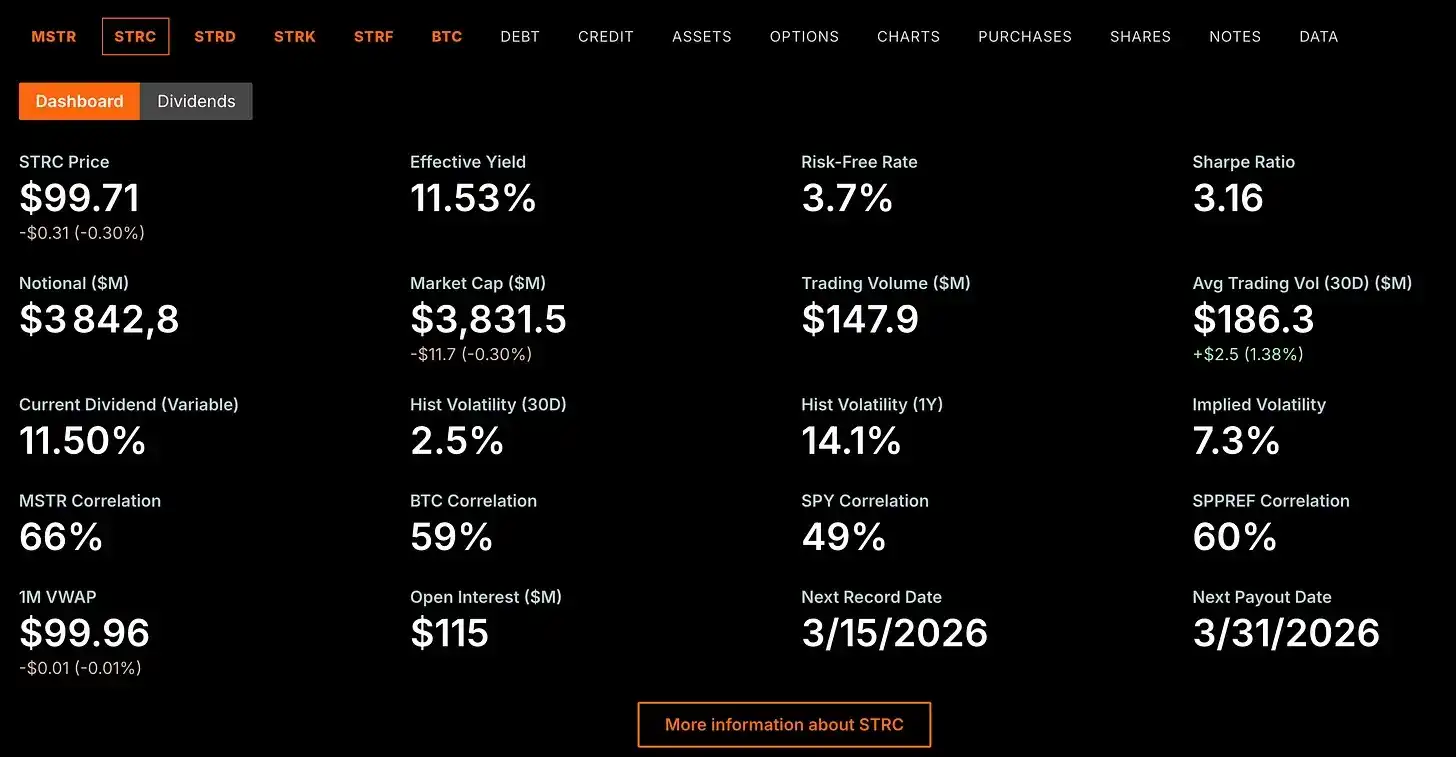
Odaily Note: All data for STRC can be found on Strategy.com. The screenshot is from March 13, 2026, which was the ex-dividend date, so STRC's price was below par.
How Does Strategy Use ATM to Control Leverage?
Although Strategy's preferred shares are not legally debt, they can be seen as a way to introduce leverage to the balance sheet. Strategy distinguishes between leverage ratio and amplification ratio—the leverage ratio only calculates "convertible debt / BTC reserves"; the amplification ratio calculates "(convertible debt + preferred shares) / BTC reserves."
In fact, the amplification ratio is the true measure of Strategy's leverage level. This means that whenever Saylor issues and sells new STRC, Strategy's leverage increases. If Saylor wants to reduce the company's leverage, he can use the common stock ATM mechanism—issuing new MSTR shares and using the proceeds to buy BTC, thereby expanding the company's size while lowering the leverage ratio.
The logic is straightforward: Suppose a company holds $10 billion in BTC, has $3 billion in debt, and a market cap of $12 billion. Its leverage ratio is: $3 billion debt / $10 billion BTC = 30%.
Assume the company issues an additional $2 billion in new shares and uses the proceeds to buy $2 billion in BTC. With BTC price unchanged, the market cap becomes $14 billion, the BTC treasury becomes $12 billion, but the nominal debt amount hasn't changed, so the new leverage ratio is: $3 billion debt / $12 billion BTC = 25%.
This example clearly shows that through common stock ATM issuance, the company can both expand its size (market cap from $12B → $14B) and reduce leverage (30% → 25%).
Is Strategy Using STRC to Aggressively Buy Coins?
How STRC Demand Translates into BTC Buying Pressure
As I mentioned earlier, Saylor only sells STRC at $100, not below.
This means that when the price is below $100, all trading volume is just STRC shares changing hands between past, present, and new holders. When the price reaches $100, part of the volume still corresponds to ordinary STRC share trading (because some are willing to sell at $100), but the remaining volume corresponds to Saylor issuing new shares and selling them to "excess demand" at $100.
Last week, the ratio of STRC's weekly trading volume to the weekly ATM size was about 40%. I'll use this number in the example below, but it's obviously not a rule; in some cases, it could be 25% or 60%.
When STRC trades near par and the daily volume is $100 million, the situation is—Saylor can issue 40% of that amount via the STRC ATM program, i.e., issue and sell $40 million in new STRC shares. He then immediately uses this $40 million to buy BTC.

Odaily Note: The ATM activates when STRC price reaches $100.
However, selling STRC increases the company's leverage (it's a debt-like instrument), and Saylor certainly wants to keep leverage stable. Strategy's current leverage is about 33%, and I believe he wants to maintain it around this level. This means that for every $1 of new debt, $3 of BTC reserves must be added. In the previous example, if Saylor adds $40 million in "debt" via STRC and buys $40 million in BTC, he still needs to add another $80 million in BTC to the company's reserves. How does he do this?
The answer was explained in the previous section—using the common stock MSTR ATM mechanism. So, Saylor issues and sells $80 million in new MSTR shares and immediately uses the proceeds to buy $80 million in BTC.
So the conclusion is, according to this rough calculation, $100 million in daily STRC volume corresponds to about $40 million in new STRC issuance and the purchase of about $120 million in BTC. Through STRC, Strategy has found a way to convert demand for stable yield into BTC buying power.
What if STRC Demand Explodes? Would Saylor Be Forced to Max Out Leverage?
I also want you to notice another point: according to the model I just described, Strategy could completely triple the market cap of STRC (in other words, add about $8 billion in STRC debt on top of the current $4 billion market cap) without increasing the company's leverage ratio (i.e., credit risk).
Saylor already has all the necessary tools to scale STRC to any extent the market demands, while still keeping leverage stable at 33%.
Obviously, this increases the nominal debt size and the dividend payments required, but these metrics grow in sync with the BTC treasury size, meaning Strategy doesn't take on any additional BTC price-related risk.
What Are the Real Limitations of This Strategy?
The mode of running both STRC and MSTR ATM mechanisms simultaneously, as I described above, requires two conditions.
The first condition is obvious: STRC must be trading at $100. When this happens, it essentially means demand for STRC exceeds its current market cap, so Saylor issues new shares to meet the excess demand.
The second condition, which I haven't mentioned before, is that mNAV must be above 1x to use the common stock ATM mechanism. As I explained in detail in another article, Strategy's core goal is always to increase the bitcoin-per-share (bps) ratio over the long term. When they sell MSTR shares and buy BTC while mNAV is above 1x, it is accretive to bps; the higher the mNAV, the more accretive the operation; when mNAV is exactly 1x, it is neutral; but when mNAV is below 1x, using MSTR sale proceeds to buy BTC is dilutive to bps, so they avoid it.
You may have noticed that in the previous section I mentioned: using the MSTR ATM mechanism can both expand the company size and reduce leverage. But if mNAV is above 1x, then using the common stock ATM has an additional benefit—increasing the bps ratio.
By the way, the mNAV metric is actually displayed directly on the Strategy.com homepage. They use the most diluted mNAV as a reference, which is correct. Currently, this value is about 1.2x, and I believe the lowest it got in 2026 was around 1x.
So, what if this scenario occurs—STRC demand is so high that Saylor has to issue new STRC shares, but mNAV is below 1x? Does this mean he cannot use the MSTR ATM to maintain stable leverage and is forced to increase leverage?
First, I think this scenario is unlikely because STRC trading stably at $100 itself implies investor confidence in the overall structure, so MSTR's mNAV should theoretically be at least above 1x. Second, this assumption overlooks another tool they have to control STRC demand—lowering the dividend.
The Dividend Rate Question: Can 11.5% Be Sustained?
First, let me remind you that STRC launched with a 9% dividend rate. The dividend rate is a tool that can be adjusted to match STRC demand and ensure its price stays near par.
Strategy's current guidance is: if STRC's monthly VWAP (Volume Weighted Average Price) is between $95–$99, they will increase the dividend rate by 25 basis points (bps); if the monthly VWAP is below $95, they will increase it by 50 bps; if the monthly VWAP is above $101, they will decrease the dividend rate.
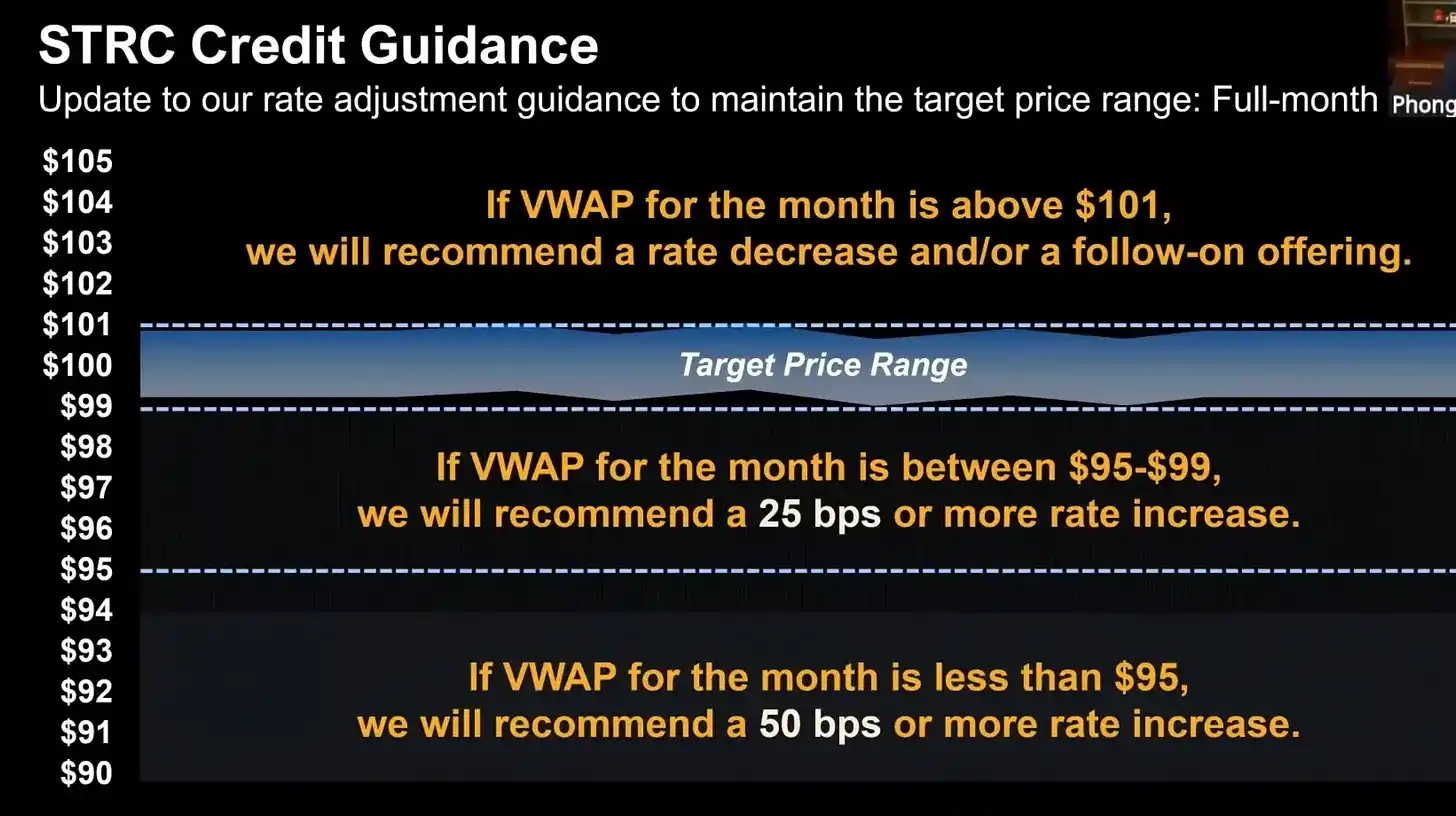
So, what they have done so far is essentially gradually increase STRC's dividend rate from 9% to 11.5% to reach an equilibrium where STRC trades around $100 daily. This week was STRC's most successful week yet, as it not only traded consistently near par but also with huge volume (about $300–400 million daily, compared to a previous average of just over $100 million).
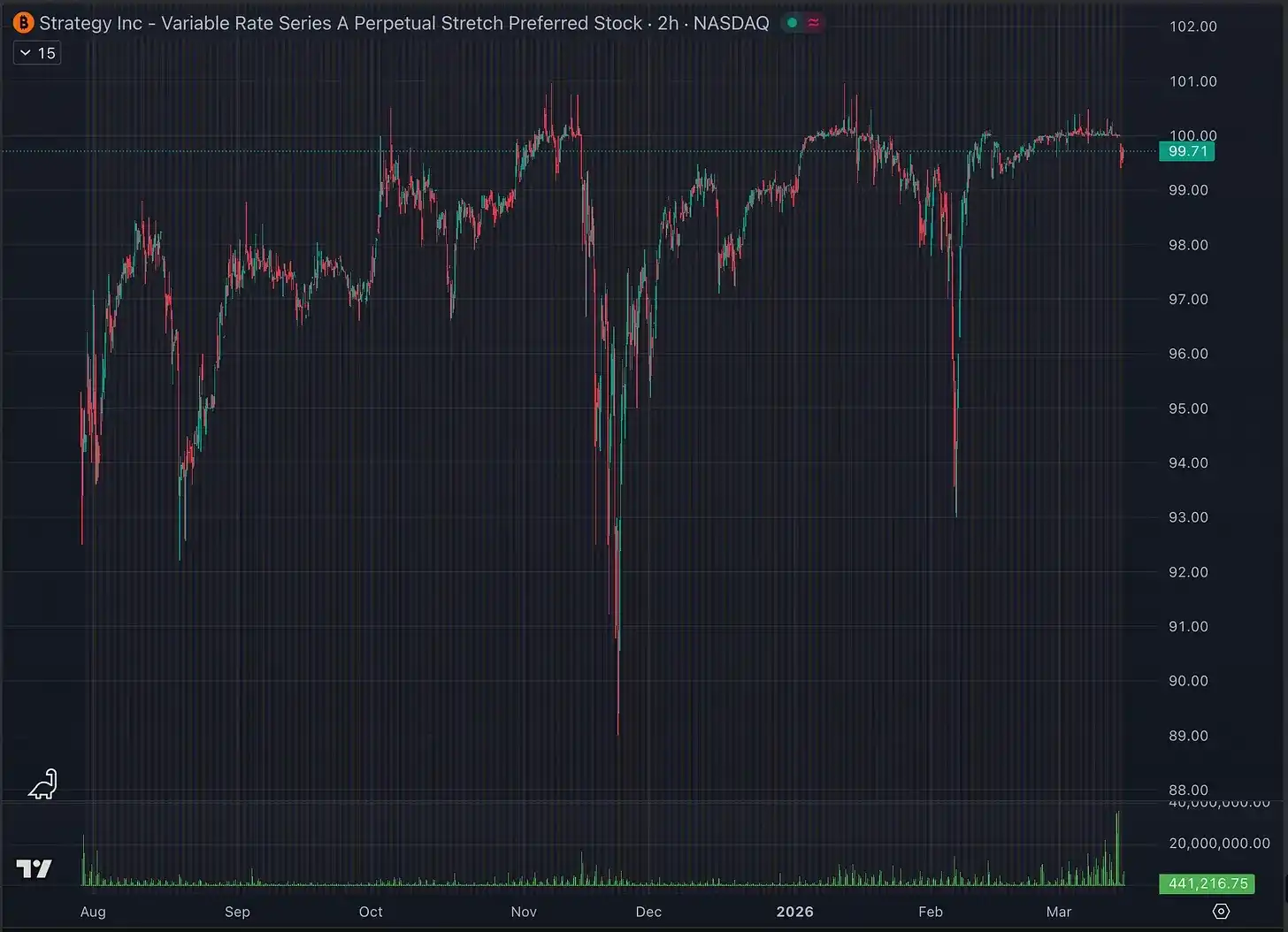
Odaily Note: STRC's price chart since launch.
STRC demand fundamentally depends on several variables:
- Credit risk: What is Strategy's current leverage ratio? In other words, how much BTC is currently "backing" STRC? This directly depends on BTC price—if BTC falls, all else equal, leverage ratio rises, credit risk increases, and STRC demand falls (i.e., STRC price drops).
- Yield: What dividend rate is STRC currently paying? The higher the dividend rate, the greater the demand for STRC.
- Awareness: How many people know about STRC? In the first few months or years after launch, this is a very important factor, as it's basically a variable that only goes up and, all else equal, significantly affects STRC demand.
- Confidence: How many people, after seeing STRC trade for months and pay dividends consistently, are willing to put money into it? This is a special factor because confidence can change dramatically—if STRC trades in a narrow range near $100 for a long time, more people will consider it safe; but if we suddenly see a 10% drop in a day, that trust could vanish quickly.
From STRC's launch until now, we've seen: credit risk increased (because BTC fell 45% from ATH), yield increased, awareness increased, and confidence increased. One factor negatively impacted demand, while three positively impacted it, and we are now finally in an "ideal" state: STRC stable around $100.
When BTC price was around $68,000, an 11.5% yield was the dividend level needed to pull STRC price back to par. For a product that has been trading for less than eight months, this seems quite positive to me. Saylor expects BTC's compound annual growth rate (CAGR) over the next 20 years to be 20–30%. As I explained in detail in another article, under this assumption, it is completely reasonable to issue debt at 11.5% to buy an asset with an expected annual growth of 25%. Theoretically, you could even pay a higher interest rate and profit from the spread between the interest cost and BTC's expected annual return.
In my view, the most likely development path is that STRC demand will continue to grow, and Strategy will gradually lower the dividend rate back to 10% (or even lower long-term) to control demand while reducing the company's interest cost.
What Happens to STRC if Everyone Wants to Sell?
In that case, STRC's price would plummet! But in fact, we've seen this happen a few times with this product: In August 2025, STRC fell from $98 to $92 (a 6% drop); during the market sell-off in November 2025, STRC dropped from $100 to $89 (an 11% drop); and this February, it fell from $100 to $93 (a 7% drop).
It's important to note that Saylor's explicit goal is to keep STRC always in a narrow range near $100, and STRC has become Strategy's core focus. Therefore, if STRC's average price for a month is below $99, Strategy will increase the dividend rate to bring demand back to a level that supports a $100 price. As long as market participants have confidence in Strategy's ability to maintain this mechanism, there will always be buyers on dips below $100, hoping to profit from the "arbitrage trade back to par."
In the short term, panic among holders could indeed cause a 10% drop. But if you have confidence in the structure Strategy has built, the price will typically return near par within days or weeks—as we've seen before.
Why Won't the Dividend Rate Rise Indefinitely?
Let's assume STRC doesn't return to par, meaning Strategy must keep increasing the dividend rate... and since the dividend rate has no formal upper limit, wouldn't this look like a "death spiral" scenario? Not exactly.
First, you need to understand that the dividend "guidance" does not legally bind Saylor to take any action. Ultimately, the company has complete discretion over the dividend rate; they could stop increasing it even if the monthly average price is below $99.
If Strategy expects BTC to grow 20–30% annually, they likely have an acceptable "maximum dividend rate" in mind, perhaps around 15%. Once it reaches that level, they might ignore STRC's trading price and stop increasing the dividend rate.
Remember, the dividend rate can be adjusted monthly. If you expect BTC to recover after a bear market, a high dividend rate doesn't need to be maintained forever. As BTC price rises again, STRC's credit risk improves, which mechanically increases demand for STRC and pushes its price back near par. At that point, Strategy can start lowering the dividend rate again. Long-term, even if the dividend rate briefly rose to 13% during a stressful period, STRC's dividend rate could eventually fall back to around 8%.
In the next section, I will outline a worst-case scenario: what happens if BTC enters a prolonged bear market and Saylor is forced to keep increasing the dividend rate.
Understanding the Risks
Reading this entire article, it might seem like nothing can go wrong, but there's no such thing as a free lunch. So, as an STRC holder, what risks am I taking?
Let me state my position clearly: I believe the market is currently mispricing the risk of STRC. Under reasonably bullish assumptions for BTC price, the risk-reward ratio is attractive. Note I'm not saying you can get high yield with zero risk; risk exists and is always related to BTC's performance.
I think there's a mismatch between people's expectations for BTC's future price and their perception of STRC's risk. Simply put, if you look at crypto-native investors' expectations for BTC over the next few years, 95% of the scenarios they envision would not materially impact STRC. In other words, within their own BTC expectation framework, they believe they can get a "low-risk" yield of over 10%. But let's still talk about these risks specifically.
Risk 1: Asymmetric Downside Risk vs. Upside Potential
STRC's structure means that if you buy at $100, the upside is capped at the annual dividend yield (currently 11.5%), while the downside could be 0–10% in a matter of days—based on historical price action.
This means if STRC drops 6% in a week, you've effectively lost half a year's worth of dividend income temporarily. If you need to exit the position quickly, this could be a problem.
If your goal is to hold STRC long-term, this is less important, as long as you believe it will eventually return to $100, you can still exit without a discount. Remember, STRC dividends are return-of-capital, meaning holders don't pay taxes on dividends, so they have less incentive for short-term trading.
Risk 2: STRC and BTC Fall Simultaneously
STRC's credit risk is directly related to BTC price, so you may have noticed that STRC's pullbacks often occur during significant BTC sell-offs. This means that your "stable, yield-generating asset allocation" is precisely losing value when you, as a crypto bull, are most vulnerable.
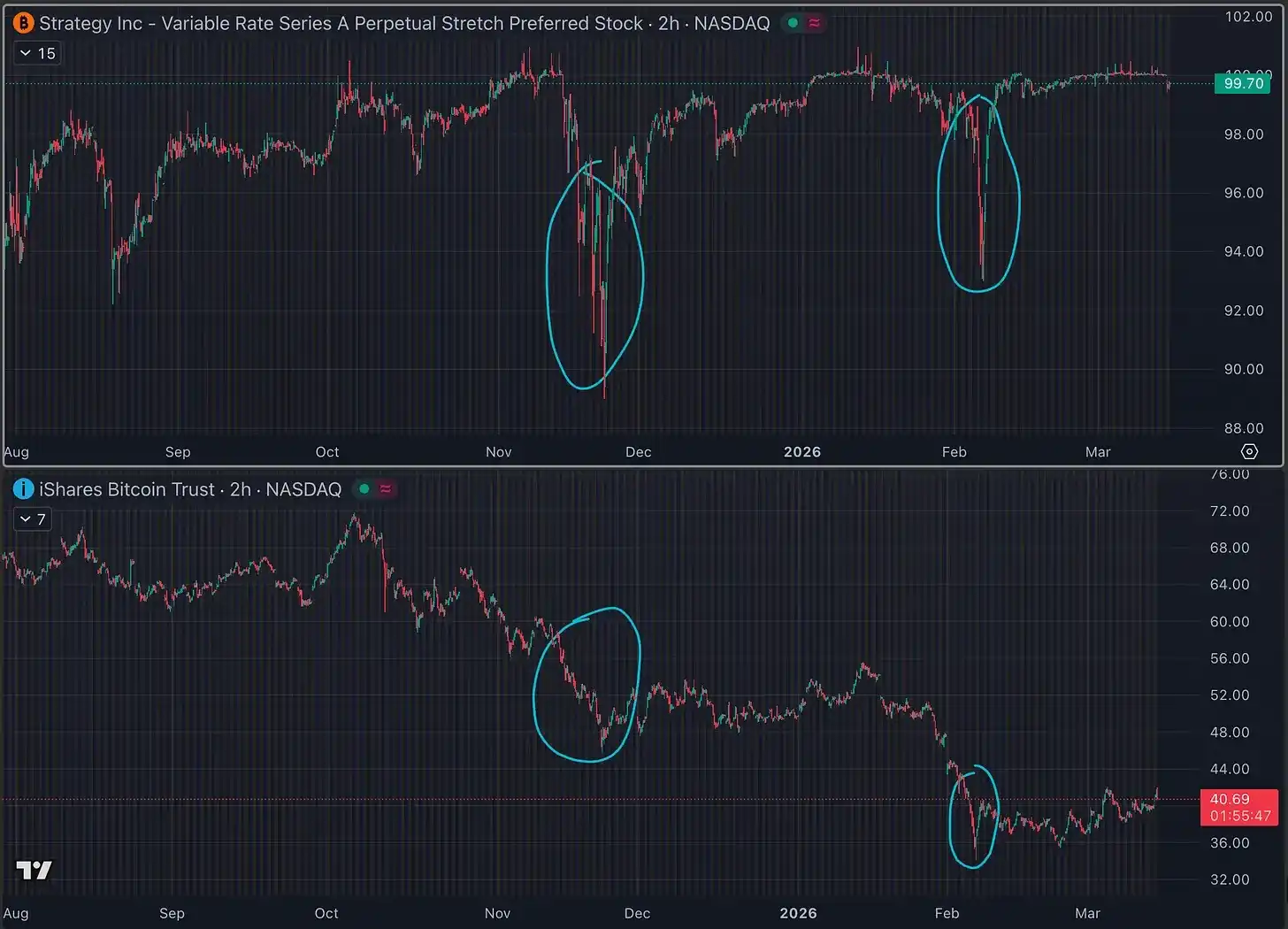
Odaily Note: IBIT (BlackRock Bitcoin ETF)'s biggest drops usually accompany STRC declines.
Risk 3: STRC Trades at a Discount Long-Term
Trust in STRC's ability to return to par comes from two factors: its actual credit risk and the risk perception formed by historical price action. The second factor can also work in reverse: what if everyone believes a 5% pullback will be quickly bought, but suddenly one time it isn't?
If that happens, those who bought at a 5% drop might choose to exit, causing further price declines and potentially triggering new emotional selling, leading to a larger drop. We can imagine a scenario where STRC falls 15% and fails to rebound for several days; the accumulated confidence could gradually erode, triggering greater selling pressure.
In this case, what stops this vicious cycle? The answer is still BTC's price. Saylor's entire strategy is ultimately built on the expectation that BTC will achieve over 20% annual returns for the next decade or more.
Risk 4 (Worst Expectation): The Fundamental Risk is Always BTC's Performance
The worst-case scenario for STRC is the situation I just described, but with BTC unable to recover strongly in a prolonged bear market. With so many variables involved, it's hard to predict exactly what would happen, but roughly it would be: STRC would trade persistently below par, so Saylor would increase the dividend rate monthly, trying to pull the price back to $100.
At some point, the dividend rate would become too high to be reasonable, and he would stop increasing it, just maintaining a certain level. This means he would no longer follow the previous "guidance"—increasing the dividend rate when the monthly VWAP is below $99. Remember, this is just guidance; nothing forces him to comply.
Not following this guidance would further weaken market confidence in STRC; it might continue trading at a significant discount, e.g., a 40% discount and a 15% dividend rate, meaning an effective yield of about 25%.
MSTR would also trade below 1x mNAV, meaning the company cannot sell MSTR shares to help pay dividends. Strategy would rely entirely on its dollar reserves to pay dividends, and currently, their reserves are sufficient to cover 28 months (about 2 years and 4 months) of dividend payments. As these 28 months gradually approach, all related assets could face greater pressure, with more reasons for BTC, MSTR, and STRC to continue falling.
When the dollar reserves are exhausted, Strategy would have to gradually sell BTC. Current annual dividend expenditure is about $1 billion; if this rises to $2 billion, Strategy would have to sell about $200 million in BTC monthly to maintain dividend payments. Alternatively, they could choose to stop paying dividends, in which case the value of preferred shares, STRC, and MSTR would fall further, and the company could do little until BTC prices recover.
This roughly outlines the worst-case scenario. As you can see, Strategy's dollar reserves provide a huge buffer for a prolonged bear market, as Strategy could theoretically do nothing and rely on reserves to pay dividends for over two years without being forced to act.
Currently, we are in the middle of a BTC bear market, with prices around $70,000 (down about 45% from the top), but STRC is still trading near par (11.5% dividend rate), and mNAV is 1.2x. Given that I don't believe BTC will experience a two-year bear market (the 2022 bear market lasted about a year from top to bottom), and Strategy hasn't even started using its dollar reserves, I think Strategy's overall structure is quite safe and resilient at current leverage levels.
Risk 5 (Long-Term Concern): Strategy's Model is Too Effective
As I said on X yesterday, as a BTC bull, the biggest risk associated with Strategy is—it might run too successfully.
"The biggest bear case for Strategy is actually that the strategy runs too successfully. If it succeeds, they will keep increasing their BTC holdings. But eventually, they become too large, polluting BTC's originally 'pure' narrative. In fact, this is already happening."
In fact, Strategy already holds about 3.5% of the total BTC supply. This could negatively impact future BTC demand, as it might start weakening the narrative of BTC as a purely decentralized asset. The "Digital Credit" narrative around STRC and its high yield has also sparked some negative reactions in the crypto community, which could indirectly affect BTC demand.
As I explained throughout the article, the amount of BTC Strategy holds will only continue to increase. The only scenario where this might not hold is if BTC experiences at least two years of painful cycles. Even then, it would take even longer低迷行情 for Strategy's BTC reserves to gradually decrease due to dividend payments.
I can understand why some people are uncomfortable with Strategy's role in the BTC ecosystem. But in my view, if this alone is enough to turn you bearish on BTC's long-term prospects, you probably weren't that bullish on BTC to begin with. From my perspective, this isn't a serious issue. True, Strategy is a single entity holding 3.5% of the BTC supply, but ultimately, Strategy and its BTC reserves belong to its shareholders.
Is this so different from BlackRock holding a similar amount of BTC on behalf of IBIT shareholders? Of course, they are not identical, and IBIT doesn't have bankruptcy risk. But in my view, they are somewhat similar—they both represent the financialization of BTC, a trend that is itself inevitable.
I don't think Strategy and STRC pose a systemic risk to BTC, but I can understand the negative impact they might have on BTC's narrative. Anyway, this article is mainly to help everyone understand STRC and Strategy's structure. After that, you can decide for yourself whether you are more bullish or bearish on it.
Is STRC the New UST?
Comparisons between STRC and Luna / UST / Anchor have been mentioned too frequently in recent social media discussions, so I think it's worth discussing specifically. Actually, the two are completely different on many levels.
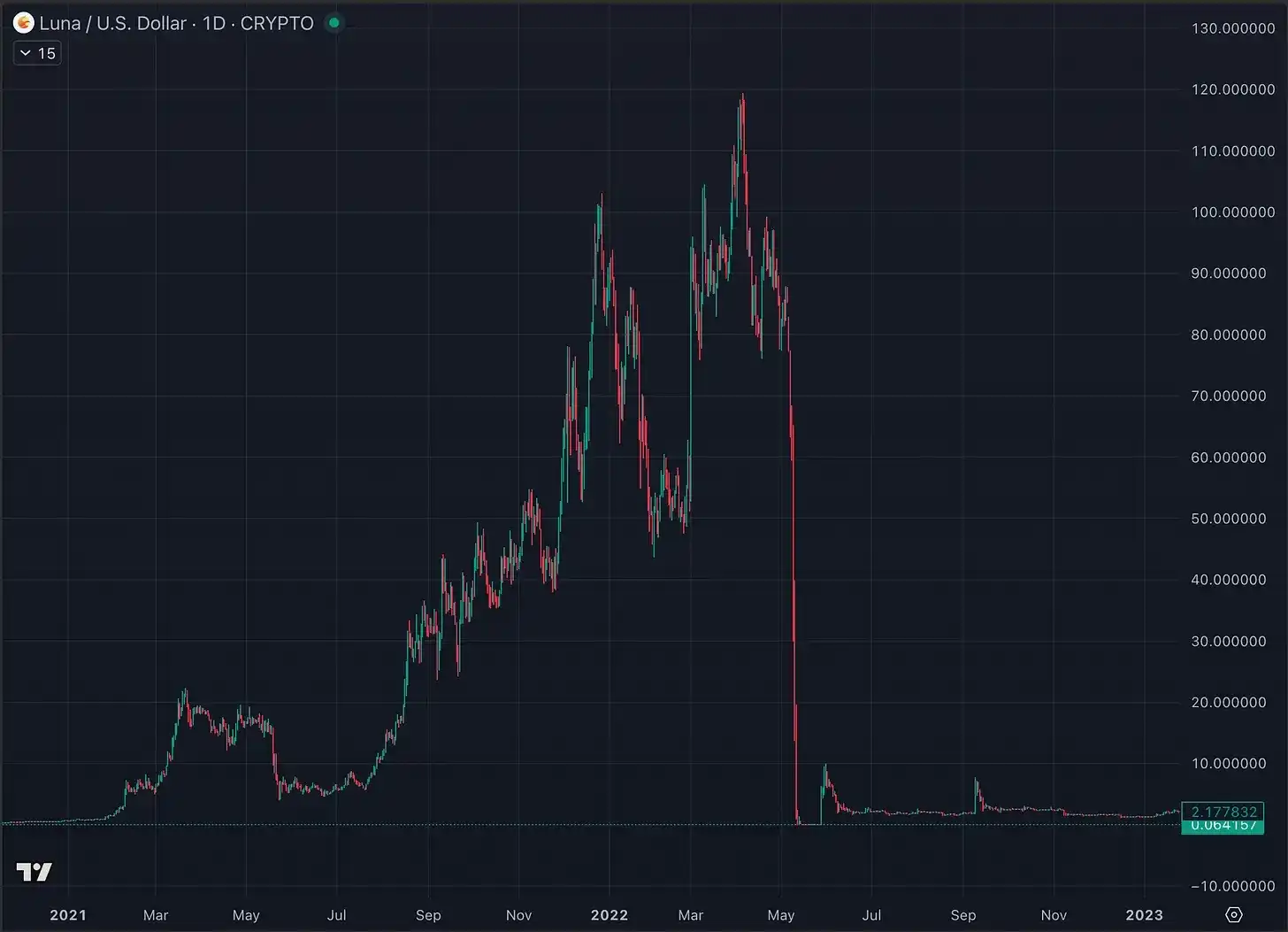
Odaily Note: LUNA's price chart before the crash.
UST was a stablecoin, so maintaining the $1 peg was critical; STRC is a preferred share, ideally trading within a 1% range near $100, but it can完全可以 fall a few percentage points. This has happened and will happen again, and it's not necessarily a problem in itself.
UST was backed by LUNA, and LUNA's value depended partly on UST's success. When UST traded below peg, users could redeem UST for newly minted LUNA. This increased selling pressure on LUNA, weakening market confidence in the system and further increasing selling pressure on UST. The result was a reflexive death spiral that drove UST and LUNA values to near zero in days. STRC has no such reflexive mechanism because a drop in STRC's price does not trigger forced issuance, redemption, or dilution of other assets in the system, nor does it affect BTC.
Anchor provided an 18%–20% yield for UST, which is not only significantly higher than STRC's current ~11.5% yield but was also largely subsidy-driven and structurally unsustainable. STRC's yield source is relatively simple: Strategy expects BTC's annualized return over the next decade to exceed 20%, STRC holders get the first ~11.5% (or whatever the dividend rate is) with relatively low volatility, and MSTR shareholders bear the remaining upside and volatility.
We also know very well how Strategy can continue paying dividends. If mNAV is above 1x, they can issue MSTR shares via ATM; if mNAV is below 1x, they can rely on dollar reserves (currently enough for over two years of dividends). If reserves are exhausted, they can eventually sell BTC derivatives or directly sell BTC from the treasury. In the case of UST and Anchor, it was essentially—"bro trust me, I'll definitely keep paying."
Price declines affect the two systems completely differently. When UST lost its peg, confidence collapsed rapidly, and the market quickly believed the system could go to zero; for STRC, a lower price means a higher effective yield, which might attract new buyers. For example, in a completely pessimistic scenario, if STRC trades at $50 with a 12% dividend rate, its effective yield is about 24%.
Finally, the time dynamics are completely different. Luna/UST was an extremely fragile system that could collapse within days after confidence was lost. For STRC, even the worst-case scenario described earlier would develop much more slowly (a very slow decline), potentially taking years, unless you assume BTC catastrophically drops 90% in a few months.