Oxford and NUS Propose the Next-Generation World Model Direction: The Mental World Model is Here
marsbitPubblicato 2026-08-13Pubblicato ultima volta 2026-08-13
Introduzione
Researchers from Oxford University and NUS propose Mental World Modeling (MWM), a framework that integrates mental variables like beliefs, goals, and social norms into world state representations, alongside physical variables. They argue that conventional world models, focused solely on physical dynamics, often produce predictions that are physically plausible but behaviorally incorrect in human-centric scenarios, as actions depend on both external and internal mental-social states. To validate MWM, they introduce MENTIS, a modular, training-free benchmark system that forces LLMs to perform explicit reasoning steps: parsing a scene into a coupled physical-mental state, generating agent-specific observations, simulating the joint state transition for candidate actions, and evaluating outcomes. Experiments on 8 LLM-based models show that explicit MWM reasoning significantly improves action prediction accuracy (F1 score rising from 63.3 to 87.9 on average), with the largest gains in social interaction scenarios. A key finding is that the primary remaining bottleneck is the simulation of state transitions. The work formalizes MWM and demonstrates its necessity for systems where behavior depends on variables not inferable from physical scenes alone.
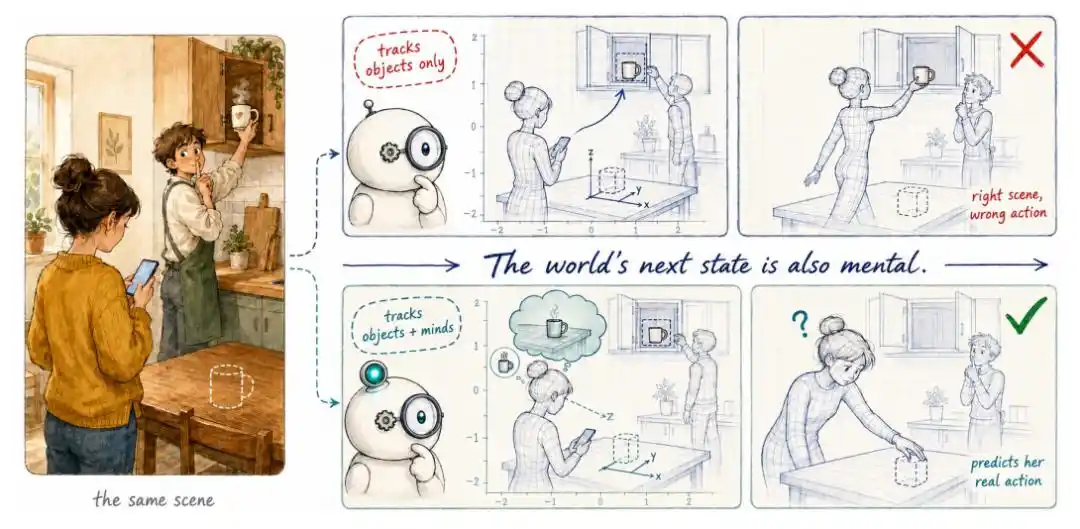
Imagine this scenario: A cup is placed into a cupboard by person A, and person B does not see it.
Question: Where will person B look for the cup next?
A world model that only knows physical facts would make the wrong prediction for B's next decision: 'The cup is currently in the cupboard, so they should look there.' (Top)
But a model that also understands the human mind would correctly predict: 'B doesn't know the cup has been moved, so they believe it's still on the table and will most likely return to the table to look.' (Bottom)
The next state of the world is also determined by mental variables
This reveals a key problem: World models that only track objects, locations, and movements can yield predictions that are 'physically plausible but behaviorally incorrect.'
Recently, a research team from the University of Oxford and the National University of Singapore published a new study, "Mental World Modeling," proposing a general framework: Mental World Modeling (MWM). This work integrates these mental variables themselves into the world state, rather than treating them merely as post-hoc explanations.
Paper Title: Mental World Modeling
Paper Link: https://arxiv.org/abs/2607.27201
Project Homepage: https://mental-world.github.io/
Open Source Code: https://github.com/mental-world/Mentis
As of publication, MWM has reached #1 on the Hugging Face Daily Papers daily ranking.
Hugging Face Paper: https://huggingface.co/papers/2607.27201
The Missing Half of World Models
Most existing world models primarily focus on the physical aspects of the world:
What objects and agents exist?
Where are they located?
How will the visible scene evolve?
In these models, humans are often just objects that move and perform actions; their internal mental states do not truly enter the world model. But in the real world, humans are not simply moving objects.
For human-centered intelligence, this is far from sufficient.
Why? Because human decision-making is not solely determined by the external environment of objects, spatial structures, and physical laws. It is jointly produced by the interaction between the external environment and internal mental-social variables.
For example, a service robot needs to judge whether a user is confused, losing patience, or indirectly seeking help; a medical assistant needs to consider the patient's cognition, risk perception, fear, and level of trust; a collaborative agent must recognize that while certain behaviors may be physically feasible, they might be socially inappropriate due to norms, role relationships, or the context of interpersonal interaction.
These scenarios require intelligent systems to continuously track the mental and social states of agents, including: what they know, believe, attend to, desire, intend to do, feel, and which behaviors they consider socially permissible. Even if two scenarios are physically identical, as long as the beliefs, goals, emotions, interpersonal relationships, or social responsibilities of the people differ, their behaviors may be completely different.
In summary: A world model can accurately reconstruct a physical scene yet still fail to correctly predict human behavior.
Cognitive science has studied these capabilities through theories such as mental models, Theory of Mind (ToM), the Belief–Desire–Intention (BDI) agent model, and embodied cognition.
However, most current AI research either constructs physical world models lacking mental states or reduces psychological reasoning to isolated Theory-of-Mind question-answering tasks.
Neither perspective is sufficient to describe a truly complete world — because the next state of the world is not determined solely by physical factors but arises from the joint evolution of physical and mental states.
How can mental variables truly be integrated into the state space of a world model?
This research attempts to propose a formal framework for Mental World Modeling to construct world models capable of simultaneously representing physical and mental dynamics.
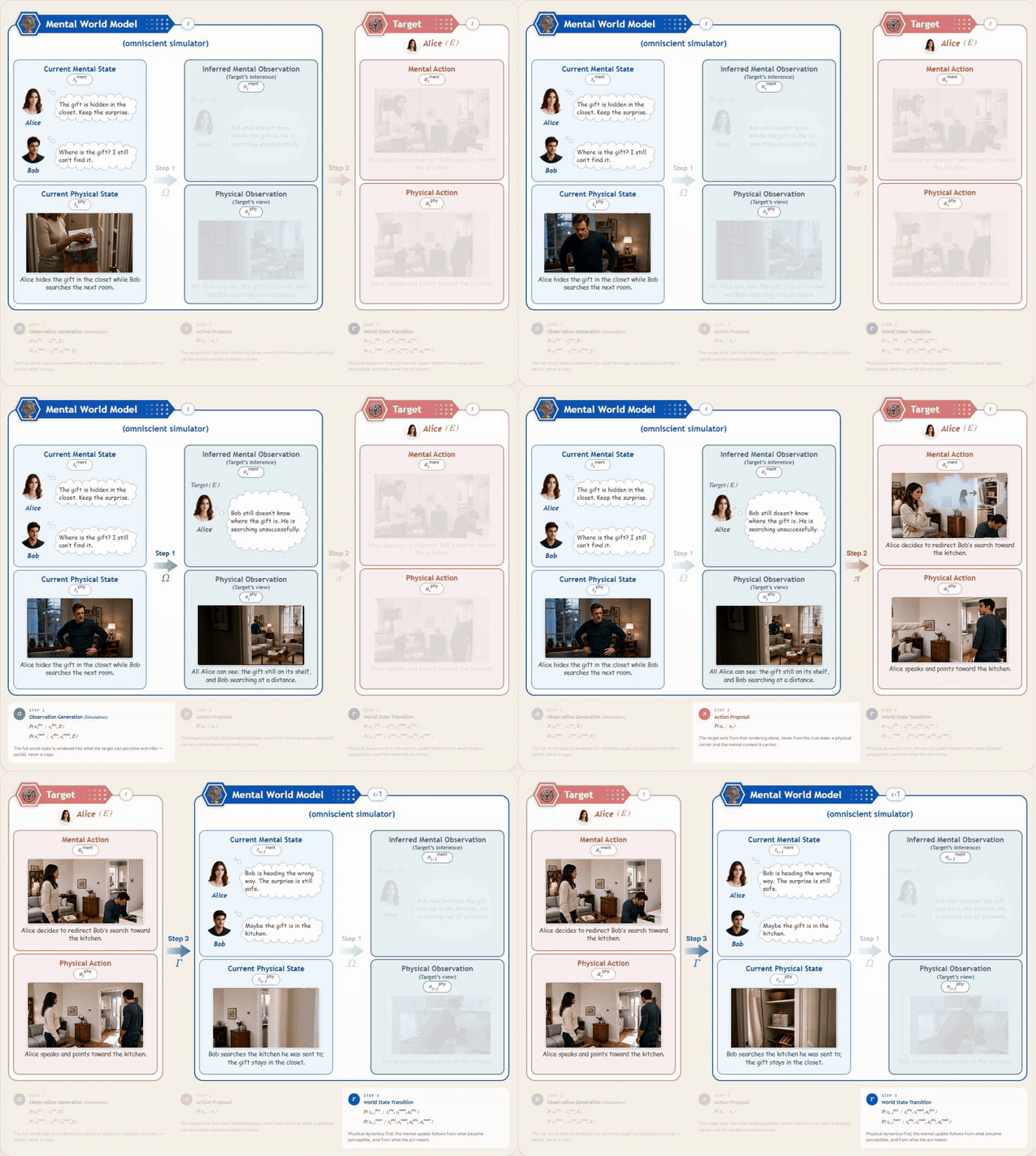
The goal of Mental World Modeling is not to simulate a person's private, subjective consciousness and experience. Instead, it aims to construct an external, approximate, task-relevant world simulator. The global state of this simulator includes both physical variables and mental variables.
Two main components, three operational modules, one coupled physical–mental state. As a global simulator, the Mental World Model first generates the information a target agent can see and infer, then allows the agent to act based on this cognition.
First, Mental World Modeling maintains a coupled physical–mental world state, representing both the physical environment and the latent mental states of agents.
Second, a target agent can only observe a transformed, partial, first-person rendering of this global state. For each target agent, MWM generates a local observation perspective tailored to that agent — i.e., what the person can actually see, hear, know, and infer.
Subsequently, the target agent takes an action based on this observation, and the world model simulates how that action will simultaneously change:
The objective scene in the physical world;
The configuration of states in the mental-social world.
How to Verify MWM Works?
To make this framework verifiable, the team implemented a modular reference system, MENTIS, an untrained, fully observable benchmark system that forces Large Language Model (LLM)-based systems to reason in a Mental World Model fashion.
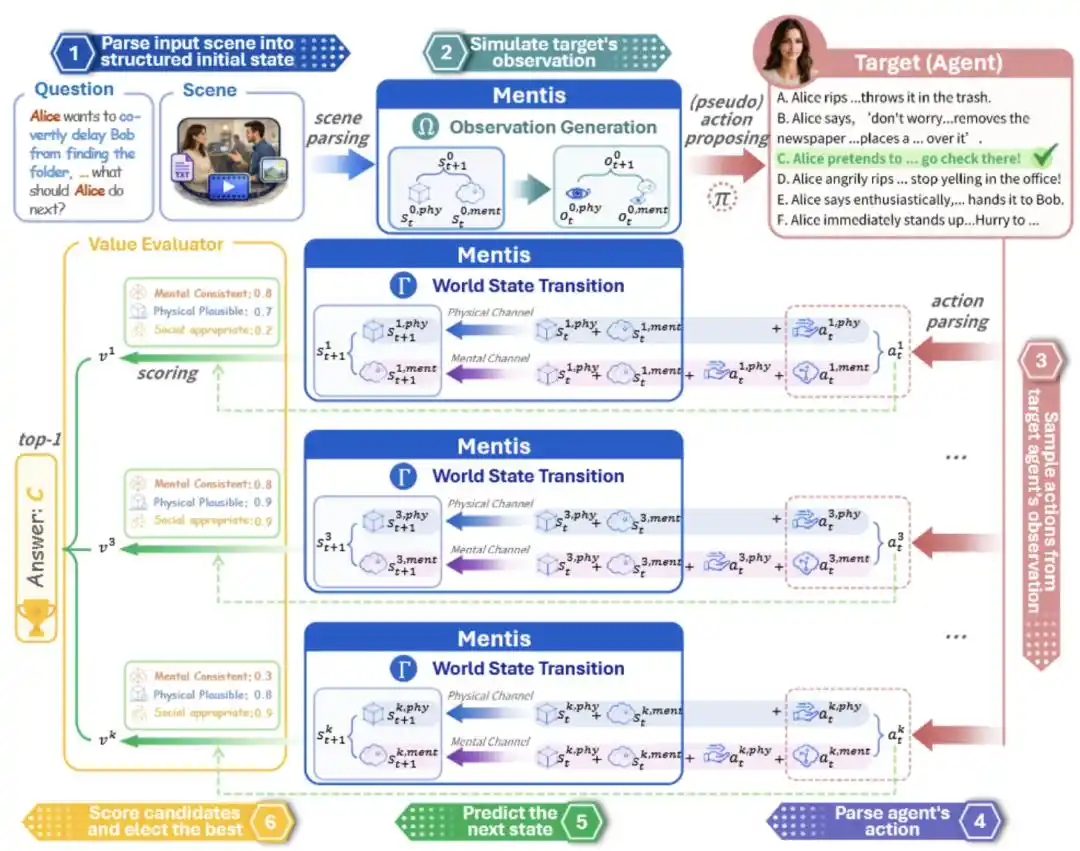
The MENTIS Process.
The system first converts the input scenario into a structured current state
, generates observations for the target pseudo-agent
, parses each candidate option into an action branch, simulates the subsequent changes in physical and mental states in parallel, and finally evaluates different future outcomes to select the final behavior.
Given a contextualized scenario, a target agent, and a set of candidate behaviors, MENTIS decomposes the decision prediction process into a series of explicit stages: state parsing → target observation generation → action decomposition → coupled physical–mental state transition simulation → branch-level evaluation → final decision.
First, it parses the scenario into a typed physical–mental state;
Then, it generates local observations that the target agent can obtain from that state;
Next, it decomposes each candidate behavior into its corresponding physical and mental effects;
Then, it simulates the coupled physical–mental next state for each possible action branch;
Finally, it scores each branch on three dimensions: physical plausibility, mental consistency, and social appropriateness, and selects the final behavior via deterministic rules.
In other words, MENTIS no longer allows the model to jump directly from scenario to behavior prediction. Instead, it requires explicit modeling of: what state the world is currently in, how the target agent perceives the world, how different actions would change the physical and mental states, and which behavior is most plausible both physically and socially.
MENTIS requires no training, so its results reflect the reasoning capability brought by the model structure itself, not parameters learned from fitting. Every stage in the system outputs machine-verifiable intermediate products, so states, observations, and simulated futures can be recorded, compared with human annotations, or directly replaced with ground truth for analysis.
Does MWM Really Work, and What are the Bottlenecks?
The researchers designed a series of experimental groups specifically testing where the framework might fail, with results showing a consistent pattern.
First, explicit Mental World Modeling is necessary for predicting human decisions.
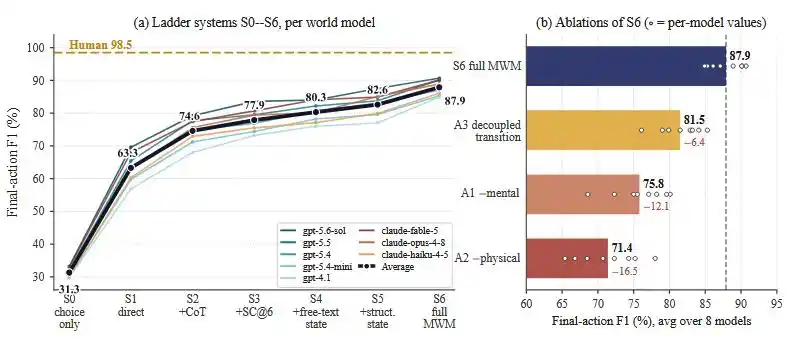
Necessity Staircase (Final Action F1, 448 records). (a) F1 scores of eight world models at different staircase stages (thin lines show individual model results, thick lines show average results) (b) S6 ablation experimental results across the eight models (white dots show corresponding values for each model).
Among the 8 LLM-based world models tested, the average F1 for direct answering was 63.3; the full MWM configuration achieved the best performance at 87.9. Removing the mental channel caused all models' performance to drop by approximately 12.1 points; removing the physical channel caused a 16.5 point drop; and predicting the two state transitions separately also resulted in a 6.4 point drop.
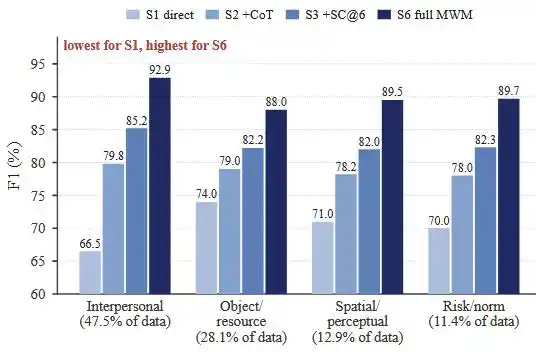
F1 score performance of four experimental setups across different scenario categories
Moreover, the performance improvement was most significant in interpersonal interaction scenarios, because decisions in these scenarios primarily depend on hidden mental variables. For gpt-5.6-sol, the full MWM raised the final action F1 from 66.5 for direct answering to 92.9, an increase of 26.4 points. This result is only from the paper's controlled tests, but it aligns with the research motivation: when beliefs, roles, and relationships dominate the next step, physical variables alone cannot explain the action.
So, what is the real bottleneck?
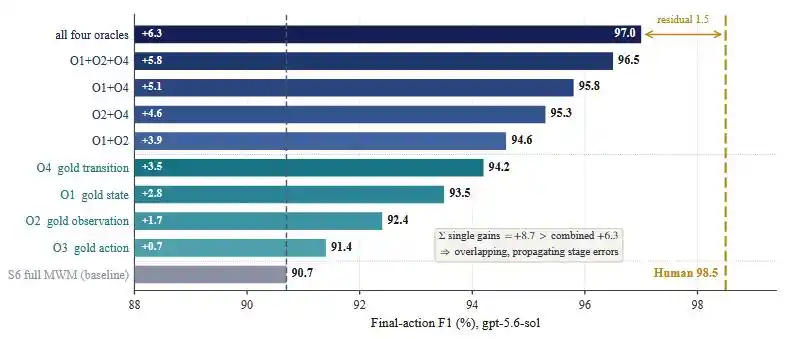
Besides proving its necessity, the paper also conducted a more diagnostic set of experiments: replacing an intermediate step with correct information (Oracle intervention) and observing how much the final prediction could improve, further attributing the gap between model and human performance.
Oracle Intervention Experiment (gpt-5.6-sol). Final action F1 scores after substituting model predictions with ground truth annotations at one or more stages; bar chart labels indicate the performance gain compared to the full prediction version S6.
The experimental results show that for gpt-5.6-sol, the full MWM scored 90.7. Using the true ground truth state transition could increase this to 94.2, yielding a +3.5 performance gain, the largest single-item improvement. With intervention on state transition alone, the model could bridge 45% of the performance gap to human performance (7.8 points).
The results indicate that the greatest remaining bottleneck is state transition simulation, i.e., the model's insufficient ability to predict how the coupled physical–mental world will change. This provides a clear direction for improving future MWM systems.
When is Mental World Modeling Most Impactful?
The application value of MWM should not be measured by 'how many social domains it can enumerate.' After all, nearly all human-facing systems are, broadly speaking, 'social' in some sense.
A more accurate and meaningful criterion is:
MWM has real value when the effectiveness of a behavior depends on variables that cannot be inferred from the physical scene alone, yet determine how humans perceive, choose, accept, resist, or learn.
From a decision theory perspective, the value of mental state information can be defined as:
The expected utility gap between the optimal intervention chosen given access to the coupled physical–mental state, and the optimal intervention chosen based solely on the physical state.
This gap is very significant when beliefs, goals, attention, trust, obligations, emotional states, or social norms change 'which behavior is beneficial.' It is small when the next action is almost entirely determined by physical feasibility.
For example, a mechanical gripper controller does not need MWM to perform the action 'reach out and grab the cup'; but a home service robot deciding 'whether to hand this cup to its owner' needs to understand the underlying mental and social states — whether this act is helpful, intrusive, impolite, risky, or conveys misinformation.
Conclusion
This work proposes a formal framework for Mental World Modeling to construct world models capable of simultaneously representing physical and mental dynamics. The core contributions can be summarized in three points:
Proposal of Mental World Modeling: A formal mathematical framework that integrates physical and mental dynamics within a unified world modeling perspective, enabling AI systems not only to reason about how the environment changes but also to understand how agents perceive, interpret, and respond to these changes mentally.
Proposal of MENTIS: An untrained benchmark implementation that concretizes and operationalizes the MWM framework through modules like state parsing, observation generation, action decomposition, coupled physical–mental state transition, and branch-level value assessment.
Conduction of systematic empirical research, with experimental results distilling two core conclusions:
Explicit Mental World Modeling is necessary for predicting human decisions, especially in social interaction and interpersonal relationship scenarios;
The key bottleneck for current MWM systems lies in insufficient state transition simulation capability, which also points the way for future research improvements.
This article is from the WeChat public account "Machine Heart"
Domande pertinenti
QWhat is the core concept of 'Mental World Modeling (MWM)' proposed by Oxford and NUS researchers?
AThe core concept is a formal framework for building world models that simultaneously represent and simulate both the physical dynamics of the environment and the mental-social dynamics of agents (like beliefs, goals, and relationships). This goes beyond traditional world models that only track physical facts.
QWhat is the key limitation of traditional world models highlighted by the article's opening example?
ATraditional world models that only track physical facts (like object positions) can make predictions that are physically accurate but behaviorally wrong. In the example, such a model would incorrectly predict agent B goes to the cabinet, not understanding that B's false belief (thinking the cup is still on the table) dictates their action.
QWhat is MENTIS, and what is its primary purpose in this research?
AMENTIS is a modular, train-free, and fully observable reference system implemented by the researchers. Its primary purpose is to serve as a benchmark that forces LLM-based systems to reason in the structured, step-by-step manner of a Mental World Model, making the reasoning process explicit and verifiable.
QAccording to the experimental results, what is identified as the 'biggest remaining bottleneck' for current MWM systems?
AThe biggest remaining bottleneck is the 'state-transition simulation' capability—the model's ability to accurately predict how the coupled physical-mental world state changes as a result of an action. Oracle intervention experiments showed that improving this part yielded the largest performance gains.
QWhen is Mental World Modeling (MWM) considered to have the most significant application value?
AMWM is most valuable when the effectiveness of an action depends on hidden mental-social variables (like beliefs, trust, social norms, or emotions) that cannot be inferred from the physical scene alone, but which critically determine how humans perceive, choose, accept, resist, or learn from the action.