RWA First Stock's Major Acquisition: Why Buy a 'Traditional' Mortgage Company?

Foresight NewsPubblicato 2026-06-12Pubblicato ultima volta 2026-06-12

Introduzione

On June 10th, Figure Technology Solutions (Nasdaq: FIGR), a blockchain-native capital markets firm, announced a $717 million acquisition of Kiavi, a leading non-bank lender for residential real estate investors. The deal involves Figure acquiring Kiavi's technology and operations for approximately $538 million, while forming a joint venture with alternative asset manager Sixth Street to purchase Kiavi's existing loan portfolio. Sixth Street also provided a $3 billion forward purchase commitment. This acquisition marks a strategic shift for Figure, known as the "RWA (Real World Asset) first stock," allowing it to expand significantly into the larger market of first-lien mortgages. Kiavi specializes in non-qualified mortgage (Non-QM) loans, such as short-term fix-and-flip (RTL) and rental property (DSCR) loans—a segment traditionally underserved by major banks. The move is expected to increase Figure's first-lien loan origination to over $7 billion annually, aiming for these to constitute about 40% of its business by 2027. Both companies leverage AI for underwriting: Kiavi uses proprietary models to value renovated properties and automate document processing, dominating the fix-and-flip lending space. Figure plans to integrate these assets onto its blockchain platform, Provenance, using its new 'Adaptor' product to standardize and tokenize the loans for institutional investors on its Democratized Prime marketplace. While the integration poses challenges—including merging dif...


Author: Sanqing, Foresight News


On June 10th, blockchain-native capital markets company Figure Technology Solutions (Nasdaq: FIGR) announced the acquisition of Kiavi for $717 million. Kiavi is a non-bank residential real estate investor lending platform founded in 2013, with cumulative loan origination exceeding $30 billion.


In the deal, Figure acquires Kiavi's technology and operational platform, funding approximately $538 million through the issuance of about $600 million in senior unsecured notes. The remaining roughly $179 million is contributed by global alternative asset manager Sixth Street, with the two parties forming a joint venture to purchase Kiavi's existing loan portfolio on its balance sheet. Sixth Street also provides a $3 billion forward purchase commitment. The two companies have been long-term partners. Kiavi's current CEO, Arvind Mohan, will join Figure as Chief Business Officer after the deal closes, leading the business integration.
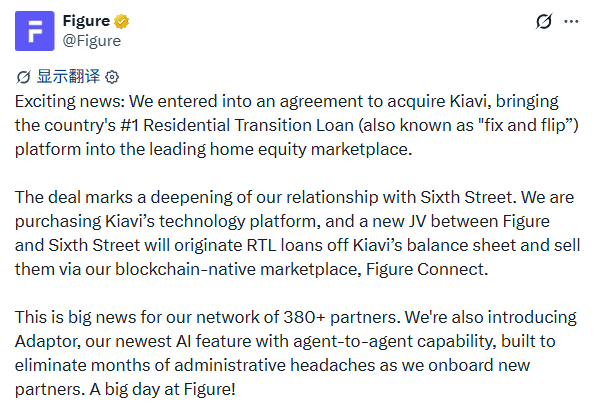

Image source: Figure tweet


After the announcement, FIGR's stock price opened higher, briefly touching $30.11 during the session, but later retreated, closing at $28.07, down 0.74%, with an intraday fluctuation of about 9%.


Kiavi


Kiavi's predecessor was LendingHome, founded in San Francisco in 2013 by Matt Humphrey and James Herbert, with backing from investors like Foundation Capital, Ribbit Capital, and Renren.com.


It primarily offers two types of products: short-term transition loans (Residential Transition Loan, RTL) for property renovation investors, and Debt Service Coverage Ratio (DSCR) loans for long-term rental properties.


It rebranded to Kiavi in 2021, and in June 2025 became the first private non-bank institution in the US to reach 100,000 cumulative loans originated.


According to the official announcement, Kiavi achieved revenue of over $250 million and EBITDA of over $100 million in 2025, both record highs; full-year origination volume was approximately $7.8 billion, up about 20% from approximately $6.5 billion in 2024.


First Lien


The origin of Figure dates back to late 2017. After leaving SoFi that year, co-founder Mike Cagney turned his attention to blockchain. In 2018, he and his wife June Ou founded Figure in San Francisco. The following year, they launched their first product on their self-built Provenance Blockchain: a home equity line of credit (HELOC) originated on-chain.


Mike Cagney | Image source: Bloomberg


Subsequently, the company expanded along the same logic—loan origination, financing, secondary market trading...—and gradually migrated these processes on-chain, building the consumer lending marketplace Figure Connect and the on-chain warehouse financing market Democratized Prime.


Following its Nasdaq listing in September 2025, Figure officially stated that it currently accounts for about 75% of the global tokenized RWA volume.


The problem is, HELOCs are second-lien loans.


Second liens rank behind first liens in repayment priority upon borrower default, carrying higher risk and supporting a smaller asset scale. Figure estimates that the market size for first liens is about 25 times that of second liens.


Kiavi's RTL and DSCR products are both first-lien loans, and they operate in the Non-Qualified Mortgage (Non-QM) space, which traditional banks have long avoided due to regulatory concerns—a space with strong demand but highly fragmented supply.


Figure is proactively shifting the focus of its asset classes.


Post-acquisition, Figure expects to add over $7 billion in new first-lien loan volume annually. According to CEO Michael Tannenbaum, Figure's first-lien business proportion had already increased from 10% to 20% in 2025, and the company expects this ratio to reach about 40% by the end of 2027.


AI


Both Figure and Kiavi excel at using AI to process non-standard data that traditional financial institutions are reluctant to touch, building moats in areas where manual processes cannot scale.


Kiavi's core technological asset is a proprietary "after-repair value estimation engine" and an automated document review system. An old, dilapidated property awaiting renovation is nearly impossible for traditional institutions to risk-quantify.


Kiavi's model can predict the post-renovation market value based on historical transaction data and renovation plans, enabling the scaling of credit decisions for loans like RTLs.


This capability has yielded significant market advantages. According to the Scotsman Guide's "2025 Top Private Lenders" rankings (underlying data from Forecasa), Kiavi's fix-and-flip loan origination volume in 2024 was approximately $5.5 billion, more than three times that of the second-place lender, and it continued to expand its lead in 2025.


Image source: Kiavi


Figure aims to solve the problem of what happens to assets after they leave Kiavi: how to put them on-chain, how to circulate them, and how to attract institutional capital. Figure's newly unveiled product in this deal, Adaptor, is designed precisely for this purpose.


It supports "Agent to Agent" automated integration, standardizing the diverse data formats from different originating institutions, thereby compressing the onboarding cycle for new partners.


Kiavi's assets will become the first real-world validation scenario for Adaptor after its launch. According to Figure's investor presentation materials, the company expects this transaction to achieve approximately $35 million in cost synergies within 24 months.


Two AI systems are being stitched together, pointing towards the same goal: making non-standard real estate loans priceable, tradable, and scalable on-chain.


Integration


Figure employs a dual-class share structure. According to the IPO prospectus, Cagney and his affiliates hold Class B shares, controlling about 69% of the total voting power at the time of the IPO; as of the latest proxy statement in April 2026, he still controls the majority of voting power, and Figure continues to be designated a "controlled company" by Nasdaq.


As a growth-stage company undertaking a major acquisition less than a year after its IPO, Figure also disclosed in its S-1 filing that previously existing material weaknesses in internal controls were yet to be remediated. The large-scale integration poses a non-negligible test for the execution team.


On Kiavi's side, its assets are sensitive to interest rate cycles. During the 2022 hiking cycle, lacking the backing of government-sponsored enterprises (GSEs) like Fannie Mae and Freddie Mac, the liquidity of Kiavi's assets in capital markets tightened, leading the company to make corresponding cost and personnel adjustments.


This vulnerability has already been validated during the high-interest-rate phase, and future interest rate changes will remain a significant external variable for RTL/DSCR origination volume.


Furthermore, Figure's existing assets are still heavily concentrated in HELOCs. Kiavi's asset types, data formats, and customer base are significantly different. It remains to be seen whether Adaptor can truly reduce integration costs and whether Kiavi's non-standard assets can be smoothly absorbed by institutional investors on Democratized Prime.


The good news is that Figure stated the deal will be accretive to earnings per share, with an unlevered cash payback period not exceeding 4 years, and reaffirmed its medium-term EBITDA margin target of around 60%; Kiavi's monthly loan flow exceeding $100 million will be directly fed into Democratized Prime.


Sixth Street's managed and committed capital scale of over $130 billion, along with its $3 billion forward purchase commitment, provides considerable capital buffer for the joint venture; Mohan's entry into the executive team means Kiavi's customer relationships and industry resources are retained within Figure's management structure.


The RWA narrative has been around for several years. This time, Figure is using $717 million to migrate an institution that has operated for 13 years and processes billions of dollars in real loans annually entirely onto the blockchain. This is one of the most structurally significant acquisitions in the RWA tokenization space to date.


The potential market space Figure points to is its estimated approximately $200 billion annual RTL/DSCR origination opportunity, underpinned by the long-term renovation and rental demand generated by the roughly $25 trillion stock of aging housing in the US.


If the integration proceeds smoothly, this could be a landmark node marking the transition of blockchain capital markets from "proof-of-concept" to "scale operations." Not just for Figure, but for the entire RWA credit asset market.

Domande pertinenti

QWhat is the main reason for Figure Technologies Solutions' acquisition of Kiavi?

AThe primary reason for Figure Technologies Solutions' acquisition of Kiavi is to pivot its business focus towards first-lien loans, such as Kiavi's Residential Transition Loans (RTL) and Debt Service Coverage Ratio (DSCR) loans. These loans represent a significantly larger market compared to Figure's existing HELOC products, which are second-lien loans.

QWhat is the significance of the 'Adaptor' product introduced by Figure in this deal?

AThe 'Adaptor' product is significant as it is designed to standardize and automate the connection of data from various loan originators, like Kiavi, onto the blockchain. It aims to reduce the integration period for new partners and facilitate the tokenization and trading of non-standard real estate loan assets on Figure's platform.

QWhat core AI-driven capabilities does Kiavi bring to the combined entity?

AKiavi brings its proprietary 'renovation-after-value estimation engine' and automated document review system. These AI capabilities allow Kiavi to assess the risk and predict the post-renovation market value of older properties, enabling the scalable underwriting of non-standard loans like fix-and-flip (RTL) loans.

QWhat are the major challenges or risks associated with integrating Kiavi into Figure's operations?

AMajor challenges include: 1) The integration complexity for Figure, a growth-stage company with recent IPO and past internal control weaknesses. 2) The interest-rate sensitivity of Kiavi's loan assets, which have shown vulnerability in high-rate environments. 3) The uncertainty of whether Kiavi's non-standard assets can be seamlessly absorbed by institutional investors on Figure's Democratized Prime platform.

QWhat makes this acquisition a structurally significant event for the broader RWA tokenization market?

AThis acquisition is structurally significant because it involves migrating a large, established, and profitable real-world lending platform (Kiavi) with over a decade of operation and billions in annual loan volume onto a blockchain ecosystem. It represents a move from conceptual proof-of-concept to large-scale operational execution in the RWA tokenization space, targeting a massive underlying market of U.S. housing renovation and rental demand.

Letture associate

Retail Ecology Dwindles, ZKsync Bets on Bank Pilots for a Breakthrough

Amidst declining retail activity, ZKsync is pivoting to target institutional banking as its primary growth strategy. The article explores this shift, contrasting it with the competitive "survival of the fittest" narrative by highlighting a cooperative model inspired by naturalist Peter Kropotkin. ZKsync is developing infrastructure like its private, permissioned Prividium suite for banks (e.g., Deutsche Bank's use case via Memento), enabling private transactions with public verifiability via zero-knowledge proofs. This appeals to institutions needing privacy, compliance, and Ethereum-based settlement security, unlike fully private chains (e.g., JPMorgan's Kinaxis) or consortium models (e.g., R3 Corda). However, this strategic focus has coincided with a steep decline in its public DeFi ecosystem, evidenced by plunging TVL and the departure of major protocols like Aave due to low fees. The network's future now hinges on banking adoption, with upcoming pilots like the Cari Network involving regional banks holding over $600 billion in deposits. A significant challenge is balancing this institutional focus with ZKsync's decentralized governance. Banks must operate on a network where rules and fees (denominated in the volatile ZK token) can be changed via community vote, and where a Security Council holds emergency control—a stark contrast to the predictable, contract-bound environments of traditional finance. The coming 18 months will test whether ZKsync can successfully onboard traditional banks onto a dynamically governed public chain or if institutions will ultimately revert to proprietary solutions.

Foresight News12 min fa

Retail Ecology Dwindles, ZKsync Bets on Bank Pilots for a Breakthrough

Foresight News12 min fa

The Recursive AI Anthropic Warned About: Tian Yuandong's New Company Has Just Taken the "First Step"

Anthropic recently highlighted the rapid progress toward "recursive self-improvement," where AI systems autonomously design and train their successors. In response, Recursive Superintelligence, a new company co-founded by former Meta researcher Tian Yuan Dong, has publicly demonstrated its first step toward automating AI research. The company released a system designed to autonomously execute the full AI research cycle: generating ideas, implementing code, running experiments, and learning from results. It validated this approach by achieving state-of-the-art results on three diverse benchmarks: 1. **NanoChat Autoresearch:** Optimizing a small language model's validation loss under a fixed 5-minute GPU budget, improving upon the community's best result. 2. **NanoGPT Speedrun:** Reducing the time to train a GPT model to a specific loss on 8 H100 GPUs from 79.7 seconds to 77.5 seconds, beating a highly optimized, human-driven community effort. 3. **SOL-ExecBench:** Improving the overall score on NVIDIA's suite of 235 GPU kernel optimization tasks by 18%, closing the gap to the hardware limit. The system discovered novel optimizations in this highly specialized domain without direct human expertise. Recursive's system operates as a general framework, capable of parallel exploration and cross-task knowledge transfer while incorporating safeguards against reward hacking. The company, backed by $650M in funding and a star-studded team including Richard Socher and Alexey Dosovitskiy, aims to create AI that recursively enhances its own research capabilities. This development represents an early but concrete move toward a new paradigm where AI accelerates its own advancement. It occurs alongside Anthropic's warnings about the need for industry coordination and potential pauses when recursive self-improvement thresholds are reached, highlighting the dual trajectory of rapid technical progress and growing calls for careful stewardship.

marsbit19 min fa

The Recursive AI Anthropic Warned About: Tian Yuandong's New Company Has Just Taken the "First Step"

marsbit19 min fa

The Gold Buy-on-the-Dip Guide: Watch Interest Rates, Not Just War

"Gold Buying Guide: Focus on Interest Rates, Not Just War" Four months ago, gold buyers likely didn't anticipate buying at a peak that even a war couldn't sustain. After hitting a record high of $5,596 on January 29, gold entered a bear market just 91 days later, its fastest decline since 2008. A key trigger was the Fed's hawkish shift, highlighting that monetary policy, not geopolitics, is the primary driver. The article argues that the traditional "buy gold in turmoil" script has changed. While the US-Iran conflict initially boosted prices, the sustained rally in oil prices heightened inflation fears, forcing central banks to maintain or consider tighter policy. Since gold yields no interest, higher rates increase its opportunity cost, eroding its appeal. This dynamic was evident when gold fell sharply on May 18 despite positive peace talks, as lower oil prices eased inflation and thus rate hike pressures. The recent sell-off is also part of a broader market deleveraging. Correlations between gold, Nasdaq, and Bitcoin spiked as leveraged investors sold liquid assets to cover losses, creating a synchronized downturn. Historically, gold bottoms align with policy shifts, not conflict resolutions. The 2008 and 2022 bear markets ended with shifts to extreme easing and peak inflation expectations, respectively. For potential buyers, the author suggests monitoring three signals: 1) Peak interest rate hike expectations, 2) Reopening of the Strait of Hormuz (to ease oil/inflation pressure), and 3) A return to net inflows for Gold ETFs, indicating the end of forced selling. While predicting the exact bottom is impossible, the author's personal strategy involves scaling into a position across price levels like $4000, $3700, and $3500, committing no more than 30% of the intended total allocation initially, and adding the remainder only if key signals emerge. The core conclusion: In turbulent times, watching interest rates is more crucial than watching wars.

marsbit26 min fa

The Gold Buy-on-the-Dip Guide: Watch Interest Rates, Not Just War

marsbit26 min fa

Recent On-Chain Review: No Clear Narrative Under U.S. Stock Market Pressure, Just Hype

This article analyzes the current state of the Solana meme coin and community token ecosystem, highlighting a market caught between two dominant forces: attention-based PvP and a gradual return to community-centric projects. The first part explores the "Attention PvP" dynamic, where success is driven by celebrity endorsements, viral events, and speed. Examples include $JOTCHUA, which surged after its meme creator's social media activity, and $WORLDCUP, which outperformed a similar Base chain project ($PITCH) largely due to influencer support. The recent "pump.fun GO" feature, allowing bounty tasks for token promotion, is critiqued for fostering sensationalist and often negative stunts—like people getting token tickers tattooed on their bodies for rewards—reminiscent of old internet shock content. In contrast, the article points to a resurgence of organic, community-driven tokens that survive market volatility through strong holder bases and shared ideology, not just hype. Influencer Ansem is cited, arguing that durable meme coins rely on communities willing to endure losses and promote their core message daily. Examples given are older tokens like $neet (anti-work ethos), $troll, $buttcoin, and $triplet, which have maintained relative price stability. A prime example of this community-build model is the new project $KINS, the token for the browser-based MMORPG Kintara. Its success stems not from advanced graphics but from consistently delivering updates, fostering player trust, and creating genuine engagement (e.g., in-game economies, events, property auctions). It has attracted a growing player base and even notable KOLs as participants, demonstrating that sustainable growth can come from building trust rather than orchestrating pumps. The article concludes by questioning whether the market is ultimately a game of mutual trust or mutual deception, expressing hope that such reflection might lead to a healthier ecosystem.

marsbit26 min fa

Recent On-Chain Review: No Clear Narrative Under U.S. Stock Market Pressure, Just Hype

marsbit26 min fa

Trading

Spot
Futures

Articoli Popolari

Cosa è $S$

Comprendere SPERO: Una Panoramica Completa Introduzione a SPERO Mentre il panorama dell'innovazione continua a evolversi, l'emergere delle tecnologie web3 e dei progetti di criptovaluta gioca un ruolo fondamentale nel plasmare il futuro digitale. Un progetto che ha attirato l'attenzione in questo campo dinamico è SPERO, denotato come SPERO,$$s$. Questo articolo mira a raccogliere e presentare informazioni dettagliate su SPERO, per aiutare gli appassionati e gli investitori a comprendere le sue basi, obiettivi e innovazioni nei domini web3 e crypto. Che cos'è SPERO,$$s$? SPERO,$$s$ è un progetto unico all'interno dello spazio crypto che cerca di sfruttare i principi della decentralizzazione e della tecnologia blockchain per creare un ecosistema che promuove l'impegno, l'utilità e l'inclusione finanziaria. Il progetto è progettato per facilitare interazioni peer-to-peer in modi nuovi, fornendo agli utenti soluzioni e servizi finanziari innovativi. Al suo interno, SPERO,$$s$ mira a responsabilizzare gli individui fornendo strumenti e piattaforme che migliorano l'esperienza dell'utente nello spazio delle criptovalute. Questo include la possibilità di metodi di transazione più flessibili, la promozione di iniziative guidate dalla comunità e la creazione di percorsi per opportunità finanziarie attraverso applicazioni decentralizzate (dApps). La visione sottostante di SPERO,$$s$ ruota attorno all'inclusività, cercando di colmare le lacune all'interno della finanza tradizionale mentre sfrutta i vantaggi della tecnologia blockchain. Chi è il Creatore di SPERO,$$s$? L'identità del creatore di SPERO,$$s$ rimane piuttosto oscura, poiché ci sono risorse pubblicamente disponibili limitate che forniscono informazioni dettagliate sul suo fondatore o fondatori. Questa mancanza di trasparenza può derivare dall'impegno del progetto per la decentralizzazione—un ethos che molti progetti web3 condividono, dando priorità ai contributi collettivi rispetto al riconoscimento individuale. Centrando le discussioni attorno alla comunità e ai suoi obiettivi collettivi, SPERO,$$s$ incarna l'essenza dell'empowerment senza mettere in evidenza individui specifici. Pertanto, comprendere l'etica e la missione di SPERO rimane più importante che identificare un creatore singolo. Chi sono gli Investitori di SPERO,$$s$? SPERO,$$s$ è supportato da una varietà di investitori che vanno dai capitalisti di rischio agli investitori angelici dedicati a promuovere l'innovazione nel settore crypto. Il focus di questi investitori generalmente si allinea con la missione di SPERO—dando priorità a progetti che promettono avanzamenti tecnologici sociali, inclusività finanziaria e governance decentralizzata. Queste fondazioni di investitori sono tipicamente interessate a progetti che non solo offrono prodotti innovativi, ma contribuiscono anche positivamente alla comunità blockchain e ai suoi ecosistemi. Il supporto di questi investitori rafforza SPERO,$$s$ come un concorrente degno di nota nel dominio in rapida evoluzione dei progetti crypto. Come Funziona SPERO,$$s$? SPERO,$$s$ impiega un framework multifunzionale che lo distingue dai progetti di criptovaluta convenzionali. Ecco alcune delle caratteristiche chiave che sottolineano la sua unicità e innovazione: Governance Decentralizzata: SPERO,$$s$ integra modelli di governance decentralizzati, responsabilizzando gli utenti a partecipare attivamente ai processi decisionali riguardanti il futuro del progetto. Questo approccio favorisce un senso di proprietà e responsabilità tra i membri della comunità. Utilità del Token: SPERO,$$s$ utilizza il proprio token di criptovaluta, progettato per servire varie funzioni all'interno dell'ecosistema. Questi token abilitano transazioni, premi e la facilitazione dei servizi offerti sulla piattaforma, migliorando l'impegno e l'utilità complessivi. Architettura Stratificata: L'architettura tecnica di SPERO,$$s$ supporta la modularità e la scalabilità, consentendo un'integrazione fluida di funzionalità e applicazioni aggiuntive man mano che il progetto evolve. Questa adattabilità è fondamentale per mantenere la rilevanza nel panorama crypto in continua evoluzione. Coinvolgimento della Comunità: Il progetto enfatizza iniziative guidate dalla comunità, impiegando meccanismi che incentivano la collaborazione e il feedback. Nutrendo una comunità forte, SPERO,$$s$ può affrontare meglio le esigenze degli utenti e adattarsi alle tendenze di mercato. Focus sull'Inclusione: Offrendo basse commissioni di transazione e interfacce user-friendly, SPERO,$$s$ mira ad attrarre una base utenti diversificata, inclusi individui che potrebbero non aver precedentemente interagito nello spazio crypto. Questo impegno per l'inclusione si allinea con la sua missione generale di empowerment attraverso l'accessibilità. Cronologia di SPERO,$$s$ Comprendere la storia di un progetto fornisce preziose intuizioni sulla sua traiettoria di sviluppo e sui traguardi. Di seguito è riportata una cronologia suggerita che mappa eventi significativi nell'evoluzione di SPERO,$$s$: Fase di Concettualizzazione e Ideazione: Le idee iniziali che formano la base di SPERO,$$s$ sono state concepite, allineandosi strettamente con i principi di decentralizzazione e focus sulla comunità all'interno dell'industria blockchain. Lancio del Whitepaper del Progetto: Dopo la fase concettuale, è stato rilasciato un whitepaper completo che dettaglia la visione, gli obiettivi e l'infrastruttura tecnologica di SPERO,$$s$ per suscitare interesse e feedback dalla comunità. Costruzione della Comunità e Prime Interazioni: Sono stati effettuati sforzi attivi di outreach per costruire una comunità di early adopters e potenziali investitori, facilitando discussioni attorno agli obiettivi del progetto e ottenendo supporto. Evento di Generazione del Token: SPERO,$$s$ ha condotto un evento di generazione del token (TGE) per distribuire i propri token nativi ai primi sostenitori e stabilire una liquidità iniziale all'interno dell'ecosistema. Lancio della Prima dApp: La prima applicazione decentralizzata (dApp) associata a SPERO,$$s$ è stata attivata, consentendo agli utenti di interagire con le funzionalità principali della piattaforma. Sviluppo Continuo e Partnership: Aggiornamenti e miglioramenti continui alle offerte del progetto, inclusi partnership strategiche con altri attori nello spazio blockchain, hanno plasmato SPERO,$$s$ in un concorrente competitivo e in evoluzione nel mercato crypto. Conclusione SPERO,$$s$ rappresenta una testimonianza del potenziale del web3 e delle criptovalute di rivoluzionare i sistemi finanziari e responsabilizzare gli individui. Con un impegno per la governance decentralizzata, il coinvolgimento della comunità e funzionalità progettate in modo innovativo, apre la strada verso un panorama finanziario più inclusivo. Come per qualsiasi investimento nello spazio crypto in rapida evoluzione, si incoraggiano potenziali investitori e utenti a ricercare approfonditamente e a impegnarsi in modo riflessivo con gli sviluppi in corso all'interno di SPERO,$$s$. Il progetto mostra lo spirito innovativo dell'industria crypto, invitando a ulteriori esplorazioni delle sue innumerevoli possibilità. Mentre il percorso di SPERO,$$s$ è ancora in fase di sviluppo, i suoi principi fondamentali potrebbero effettivamente influenzare il futuro di come interagiamo con la tecnologia, la finanza e tra di noi in ecosistemi digitali interconnessi.

75 Totale visualizzazioniPubblicato il 2024.12.17Aggiornato il 2024.12.17

Cosa è $S$

Cosa è AGENT S

Agent S: Il Futuro dell'Interazione Autonoma in Web3 Introduzione Nel panorama in continua evoluzione di Web3 e criptovalute, le innovazioni stanno costantemente ridefinendo il modo in cui gli individui interagiscono con le piattaforme digitali. Uno di questi progetti pionieristici, Agent S, promette di rivoluzionare l'interazione uomo-computer attraverso il suo framework agentico aperto. Aprendo la strada a interazioni autonome, Agent S mira a semplificare compiti complessi, offrendo applicazioni trasformative nell'intelligenza artificiale (AI). Questa esplorazione dettagliata approfondirà le complessità del progetto, le sue caratteristiche uniche e le implicazioni per il dominio delle criptovalute. Cos'è Agent S? Agent S si presenta come un innovativo framework agentico aperto, progettato specificamente per affrontare tre sfide fondamentali nell'automazione dei compiti informatici: Acquisizione di Conoscenze Specifiche del Dominio: Il framework apprende in modo intelligente da varie fonti di conoscenza esterne ed esperienze interne. Questo approccio duale gli consente di costruire un ricco repository di conoscenze specifiche del dominio, migliorando le sue prestazioni nell'esecuzione dei compiti. Pianificazione su Lungo Orizzonte di Compiti: Agent S impiega una pianificazione gerarchica potenziata dall'esperienza, un approccio strategico che facilita la suddivisione e l'esecuzione efficiente di compiti complessi. Questa caratteristica migliora significativamente la sua capacità di gestire più sottocompiti in modo efficiente ed efficace. Gestione di Interfacce Dinamiche e Non Uniformi: Il progetto introduce l'Interfaccia Agente-Computer (ACI), una soluzione innovativa che migliora l'interazione tra agenti e utenti. Utilizzando Modelli Linguistici Multimodali di Grandi Dimensioni (MLLM), Agent S può navigare e manipolare senza sforzo diverse interfacce grafiche utente. Attraverso queste caratteristiche pionieristiche, Agent S fornisce un framework robusto che affronta le complessità coinvolte nell'automazione dell'interazione umana con le macchine, preparando il terreno per innumerevoli applicazioni nell'AI e oltre. Chi è il Creatore di Agent S? Sebbene il concetto di Agent S sia fondamentalmente innovativo, informazioni specifiche sul suo creatore rimangono elusive. Il creatore è attualmente sconosciuto, il che evidenzia sia la fase embrionale del progetto sia la scelta strategica di mantenere i membri fondatori sotto anonimato. Indipendentemente dall'anonimato, l'attenzione rimane sulle capacità e sul potenziale del framework. Chi sono gli Investitori di Agent S? Poiché Agent S è relativamente nuovo nell'ecosistema crittografico, informazioni dettagliate riguardanti i suoi investitori e sostenitori finanziari non sono documentate esplicitamente. La mancanza di approfondimenti pubblicamente disponibili sulle fondazioni di investimento o sulle organizzazioni che supportano il progetto solleva interrogativi sulla sua struttura di finanziamento e sulla roadmap di sviluppo. Comprendere il supporto è cruciale per valutare la sostenibilità del progetto e il suo potenziale impatto sul mercato. Come Funziona Agent S? Al centro di Agent S si trova una tecnologia all'avanguardia che gli consente di funzionare efficacemente in contesti diversi. Il suo modello operativo è costruito attorno a diverse caratteristiche chiave: Interazione Uomo-Computer Simile a Quella Umana: Il framework offre una pianificazione AI avanzata, cercando di rendere le interazioni con i computer più intuitive. Mimando il comportamento umano nell'esecuzione dei compiti, promette di elevare le esperienze degli utenti. Memoria Narrativa: Utilizzata per sfruttare esperienze di alto livello, Agent S utilizza la memoria narrativa per tenere traccia delle storie dei compiti, migliorando così i suoi processi decisionali. Memoria Episodica: Questa caratteristica fornisce agli utenti una guida passo-passo, consentendo al framework di offrire supporto contestuale mentre i compiti si sviluppano. Supporto per OpenACI: Con la capacità di funzionare localmente, Agent S consente agli utenti di mantenere il controllo sulle proprie interazioni e flussi di lavoro, allineandosi con l'etica decentralizzata di Web3. Facile Integrazione con API Esterne: La sua versatilità e compatibilità con varie piattaforme AI garantiscono che Agent S possa adattarsi senza problemi agli ecosistemi tecnologici esistenti, rendendolo una scelta attraente per sviluppatori e organizzazioni. Queste funzionalità contribuiscono collettivamente alla posizione unica di Agent S all'interno dello spazio crittografico, poiché automatizza compiti complessi e multi-fase con un intervento umano minimo. Man mano che il progetto evolve, le sue potenziali applicazioni in Web3 potrebbero ridefinire il modo in cui si svolgono le interazioni digitali. Cronologia di Agent S Lo sviluppo e le tappe di Agent S possono essere riassunti in una cronologia che evidenzia i suoi eventi significativi: 27 Settembre 2024: Il concetto di Agent S è stato lanciato in un documento di ricerca completo intitolato “Un Framework Agentico Aperto che Usa i Computer Come un Umano”, mostrando le basi per il progetto. 10 Ottobre 2024: Il documento di ricerca è stato reso pubblicamente disponibile su arXiv, offrendo un'esplorazione approfondita del framework e della sua valutazione delle prestazioni basata sul benchmark OSWorld. 12 Ottobre 2024: È stata rilasciata una presentazione video, fornendo un'idea visiva delle capacità e delle caratteristiche di Agent S, coinvolgendo ulteriormente potenziali utenti e investitori. Questi indicatori nella cronologia non solo illustrano i progressi di Agent S, ma indicano anche il suo impegno per la trasparenza e il coinvolgimento della comunità. Punti Chiave su Agent S Man mano che il framework Agent S continua a evolversi, diversi attributi chiave si distinguono, sottolineando la sua natura innovativa e il potenziale: Framework Innovativo: Progettato per fornire un uso intuitivo dei computer simile all'interazione umana, Agent S porta un approccio nuovo all'automazione dei compiti. Interazione Autonoma: La capacità di interagire autonomamente con i computer attraverso GUI segna un passo avanti verso soluzioni informatiche più intelligenti ed efficienti. Automazione di Compiti Complessi: Con la sua metodologia robusta, può automatizzare compiti complessi e multi-fase, rendendo i processi più veloci e meno soggetti a errori. Miglioramento Continuo: I meccanismi di apprendimento consentono ad Agent S di migliorare dalle esperienze passate, migliorando continuamente le sue prestazioni e la sua efficacia. Versatilità: La sua adattabilità attraverso diversi ambienti operativi come OSWorld e WindowsAgentArena garantisce che possa servire un'ampia gamma di applicazioni. Man mano che Agent S si posiziona nel panorama di Web3 e delle criptovalute, il suo potenziale per migliorare le capacità di interazione e automatizzare i processi segna un significativo avanzamento nelle tecnologie AI. Attraverso il suo framework innovativo, Agent S esemplifica il futuro delle interazioni digitali, promettendo un'esperienza più fluida ed efficiente per gli utenti in vari settori. Conclusione Agent S rappresenta un audace passo avanti nell'unione tra AI e Web3, con la capacità di ridefinire il modo in cui interagiamo con la tecnologia. Sebbene sia ancora nelle sue fasi iniziali, le possibilità per la sua applicazione sono vaste e coinvolgenti. Attraverso il suo framework completo che affronta sfide critiche, Agent S mira a portare le interazioni autonome al centro dell'esperienza digitale. Man mano che ci addentriamo nei regni delle criptovalute e della decentralizzazione, progetti come Agent S giocheranno senza dubbio un ruolo cruciale nel plasmare il futuro della tecnologia e della collaborazione uomo-computer.

538 Totale visualizzazioniPubblicato il 2025.01.14Aggiornato il 2025.01.14

Cosa è AGENT S

Come comprare S

Benvenuto in HTX.com! Abbiamo reso l'acquisto di Sonic (S) semplice e conveniente. Segui la nostra guida passo passo per intraprendere il tuo viaggio nel mondo delle criptovalute.Step 1: Crea il tuo Account HTXUsa la tua email o numero di telefono per registrarti il tuo account gratuito su HTX. Vivi un'esperienza facile e sblocca tutte le funzionalità,Crea il mio accountStep 2: Vai in Acquista crypto e seleziona il tuo metodo di pagamentoCarta di credito/debito: utilizza la tua Visa o Mastercard per acquistare immediatamente SonicS.Bilancio: Usa i fondi dal bilancio del tuo account HTX per fare trading senza problemi.Terze parti: abbiamo aggiunto metodi di pagamento molto utilizzati come Google Pay e Apple Pay per maggiore comodità.P2P: Fai trading direttamente con altri utenti HTX.Over-the-Counter (OTC): Offriamo servizi su misura e tassi di cambio competitivi per i trader.Step 3: Conserva Sonic (S)Dopo aver acquistato Sonic (S), conserva nel tuo account HTX. In alternativa, puoi inviare tramite trasferimento blockchain o scambiare per altre criptovalute.Step 4: Scambia Sonic (S)Scambia facilmente Sonic (S) nel mercato spot di HTX. Accedi al tuo account, seleziona la tua coppia di trading, esegui le tue operazioni e monitora in tempo reale. Offriamo un'esperienza user-friendly sia per chi ha appena iniziato che per i trader più esperti.

1.1k Totale visualizzazioniPubblicato il 2025.01.15Aggiornato il 2026.06.02

Come comprare S

Discussioni

Benvenuto nella Community HTX. Qui puoi rimanere informato sugli ultimi sviluppi della piattaforma e accedere ad approfondimenti esperti sul mercato. Le opinioni degli utenti sul prezzo di S S sono presentate come di seguito.

活动图片