Second Largest Whale Cuts Losses and Liquidates, Can AAVE Still Be Bought Amid Deepening Divisions?

marsbitPubblicato 2025-12-22Pubblicato ultima volta 2025-12-22

Introduzione

The second-largest AAVE whale, excluding the project team, protocol contracts, and CEXs, has sold 230,000 AAVE tokens at a significant loss of $13.45 million, causing a 12% price drop. This sell-off reflects growing tensions between Aave Labs and the community over governance and fund allocation. The conflict began when Aave switched its default swap aggregator to Cow Swap, redirecting front-end transaction fees—previously sent to the Aave DAO treasury—to Aave Labs instead. Community members estimated this change could divert over $10 million annually from the DAO to the team, raising concerns about transparency and control. Aave Labs argued that front-end products are separate from the protocol and that the team has the right to monetize them. In response, a proposal was made to transfer control of Aave’s brand assets (domains, social accounts, etc.) to token holders. Founder Stani Kulechov opposed the proposal, citing its oversimplification of complex legal and operational issues, further escalating community backlash. The situation highlights deeper structural challenges in DeFi governance, where protocol value, team control, and community rights intersect. The outcome of an ongoing snapshot vote on the proposal may determine AAVE’s short-term price direction and long-term community trust. If the conflict signals fundamental misalignment between Aave Labs and the DAO, this could mark the start of continued tension rather than an isolated incident.

Author|Azuma(@azuma_eth)
The leading lending protocol Aave is embroiled in a public opinion storm. The escalating tensions between the team and the community have objectively shaken the confidence of token holders in the AAVE token itself.

In the early hours of today, the second-largest AAVE whale, excluding the project team, protocol contracts, and CEXs, cut losses and liquidated 230,000 AAVE (worth approximately $38 million), causing AAVE to drop 12% short-term. It is reported that this "number two big brother" purchased their AAVE holdings from late last year to early this year at an average price of $223.4. The average selling price today was about $165, resulting in a final loss of $13.45 million.

  • Odaily Note: The whale address is https://debank.com/profile/0xa923b13270f8622b5d5960634200dc4302b7611e.

Origin of the Incident: Dispute Over Fee Flow

To understand the current community crisis at Aave, we need to start with a recent change to the Aave frontend.

n

On December 4th, Aave announced a partnership with Cow Swap, adopting the latter as the default trading path for the swap function on the Aave frontend (Odaily Note: previously ParaSwap), utilizing its anti-MEV features for better quotes.
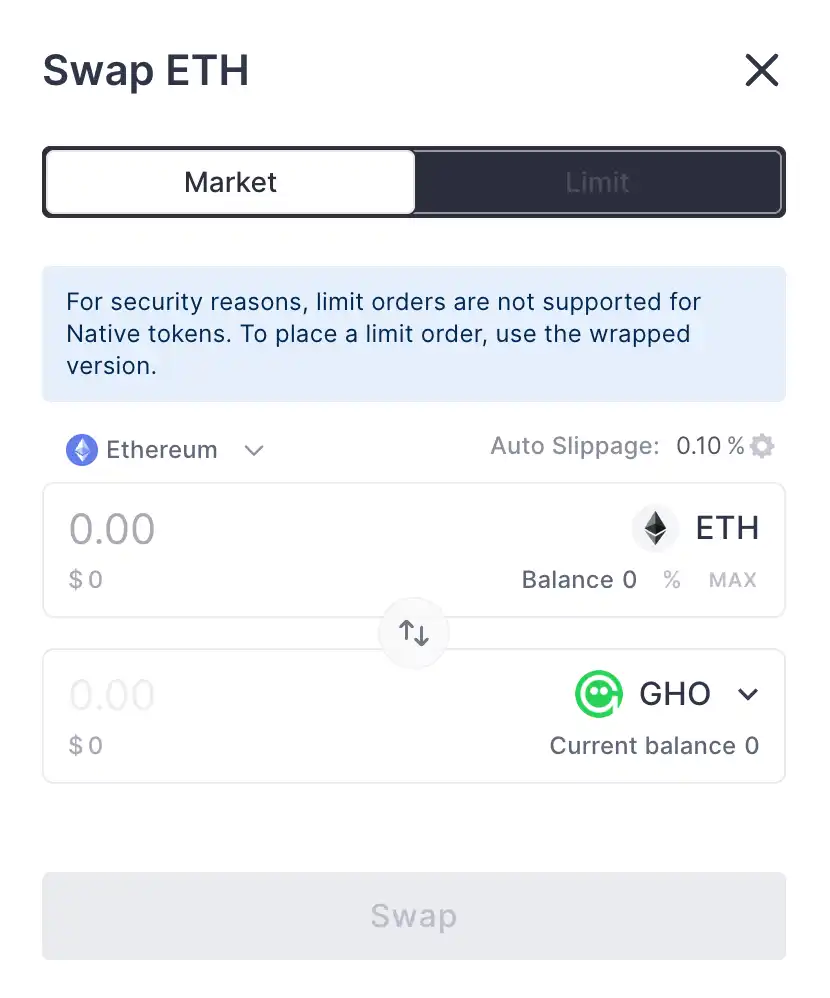
This seemed like a normal functional upgrade, but the community soon discovered that while the additional fees generated by this function (including referral fees or positive slippage surplus fees) previously flowed to the Aave DAO treasury address when using ParaSwap, after switching to Cow Swap, they were redirected to the Aave Labs address.

Community representative EzR3aL was the first to notice this unannounced change. They questioned the Aave team in the governance forum and estimated that, just tracking the income flow on Ethereum and Arbitrum, this change could generate approximately $200,000 in weekly revenue, corresponding to an annualized income of over $10 million — meaning Aave had quietly redirected at least tens of millions of dollars in revenue from the community address to the team address.

Core Controversy: Who Really Owns the Aave Brand?

As EzR3aL's post gained traction, a large number of AAVE holders felt betrayed, especially considering Aave made this change without community communication or any disclosure, seemingly intending to conceal it.

In response to community concerns, Aave Labs replied directly under EzR3aL's post, stating that there should be a clear distinction between the protocol layer and the product layer. The swap function interface on the Aave frontend is entirely operated by Aave Labs, which is responsible for the capital investment, construction, and maintenance. This function is completely independent of the DAO-managed protocol, therefore Aave Labs has the right to independently decide how to operate and profit... The revenue previously flowing to the Aave DAO address was a donation from Aave Labs, but not an obligation.

In short, Aave Labs' stance is that the frontend interface and its ancillary functions are essentially team products, and the revenue generated should be considered company property, not to be conflated with the protocol and its revenue controlled by the DAO.

This statement quickly sparked heated debate within the community regarding the ownership of the Aave protocol versus its products. A well-known DeFi analyst wrote an article titled "Who Really Owns 'Aave': Aave Labs vs Aave DAO," which Odaily Planet Daily also translated into Chinese for supplementary reading.

On December 16th, the conflict intensified further. Former Aave CTO Ernesto Boado initiated a proposal in the governance forum requesting the transfer of control over Aave brand assets (including domain names, social media accounts, naming rights, etc.) to AAVE token holders. These assets would be managed through a DAO-controlled entity (the specific form to be determined later) with strict anti-encroachment protection mechanisms.

The proposal received nearly ten thousand views and hundreds of high-quality replies within the Aave governance forum, with various participants in the Aave ecosystem weighing in. Although some voices felt the proposal's execution plan was imperfect and risked exacerbating divisions, the majority of responses expressed support.

Founder's Statement Fails to Placate Community

As community sentiment heated up, Aave founder Stani responded in the forum: "...This proposal leads us in a direction unfavorable to the Aave ecosystem. It attempts to reduce a complex legal and operational issue to a simple 'yes/no' vote without providing a clear execution path. Handling such a complex issue should involve a specially designed, structured process, achieving consensus through multiple interim checks accompanied by specific solutions. For the reasons above, I will vote against this proposal..."
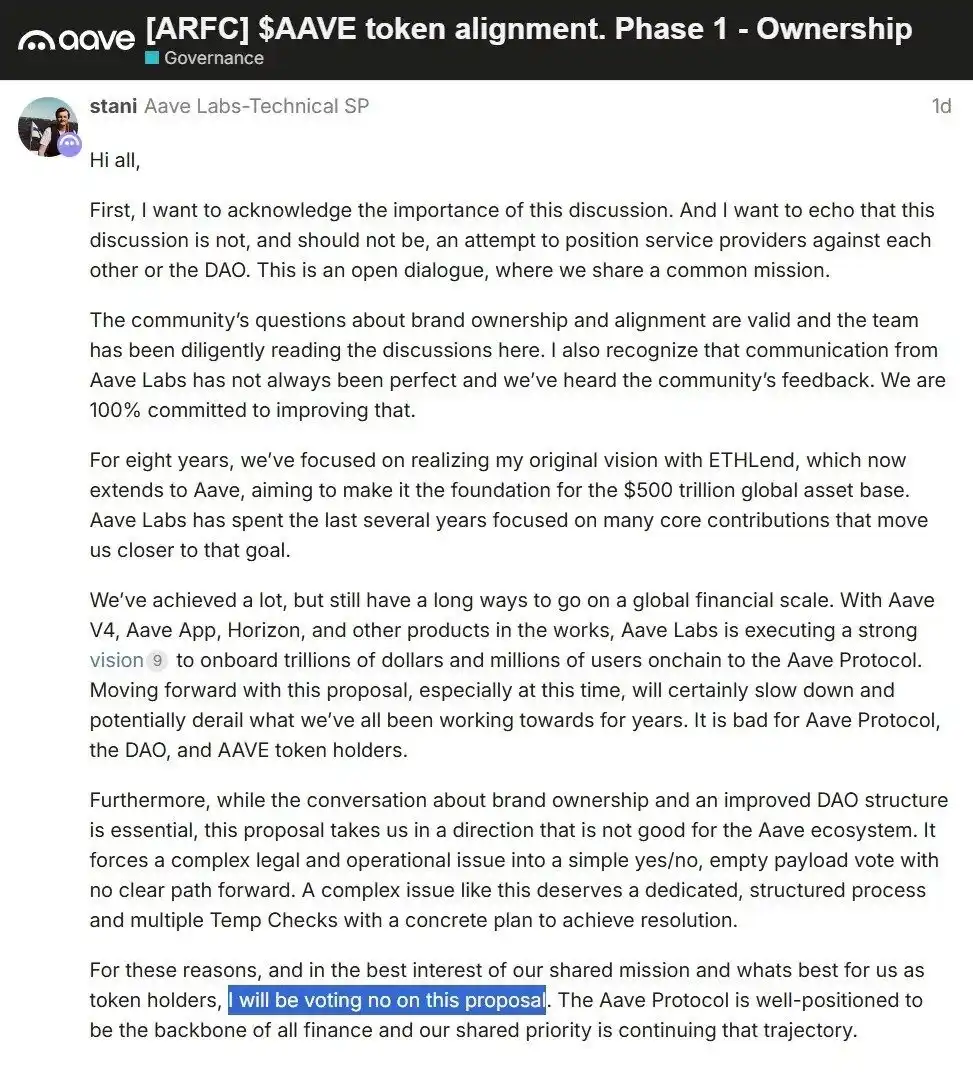
From a business operations perspective, Stani's claim that the proposal is too rash might not be wrong. However, in the current discussion atmosphere, this statement was easily interpreted as 'the Aave founder disagrees with transferring brand assets to token holders,' which obviously further intensified the对立情绪 (oppositional sentiment) between the community and the team.

After Stani's statement, even some aggressive comments targeting Stani appeared under the original post. More users expressed their discontent via the forum or social media. An OG user mentioned it was the first time they considered liquidating their AAVE, and a loyal AAVE believer stated: "AAVE holders should realize this is just another DeFi shitcoin. It's neither better nor worse than the others."

The latest community activity is the "number two big brother" cutting losses and exiting with millions in losses mentioned at the beginning of this article.

Can AAVE Still Be Bought?

Just two weeks ago, Odaily Planet Daily wrote an article titled "What Do the Smart Money Frantically Buying AAVE at Lows See?". At that time, AAVE was still a favorite of top institutions like Multicoin Capital. Its优质的信誉 (high-quality brand reputation),雄厚沉淀资金 (substantial deposited funds),清晰的扩展路径 (clear expansion path),强劲的收入与回购流水 (strong revenue and buyback flow) all proved AAVE was a 'true value token' different from other altcoins.

But in just two weeks, a舆论危机 (public opinion crisis) spanning fee ownership, brand control, and team-community relations has rapidly plunged AAVE from "value token representative" into the center of controversy, even landing it on the short-term top decliners list due to emotional impact.

As of writing, Aave Labs has stated under Ernesto's proposal that they have initiated an ARFC snapshot vote on the proposal, allowing AAVE token holders to formally express their stance and clarify the future direction. The outcome of this vote and the subsequent handling attitude of the Aave Labs team will undoubtedly significantly impact Aave's community faith and AAVE's short-term price performance.

It is important to emphasize that this incident is not merely "bad news" or a "performance change," but a集中拷问 (集中拷问 - concentrated interrogation) of Aave's existing governance structure and the boundaries of rights.

If you believe Aave Labs will still maintain高度一致 (high alignment) with Aave DAO regarding long-term interests, and the current friction is more of a communication and process失误 (mistake), then the price pullback led by emotion might be a good entry window. But if you believe this controversy exposes not an occasional problem, but a结构性矛盾 (structural contradiction) of long-term unclear rights between the team and the protocol, lacking institutional constraints, then this storm might just be the beginning.

From a broader perspective, Aave's controversy is not an isolated case. As DeFi matures, protocol revenue becomes substantial and real, and brands and frontends begin to possess commercial value, structural contradictions between protocols and products, teams and communities will surface. Aave is under the spotlight this time not because it is more wrong, but because it has gone further.

This debate over fees, brand, and control rights poses a question that needs answering not just by AAVE, but is an inevitable question the entire DeFi industry must eventually face.

Domande pertinenti

QWhat was the main reason behind the community crisis and whale selling AAVE tokens?

AThe crisis stemmed from a change in Aave's front-end that redirected fees from the swap function to Aave Labs instead of the Aave DAO treasury, which the community perceived as a lack of transparency and a shift of value away from token holders.

QHow much did the second-largest AAVE whale lose after selling their holdings?

AThe second-largest AAVE whale sold 230,000 AAVE tokens at a loss of approximately $13.45 million, after buying at an average price of $223.4 and selling at around $165 per token.

QWhat was Aave Labs' justification for redirecting the swap fees to their own address?

AAave Labs argued that the front-end swap function is their product, built and maintained independently from the DAO-managed protocol, and therefore they have the right to decide how to operate and profit from it, considering previous donations to the DAO as voluntary, not obligatory.

QWhat proposal did Aave's former CTO Ernesto Boado make to address the community's concerns?

AErnesto Boado proposed transferring control of Aave's brand assets, including domains, social accounts, and naming rights, to AAVE token holders through a DAO-controlled entity with anti-takeover protections.

QHow did Aave's founder Stani Kulechov respond to the proposal, and what was the community's reaction?

AStani Kulechov opposed the proposal, stating it oversimplified a complex legal and operational issue without a clear execution path. The community perceived this as resistance to decentralizing control, further escalating tensions and leading to increased criticism and selling pressure.

Letture associate

Outpacing PayPal and Breaking into the Top Five in Half a Year: Trump's Stablecoin 'Game of Thrones'

In just over six months, the Trump-affiliated stablecoin USD1, issued by World Liberty Financial (WLFI), has surpassed PayPal’s PYUSD in market capitalization, reaching $4.9 billion and entering the top five stablecoins. Its rapid growth stems from a strategic alliance with Binance, which launched high-yield incentive programs like "USD1 Booster" to drive liquidity and user adoption through subsidized returns and platform-wide integrations. USD1’s expansion extends beyond crypto markets. A memorandum with Pakistan’s central bank aims to integrate USD1 into cross-border payments, leveraging its low-cost efficiency for remittances. This move positions USD1 as a potential tool of "digital dollar hegemony," aligning with U.S. geopolitical interests. The project is deeply intertwined with Trump family influence and political networks. Key figures, including WLFI co-founder Eric Trump and Zach Witkoff, son of the U.S. envoy to Pakistan, facilitate these partnerships. The Trump family receives 75% of net profits from USD1 operations, raising concerns about conflicts of interest. Regulatory leniency under the Trump administration has benefited USD1 backers: the SEC dropped cases against Binance and others after significant investments in WLFI. However, USD1 faces risks due to opaque reserve management, delayed audits, and over-reliance on Binance for liquidity. Its stability is heavily tied to Trump’s political standing, making it vulnerable to future regulatory or political shifts.

marsbit9 min fa

Outpacing PayPal and Breaking into the Top Five in Half a Year: Trump's Stablecoin 'Game of Thrones'

marsbit9 min fa

January 28 Market Watch: Dollar Breaks Below 96, Fed Meeting Approaches

Dollar Index Falls Below 96, Hits Three-Month Low Amid Fed Meeting Anticipation On January 28, the dollar index dropped 0.84% to 96.219, falling below the 96 mark and hitting a three-month low. The decline is part of a broader weakening trend since early 2026, with a cumulative loss of nearly 7%. Former President Trump’s comments endorsing the dollar’s performance added further pressure. Markets are closely watching the upcoming Fed meeting, where rates are expected to remain unchanged at 3.50%–3.75%. However, attention is on Chair Powell’s stance amid political pressure and threats of a criminal investigation by the Justice Department. Structural issues underlie the dollar’s weakness: its share in global forex reserves has fallen below 60%, while gold’s share rose to 25.94%. Trump’s tariff policies are further eroding dollar credibility, signaling a shift away from dollar dominance. Gold held above $5,000, briefly surpassing $5,200, with central banks—including China’s—continuing to accumulate gold. Silver rose over 5%, exceeding $110/oz, though some funds halted subscriptions, suggesting overheating. Institutional views are mixed, with Citi bullish on silver and others cautious on short-term gold pressures. U.S. stocks were mixed: tech gains lifted the Nasdaq, but healthcare stocks plunged, dragging down the Dow. Market focus includes potential Fed leadership changes and government shutdown risks. Small caps are outperforming, reflecting a rotation away from high-value tech stocks amid AI profitability concerns. Crypto, meanwhile, struggled as capital flowed into traditional safe havens like gold and silver. The core dynamic remains a structural recalibration of dollar credibility. The Fed’s upcoming decision highlights a policy dilemma: cutting rates may spur inflation and dollar depreciation, while holding rates could harm the economy. Uncertainty prevails.

marsbit49 min fa

January 28 Market Watch: Dollar Breaks Below 96, Fed Meeting Approaches

marsbit49 min fa

Gold Breaks Through Stocks: The 1.45 Lifeline and the Truth About Your Shrinking Assets

Gold's Breakthrough vs. Stocks: The Critical 1.45 Level and the Truth About Your Shrinking Assets Analyst Benjamin Cowen highlights a critical financial indicator: the S&P 500 divided by the Gold price (SPX:GOLD), currently at 1.45. Historically, this ratio has signaled major market shifts when breached, preceding the Great Depression (1929), the 1970s stagflation (1973), and the Global Financial Crisis (2008). We are now at this pivotal level again. Despite nominal all-time highs in the S&P 500, when measured in gold, the index has fallen 46% over the past four years. This "Bleed" represents a period of sustained relative devaluation for risk assets like stocks and cryptocurrencies against gold, regardless of gold's own price movements. Cowen's analysis, based on mid-term election year cycles, projects a potential timeline: Gold may peak in Q1-Q2 2026, experience a significant correction in Q3-Q4 2026, and cryptocurrencies would likely bottom alongside it. This would pave the way for a new cycle in 2027-2028. Key observations include: * A shift to a gold-dominant market regime, not a simple rotation between assets. * Rising unemployment, particularly among new labor market entrants, signals economic deceleration. * Gold has already technically broken out against the S&P 500. * Altcoins are experiencing multi-layered devaluation against gold, bitcoin, and stocks. The crucial signal to watch is a monthly close of the SPX:GOLD ratio below 1.44. The core advice is to avoid being wedded to a single asset class and to adapt to the market's current structure, which favors hard assets over risk assets.

marsbit1 h fa

Gold Breaks Through Stocks: The 1.45 Lifeline and the Truth About Your Shrinking Assets

marsbit1 h fa

Trading

Spot
Futures

Articoli Popolari

Come comprare AAVE

Benvenuto in HTX.com! Abbiamo reso l'acquisto di Aave Protocol (AAVE) semplice e conveniente. Segui la nostra guida passo passo per intraprendere il tuo viaggio nel mondo delle criptovalute.Step 1: Crea il tuo Account HTXUsa la tua email o numero di telefono per registrarti il tuo account gratuito su HTX. Vivi un'esperienza facile e sblocca tutte le funzionalità,Crea il mio accountStep 2: Vai in Acquista crypto e seleziona il tuo metodo di pagamentoCarta di credito/debito: utilizza la tua Visa o Mastercard per acquistare immediatamente Aave ProtocolAAVE.Bilancio: Usa i fondi dal bilancio del tuo account HTX per fare trading senza problemi.Terze parti: abbiamo aggiunto metodi di pagamento molto utilizzati come Google Pay e Apple Pay per maggiore comodità.P2P: Fai trading direttamente con altri utenti HTX.Over-the-Counter (OTC): Offriamo servizi su misura e tassi di cambio competitivi per i trader.Step 3: Conserva Aave Protocol (AAVE)Dopo aver acquistato Aave Protocol (AAVE), conserva nel tuo account HTX. In alternativa, puoi inviare tramite trasferimento blockchain o scambiare per altre criptovalute.Step 4: Scambia Aave Protocol (AAVE)Scambia facilmente Aave Protocol (AAVE) nel mercato spot di HTX. Accedi al tuo account, seleziona la tua coppia di trading, esegui le tue operazioni e monitora in tempo reale. Offriamo un'esperienza user-friendly sia per chi ha appena iniziato che per i trader più esperti.

206 Totale visualizzazioniPubblicato il 2024.12.11Aggiornato il 2025.03.21

Discussioni

Benvenuto nella Community HTX. Qui puoi rimanere informato sugli ultimi sviluppi della piattaforma e accedere ad approfondimenti esperti sul mercato. Le opinioni degli utenti sul prezzo di AAVE AAVE sono presentate come di seguito.

活动图片