Earnings Beat Expectations, $222 Million Chain Launch: Can Circle Escape the 'Interest Stock' Valuation Narrative?

marsbitPubblicato 2026-05-12Pubblicato ultima volta 2026-05-12

Introduzione

Circle released its Q1 2026 financial results, with revenue of $6.94 billion missing expectations but adjusted EPS of $0.21 beating forecasts. USDC circulation grew 28% to $770 billion, and on-chain transaction volume surged 263% to $21.5 trillion. The same day, Circle announced it raised $222 million in a token pre-sale for its new Arc blockchain at a $3 billion valuation, led by a16z. It also unveiled Agent Stack, a suite of tools for AI agents to autonomously hold and transact in USDC. CEO Jeremy Allaire stated the company is evolving into a broader internet platform and operating system business. CRCL's stock price rose 16% on the news. Analysts are divided, with some viewing the strategic moves as an effort to shift Circle's valuation narrative away from reliance on USDC interest income and towards being an infrastructure platform and gateway to the AI agent economy. The success of this transition hinges on Arc's adoption and Agent Stack's competitiveness.

Author: Claude, Shenchao TechFlow

Shenchao Introduction: Circle released its Q1 2026 earnings, reporting adjusted EPS of $0.21 which beat expectations, but revenue of $694 million missed estimates. USDC circulation reached $77 billion, and on-chain transaction volume surged 263% to $215 trillion. On the same day, it announced the completion of a $222 million token pre-sale for the Arc blockchain at a $3 billion valuation, with a16z leading a $75 million investment and participation from BlackRock, Apollo, and others. The company also released the Agent Stack toolkit, enabling AI agents to autonomously hold USDC, initiate payments, and call services. CRCL stock soared 16% to $131.76 on the day, bringing year-to-date gains to 66%.

Circle is experiencing its most intense wave of strategic moves since its IPO.

On May 11th, the issuer of the world's second-largest stablecoin, USDC, simultaneously dropped three bombshells: Q1 2026 earnings, the completion of the Arc blockchain token pre-sale, and a new infrastructure toolkit for AI agents called Agent Stack. According to Cointelegraph, CRCL stock closed up nearly 16% at $131.76, hitting its highest level since March 18th and expanding year-to-date gains to 66%, with a market cap of approximately $35 billion.

Circle CEO Jeremy Allaire told CNBC, "We are becoming a broader internet platform company, we're getting into the operating systems business." He positioned Arc as a multi-stakeholder distributed network, analogous to mobile operating systems and cloud platforms.

Viewed together, these three events point to the same conclusion: Circle is attempting to escape the valuation narrative of being a 'one-trick pony' reliant on USDC interest income, and is pivoting towards becoming an infrastructure platform company.

Earnings: Revenue Misses, Profit Beats, USDC Transaction Volume Grows 263%

According to CoinDesk, Circle's Q1 2026 revenue was $694 million, up 20% year-over-year, but below Wall Street's consensus estimate of about $715 million. Adjusted earnings per share were $0.21, beating analyst expectations of $0.17. Adjusted EBITDA was $151 million, a 24% increase year-over-year. Net income was $55 million, down 15% mainly due to post-IPO equity incentive expenses and a 76% increase in operating expenses.

However, key operational metrics showed strong performance.
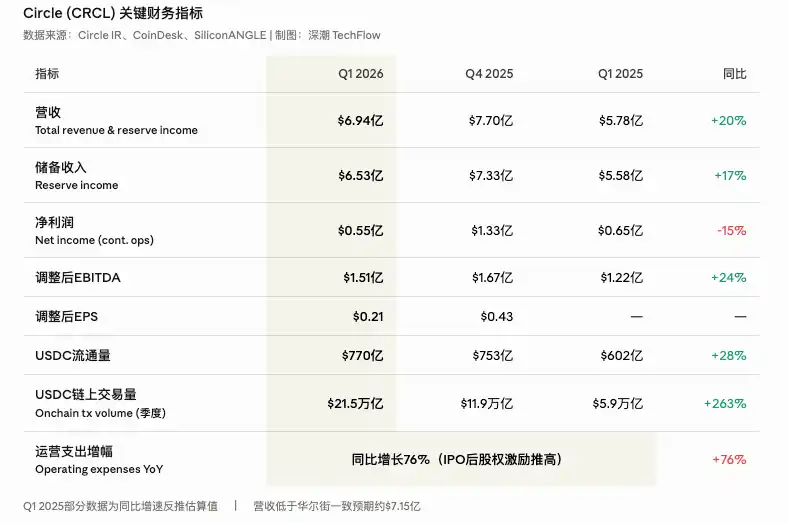
As of the end of Q1, USDC circulation reached $77 billion, up 28% year-over-year. More notably, on-chain USDC transaction volume reached $215 trillion for the quarter, skyrocketing 263% year-over-year. According to a Mizuho analyst report, adjusted USDC transaction volume for 2026 to date is approximately $2.2 trillion, surpassing Tether's USDT (approximately $1.3 trillion), capturing about 64% of adjusted stablecoin transaction volume to take the top spot. This is the first time USDC has led in this metric since 2019.

But the core reason for the revenue miss is clear: interest rates. Over 95% of Circle's revenue comes from interest income on USDC reserve assets. Q1 reserve revenue was $653 million, up 17% year-over-year. In Q4 2025, the reserve yield had already fallen 68 basis points year-over-year to 3.8%. The dampening effect of the interest rate cutting cycle on Circle's revenue is gradually becoming apparent. Even as USDC circulation continues to expand, declining rates remain a sword hanging overhead. This is precisely the underlying motivation for Circle's urgency in crafting its 'second growth curve' story.

Arc Token Pre-Sale: Building Its Own Blockchain, $3 Billion Valuation

Disclosed alongside the earnings was the heavyweight news of the completion of the Arc blockchain token pre-sale. According to an exclusive CNBC report, Circle sold 740 million ARC tokens at a price of $0.30 per token, raising $222 million at a fully diluted valuation of $3 billion. This marks the first token pre-sale conducted by a publicly listed company.

a16z crypto led the round with a $75 million investment. Other participating investors formed a formidable lineup: BlackRock, Apollo Global Management, Intercontinental Exchange (ICE), Standard Chartered Ventures, ARK Invest, General Catalyst, Haun Ventures, and Bullish.
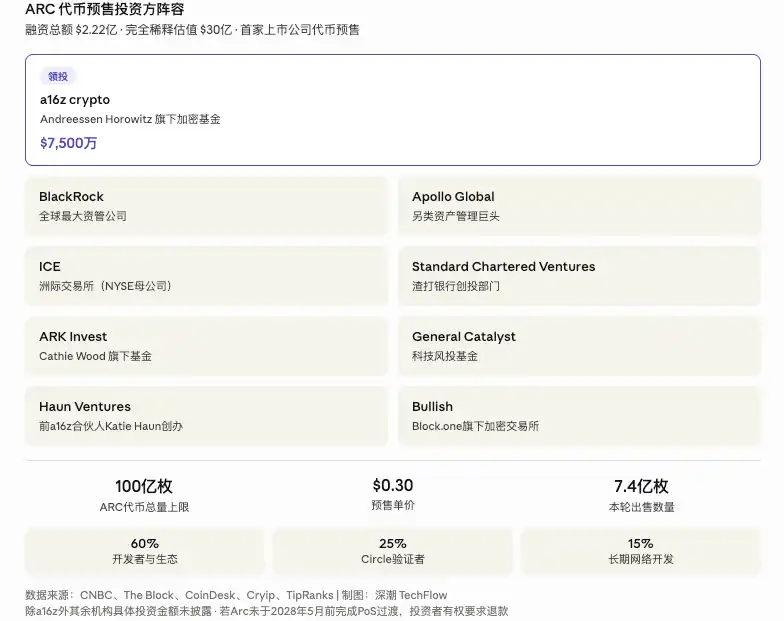
Currently, USDC heavily relies on third-party networks like Ethereum and Solana for settlement and on distributors like Coinbase to reach users. Building its own blockchain signifies Circle's desire to control more of the underlying infrastructure on which USDC operates. From a defensive perspective, with the GENIUS Act signed into law and the CLARITY Act scheduled for a preliminary vote in the Senate Banking Committee this week, the legalization of stablecoin regulation is lowering industry barriers to entry, potentially allowing banks and fintech companies to launch their own dollar tokens. By building its own network, Circle is attempting to lock in a first-mover advantage at the infrastructure layer before this competitive landscape fully materializes.

Circle explicitly stated in its earnings report that current performance guidance does not yet include "future Arc-related revenue streams," hinting that Arc could become an independent revenue source alongside USDC.

Agent Stack: When AI Agents Become the 'Customer'

The third card played on the same day was the Circle Agent Stack, a suite of financial infrastructure tools designed for AI agents.

According to Decrypt, Agent Stack consists of four core components: Agent Wallets allow AI agents to autonomously hold assets; Circle CLI allows developers and AI agents to build applications on the Circle platform; Agent Marketplace enables AI agents to browse, evaluate, and pay for services offered by other agents; Nanopayments, based on Circle Gateway, support gas-free USDC transfers as low as $0.000001.

Allaire stated in the press release, "Financial infrastructure has historically been built for humans, with manual onboarding flows, approvals, and payment flows. It was never designed for software that runs autonomously. Agent Stack is our first full-service suite built for AI agents themselves as customers, not just developers and enterprises."

Circle is betting on a future of machine-to-machine payments: AI agents autonomously transacting with each other, hiring each other's services, settling instantly on-demand, all conducted in USDC.

But Circle is not the only player; recently, Amazon partnered with Coinbase and Stripe, Google Cloud with the Solana Foundation, and MoonPay have all launched similar AI agent stablecoin payment solutions.

$35 Billion Valuation: Can It Hold?

CRCL's current market capitalization is approximately $35 billion, with a forward P/E ratio of about 135x, far above the industry median of around 33x. Citi analyst Peter Christiansen has a $243 price target, Bernstein's Gautam Chhugani has a $190 target, and all 12 analysts tracked by TipRanks give a 'Buy' rating, with a consensus target price of $138.50.

But some are applying the brakes. Compass Point downgraded CRCL to 'Sell' in April, warning that gross margins are narrowing in the first half of 2026 due to USDC supply shifting to lower-margin areas. Even per management guidance, non-reserve revenue (full-year $150-170 million) remains negligible compared to the reserve revenue engine. Whether Arc can transition from a whitepaper to a business line that genuinely contributes revenue is a core validation point for the second half of 2026.

William Blair analyst Andrew Jeffrey told clients that Circle stock "could remain volatile" in the near term, but the company has multiple positive catalysts stemming from its "significant stablecoin commercial advantages."

CRCL had already surged nearly 20% on May 4th when the bipartisan compromise version of the CLARITY Act was finalized. This week's preliminary vote in the Senate Banking Committee will be the next catalytic event. Analysts believe the Act essentially provides Circle with a "regulatory shield": compliance restrictions mean Circle is not required to distribute USDC reserve earnings to users, effectively preserving its profit margins under regulatory cover.

Having played its three cards, Circle's valuation narrative has shifted from a 'stablecoin interest income stock' to an 'infrastructure platform + AI agent economy gateway.' Whether this narrative materializes depends on the actual adoption of the Arc mainnet after its launch and Agent Stack's competitive performance in the machine-to-machine payments arena.

Domande pertinenti

QWhat were the key highlights of Circle's Q1 2026 financial results, and what is the main concern regarding its revenue?

ACircle's Q1 2026 revenue was $6.94 billion, missing analyst estimates, but adjusted EPS of $0.21 exceeded expectations. USDC circulation reached $770 billion, and on-chain transaction volume surged 263% to $21.5 trillion. The main concern is that over 95% of revenue comes from interest on USDC reserves. With interest rates declining, this poses a significant risk to future revenue, driving Circle's need to develop new growth areas.

QWhat is the significance of Circle's Arc blockchain token presale, and which major investors participated?

AThe Arc blockchain token presale raised $222 million at a $3 billion fully diluted valuation. This marks the first token presale by a publicly traded company. Major investors include a16z crypto (leading $75 million), BlackRock, Apollo Global Management, ICE, Standard Chartered Ventures, ARK Invest, General Catalyst, Haun Ventures, and Bullish. Arc aims to give Circle more control over the underlying infrastructure for USDC and create a new, independent revenue stream beyond stablecoin interest.

QWhat is Circle Agent Stack, and what future trend does it represent for the company?

ACircle Agent Stack is a financial infrastructure toolkit designed for AI agents. Its core components include Agent Wallets for autonomous asset holding, a CLI for development, an Agent Marketplace for AI-to-AI service transactions, and Nanopayments for tiny, gasless USDC transfers. It represents Circle's bet on a future of machine-to-machine (M2M) payments, where AI agents autonomously trade, hire services, and settle transactions instantly using USDC, positioning Circle as an entry point to the AI agent economy.

QWhat is the current market valuation and analyst sentiment for Circle (CRCL), and what are the opposing views?

ACircle's market capitalization is approximately $35 billion, with a forward P/E ratio of about 135, significantly higher than the industry median. Analysts are generally bullish, with Citi setting a $243 price target and Bernstein at $190. TipRanks shows all 12 tracked analysts give a 'Buy' rating. However, Compass Point downgraded CRCL to 'Sell', citing narrowing gross margins and the still-insignificant contribution of non-reserve revenue compared to the core interest income business.

QHow is Circle attempting to change its valuation narrative, and what does its success depend on?

ACircle is attempting to shift its valuation narrative from being a 'stablecoin interest income stock' to an 'infrastructure platform + AI agent economy gateway.' This strategic pivot is driven by the launch of the Arc blockchain and the Agent Stack toolkit. The success of this new narrative depends on the actual adoption of the Arc mainnet after its launch and Circle's competitive performance in the emerging machine-to-machine payment sector against rivals like Amazon/Coinbase and Google Cloud/Solana.

Letture associate

Cerebras IPO: A $48.8 Billion Valuation—Is the 'Nvidia Challenger' a Bubble or a New King?

Cerebras Systems, positioning itself as an NVIDIA challenger, is going public with a $48.8 billion valuation despite several underlying paradoxes revealed in its S-1 filing. While 2025 revenue grew 76% to $510M and GAAP net income was $237.8M, this profitability relies heavily on a one-time, non-cash accounting gain. Adjusting for this, the company's non-GAAP net loss actually widened to $75.7M. Furthermore, customer concentration remains extreme: 86% of 2025 revenue came from two Abu Dhabi-based entities, MBZUAI (62%) and G42 (24%). Its landmark deal with OpenAI, valued at over $20 billion, creates a complex, nested relationship where OpenAI is simultaneously a major customer, lender, warrant holder, and strategic partner with exclusivity clauses. Cerebras's technical edge in latency-sensitive AI inference is real, with its wafer-scale chip outperforming competitors in benchmarks. However, this advantage is confined to a specific niche, not the broader AI training market dominated by NVIDIA's CUDA ecosystem. With a 95x price-to-sales ratio, the valuation demands flawless execution of the OpenAI contract and massive future revenue growth. Key long-term risks include intense competition from giants like NVIDIA and AMD, a dual-class share structure granting insiders near-total voting control, and ongoing geopolitical uncertainties regarding export controls. The IPO is a pivotal capital markets event for AI infrastructure. As an investment, it represents a high-risk, high-reward bet on the "inference-first" narrative and Cerebras's ability to dominate its specialized segment, underpinned by a valuation that highlights the current fervor in the sector.

marsbit34 min fa

Cerebras IPO: A $48.8 Billion Valuation—Is the 'Nvidia Challenger' a Bubble or a New King?

marsbit34 min fa

What Happens to Ethereum Developer Tools After the Grants Run Out?

On February 27th, the Ethereum Foundation (EF) announced Project Odin, a structured sustainability support program designed for a select group of strategic, previously grant-funded teams. Unlike a standard grant, Odin offers a long-term advisory mechanism focused on helping these teams establish credible, sustainable paths within a two-year framework, thereby reducing long-term dependence on single funding sources. The program addresses a critical post-grant challenge: how essential public goods, especially major developer tools, can achieve financial sustainability beyond initial funding. While grants from EF and programs like Gitcoin or RetroPGF remain vital for startups and research, they often fall short for mature, widely-used infrastructure. Tools like compilers, languages, and network stacks are deeply embedded but struggle with monetization, trapped between being too foundational to lose and too public to generate natural revenue. Project Odin provides teams with a dedicated Strategic Advisor to guide them through a three-phase process: 1) analyzing current funding and realistic options, 2) validating potential paths with stakeholders, and 3) executing plans, which may include crafting support contracts, service agreements, or other recurring revenue models. The first pilot participant is Vyper, a critical smart contract language for the EVM, highlighting the need for sustainable models for core infrastructure. The initiative reframes the public goods conversation from "who should be funded" to "how do already-proven teams avoid perpetual funding crises?" It encourages ecosystem participants—protocols and projects that depend on these tools—to view sustainable support not just as charity, but as essential risk management for their own operational supply chains.

marsbit1 h fa

What Happens to Ethereum Developer Tools After the Grants Run Out?

marsbit1 h fa

Trading

Spot
Futures

Articoli Popolari

Come comprare BEAT

Benvenuto in HTX.com! Abbiamo reso l'acquisto di Audiera (BEAT) semplice e conveniente. Segui la nostra guida passo passo per intraprendere il tuo viaggio nel mondo delle criptovalute.Step 1: Crea il tuo Account HTXUsa la tua email o numero di telefono per registrarti il tuo account gratuito su HTX. Vivi un'esperienza facile e sblocca tutte le funzionalità,Crea il mio accountStep 2: Vai in Acquista crypto e seleziona il tuo metodo di pagamentoCarta di credito/debito: utilizza la tua Visa o Mastercard per acquistare immediatamente AudieraBEAT.Bilancio: Usa i fondi dal bilancio del tuo account HTX per fare trading senza problemi.Terze parti: abbiamo aggiunto metodi di pagamento molto utilizzati come Google Pay e Apple Pay per maggiore comodità.P2P: Fai trading direttamente con altri utenti HTX.Over-the-Counter (OTC): Offriamo servizi su misura e tassi di cambio competitivi per i trader.Step 3: Conserva Audiera (BEAT)Dopo aver acquistato Audiera (BEAT), conserva nel tuo account HTX. In alternativa, puoi inviare tramite trasferimento blockchain o scambiare per altre criptovalute.Step 4: Scambia Audiera (BEAT)Scambia facilmente Audiera (BEAT) nel mercato spot di HTX. Accedi al tuo account, seleziona la tua coppia di trading, esegui le tue operazioni e monitora in tempo reale. Offriamo un'esperienza user-friendly sia per chi ha appena iniziato che per i trader più esperti.

160 Totale visualizzazioniPubblicato il 2026.01.22Aggiornato il 2026.01.22

Come comprare BEAT

Discussioni

Benvenuto nella Community HTX. Qui puoi rimanere informato sugli ultimi sviluppi della piattaforma e accedere ad approfondimenti esperti sul mercato. Le opinioni degli utenti sul prezzo di BEAT BEAT sono presentate come di seguito.

活动图片