AI Agents Also Need 'Credit Checks': ERC-8126 is Filling the Gap in On-chain Trust

marsbitPubblicato 2026-06-22Pubblicato ultima volta 2026-06-22

Introduzione

The article discusses ERC-8126, a proposed standard designed to address the lack of trust and verification for AI Agents operating on-chain. While ERC-8004 provides AI Agents with a basic on-chain identity (answering "Who are you?"), it does not guarantee trustworthiness. ERC-8126 aims to fill this gap by establishing a verification layer (answering "Are you reliable?"). It standardizes how independent verification providers can assess an agent's associated risks across five key areas: Token/Contract Verification (ETV), Media Content Verification (MCV), Solidity Code Verification (SCV), Web Application Verification (WAV), and Wallet Verification (WV). These providers generate a standardized risk score (0-100) and proofs based on their checks, without acting as a single authoritative certifier. This allows wallets, marketplaces, dApps, and other agents to consume these risk signals—for example, to display warnings, filter listings, or make interaction decisions. The standard also incorporates concepts like Private Data Verification (PDV) and Zero-Knowledge Proofs (ZKP) to allow verification without exposing sensitive underlying data. Positioned alongside ERC-8004 (Identity) and ERC-8183 (Commerce for agents), ERC-8126 represents a step toward building a verifiable and accountable infrastructure for the emerging on-chain AI Agent economy, shifting trust assessment from purely user-based judgment to standardized, consumable signals.

Author: Xiaobai

This article is an original contribution by the author. The views expressed are solely those of the author. ETHPanda has edited and organized the content.

Once AI Agents are on-chain, the issue is no longer just 'can they chat'.

They might sign messages, receive payments, initiate transactions, deploy contracts, manage wallets, call APIs, and even collaborate with other agents to complete tasks. At this point, what users truly care about is not whether it has a nice name, but:

Is this agent actually reliable?

Is its wallet clean? Are the contracts it associates with real? Are its website and APIs risky? Is the media content it publishes forged? Does its Solidity code have obvious vulnerabilities? Has it already been attacked?

ERC-8126 targets precisely these types of verification problems.

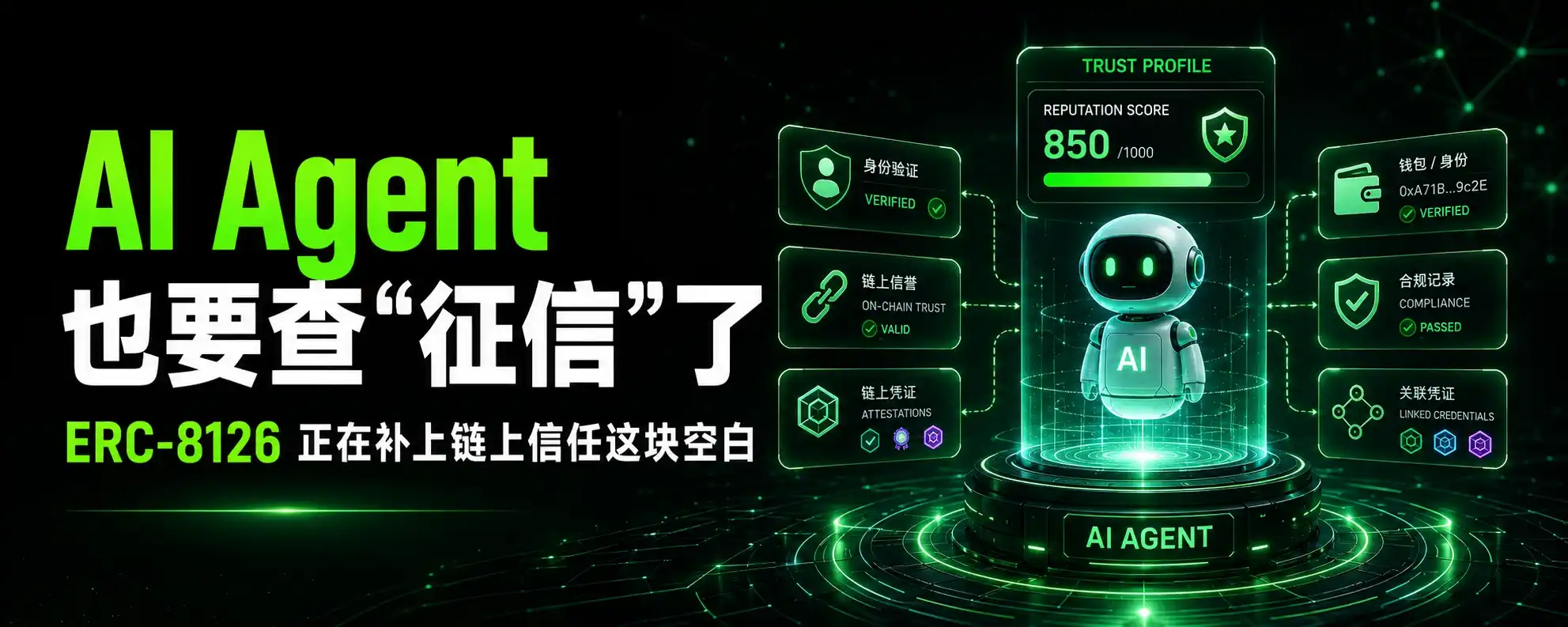
Simply put, ERC-8126 is the verification layer for AI Agents. It builds upon the agent registration of ERC-8004, allowing independent verification providers to perform multi-layered verification around the same agent identity and transform the results into risk signals that wallets, marketplaces, applications, and other agents can consume.

It does not aim to prove an agent is forever trustworthy, but rather standardizes 'how to verify an agent, how verification results should be expressed, and how other systems can read these results'.

Having an Identity Does Not Equal Being Trusted

ERC-8004 solves the identity problem for agents.

You can think of it like this: first, give an AI Agent a registerable, discoverable, and indexable identity on-chain. This identity corresponds to an agentId and describes the agent's name, wallet, endpoint, website, contract address, etc., through metadata.

But identity itself does not equal trust.

A malicious agent can also register an identity. A phishing agent can also write beautiful metadata. An agent that is normal today doesn't mean its endpoint won't be hijacked tomorrow. An agent having an avatar, an official website, and a wallet address does not mean its contracts are secure, its wallet is clean, or its content is authentic.

Therefore, ERC-8004 is more about answering:

Who is this agent?

ERC-8126 further asks:

Is this agent worth interacting with?

How Does ERC-8126 Do Verification?

First, a verification request references the agentId from the ERC-8004 Identity Registry. The verification provider then reads the corresponding metadata via this agentId, parses information such as wallet, contract, website, endpoint, media content, etc., from it, and finally generates a risk score and verification proof.

This process can be broken down into four steps:

  1. The AI Agent first registers its identity via ERC-8004.
  2. The ERC-8126 provider reads this agent's agentId and metadata.
  3. The provider performs multi-layered verification on the agent.
  4. The verification results, in forms like risk score, proof, attestation, are consumed by wallets, marketplaces, dApps, or other agents.

The key point here is: ERC-8126 does not introduce a single 'official certification authority'.

It is more like an open market for verification providers. Different providers can use their own methods for security checks, but the output results must be expressed in a standardized format. This allows wallets, agent marketplaces, task markets, and other applications to read these signals across platforms.

This goes a step further than 'a project claiming itself is safe': it breaks trust judgment into signals that can be checked, recorded, and read by third parties.

Five Layers of Verification: Deconstructing an Agent

ERC-8126 primarily defines five categories of verification, covering the most problematic aspects after an agent is on-chain: contracts, media, code, web, and wallet. It standardizes the verification types, result expression, and consumable interfaces, rather than turning every security check into a unique official audit method. Different verification providers can still use their own detection processes and risk models.

ETV: Token / Contract Verification

ETV checks the token or contract associated with an agent.

If the agent metadata includes a contractAddress, the provider will check whether this address actually has contract code on the corresponding chain, if there are obvious risks, or if it's just a fake address filled in arbitrarily.

For users, ETV answers:

Is the on-chain asset or contract this agent claims to be associated with actually real?

Because once an agent starts receiving payments, issuing tokens, staking, executing strategies, the contracts behind it are no longer decorations, but places where user funds will actually interact.

MCV: Media Content Verification

MCV checks the media content used by an agent, such as avatars, images, brand materials, proof images, etc.

This might not sound like a core issue, but it's important in the AI Agent scenario. A fake agent can impersonate a project logo, forge official screenshots, or even use AI-generated images to create a sense of endorsement.

MCV checks for information like content source, integrity, tampering traces, watermarks, signatures, etc.

It answers:

Has the content this agent shows to users been forged or tampered with?

SCV: Solidity Code Verification

SCV checks the Solidity code or contract security associated with an agent.

If the metadata includes relevant code or contract information, the provider can check for common risks, such as reentrancy, permission issues, dangerous calls, flash loan attack surfaces, etc.

SCV can reduce some common contract risks, but it is not equivalent to a full manual audit.

It's more like a standardized entry point for contract security checks. Passing SCV does not mean a contract is absolutely secure; it indicates that this agent's code or contract has been checked by a provider and generated consumable risk signals.

WAV: Web Application Verification

WAV checks the agent's website, APIs, and endpoints.

Many agents, despite having an on-chain identity, still have their actual interaction points off-chain, such as official websites, APIs, MCP servers, A2A endpoints, or dashboards.

Problems in these areas can be as risky as contract issues. An expired website certificate could lead to man-in-the-middle attacks; a hijacked API could cause the agent to execute wrong commands; a front-end injected with malicious scripts could lead users to sign dangerous transactions.

WAV answers:

Are this agent's web entry points and service endpoints secure?

WV: Wallet Verification

WV checks the wallet risk of an agent.

It examines whether the wallet has transaction history, if it's a newly created empty shell, if it's associated with high-risk addresses, phishing addresses, attacker addresses, or other objects in threat intelligence databases.

WV answers:

Is this agent's on-chain behavior record clean?

Unified Risk Score: Making it Actually Usable for Wallets and Apps

ERC-8126 transforms verification results into a risk score from 0 to 100.

A lower score indicates lower risk; a higher score indicates higher risk.

  • 0-20: Low Risk
  • 21-40: Medium Risk
  • 41-60: Elevated Risk
  • 61-80: High Risk
  • 81-100: Severe Risk

The product rationale for this design is straightforward.

Wallets cannot expect ordinary users to read a full security report every time. Marketplaces aren't suited to rely solely on project self-descriptions for ranking. A unified risk score can become input for product strategies.

For example:

  • If the risk score is too high, a wallet can warn or block interaction.
  • Without verification results, a marketplace can lower display weight.
  • If wallet risk is abnormal, a task market can restrict order acceptance.
  • If web endpoint risk is high, a front-end can warn users to visit cautiously.

However, a single total score cannot represent the full picture.

Contract risk, wallet risk, website risk, and media risk are inherently different types of risks. Better product design would be to display both the total score and sub-scores, letting users know exactly where the problems lie.

PDV and ZKP: Proving Verification Without Revealing All Details

Verifying agents involves a lot of sensitive information.

Such as source code, infrastructure configuration, security reports, private logs, wallet profiles, etc. Revealing everything could actually expand the attack surface.

Therefore, ERC-8126 introduces PDV and ZKP.

PDV is Private Data Verification, and ZKP is Zero-Knowledge Proof. Their role is: to allow an agent to prove it has passed a verification without publicly revealing all the underlying details.

Think of it as:

The external world sees 'verification passed, risk score is X, proof is here', rather than the complete internal security materials.

This makes ERC-8126 more like a verifiable due diligence summary, rather than laying all data open for the entire network to see.

ERC-8004 / ERC-8126 / ERC-8183: Identity, Verification, Commerce

Deconstructing the AI Agent economy into three layers, it can be understood like this. It's important to note the status first: ERC-8126 has entered Final status, while ERC-8004 and ERC-8183 are still in Draft stage. Therefore, the three are better understood as an emerging infrastructure direction rather than a fully formed protocol stack.

  • ERC-8004: Identity gives agents identity, registration, and discoverability.
  • ERC-8126: Verification makes agent security and risk signals verifiable and consumable.
  • ERC-8183: Commerce enables agents to accept tasks, submit results, and enter escrow and settlement processes.

More plainly:

  • ERC-8004 answers: Who are you?
  • ERC-8126 answers: Are you reliable?
  • ERC-8183 answers: Can you work, get paid, settle?

Put together, these three present a relatively clear agent economy narrative:

First identity, then verification, and finally, easier entry into transactions and settlements.

This relationship can be elaborated further. ERC-8126 indeed builds upon ERC-8004; ERC-8183 and ERC-8126 are more like natural complements rather than a hard-bound relationship.

In other words, agent commerce protocols like ERC-8183 can naturally consume ERC-8126 verification signals, such as checking an agent's risk score before accepting a task, or verifying proofs before an evaluator releases payment. But this is more of an engineering combination direction, not a hard dependency of ERC-8183 on ERC-8126.

What Does This Mean for Developers?

If looking at AI Agents only from a market narrative, discussions can easily stay at tokens, launches, marketplaces, and trading hype. But for those actually building agent products, wallet integrations, task networks, or protocol infrastructure, the more critical question is: when an agent starts managing assets, calling services, submitting results, and collaborating with other agents, who bears the trust cost?

In the past, this cost was mostly dumped on users. Users judged project reliability themselves, checked if contracts were audited themselves, investigated wallet cleanliness themselves, identified fake websites themselves, and ultimately bore the consequences of scams or failed interactions.

The value of ERC-8126 lies in its attempt to break these judgments into standardized, composable verification signals that can be read by products.

It won't eliminate risk, nor can it guarantee an agent is forever trustworthy. But if such verification signals are adopted by more wallets, marketplaces, dApps, and agent networks, many product decisions no longer need to rely solely on project self-descriptions.

Specifically:

For wallets, the risk score can become input for pre-transaction risk control and warnings.

For agent marketplaces, verification results can influence ranking, filtering, display weight, and risk labels.

For AI x ETH applications, it can serve as a security check before agent integration.

For agent-to-agent collaboration, it can help agents screen out obviously high-risk counterparts before cooperation.

This is also where ERC-8126 deserves attention: it's not just another AI concept ERC, but an attempt to push on-chain agents from 'registerable' to 'verifiable, risk-controllable'.

It's Still a Standard, Not a Currently Operating Network

This part can be viewed from another angle.

ERC-8126 defines standard interfaces and a verification framework. It specifies how verification can be done, how results can be expressed, but it does not mean there is currently a mature public verification network running uniformly across wallets, marketplaces, and chains.

From the current specification, it has clarified several things:

  • ERC-8126 defines the standard process for agent verification.
  • It requires verification to be anchored to the ERC-8004 agentId.
  • It covers five categories of risk: token/contract, media, Solidity, Web, wallet.
  • It supports risk scoring, proof, and attestation.
  • It provides a foundation for wallets, marketplaces, and dApps to consume verification signals.

For these capabilities to truly work, it depends on how many providers, wallets, marketplaces, and applications adopt it subsequently. In other words, it is not yet in a state like:

  • All wallets are already integrated.
  • All agent marketplaces have adopted it.
  • All providers use completely consistent scoring standards.
  • The entire industry has formed a mature verification network.
  • ZKP and risk scoring are fully unified in production environments.

In other words:

ERC-8126 first standardizes the verification language for AI Agents. To become a public trust layer, it still needs providers, wallets, markets, and applications to continue integrating.

Conclusion

After AI Agents enter the on-chain economy, identity is just the starting point. A more practical problem will follow: can they be verified?

ERC-8004 gives agents identity. ERC-8126 makes the risks behind that identity verifiable. ERC-8183 then enables agents to use these verification signals in task, escrow, and settlement scenarios.

Therefore, the significance of ERC-8126 is not to give an agent a 'permanently trustworthy' badge, but to standardize a more realistic question:

When an AI Agent is about to enter wallets, markets, task networks, and on-chain transaction processes, how should we check it? How should the check results be expressed? And how should other systems consume these results?

This might be the trust layer the AI Agent economy needs to fill next.

References

  • ERC-8126: AI Agent Verification
  • ERC-8126 Raw Markdown
  • ERC-8004: Trustless Agents
  • ERC-8183: Agentic Commerce
  • Ethereum Magicians: ERC-8126 Discussion
  • DonJohnson X Thread: Introducing ERC-8126
  • Cybercentry Web3 Security & Verification Services
  • ERC-8126 Scan

Crypto di tendenza

Domande pertinenti

QWhat is the primary purpose of the ERC-8126 standard, as described in the article?

AERC-8126 is a verification layer for AI Agents on-chain. Its primary purpose is to standardize how AI Agents are verified for security and trustworthiness, how the verification results are expressed, and how other systems (like wallets, marketplaces, dApps) can consume these risk signals. It addresses the question 'Is this agent trustworthy to interact with?' after ERC-8004 establishes an agent's identity.

QWhat are the five main categories of verification defined by ERC-8126?

AERC-8126 defines five main verification categories: 1) ETV (Token/Contract Verification), 2) MCV (Media Content Verification), 3) SCV (Solidity Code Verification), 4) WAV (Web Application Verification), and 5) WV (Wallet Verification). These layers check an agent's associated contracts, media assets, code security, web endpoints, and wallet history, respectively.

QHow does the ERC-8126 standard transform verification results into a format usable by end-user applications like wallets?

AERC-8126 transforms verification results into a unified risk score ranging from 0 to 100, where a lower score indicates lower risk. This standardized score allows applications like wallets, marketplaces, and dApps to easily integrate risk assessment into their user interfaces—for example, by blocking high-risk interactions, displaying warnings, or adjusting agent visibility based on the score.

QAccording to the article, what role do PDV and ZKP play within the ERC-8126 framework?

APDV (Private Data Verification) and ZKP (Zero-Knowledge Proof) allow an AI Agent to prove it has passed a specific verification check without publicly disclosing the underlying sensitive details (like source code, private logs, or infrastructure configurations). This provides verifiable proof of security while protecting the agent's attack surface and privacy.

QHow does the article position ERC-8126 within the broader 'agent economy' narrative alongside ERC-8004 and ERC-8183?

AThe article positions ERC-8004, ERC-8126, and ERC-8183 as a three-layer foundational stack for the on-chain AI Agent economy: ERC-8004 establishes agent identity ('Who are you?'), ERC-8126 provides agent verification ('Are you trustworthy?'), and ERC-8183 enables agent commerce ('Can you work, get paid, and settle?'). Together, they create a progression from identity to trust to economic activity.

Letture associate

Report Interpretation: J.P. Morgan Details Micron's Pre-Earnings Sentiment, Current Hardware Sector Dynamics

Morgan Stanley analyst Joshua Meyers' report (June 21, 2026) highlights key trends in the hardware and semiconductor sector ahead of Micron's earnings. The core takeaways are: 1. **Micron & Memory:** Memory remains a high-conviction long theme, driven by strong AI demand and rising ASPs. However, investor focus is shifting to the sustainability of Micron's >80% gross margins and the specifics of potential new long-term supply agreements (SCAs). 2. **Hardware Supply Chain:** AI-related demand for servers, networking, and storage remains robust, but company performance is diverging. Celestica (CLS) shows improved margin confidence, Western Digital and Seagate benefit from pricing, Fabrinet (FN) sees predictable AI optics growth, and Teradyne (TER) anticipates a new Google customer. 3. **AI Capex & WFE Forecasts:** JPMorgan increased its Wafer Fab Equipment (WFE) market growth forecasts to 28% in 2026 and 29% in 2027. AI infrastructure financing is evolving, with higher project-level debt reducing constraints on capex expansion. The report signals that while the AI-driven hardware cycle is strong, the market is entering a phase focused on execution verification (e.g., Micron's SCA details, Fabrinet's ramp with Amazon) and valuation sustainability. Key near-term signals include Micron's guidance, Arista Networks' outlook, and the pace of demand normalization post potential tariff-related pull-ins.

marsbit4 h fa

Report Interpretation: J.P. Morgan Details Micron's Pre-Earnings Sentiment, Current Hardware Sector Dynamics

marsbit4 h fa

Research Report Analysis: The Fed's New Chair's Debut – New Leader, But Same Script?

Report Analysis: Federal Reserve's New Chair Debut – A New Captain, But the Same Script? Morgan Stanley's chief global economist Seth B. Carpenter analyzes the first FOMC meeting under new Fed Chair Kevin Warsh in a June 21 report. Warsh deliberately avoided providing forward guidance on interest rates, aligning with his philosophy. However, market expectations for a rate hike this year were reinforced. Key signals lie elsewhere: inflation may fall more than expected, and quantitative tightening (QT) could be more aggressive than anticipated. The FOMC's "dot plot" suggests only one rate hike in 2026. Carpenter argues that if inflation undershoots forecasts, the logic for even a single hike weakens, especially as projections indicate potential rate cuts in 2027. On QT, Warsh's stance is clear. Carpenter notes that measures like halving the Treasury's account balance could shrink the Fed's balance sheet by around $500 billion with minimal market impact. Combined with adjustments to reserve interest and liquidity rules, the ultimate QT scale may exceed expectations, though its market effect might be less disruptive unless the Fed actively sells Mortgage-Backed Securities (MBS). While Warsh initiated a review of the Fed's policy framework, the 2% inflation target remains intact for now. The report concludes that the market may be overestimating the significance of reduced forward guidance and the near-term rate hike risk, while potentially underestimating the scope and manageable nature of the coming balance sheet reduction. The key debates will hinge on upcoming core PCE data, the specifics of the QT path, and the framework review's findings.

marsbit4 h fa

Research Report Analysis: The Fed's New Chair's Debut – New Leader, But Same Script?

marsbit4 h fa

Critical Game Week: BTC Retracement Confirmation vs. HYPE Support Battle | Guest Analysis

This weekly analysis outlines a critical juncture for BTC and HYPE markets, focusing on key price level confirmations. **BTC Analysis:** BTC is at a pivotal point after a five-wave rally from the June 5th low of $59,100. The price has broken below a short-term rising channel's lower boundary, with the current move seen as a pullback to test this breakdown. Failure to reclaim this level could lead to a retest of the $59,000-$60,000 support zone. The core scenario hinges on this channel retest outcome. * **Key Levels:** Resistance at $64,500-$65,000 (channel boundary) and $69,500-$70,500. Support at $59,000-$60,000 and $55,000. * **Strategy:** A core bearish stance is maintained (20% short from last week), with short-term plans for tactical trades. Three detailed contingency plans (A/B/C) are provided for short positions on resistance tests or breakdowns, emphasizing strict stop-loss discipline. **HYPE Analysis:** HYPE shows strong momentum but is currently in a corrective phase after hitting a new high of $76.94. The price is retesting the crucial $64-$66 support area. * **Key Levels:** Resistance near $77 and $80-$82. Support at $64-$66 and $52-$54. * **Strategy:** The short-term approach is "buy on dips, avoid chasing rallies." A long position is considered only if clear stabilization signals appear at the $64-$66 or deeper $52-$54 support zones, with tight risk controls. **General Risk Management:** A standardized trailing stop-loss protocol is emphasized: set initial stop, breakeven at +1% profit, then trail stops upward to lock in gains. *Disclaimer: All analysis is presented as a personal trading framework, not investment advice. Market conditions are complex and require dynamic adjustment.*

marsbit5 h fa

Critical Game Week: BTC Retracement Confirmation vs. HYPE Support Battle | Guest Analysis

marsbit5 h fa

Trading

Spot
Futures

Articoli Popolari

Cosa è GROK AI

Grok AI: Rivoluzionare la Tecnologia Conversazionale nell'Era Web3 Introduzione Nel panorama in rapida evoluzione dell'intelligenza artificiale, Grok AI si distingue come un progetto notevole che collega i domini della tecnologia avanzata e dell'interazione con l'utente. Sviluppato da xAI, un'azienda guidata dal rinomato imprenditore Elon Musk, Grok AI cerca di ridefinire il modo in cui interagiamo con l'intelligenza artificiale. Mentre il movimento Web3 continua a prosperare, Grok AI mira a sfruttare il potere dell'IA conversazionale per rispondere a query complesse, offrendo agli utenti un'esperienza che è non solo informativa ma anche divertente. Cos'è Grok AI? Grok AI è un sofisticato chatbot di intelligenza artificiale conversazionale progettato per interagire dinamicamente con gli utenti. A differenza di molti sistemi di intelligenza artificiale tradizionali, Grok AI abbraccia un'ampia gamma di domande, comprese quelle tipicamente considerate inappropriate o al di fuori delle risposte standard. Gli obiettivi principali del progetto includono: Ragionamento Affidabile: Grok AI enfatizza il ragionamento di buon senso per fornire risposte logiche basate sulla comprensione contestuale. Supervisione Scalabile: L'integrazione dell'assistenza degli strumenti garantisce che le interazioni degli utenti siano sia monitorate che ottimizzate per la qualità. Verifica Formale: La sicurezza è fondamentale; Grok AI incorpora metodi di verifica formale per migliorare l'affidabilità delle sue uscite. Comprensione del Lungo Contesto: Il modello di IA eccelle nel trattenere e richiamare una vasta storia di conversazione, facilitando discussioni significative e consapevoli del contesto. Robustezza Adversariale: Concentrandosi sul miglioramento delle sue difese contro input manipolati o malevoli, Grok AI mira a mantenere l'integrità delle interazioni degli utenti. In sostanza, Grok AI non è solo un dispositivo di recupero informazioni; è un partner conversazionale immersivo che incoraggia un dialogo dinamico. Creatore di Grok AI Il cervello dietro Grok AI non è altri che Elon Musk, un individuo sinonimo di innovazione in vari campi, tra cui automotive, viaggi spaziali e tecnologia. Sotto l'egida di xAI, un'azienda focalizzata sull'avanzamento della tecnologia AI in modi benefici, la visione di Musk mira a rimodellare la comprensione delle interazioni con l'IA. La leadership e l'etica fondamentale sono profondamente influenzate dall'impegno di Musk nel superare i confini tecnologici. Investitori di Grok AI Sebbene i dettagli specifici riguardanti gli investitori che sostengono Grok AI rimangano limitati, è pubblicamente riconosciuto che xAI, l'incubatore del progetto, è fondato e supportato principalmente dallo stesso Elon Musk. Le precedenti imprese e partecipazioni di Musk forniscono un robusto sostegno, rafforzando ulteriormente la credibilità e il potenziale di crescita di Grok AI. Tuttavia, al momento, le informazioni riguardanti ulteriori fondazioni di investimento o organizzazioni che supportano Grok AI non sono facilmente accessibili, segnando un'area per potenziali esplorazioni future. Come Funziona Grok AI? Le meccaniche operative di Grok AI sono innovative quanto il suo framework concettuale. Il progetto integra diverse tecnologie all'avanguardia che facilitano le sue funzionalità uniche: Infrastruttura Robusta: Grok AI è costruito utilizzando Kubernetes per l'orchestrazione dei container, Rust per prestazioni e sicurezza, e JAX per il calcolo numerico ad alte prestazioni. Questo trio garantisce che il chatbot operi in modo efficiente, si scaldi efficacemente e serva gli utenti prontamente. Accesso alla Conoscenza in Tempo Reale: Una delle caratteristiche distintive di Grok AI è la sua capacità di attingere a dati in tempo reale attraverso la piattaforma X—precedentemente nota come Twitter. Questa capacità consente all'IA di accedere alle informazioni più recenti, permettendole di fornire risposte e raccomandazioni tempestive che altri modelli di IA potrebbero perdere. Due Modalità di Interazione: Grok AI offre agli utenti la scelta tra “Modalità Divertente” e “Modalità Normale”. La Modalità Divertente consente uno stile di interazione più giocoso e umoristico, mentre la Modalità Normale si concentra sulla fornitura di risposte precise e accurate. Questa versatilità garantisce un'esperienza su misura che soddisfa varie preferenze degli utenti. In sostanza, Grok AI sposa prestazioni con coinvolgimento, creando un'esperienza che è sia arricchente che divertente. Cronologia di Grok AI Il viaggio di Grok AI è segnato da traguardi fondamentali che riflettono le sue fasi di sviluppo e distribuzione: Sviluppo Iniziale: La fase fondamentale di Grok AI si è svolta in circa due mesi, durante i quali sono stati condotti l'addestramento iniziale e il perfezionamento del modello. Rilascio Beta di Grok-2: In un significativo avanzamento, è stata annunciata la beta di Grok-2. Questo rilascio ha introdotto due versioni del chatbot—Grok-2 e Grok-2 mini—ognuna dotata delle capacità per chattare, programmare e ragionare. Accesso Pubblico: Dopo lo sviluppo beta, Grok AI è diventato disponibile per gli utenti della piattaforma X. Coloro che hanno account verificati tramite un numero di telefono e attivi per almeno sette giorni possono accedere a una versione limitata, rendendo la tecnologia disponibile a un pubblico più ampio. Questa cronologia racchiude la crescita sistematica di Grok AI dall'inizio all'impegno pubblico, enfatizzando il suo impegno per il miglioramento continuo e l'interazione con gli utenti. Caratteristiche Chiave di Grok AI Grok AI comprende diverse caratteristiche chiave che contribuiscono alla sua identità innovativa: Integrazione della Conoscenza in Tempo Reale: L'accesso a informazioni attuali e rilevanti differenzia Grok AI da molti modelli statici, consentendo un'esperienza utente coinvolgente e accurata. Stili di Interazione Versatili: Offrendo modalità di interazione distinte, Grok AI soddisfa varie preferenze degli utenti, invitando alla creatività e alla personalizzazione nella conversazione con l'IA. Avanzata Struttura Tecnologica: L'utilizzo di Kubernetes, Rust e JAX fornisce al progetto un solido framework per garantire affidabilità e prestazioni ottimali. Considerazione del Discorso Etico: L'inclusione di una funzione di generazione di immagini mette in mostra lo spirito innovativo del progetto. Tuttavia, solleva anche considerazioni etiche riguardanti il copyright e la rappresentazione rispettosa di figure riconoscibili—una discussione in corso all'interno della comunità AI. Conclusione Come entità pionieristica nel campo dell'IA conversazionale, Grok AI incarna il potenziale per esperienze utente trasformative nell'era digitale. Sviluppato da xAI e guidato dall'approccio visionario di Elon Musk, Grok AI integra conoscenze in tempo reale con capacità di interazione avanzate. Si sforza di spingere i confini di ciò che l'intelligenza artificiale può realizzare, mantenendo un focus su considerazioni etiche e sicurezza degli utenti. Grok AI non solo incarna il progresso tecnologico, ma rappresenta anche un nuovo paradigma conversazionale nel panorama Web3, promettendo di coinvolgere gli utenti con sia conoscenze esperte che interazioni giocose. Man mano che il progetto continua a evolversi, si erge come testimonianza di ciò che l'incrocio tra tecnologia, creatività e interazione simile a quella umana può realizzare.

499 Totale visualizzazioniPubblicato il 2024.12.26Aggiornato il 2024.12.26

Cosa è GROK AI

Cosa è ERC AI

Euruka Tech: Una Panoramica di $erc ai e delle sue Ambizioni in Web3 Introduzione Nel panorama in rapida evoluzione della tecnologia blockchain e delle applicazioni decentralizzate, nuovi progetti emergono frequentemente, ciascuno con obiettivi e metodologie uniche. Uno di questi progetti è Euruka Tech, che opera nel vasto dominio delle criptovalute e del Web3. L'obiettivo principale di Euruka Tech, in particolare del suo token $erc ai, è presentare soluzioni innovative progettate per sfruttare le crescenti capacità della tecnologia decentralizzata. Questo articolo si propone di fornire una panoramica completa di Euruka Tech, un'esplorazione dei suoi obiettivi, della funzionalità, dell'identità del suo creatore, dei potenziali investitori e della sua importanza nel contesto più ampio del Web3. Cos'è Euruka Tech, $erc ai? Euruka Tech è caratterizzato come un progetto che sfrutta gli strumenti e le funzionalità offerte dall'ambiente Web3, concentrandosi sull'integrazione dell'intelligenza artificiale nelle sue operazioni. Sebbene i dettagli specifici sul framework del progetto siano piuttosto sfuggenti, è progettato per migliorare l'engagement degli utenti e automatizzare i processi nello spazio crypto. Il progetto mira a creare un ecosistema decentralizzato che non solo faciliti le transazioni, ma incorpori anche funzionalità predittive attraverso l'intelligenza artificiale, da cui il nome del suo token, $erc ai. L'obiettivo è fornire una piattaforma intuitiva che faciliti interazioni più intelligenti e un'elaborazione delle transazioni più efficiente all'interno della crescente sfera del Web3. Chi è il Creatore di Euruka Tech, $erc ai? Attualmente, le informazioni riguardanti il creatore o il team fondatore di Euruka Tech rimangono non specificate e piuttosto opache. Questa assenza di dati solleva preoccupazioni, poiché la conoscenza del background del team è spesso essenziale per stabilire credibilità nel settore blockchain. Pertanto, abbiamo classificato queste informazioni come sconosciute fino a quando dettagli concreti non saranno resi disponibili nel dominio pubblico. Chi sono gli Investitori di Euruka Tech, $erc ai? Allo stesso modo, l'identificazione degli investitori o delle organizzazioni di supporto per il progetto Euruka Tech non è prontamente fornita attraverso la ricerca disponibile. Un aspetto cruciale per i potenziali stakeholder o utenti che considerano di impegnarsi con Euruka Tech è la garanzia che deriva da partnership finanziarie consolidate o dal supporto di società di investimento rispettabili. Senza divulgazioni sulle affiliazioni di investimento, è difficile trarre conclusioni complete sulla sicurezza finanziaria o sulla longevità del progetto. In linea con le informazioni trovate, anche questa sezione rimane allo stato di sconosciuto. Come funziona Euruka Tech, $erc ai? Nonostante la mancanza di specifiche tecniche dettagliate per Euruka Tech, è essenziale considerare le sue ambizioni innovative. Il progetto cerca di sfruttare la potenza computazionale dell'intelligenza artificiale per automatizzare e migliorare l'esperienza dell'utente all'interno dell'ambiente delle criptovalute. Integrando l'IA con la tecnologia blockchain, Euruka Tech mira a fornire funzionalità come operazioni automatizzate, valutazioni del rischio e interfacce utente personalizzate. L'essenza innovativa di Euruka Tech risiede nel suo obiettivo di creare una connessione fluida tra gli utenti e le vaste possibilità presentate dalle reti decentralizzate. Attraverso l'utilizzo di algoritmi di apprendimento automatico e IA, mira a ridurre le sfide degli utenti alle prime armi e semplificare le esperienze transazionali all'interno del framework Web3. Questa simbiosi tra IA e blockchain sottolinea l'importanza del token $erc ai, fungendo da ponte tra le interfacce utente tradizionali e le avanzate capacità delle tecnologie decentralizzate. Cronologia di Euruka Tech, $erc ai Sfortunatamente, a causa delle limitate informazioni disponibili riguardo a Euruka Tech, non siamo in grado di presentare una cronologia dettagliata dei principali sviluppi o traguardi nel percorso del progetto. Questa cronologia, tipicamente preziosa per tracciare l'evoluzione di un progetto e comprendere la sua traiettoria di crescita, non è attualmente disponibile. Man mano che le informazioni su eventi notevoli, partnership o aggiunte funzionali diventano evidenti, gli aggiornamenti miglioreranno sicuramente la visibilità di Euruka Tech nella sfera crypto. Chiarimento su Altri Progetti “Eureka” È importante sottolineare che più progetti e aziende condividono una nomenclatura simile con “Eureka.” La ricerca ha identificato iniziative come un agente IA della NVIDIA Research, che si concentra sull'insegnamento ai robot di compiti complessi utilizzando metodi generativi, così come Eureka Labs ed Eureka AI, che migliorano l'esperienza utente nell'istruzione e nell'analisi del servizio clienti, rispettivamente. Tuttavia, questi progetti sono distinti da Euruka Tech e non dovrebbero essere confusi con i suoi obiettivi o funzionalità. Conclusione Euruka Tech, insieme al suo token $erc ai, rappresenta un attore promettente ma attualmente oscuro nel panorama del Web3. Sebbene i dettagli sul suo creatore e sugli investitori rimangano non divulgati, l'ambizione centrale di combinare intelligenza artificiale e tecnologia blockchain si erge come un punto focale di interesse. Gli approcci unici del progetto nel promuovere l'engagement degli utenti attraverso l'automazione avanzata potrebbero distinguerlo mentre l'ecosistema Web3 progredisce. Con l'evoluzione continua del mercato crypto, gli stakeholder dovrebbero tenere d'occhio gli sviluppi riguardanti Euruka Tech, poiché lo sviluppo di innovazioni documentate, partnership o una roadmap definita potrebbe presentare opportunità significative nel prossimo futuro. Così com'è, attendiamo ulteriori approfondimenti sostanziali che potrebbero svelare il potenziale di Euruka Tech e la sua posizione nel competitivo panorama crypto.

520 Totale visualizzazioniPubblicato il 2025.01.02Aggiornato il 2025.01.02

Cosa è ERC AI

Cosa è DUOLINGO AI

DUOLINGO AI: Integrare l'apprendimento delle lingue con Web3 e innovazione AI In un'era in cui la tecnologia rimodella l'istruzione, l'integrazione dell'intelligenza artificiale (AI) e delle reti blockchain annuncia una nuova frontiera per l'apprendimento delle lingue. Entra in scena DUOLINGO AI e la sua criptovaluta associata, $DUOLINGO AI. Questo progetto aspira a fondere la potenza educativa delle principali piattaforme di apprendimento delle lingue con i benefici della tecnologia decentralizzata Web3. Questo articolo esplora gli aspetti chiave di DUOLINGO AI, esaminando i suoi obiettivi, il framework tecnologico, lo sviluppo storico e il potenziale futuro, mantenendo chiarezza tra la risorsa educativa originale e questa iniziativa indipendente di criptovaluta. Panoramica di DUOLINGO AI Alla sua base, DUOLINGO AI cerca di stabilire un ambiente decentralizzato in cui gli studenti possono guadagnare ricompense crittografiche per il raggiungimento di traguardi educativi nella competenza linguistica. Applicando smart contracts, il progetto mira ad automatizzare i processi di verifica delle competenze e le allocazioni di token, aderendo ai principi di Web3 che enfatizzano la trasparenza e la proprietà da parte degli utenti. Il modello si discosta dagli approcci tradizionali all'acquisizione linguistica, facendo forte affidamento su una struttura di governance guidata dalla comunità, che consente ai detentori di token di suggerire miglioramenti ai contenuti dei corsi e alle distribuzioni delle ricompense. Alcuni degli obiettivi notevoli di DUOLINGO AI includono: Apprendimento Gamificato: Il progetto integra traguardi blockchain e token non fungibili (NFT) per rappresentare i livelli di competenza linguistica, promuovendo la motivazione attraverso ricompense digitali coinvolgenti. Creazione di Contenuti Decentralizzati: Apre opportunità per educatori e appassionati di lingue di contribuire con i propri corsi, facilitando un modello di condivisione dei ricavi che beneficia tutti i collaboratori. Personalizzazione Guidata dall'AI: Utilizzando modelli avanzati di machine learning, DUOLINGO AI personalizza le lezioni per adattarsi ai progressi individuali, simile alle funzionalità adattive presenti nelle piattaforme consolidate. Creatori del Progetto e Governance A partire da aprile 2025, il team dietro $DUOLINGO AI rimane pseudonimo, una pratica comune nel panorama decentralizzato delle criptovalute. Questa anonimato è inteso a promuovere la crescita collettiva e il coinvolgimento degli stakeholder piuttosto che concentrarsi su sviluppatori individuali. Lo smart contract distribuito sulla blockchain di Solana annota l'indirizzo del wallet dello sviluppatore, che segna l'impegno verso la trasparenza riguardo alle transazioni, nonostante l'identità dei creatori sia sconosciuta. Secondo la sua roadmap, DUOLINGO AI mira a evolversi in un'Organizzazione Autonoma Decentralizzata (DAO). Questa struttura di governance consente ai detentori di token di votare su questioni critiche come l'implementazione di funzionalità e le allocazioni del tesoro. Questo modello si allinea con l'etica dell'empowerment della comunità presente in varie applicazioni decentralizzate, enfatizzando l'importanza del processo decisionale collettivo. Investitori e Partnership Strategiche Attualmente, non ci sono investitori istituzionali o capitalisti di rischio identificabili pubblicamente legati a $DUOLINGO AI. Invece, la liquidità del progetto proviene principalmente da scambi decentralizzati (DEX), segnando un netto contrasto con le strategie di finanziamento delle aziende tradizionali di tecnologia educativa. Questo modello di base indica un approccio guidato dalla comunità, riflettendo l'impegno del progetto verso la decentralizzazione. Nel suo whitepaper, DUOLINGO AI menziona la formazione di collaborazioni con “piattaforme educative blockchain” non specificate, mirate ad arricchire la sua offerta di corsi. Sebbene partnership specifiche non siano ancora state divulgate, questi sforzi collaborativi suggeriscono una strategia per mescolare innovazione blockchain con iniziative educative, ampliando l'accesso e il coinvolgimento degli utenti attraverso diverse vie di apprendimento. Architettura Tecnologica Integrazione AI DUOLINGO AI incorpora due componenti principali guidate dall'AI per migliorare la sua offerta educativa: Motore di Apprendimento Adattivo: Questo sofisticato motore apprende dalle interazioni degli utenti, simile ai modelli proprietari delle principali piattaforme educative. Regola dinamicamente la difficoltà delle lezioni per affrontare le sfide specifiche degli studenti, rinforzando le aree deboli attraverso esercizi mirati. Agenti Conversazionali: Utilizzando chatbot alimentati da GPT-4, DUOLINGO AI offre una piattaforma per gli utenti per impegnarsi in conversazioni simulate, promuovendo un'esperienza di apprendimento linguistico più interattiva e pratica. Infrastruttura Blockchain Costruito sulla blockchain di Solana, $DUOLINGO AI utilizza un framework tecnologico completo che include: Smart Contracts per la Verifica delle Competenze: Questa funzionalità assegna automaticamente token agli utenti che superano con successo i test di competenza, rinforzando la struttura di incentivi per risultati di apprendimento genuini. Badge NFT: Questi token digitali significano vari traguardi che gli studenti raggiungono, come completare una sezione del loro corso o padroneggiare competenze specifiche, consentendo loro di scambiare o mostrare digitalmente i loro successi. Governance DAO: I membri della comunità dotati di token possono partecipare alla governance votando su proposte chiave, facilitando una cultura partecipativa che incoraggia l'innovazione nell'offerta di corsi e nelle funzionalità della piattaforma. Cronologia Storica 2022–2023: Concettualizzazione I lavori per DUOLINGO AI iniziano con la creazione di un whitepaper, evidenziando la sinergia tra i progressi dell'AI nell'apprendimento delle lingue e il potenziale decentralizzato della tecnologia blockchain. 2024: Lancio Beta Un lancio beta limitato introduce offerte in lingue popolari, premiando i primi utenti con incentivi in token come parte della strategia di coinvolgimento della comunità del progetto. 2025: Transizione DAO Ad aprile, avviene un lancio completo della mainnet con la circolazione di token, stimolando discussioni nella comunità riguardo a possibili espansioni nelle lingue asiatiche e ad altri sviluppi dei corsi. Sfide e Direzioni Future Ostacoli Tecnici Nonostante i suoi obiettivi ambiziosi, DUOLINGO AI affronta sfide significative. La scalabilità rimane una preoccupazione costante, in particolare nel bilanciare i costi associati all'elaborazione dell'AI e nel mantenere una rete decentralizzata reattiva. Inoltre, garantire la creazione e la moderazione di contenuti di qualità in un'offerta decentralizzata presenta complessità nel mantenere standard educativi. Opportunità Strategiche Guardando al futuro, DUOLINGO AI ha il potenziale per sfruttare partnership di micro-credentialing con istituzioni accademiche, fornendo validazioni verificate dalla blockchain delle competenze linguistiche. Inoltre, l'espansione cross-chain potrebbe consentire al progetto di attingere a basi utenti più ampie e a ulteriori ecosistemi blockchain, migliorando la sua interoperabilità e portata. Conclusione DUOLINGO AI rappresenta una fusione innovativa di intelligenza artificiale e tecnologia blockchain, presentando un'alternativa focalizzata sulla comunità ai sistemi tradizionali di apprendimento delle lingue. Sebbene il suo sviluppo pseudonimo e il modello economico emergente comportino alcuni rischi, l'impegno del progetto verso l'apprendimento gamificato, l'istruzione personalizzata e la governance decentralizzata illumina un percorso per la tecnologia educativa nel regno di Web3. Man mano che l'AI continua a progredire e l'ecosistema blockchain evolve, iniziative come DUOLINGO AI potrebbero ridefinire il modo in cui gli utenti interagiscono con l'istruzione linguistica, potenziando le comunità e premiando il coinvolgimento attraverso meccanismi di apprendimento innovativi.

474 Totale visualizzazioniPubblicato il 2025.04.11Aggiornato il 2025.04.11

Cosa è DUOLINGO AI

Discussioni

Benvenuto nella Community HTX. Qui puoi rimanere informato sugli ultimi sviluppi della piattaforma e accedere ad approfondimenti esperti sul mercato. Le opinioni degli utenti sul prezzo di AI AI sono presentate come di seguito.

活动图片