The warnings from Arizona are becoming increasingly urgent.
Attorney General Kris Mayes issued a stark alert regarding a surge in cryptocurrency ATM scams targeting older adults, a predatory trend that exploits the irreversible nature of blockchain transactions.
According to the AG’s Office, scammers are posing as government officials or tech support agents. They then direct victims to deposit cash into physical Bitcoin kiosks under the guise of ‘protecting’ their savings.
It exposes a critical vulnerability in the current crypto on-ramp infrastructure: the lack of safety guardrails for non-technical users. Once cash is fed into a kiosk and converted to crypto in a scammer’s wallet, the funds are effectively gone.
The technological barrier to entry, combined with high-pressure social engineering, creates a perfect storm for fraud. While state regulators launch reporting tools and public awareness campaigns, the deeper issue lies in the complexity of the current blockchain landscape.
When users are forced to navigate confusing interfaces and fragmented networks, security risks compound. The solution might not just be better education, but better underlying infrastructure that simplifies execution.
That’s the precise operational gap LiquidChain ($LIQUID) aims to fill by rethinking how liquidity moves across the blockchain ecosystem.
Fragmented Liquidity Creates Vectors For Exploitation
The scams plaguing Arizona seniors often rely on the opacity of moving funds between different silos. Frankly, the current DeFi landscape is a mess. Liquidity is fragmented across Bitcoin, Ethereum, and Solana. Jumping between these chains usually requires complex bridging, wrapped assets, and multiple transaction steps.
Each step introduces friction and a potential point of failure where malicious actors can confuse users.
LiquidChain ($LIQUID) tackles this fundamental flaw by functioning as a Layer 3 (L3) infrastructure that fuses Bitcoin, Ethereum, and Solana liquidity into a single execution environment. By creating a Unified Liquidity Layer, the protocol eliminates the need for risky wrapped assets or convoluted bridge transfers.
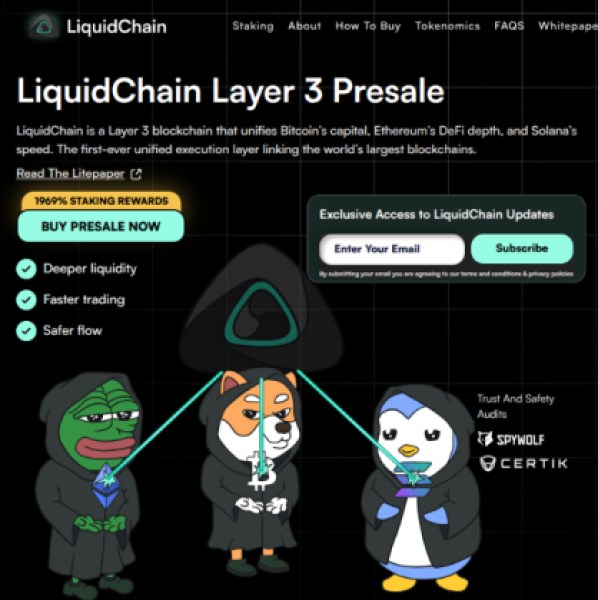
Source: LiquidChain
For a user or developer, this means Single-Step Execution. The data suggests that reducing the number of ‘hops’ a transaction must take drastically lowers the surface area for errors.
The project’s ‘Deploy-Once Architecture’ allows developers to build applications accessing users and liquidity from all three major chains simultaneously. Instead of a disjointed system where funds can easily disappear into the ether of a complex bridge, LiquidChain offers a cohesive environment.
This consolidation is critical. By streamlining the user flow, the protocol removes the technical obfuscation that scammers often hide behind.
EXPLORE THE LIQUIDCHAIN ECOSYSTEM.
LiquidChain L3 Protocol Enhances Verifiable Settlement
Beyond simplification, the core security proposition of LiquidChain lies in its status as a Layer 3 protocol. Layer 1s (like Bitcoin) provide security, and Layer 2s handle scaling. But L3s? That’s where the magic happens, application-specific layers where custom logic and verifiable settlement occur.
The project utilizes a Cross-Chain VM (Virtual Machine) designed to handle the intricacies of multi-chain settlement without forcing the user to manage distinct wallets for every network.
This infrastructure is powered by the $LIQUID token, which serves as the primary transaction fuel for the network. Unlike legacy systems, where value transfer is opaque, the LiquidChain model emphasizes verifiable settlement.
For institutional participants (and savvy retail traders), this transparency is non-negotiable. The protocol also introduces Liquidity Staking, incentivizing users to secure the network while earning rewards, creating a deeper economic alignment between network security and user participation.
We’re seeing a clear shift in the market away from ‘wild west’ infrastructure toward compliant, transparent execution layers.
With Developer Grants available to encourage secure application building, the ecosystem is positioning itself as a hub for the next generation of safe, cross-chain DeFi. If you’re watching the infrastructure thesis, $LIQUID represents a bet on the convergence of major chains into a safer, more usable whole.
VISIT THE OFFICIAL LIQUIDCHAIN ($LIQUID) PRESALE SITE.
This article is for informational purposes only and does not constitute financial advice. Cryptocurrency investments, including presales and new protocols like LiquidChain, carry significant market risk and volatility. Always conduct independent research.