Peeking Through Windows, Precision Hijacking? Two Giants of Prediction Markets Engage in Corporate Espionage

foresightnews_apiPubblicato 2026-06-05Pubblicato ultima volta 2026-06-05

Introduzione

Polymarket, a prediction market platform, is investigating a suspected corporate espionage case involving its main rival, Kalshi. Polymarket accuses Kalshi of stealing business information and copying product launches through potentially illicit means, compiling a "plagiarism file" documenting over a dozen suspiciously coincidental product releases and marketing campaigns. Key incidents include a February 2026 free-grocery pop-up event, where Kalshi launched an almost identical campaign just nine days before Polymarket's scheduled launch, seemingly to siphon attention. Furthermore, an article leaked Kalshi's plans for a perpetual futures trading product merely an hour before Polymarket's own planned announcement for a similar tool in April 2026. Polymarket executives suspect either an internal mole or physical surveillance, noting that the office of Paradigm—a Kalshi investor—directly faces their Manhattan workspace, leading them to install dark window film. Both Paradigm and Kalshi have dismissed the allegations as baseless and ridiculous. Kalshi claims its product developments are independent and coincidental timing is merely market-driven. The rivalry intensifies as both companies secure significant funding, with Polymarket seeking a $15 billion valuation and Kalshi valued at $22 billion amid growing regulatory scrutiny of the prediction market industry.


By: Marc Vartabedian, New York Post

Compiled by: Luffy, Foresight News


The prediction market platform Polymarket is investigating a suspected case of corporate espionage by a competitor. The platform allows users to place bets on sports events, weather, and geopolitical conflicts. The company alleges its top rival, Kalshi, used improper methods to steal business information and copycat its products.


Led by its 27-year-old CEO Shayne Coplan, the New York-based prediction platform has compiled a "copycat file," documenting over a dozen suspicious incidents: the launch times and product designs of several Kalshi new offerings were strikingly similar to Polymarket's, with coincidences in release timing being alarmingly abnormal.


Matthew Modabber, head of markets at Polymarket, said in a phone interview that the coincidences were simply too many and too abnormal, suggesting a deliberate and aggressive effort to copy their business.


Polymarket CEO Shayne Coplan speaking at the New York Stock Exchange on November 13 last year


The executive did not disclose further details, but people familiar with the matter revealed the company internally suspects two possibilities: one is a mole planted inside Polymarket; the other is a more bizarre suspicion of surveillance.


In recent months, several employees have suggested that Paradigm, an investor in Kalshi, may have been monitoring Polymarket's Lower Manhattan office from across the street. Paradigm's office in New York's SoHo district faces Polymarket's office, with floor-to-ceiling windows offering a direct view into Polymarket's workspace, potentially even observing employees' computer screens. The street-level below houses trendy clothing stores and the upscale restaurant Balthazar.


Due to surveillance concerns, Polymarket specifically applied dark tinted window film to its office windows this spring. An internal employee stated: "The possibility of being spied on was discussed in company meetings. The final conclusion was that, given Kalshi's past conduct, such clandestine surveillance is entirely plausible."


When asked about the espionage allegations, a Paradigm spokesperson responded: "That claim is laughable." Kalshi spokesperson Jack Such responded: "The related accusations are baseless, bordering on delusional. Polymarket is welcome to spend its energy on self-investigation. Kalshi will continue to diligently improve its products."
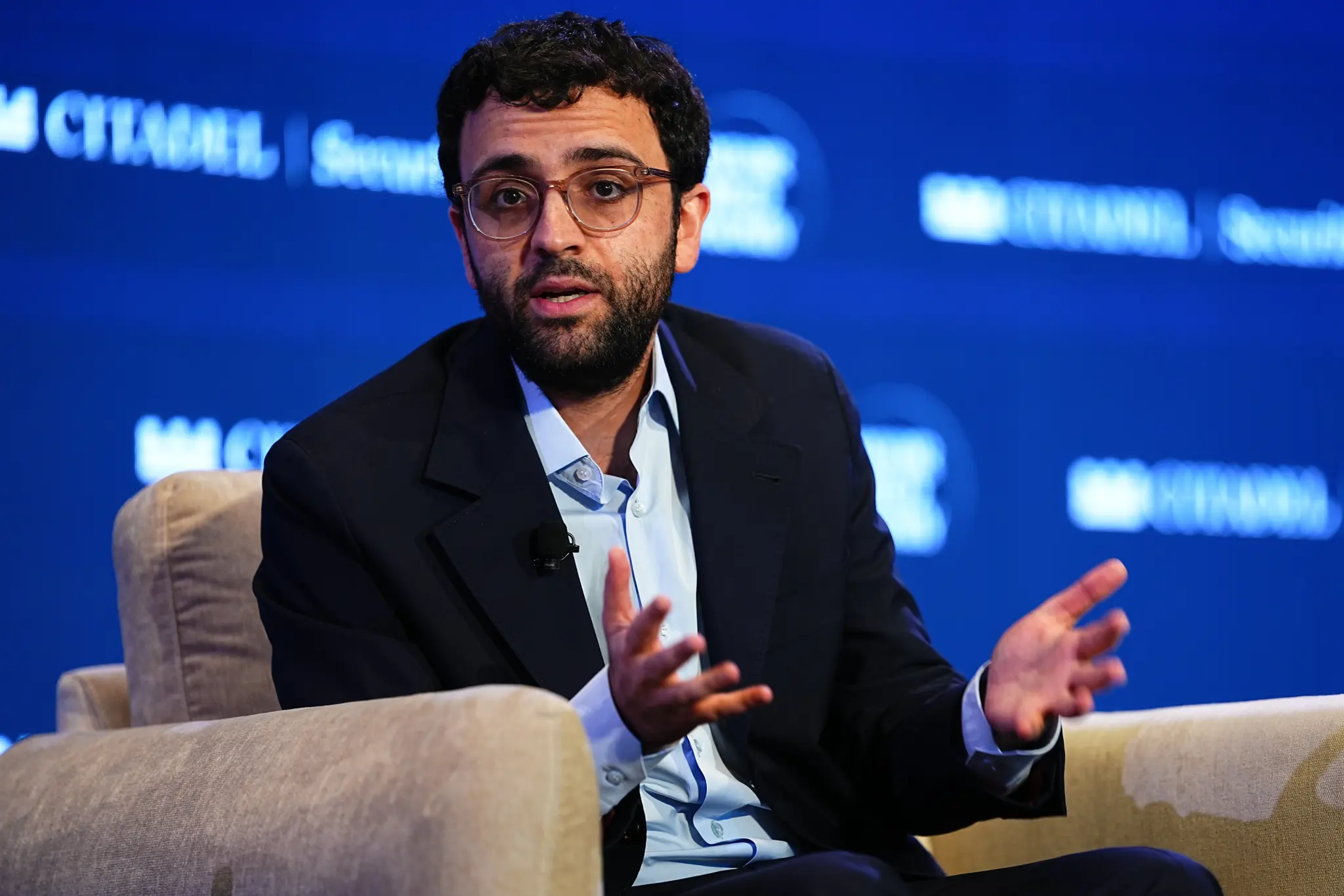

Kalshi co-founder Tarek Mansour speaking at the Semafor World Economy Summit in Washington, D.C., on April 15


Polymarket's investigation focuses on two points: how Kalshi precisely obtained advance knowledge of its new product launches and marketing campaign schedules, and what level of detail they acquired to enable such efficient and comprehensive replication.


Suspicions within the platform have been accumulating over the past year, and an incident at an offline event in February became the catalyst for the current conflict. Polymarket had been preparing a pop-up grocery store event since last November, scheduled to open in Manhattan on February 12: the first 300 in-store customers would receive free groceries. For this, they signed contracts totaling $643,380 for venue, branding, and execution.


Just nine days before Polymarket's opening, Kalshi suddenly launched an identical free grocery marketing campaign at a Westside supermarket in New York, distributing $50 grocery vouchers with the promotional slogan "Free Market," while simultaneously launching prediction markets on topics like monthly egg price increases.


A Polymarket insider claimed the move was clearly intended to divert traffic from their event. Founder Shayne, who grew up in New York, said the event held special significance for the company, and being maliciously hijacked was very disappointing for the team.


Kalshi's head of communications, Elisabeth Diana, denied copying, stating their grocery marketing plan had been in preparation for a long time and they did not obtain the competitor's event timing through an insider. Kalshi spokesperson Such added that both companies' event inspirations came from the New York Mayor's campaign platform promoting grocery subsidies.


Furthermore, since January, Polymarket had been secretly developing a spot perpetual contract trading tool, allowing users to bet on real-time price movements of assets like stocks without holding the underlying asset, originally scheduled for announcement and launch on April 21. However, just one hour before Polymarket's announcement, the tech media outlet *The Information* published an exclusive article citing anonymous sources, revealing Kalshi was about to launch a similar perpetual contract product.


Polymarket's office is located in a fashionable New York neighborhood, directly across the street from Paradigm


According to sources, Polymarket executives were furious about this.


One source said, "It seemed like they knew we would announce that day, which is very suspicious."


Such explained that Kalshi's perpetual product development started in 2024. He believed *The Information* learned about the plan from a social media teaser Kalshi posted on X on April 13. The teaser showed a video of what appeared to be an infinite loop spring toy with the caption "Timeless," which in finance refers to perpetual futures contracts, contracts that never expire.


Polymarket's "copycat file" includes over a dozen sets of screenshots comparing official announcements, social media posts, and product interfaces from both companies. An executive stated these archived cases represent only one-tenth of all similar incidents.


One page of the file records: On June 10, 2025, at 9:01 AM, Polymarket announced on X an hourly crypto price prediction product, garnering nearly 24 million impressions. On the same day at 9:00 AM, the brokerage Webull jointly announced with Kalshi the launch of an identical product. Polymarket's file notes: "Same day?"


But Such countered, stating Kalshi had already launched a similar product before June 10, 2025, and that day was merely its listing on Webull through partnership. He argued it was actually Polymarket that launched later, making it clear who copied whom.


There are also cases of advertising material collisions. On Friday, August 22 last year, Polymarket ran a Meta ad in California for football betting, with the prominent headline "Hey, California"; just one weekend later, Kalshi launched an almost identical targeted ad with the same headline.


Such stated "Hey, California" is generic promotional language, not protected by trademark or copyright. He argued that claiming corporate espionage based solely on an advertising slogan is illogical.


The feud between the two prediction platforms has intensified in 2026. U.S. lawmakers and regulators are tightening oversight of prediction markets, with the industry facing criticism related to insider trading and war gambling. Meanwhile, capital continues to pour heavily into both leading platforms.


According to data from analytics firm PitchBook, Polymarket, founded in 2020, has raised approximately $2 billion to date, with its latest funding round aiming for a valuation of $15 billion. Kalshi, founded in 2018, has raised $2.6 billion, with its latest valuation at $22 billion, double its valuation from December last year.


Domande pertinenti

QWhat are the two main prediction market platforms involved in the alleged corporate espionage case, as described in the article?

AThe two main prediction market platforms are Polymarket and Kalshi.

QWhat specific incident in February did Polymarket cite as a key event leading to heightened suspicions against Kalshi?

APolymarket cited an incident where, just 9 days before their planned Manhattan pop-up grocery event, Kalshi launched a similar free-groceries promotional event in New York, which Polymarket believed was an attempt to divert traffic from their own event.

QWhat two possibilities does Polymarket internally suspect regarding how Kalshi might have obtained its confidential information?

APolymarket internally suspects two possibilities: that there is a mole within Polymarket, or that Kalshi's investor Paradigm has been conducting surveillance from their office across the street.

QHow did Polymarket reportedly respond to the surveillance concerns regarding Paradigm's office location?

AIn response to the surveillance concerns, Polymarket reportedly installed dark, tinted window film on their office windows during the spring.

QAccording to the article, what was Kalshi's explanation for the coincidental timing of their perpetual futures product announcement with Polymarket's?

AKalshi's spokesperson, Such, explained that their perpetual product development started in 2024 and suggested that the media outlet The Information learned of their plans from a social media teaser Kalshi posted on April 13th, not from inside information about Polymarket's schedule.

Letture associate

Take a Calm Look at Domestic Lithography Machines: 5 Units Delivered, How Far Are We from Challenging ASML?

This article analyzes recent news about China's domestic DUV lithography machines, advising a measured perspective. A state-backed enterprise plans to deliver about 5 immersion DUV systems this year, with a 2027 target of 20 units, aimed at 28nm processes. While this marks a step from R&D into initial customer validation, the author cautions against over-optimism. The piece clarifies this is DUV, not EUV technology. DUV is crucial but cannot economically solve challenges for advanced nodes like 5nm or below, where EUV is key. The 5-unit volume is minimal compared to ASML's annual output of over 130 such machines. The author highlights unverified claims regarding specs like 90% yield and warns against conflating this news with unconfirmed reports about Shanghai Micro Electronics' production. China's EUV efforts, while progressing with a prototype, remain in early testing, facing significant hurdles in core components like high-precision optics. The analogy of a "DeepSeek moment" is deemed misleading, as lithography involves slow, iterative precision engineering, not rapid software-like breakthroughs. Current progress represents establishing a potential second supply source and gaining vital engineering experience rather than an imminent industry disruption. For investors, the key indicators to watch are formal customer acceptance, stable operational performance, repeat orders, and growth in production volume and component localization. The conclusion is that this is a positive but early-stage development, far from altering the global competitive landscape.

marsbit51 min fa

Take a Calm Look at Domestic Lithography Machines: 5 Units Delivered, How Far Are We from Challenging ASML?

marsbit51 min fa

The 800x Golden Dog, "Gacha" Saves NFT Trading

Title: 800x Golden Dog: How 'Gacha' Mechanics Are Rescuing NFT Trading In the past month, the on-chain TCG (Trading Card Game) narrative, centered around "gacha" or loot box mechanics, has emerged as a major crypto-native revenue generator, second only to platforms like Hyperliquid and pump.fun. Recently, this trend hit Ethereum with Fake World Assets (FWA). Within just over a week, FWA generated approximately $1.3 million in revenue, ranking 15th in the past week's crypto app earnings. Its token, $FWA, surged from an initial market cap of ~$47,550 to a peak of ~$38.8 million—an 800x gain. Meanwhile, Collector Cards' token $CARDS declined significantly from its previous highs. FWA, developed by the team behind "PunkStrategy," operates as an NFT gacha system with a built-in token flywheel. Users deposit NFTs paired with ETH as liquidity into pools. Each deposit creates a personal pool; more ETH deposited lowers the chance of the NFT being "won" in a draw. Players spend ETH to "draw" (gacha). If they get an undesirable NFT, they can instantly sell it back to the original depositor at an 85% discount, generating income for the depositor. A 1% fee is taken on each draw and on depositor earnings when an NFT is kept. The key to FWA's momentum is its token $FWA. It cannot be bought directly externally. The primary way to acquire it is by playing the gacha and choosing to receive $FWA (instead of ETH) when selling back an unwanted NFT. This mechanism creates constant buy pressure for $FWA as players engage, especially during its price ascent. Early participants who held $FWA benefited massively from subsequent inflows. This contrasts with projects like Collector Cards, which, despite strong revenues, suffer from perceived low token utility beyond buybacks. In conclusion, while FWA's flywheel design—linking speculative token gains directly to NFT trading activity—has driven rapid growth, its sustainability is questionable. The model relies heavily on continuous $FWA price appreciation to offset the inherent negative expectancy of each draw. When price momentum stalls, activity will likely decline. The case highlights that in crypto markets, pure profitability narratives can be fleeting; understanding the relationship between attention, token buy pressure, and sustainable mechanics is crucial to avoid speculative pitfalls.

marsbit1 h fa

The 800x Golden Dog, "Gacha" Saves NFT Trading

marsbit1 h fa

The Quantum Computing Threat Approaches, Cryptocurrency May Be Exposed to Risks Before Banks

Quantum computing poses a significant threat to all cryptographic systems, including banks and governments, but decentralized cryptocurrencies with public ledgers like Bitcoin are likely the first practical target. Experts warn that a cryptographically relevant quantum computer (CRQC), capable of running Shor's algorithm to break the elliptic curve cryptography securing most crypto wallets, could emerge around 2029. Recent research shows the required quantum resources for such attacks are shrinking dramatically, potentially enabling key extraction in minutes. The core vulnerability for cryptocurrencies is not the cryptography itself—post-quantum standards are being developed—but the slow, decentralized governance required to implement upgrades. Unlike centralized banks that can swiftly transition, Bitcoin needs near-unanimous consensus among its global network, a historically difficult process as seen in past upgrades. Estimates suggest migrating all vulnerable Bitcoin funds could take at least 76 days of dedicated network time, and it must be completed before a CRQC exists to prevent "now-or-never" attacks on exposed keys. The threat is not binary; it begins when a quantum computer can decrypt data before it loses value, not necessarily in real-time. A significant portion of Bitcoin (estimated at millions of coins) already has public keys permanently exposed on-chain, making them vulnerable to eventual "static attacks." While technical solutions exist, the race is against time for decentralized networks to coordinate a defensive transition, serving as an early warning for the broader financial system.

marsbit1 h fa

The Quantum Computing Threat Approaches, Cryptocurrency May Be Exposed to Risks Before Banks

marsbit1 h fa

Trading

Spot
活动图片