Trade.xyz to cover SK Hynix perp liquidation losses tied to price anomaly

cointelegraphPubblicato 2026-07-29Pubblicato ultima volta 2026-07-29

Introduzione

Trade.xyz, operator of onchain perpetual markets on Hyperliquid, will cover eligible liquidation losses following a price anomaly in its SK Hynix perpetual contract. The mark price dropped sharply after an executed trade from an external venue was relayed by data providers, triggering liquidations. The platform stated its oracle functioned as specified but acknowledged trader frustration, calling the reimbursement a one-time discretionary decision. It plans to review price formation during extreme events and may increase reliance on its own order books, which now provide meaningful liquidity. The SK Hynix contract is one of Hyperliquid's most active markets. Trade.xyz did not disclose the number of affected traders or the total reimbursement amount.

Trade.xyz, an operator of onchain perpetual markets on Hyperliquid, said it will cover eligible liquidation losses after a price anomaly hit its contract tracking SK Hynix, a South Korean chipmaker and producer of high-bandwidth memory for artificial intelligence.

Trade.xyz said the SKHYNIX contract’s mark price fell from $1,127.90 to $917.25 at 23:01 UTC on Monday after an executed trade was relayed by multiple independent data providers. Eligibility requirements will be announced soon, with distributions expected in the coming days.

The SK Hynix contract ranks among Hyperliquid’s most active markets. On Wednesday, Hyperliquid data showed the contract had generated over $1.5 billion in 24-hour volume and held nearly $600 million in open interest at the time of writing.

Trade.xyz said its oracle was tracking the external venue used as the primary South Korean pre-market and had “worked as intended according to its specification.” It acknowledged traders’ frustration and described the reimbursement as a “one-time discretionary decision,” adding that it would review how prices are formed during extreme market events.

The platform did not disclose how many traders would qualify for reimbursement or the total amount it expects to distribute.
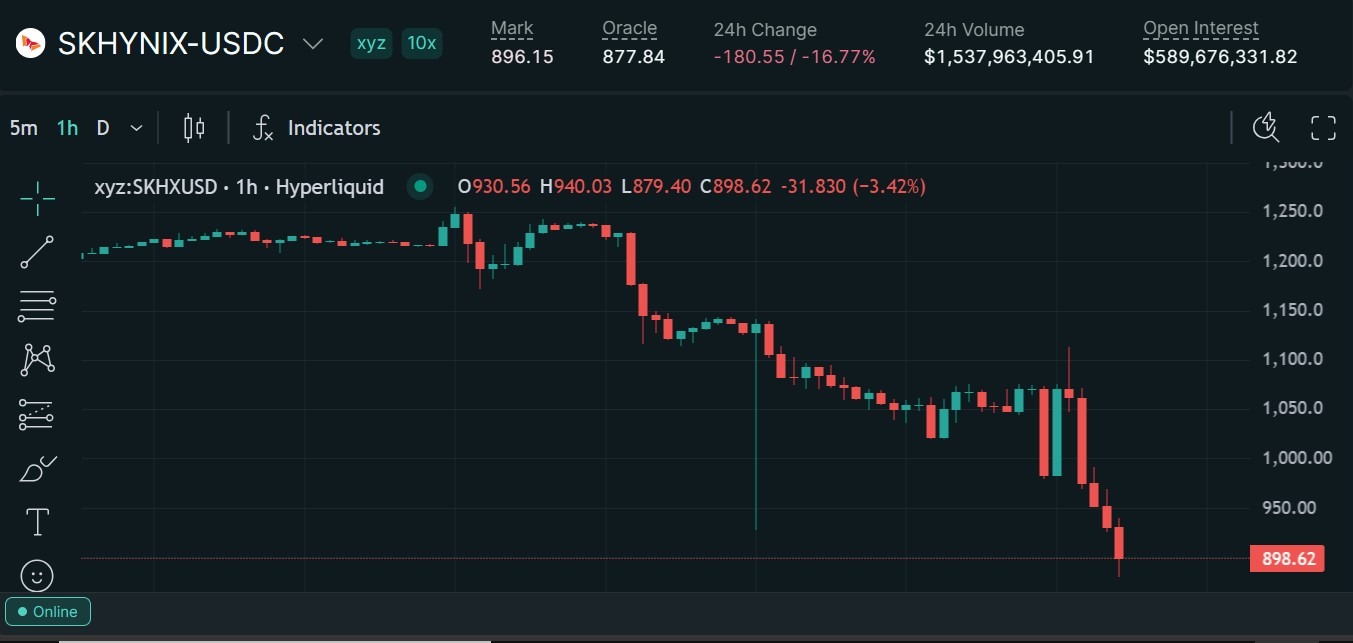
SK Hynix trading chart. Source: Hyperliquid

How the anomaly reached the perpetual market

Trade.xyz said the sharp move originated from an executed transaction on an external market rather than its own order book. Its SK Hynix oracle tracks the US dollar value of one SKHX common share by converting the underlying Korean won price using the prevailing exchange rate, according to its documentation.

The external print fed into the oracle and contributed to the contract’s mark-price move. Hyperliquid uses the mark price to value positions for margin purposes and determine when leveraged positions should be liquidated.

The platform said it is considering giving more weight to prices formed on its own order books, which it said now provide meaningful liquidity and market signals.

Related: Onchain commodity trading is here to stay, but liquidity remains an issue

Trade.xyz operates under Hyperliquid’s HIP-3 framework, which allows builders to launch perpetual contracts tied to assets with external price feeds.

The platform accounted for more than $22 billion of HIP-3’s first $25 billion in cumulative volume and later launched an officially licensed S&P 500 perpetual using S&P Dow Jones Indices data.

Magazine: How Hong Kong is turning tokenized bonds into real market infrastructure

Domande pertinenti

QWhat is the name of the platform that will cover liquidation losses due to the SK Hynix price anomaly?

ATrade.xyz

QWhich underlying asset's price anomaly caused the liquidation losses on Trade.xyz?

AThe SK Hynix contract, which tracks the South Korean chipmaker SK Hynix.

QOn which underlying protocol or exchange does Trade.xyz operate its perpetual markets?

AHyperliquid

QAccording to Trade.xyz, what was the source of the price anomaly that affected the SK Hynix perpetual contract?

AAn executed transaction on an external market (a Korean pre-market venue) that was relayed by multiple independent data providers.

QWhat framework on Hyperliquid does Trade.xyz operate under to launch perpetual contracts?

AThe HIP-3 framework.

Letture associate

A Brief History of the Lithography Machine: How a Beam of Light Walked Sixty-Nine Years

A Brief History of Lithography: 69 Years of Light In July 2026, reports of a Chinese state-backed company producing five immersion DUV lithography machines sent shockwaves through Wall Street, wiping roughly $44 billion from ASML's market cap in a single day. This event signaled a crack in the long-held assumption of Western monopoly over advanced chipmaking equipment. The journey began in 1957 when Jay Lathrop coined the term "photolithography." Early contact aligners (1960s) gave way to PerkinElmer's revolutionary projection aligners in 1973, boosting yields dramatically. GCA's step-and-repeat system (1978) established the modern stepper blueprint. However, within a decade, Japanese firms like Nikon and Canon, supported by a strong domestic market, captured nearly 90% of the global market from American pioneers, who ultimately exited the business. ASML, founded in a leaky shed in 1984, rose to dominance through key strategic moves: the TWINSCAN dual-stage platform (2001) and the acquisition of SVG, gaining access to Intel. A pivotal moment came in the early 2000s with the industry at a 193nm wavelength impasse. While most invested in the costly 157nm path, TSMC's Burn Lin proposed immersion lithography—using water between the lens and wafer. ASML bet on this simpler idea and, with Zeiss, delivered the first commercial immersion tool in 2004, effectively ending the 157nm roadmap and leaving competitors behind. The subsequent push for Extreme Ultraviolet (EUV) lithography was an even greater marathon. Deemed the least promising option in 1997, EUV's development, led by ASML, required vacuum chambers, reflective optics, and a complex tin-droplet laser plasma source. Critical to its eventual success (first high-volume manufacturing in 2018) was the 2012 "Customer Co-Investment Program," where Intel, TSMC, and Samsung provided upfront funding and equity, sharing the immense risk and cost. Today, ASML holds a near-total monopoly in EUV and immersion DUV. The core lesson of this 69-year history is not merely one of technological invention but of sustained partnership. Successive leaders—PerkinElmer, GCA, Nikon—were not ultimately defeated by superior technology but by losing the vital connection to customers willing to tolerate years of iteration, fund long-term R&D, and integrate early, imperfect tools into their production lines. The "light" that completed the journey was always carried by those patient, invested partners.

marsbit21 min fa

A Brief History of the Lithography Machine: How a Beam of Light Walked Sixty-Nine Years

marsbit21 min fa

CryptoQuant Analyst Claims 'Frightening Scenario and Simultaneously Promising Signal for Bitcoin' Reveals Ultimate Bottom Point! Here Are the Details

Bitcoin, the leading cryptocurrency, entered a bear market after hitting a historic high of $126,000 in October 2025 and has since fallen over 50%. As BTC recently dropped to around $57,000, opinions diverge on whether the bottom has been reached, with some expecting a drop closer to $50,000. According to a pseudonymous CryptoQuant analyst, the Bitcoin bear market may be nearing its end. The analyst notes that as selling pressure following the all-time high weakens, price corrections are becoming shorter and recovery periods more substantial. The July decline was only slightly below lows seen in early February, and BTC has remained relatively stable around $60,000 since, indicating diminished seller influence. Positive technical signals are also cited, with MACD and RSI showing bullish signals, positive divergences, and oversold conditions, collectively suggesting a potential bottom formation for BTC. However, the analyst does not rule out a final sell-off in the short term. They suggest the ultimate market bottom could be around $51,336, corresponding to the 61.8% Fibonacci retracement level. The $50,000 area is highlighted as a crucial historical support zone, aligning with the average investor cost basis and the 200-week moving average—conditions similar to bottoms in previous bear markets. *This is not investment advice.

cryptonews.ru1 h fa

CryptoQuant Analyst Claims 'Frightening Scenario and Simultaneously Promising Signal for Bitcoin' Reveals Ultimate Bottom Point! Here Are the Details

cryptonews.ru1 h fa

Trading

Spot
活动图片