IOSG | EIP-8363 Quantitative Review: Slashing Staking 'Subsidies'—What Does Ethereum Want in Return?

marsbitPubblicato 2026-08-25Pubblicato ultima volta 2026-08-25

Introduzione

**Title: IOSG | EIP-8363 Quantitative Review: Cutting Staking "Subsidies"—What Does Ethereum Aim to Gain?** **Summary:** EIP-8363 proposes a mechanism to progressively destroy a larger portion of validator rewards as the staking ratio increases, reaching 100% destruction when 50% of ETH supply is staked. This analysis models its impact on issuance, yield, and staking equilibrium, investigates whether ETH's yield truly explains its price, quantifies the on-chain economy's dependence on this yield, and presents conclusions. Key findings: 1. EIP-1559's fee-burn mechanism has become largely ineffective, with burn rates down 98% since 2022. Issuance policy is now Ethereum's primary remaining lever over ETH supply. 2. At the current staking level (~35% of supply), EIP-8363 would cut issuance by ~58.6% and staking APR by ~56.4%, not eliminate it entirely. The mechanism is self-limiting; under reasonable yield thresholds, the system would stabilize at 26–34% staking with 0.3–0.5% annual issuance. 3. No statistically significant correlation exists between historical staking yield changes and ETH price movements. The natural 37% yield decline since 2023 showed no detectable price impact. 4. The on-chain economy's direct dependence on this yield is limited. Liquid staking tokens (LSTs) like wstETH are crucial as collateral (e.g., 34.2% in major lending markets), but their utility persists as long as yield is positive. Staking-focused ETFs represent a tiny fraction (0.19% of supply...

Author:Mario Chow,IOSG

EIP-8363 Proposal: As the staking ratio increases, burn an increasingly larger portion of validator rewards, reaching 100% burn when 50% of the supply is staked. This article models its impact on issuance, yield, and staking equilibrium; examines whether ETH's yield has ever truly explained its price; quantifies how much of the on-chain economy actually relies on this yield; and presents our conclusions.

All calculations are based on on-chain data and the original EIP. The model is independently constructed, with a discrepancy of less than 2% from publicly available third-party data. Data updated as of August 24, 2026.

One-sentence version of the argument
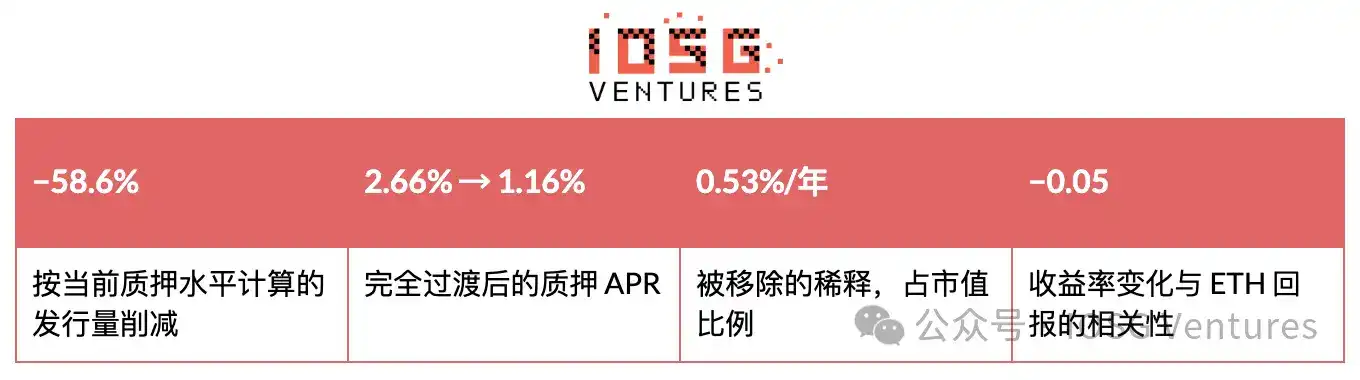
The fee burn is dead, making issuance the only lever Ethereum still has over ETH supply. The proposal halves issuance at current staking levels, not zeroes it; and it's self-limiting: at any reasonable staker hurdle rate, the system ultimately stabilizes with 26–34% of supply staked and issuance at 0.3–0.5%/year. Meanwhile, the portion of yield it cuts shows no detectable relationship with ETH's price.

I. The Burn Mechanism Is Already Broken

EIP-1559 burned 1.48 million ETH in 2022. EIP-1559 burns the base fee, which is essentially congestion pricing; once blobs move rollup data off L1 and the gas limit is raised, congestion disappears: gas usage doubled while the average base fee fell 96%, and burn volume has dropped 98% since 2022. Over the past twelve months, it burned only 25,660 ETH, and the 30-day run rate is even lower: 39 ETH/day, annualized to about 14,300 ETH.
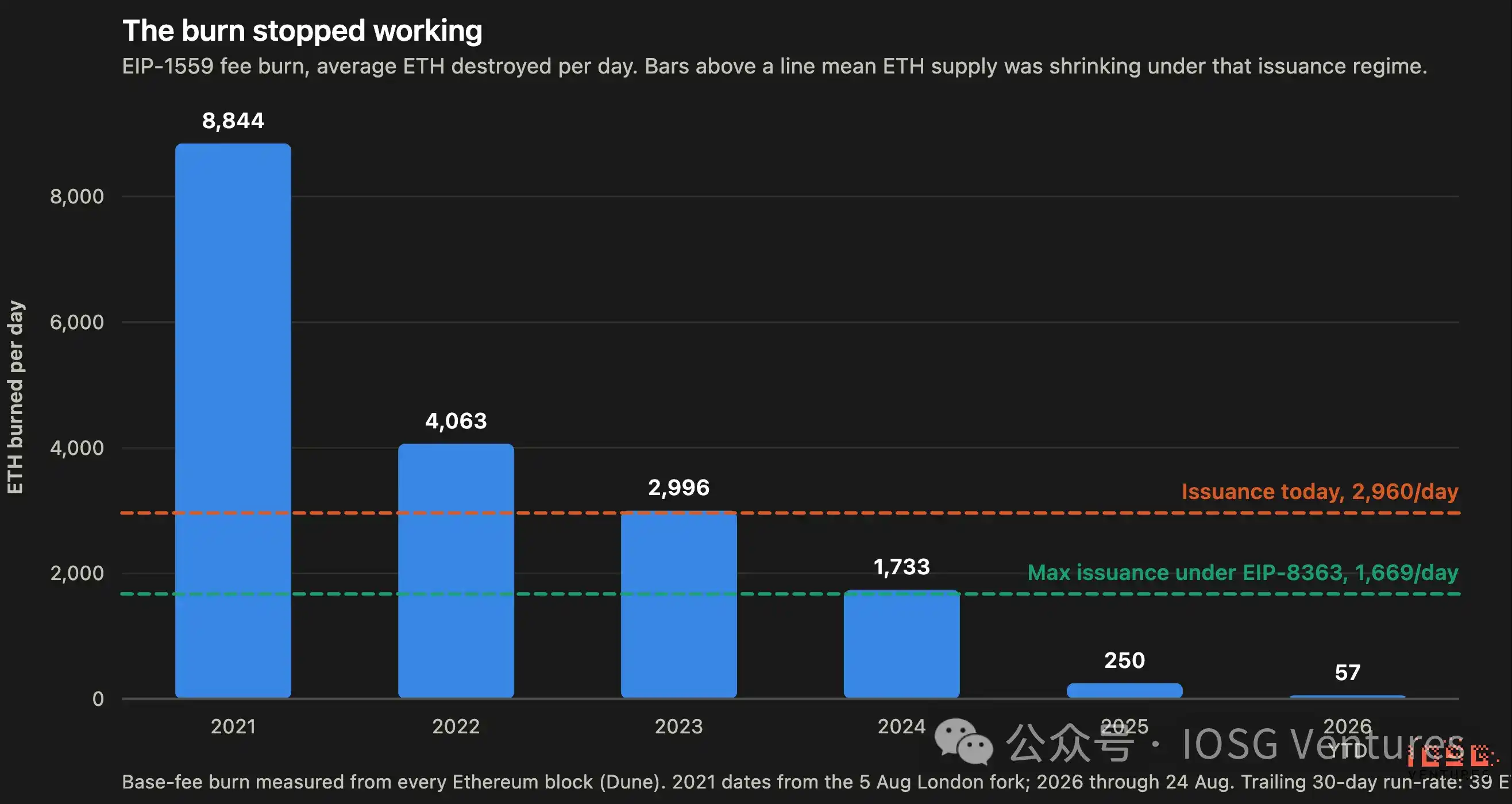
▲ Daily EIP-1559 fee burn volume by year: from 8,844 ETH/day in 2021 to 57 ETH/day in 2026—far below both current issuance and the maximum issuance curve under EIP-8363.

Compared to total issuance of about 1.08 million ETH/year, the burn now offsets only 2.4% of new supply. As a mechanism, "ultrasound money" is over. L2 migration and blob scaling moved the fee base away from L1: L1 gas usage actually doubled over the same period (3.4 billion → 6.7 billion units/month), while the average base fee dropped from 4.00 gwei to 0.17 gwei: this is a price effect, not a demand effect.

Net Issuance: What's Really Happening to Supply

The burn is only half the ledger. Looking at it together with issuance paints a grimmer picture: issuance has never stopped growing, while the offsetting item has vanished beneath it.
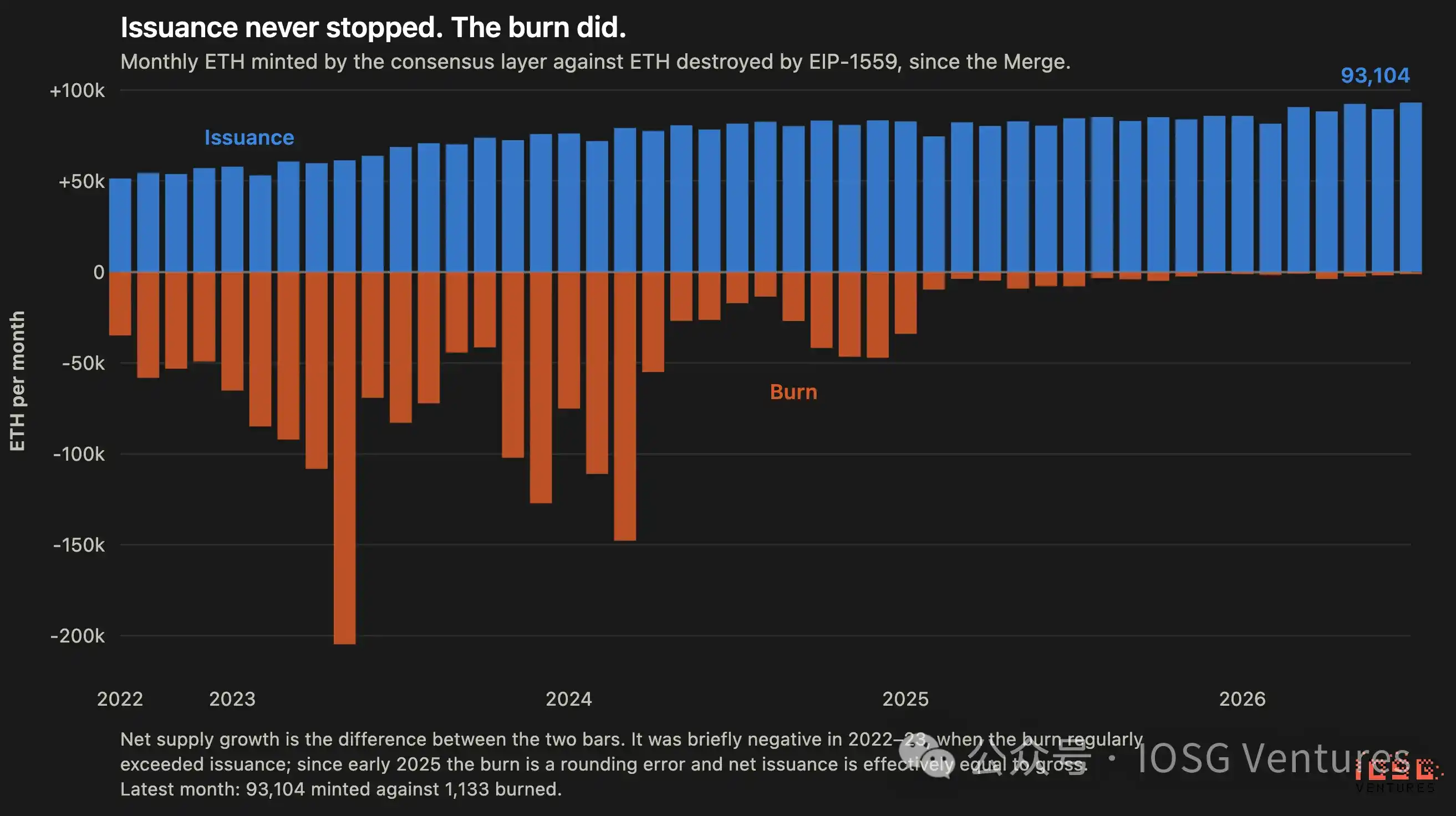
▲ Monthly ETH minted on the consensus layer vs. ETH burned by EIP-1559 since The Merge. Issuance bars have steadily grown; burn bars have shrunk to almost zero by 2025.

Out of the 47 months since The Merge, only 13 were deflationary—the last being March 2024. ETH has been inflationary for 28 consecutive months, and the rate has roughly tripled during this period, from +0.26%/year to +0.87%/year. The reason isn't that issuance increased much (up only 4% since 2024), but that the offset has gone to zero.

This reframes the entire debate. EIP-8363 is often framed as a choice between staking yield and monetary scarcity. But a more accurate understanding is narrower and more forced: issuance policy is now the only lever Ethereum has left over ETH supply, because the demand-driven one no longer works. Whether legislated or not, all supply questions now pass through the issuance curve.

II. What EIP-8363 Actually Does

Before unpacking the mechanism, we need to address the official core motivation: safeguarding network security. The proposal authors believe that once the network staking ratio crosses the 50% red line, Ethereum will lose its 'social layer defense' capability and face systemic parasitic risks from LST oligopolies that are too big to fail. Thus, the proposal attempts to cap staking by forcibly lowering yields. However, grand security philosophies often obscure the real meat on the ledger. Setting aside metaphysical debates about decentralization, what does this mechanism actually mean for the real on-chain economy? Here is a purely quantitative deduction.
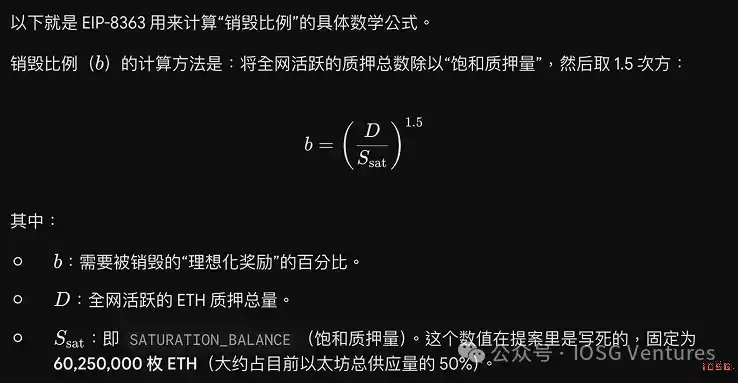
How is the money deducted? (Core Mechanism)

  • Pay first, then burn: Validators initially earn full rewards for all tasks as normal, but the system then directly "burns" a portion of the rewards according to a ratio (assume b).
  • Deduct based on "theoretical full amount," no double penalty: The key here is that the system calculates the burn amount based on the full theoretical reward you should receive, not the actual reward you get. Why? Because if you accidentally go offline, you already don't get the reward; if the system then deducts based on your actual situation, it's too unfair to offline participants. Deducting based on the "theoretical value" ensures motivation to work remains unchanged, and offline participants aren't penalized twice.
  • Extreme case protection: If the Ethereum network experiences severe issues (entering inactivity leak state), this portion of attestation reward burning is paused.
  • Extra income unaffected: This proposal only touches consensus layer rewards. Your side income from running a node—namely, MEV and priority fees—remains completely unaffected.

The two most common misconceptions in the community

Misconception 1: "Ethereum's issuance will be directly cut to zero."

  • Truth: Far from it. At the current staking level of approximately 42.2 million ETH, the burn ratio b is 58.6%.
  • To reduce issuance completely to zero, staked amount would need to surge to 60.25 million ETH (43% higher than current levels). So the accurate statement is: At this stage, the proposal only cuts issuance roughly in half, far from zero.

Misconception 2: "Yields plummet instantly, triggering a DeFi crash on day one."

  • Truth: An 18-month "soft landing" period is officially designed, making the first day almost imperceptible.
  • To prevent sudden shock, upon activation, the proposal will double the base reward factor (the parameter used to calculate rewards) from 64 to 128. This doubling precisely offsets the aforementioned 58.6% burn ratio.
  • In other words, on the first day of the upgrade, net issuance will remain at about 83% of current levels. Over the next 18 months, the parameter will gradually decrease back to the normal 64, with issuance slowly sliding down to 41% of current levels.
  • Summary: Yield decline is spread over a year and a half, not an overnight crash. Arguments fearing an "instant DeFi bubble pop" ignore this buffer mechanism.

III. Baseline: Where Ethereum Actually Is Today
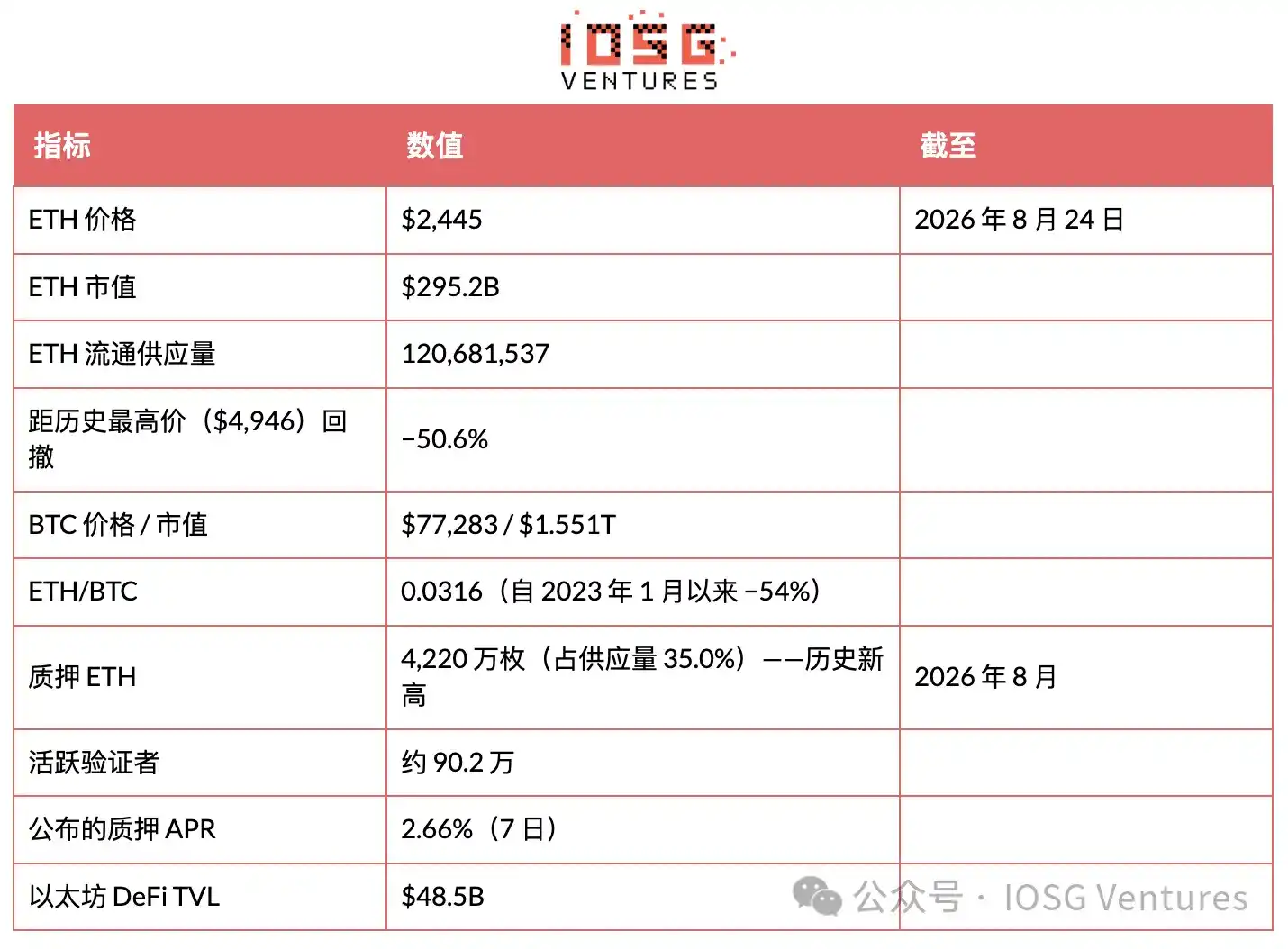
Supply Dynamics
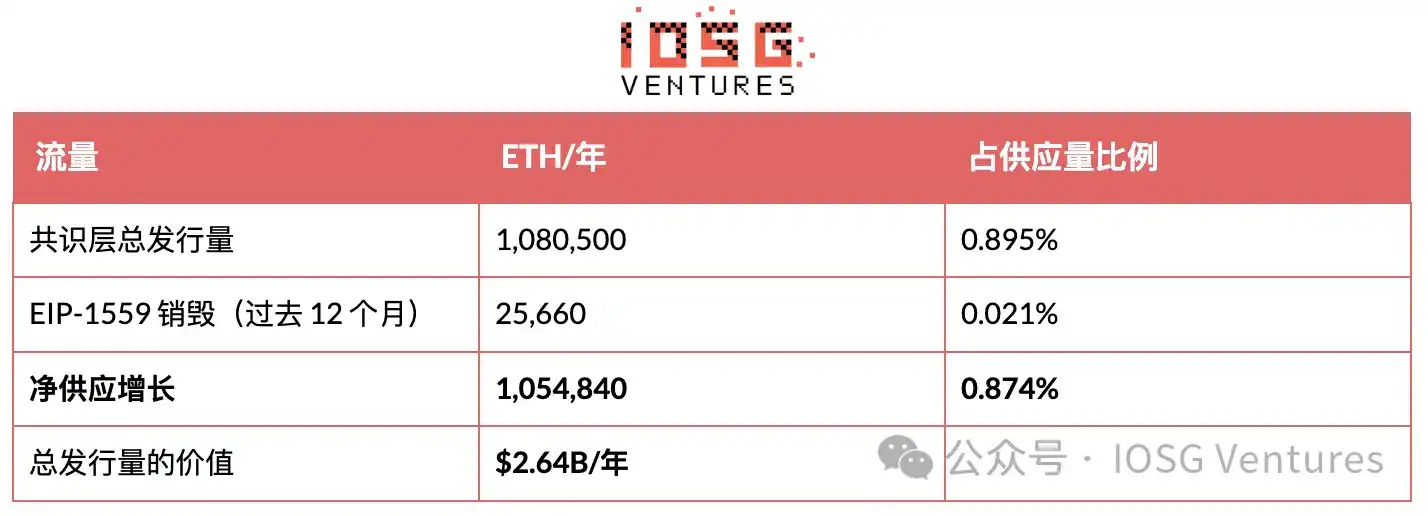
Where Issuance Comes From

All from staking rewards. Post-Merge, new ETH has only one source: payments from the consensus layer to validators, allocated with fixed canonical weights (denominator 64) across three duties: attestation 54/64 (84.4%, 911,672 ETH/year), block proposal 8/64 (12.5%, 135,063), sync committee 2/64 (3.1%, 33,766).

Issuance is modeled as I(S) = 940.9 · √(S/32) ETH/year, i.e., the protocol's own reward curve. At S = 42.2 million, this corresponds to a consensus layer APR of 2.560%. Measured priority fees for the first 23 days of August were 2,623 ETH, annualized to 41.5k ETH: equivalent to 0.098% on the staking base. Summed, this gives 2.658%, almost exactly matching the published 2.66%.

Using measured priority fees, at least 96% of validator income comes from issuance, at most 4% from fees. Proposer payments in MEV-boost beyond direct priority fees are not captured, so the fee share is a lower bound. Regardless, issuance dominates absolutely, and this proportion is key to the entire debate.

IV. Modeling the Proposal

The earliest attempts were to design a whole network around "hiding," not patching an existing one. On this path, two tokens led the way, placing completely opposite bets. The third case was built for banks, not individuals, but belongs to the same family.

Applied at current staking levels, ignoring behavioral response
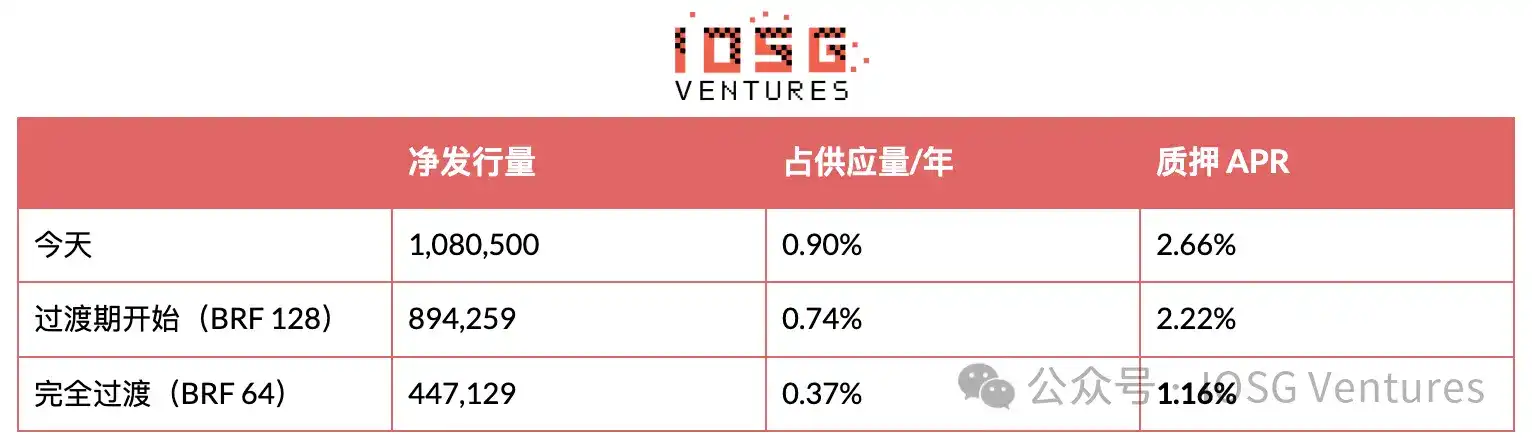
Issuance cut: −58.6%. Staking APR cut: −56.4%. Dilution removed: 633k ETH/year = $1.55B/year = 0.53% of ETH market cap annually.
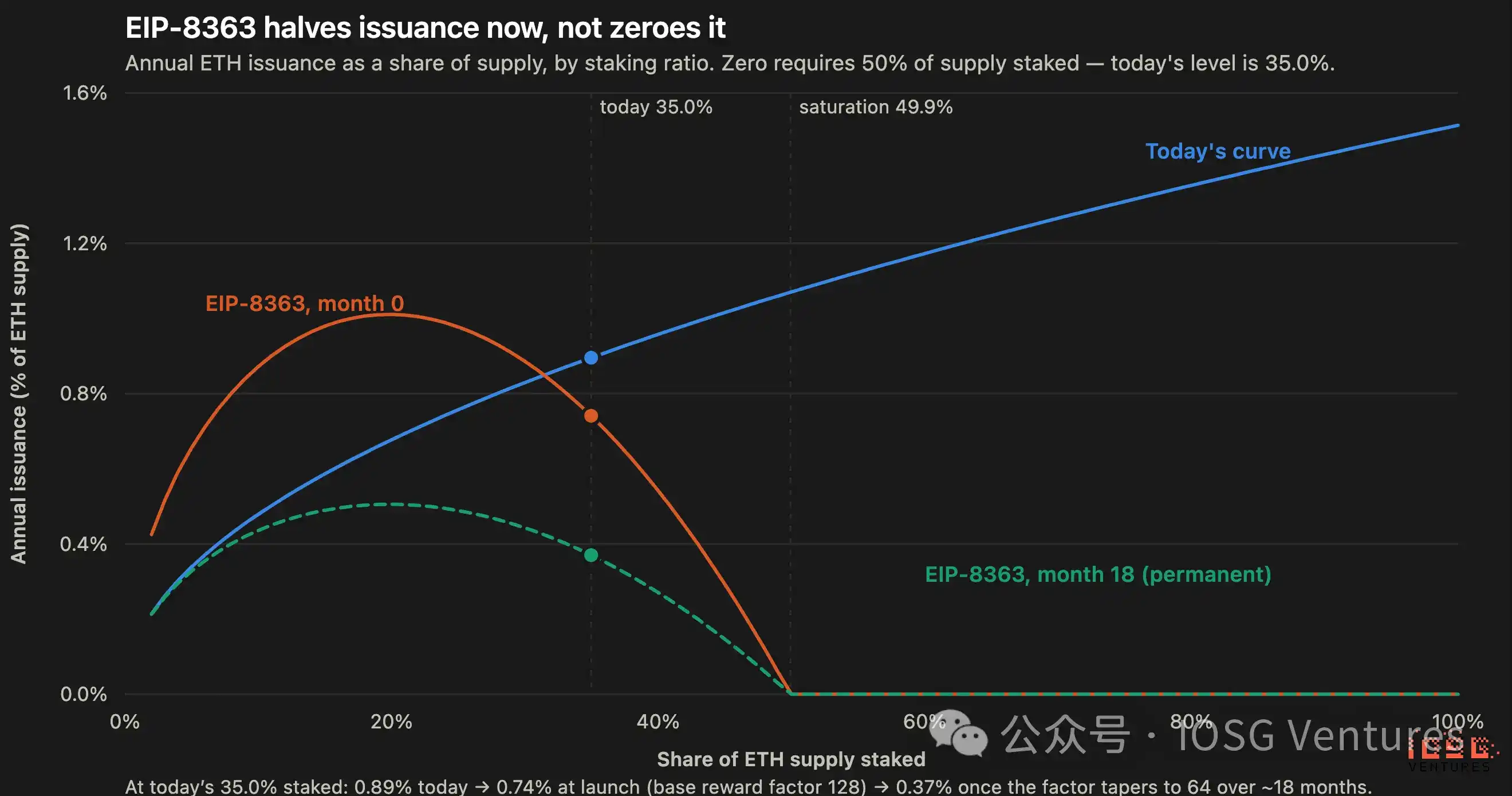
▲ Annual ETH issuance as a percentage of supply vs. staking ratio. Today's curve rises steadily; the EIP-8363 post-activation curve peaks at about 1.0% near 20% staking ratio; the permanent curve peaks at about 0.5%. Both curves drop to zero at 50% staking ratio.

Full curve (after complete transition)
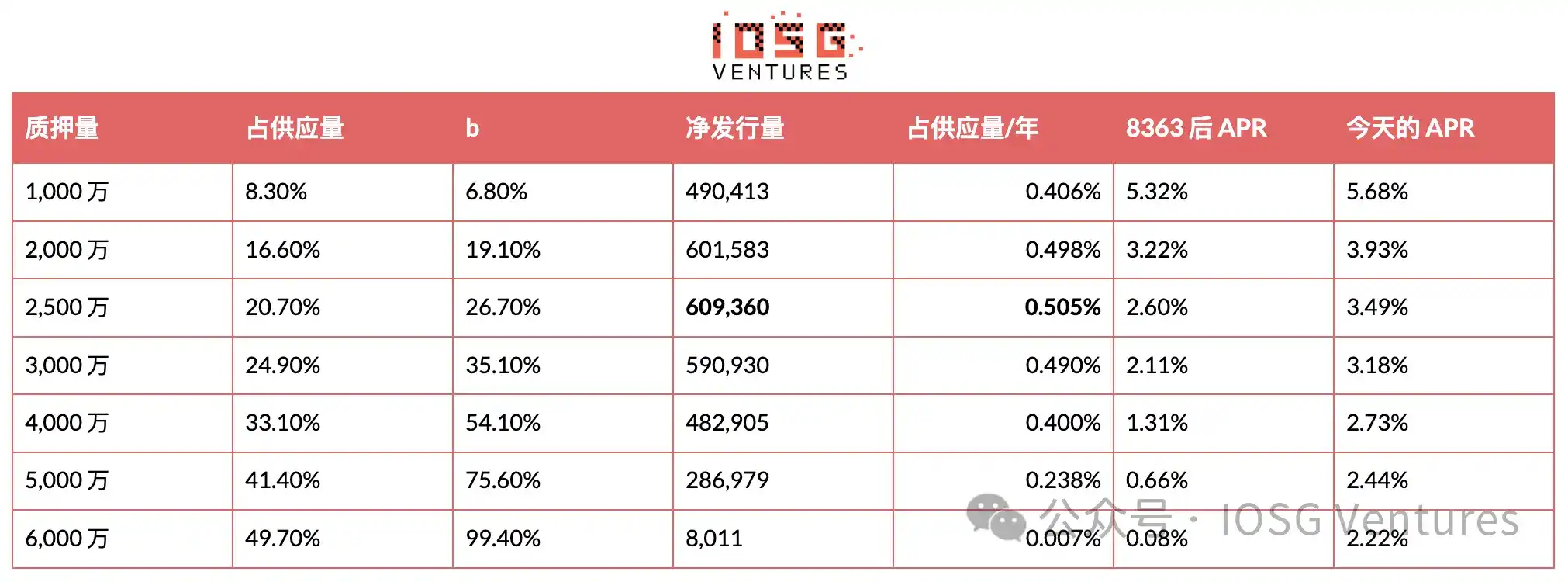
Issuance peaks near 25 million staked, at about 0.505% of supply, then declines—consistent with the EIP's own description.

Equilibrium—The Number That Truly Ends the Debate

Stakers are not passive. If yield falls below their required return, they exit, which both pushes up gross APR and lowers b. Solving for the fixed point:
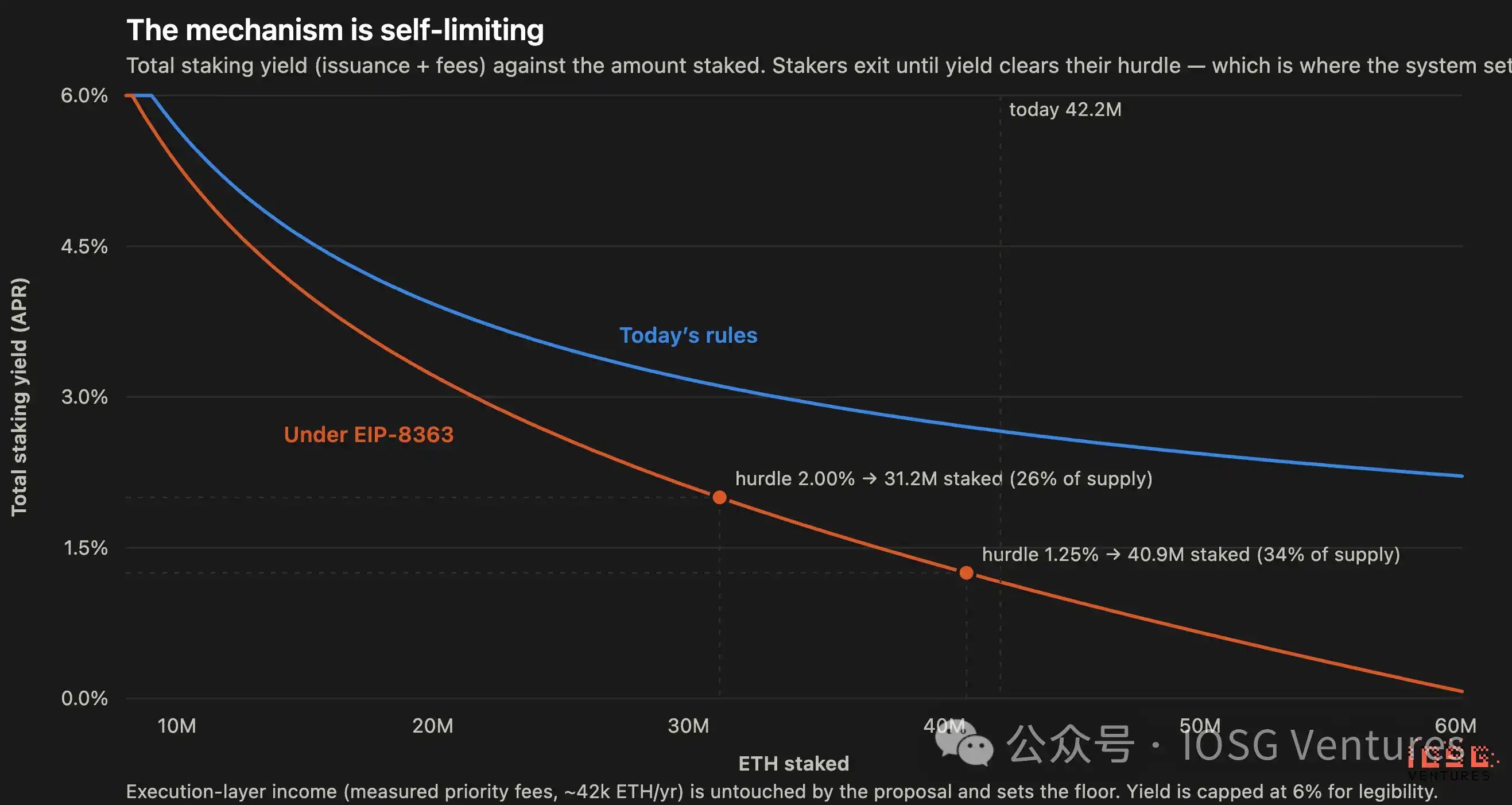
▲ Total staking yield vs. amount of ETH staked under current rules and EIP-8363. The EIP-8363 curve intersects the 2% hurdle at 31.2 million staked and the 1.25% hurdle at 40.9 million.
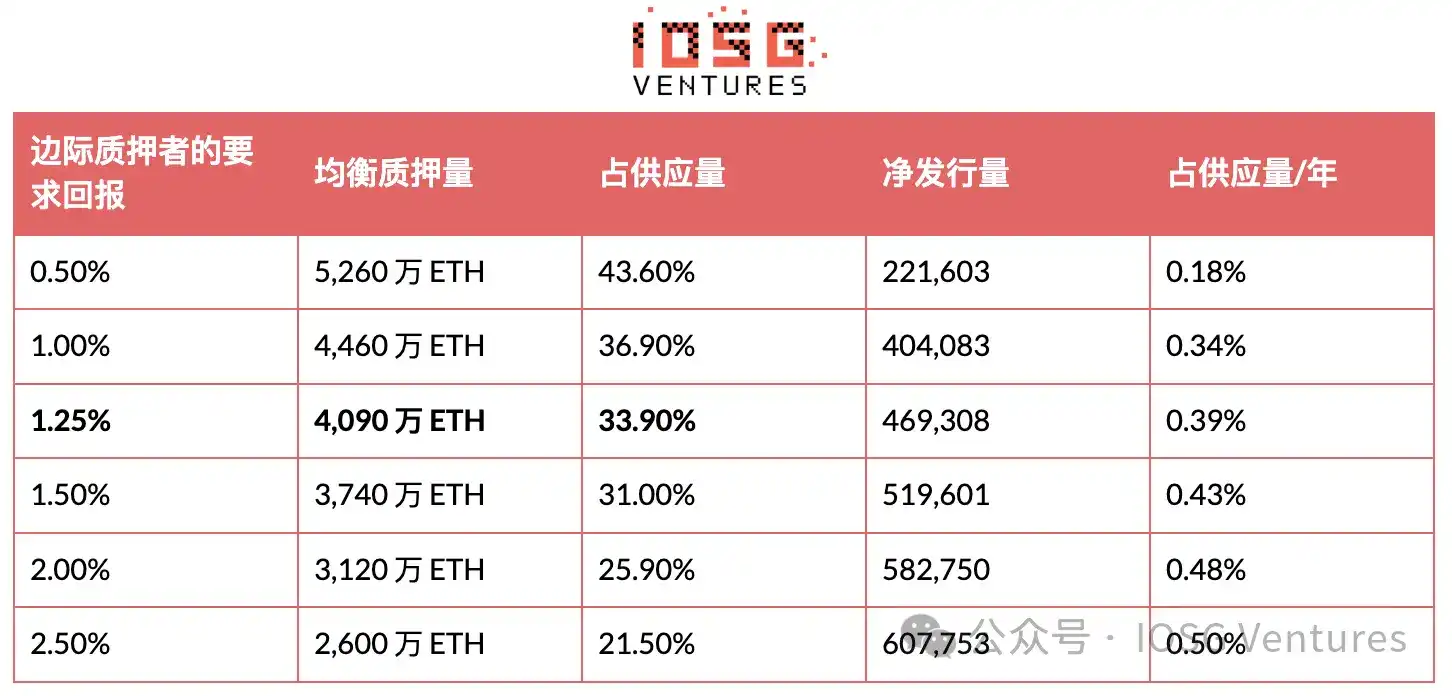
Reading this table against the two loudest claims in the debate:

  • "Issuance will go to zero." Only true if marginal stakers are willing to work for ~0.5% return. At any reasonable required return, ETH still inflates at 0.3–0.5%/year. Supporters exaggerate.
  • "Staking will collapse." At a 2% hurdle, staking stabilizes at 26%: lower than today's 35%, but roughly the level seen throughout 2024. Critics also exaggerate.

This mechanism is self-limiting by design. This is the most interesting property of the design and the least discussed point.

V. Can Staking Yield Explain ETH's Price?

First, address the "question behind the question"

Are staking ratio and yield correlated? Yes: perfectly, and by definition, not observation. This must be clarified first, as it determines what the data can and cannot say.

The reward pool paid by the protocol scales with the square root of the staked balance, so yield per ETH has a closed-form solution:

issuance(S) = 940.9 · √(S/32) ETH/year APR(S) = issuance(S)/S = 166.28 / √S

The more staked, the same pool is divided among more coins. The correlation between staking ratio and issuance yield is −1 by construction. Plotting them together is plotting an identity.

The only free variable is the difference between reported yield and the formula value: fee income. It was about 1.34 percentage points in 2022; today it's 0.10 percentage points.

The correlation itself

Answer: No correlation exists. 43 months, Jan 2023 → Jul 2026. (Data refreshed Aug 24, but this test was not rerun; window ends Jul 2026, price movements after do not affect result.)
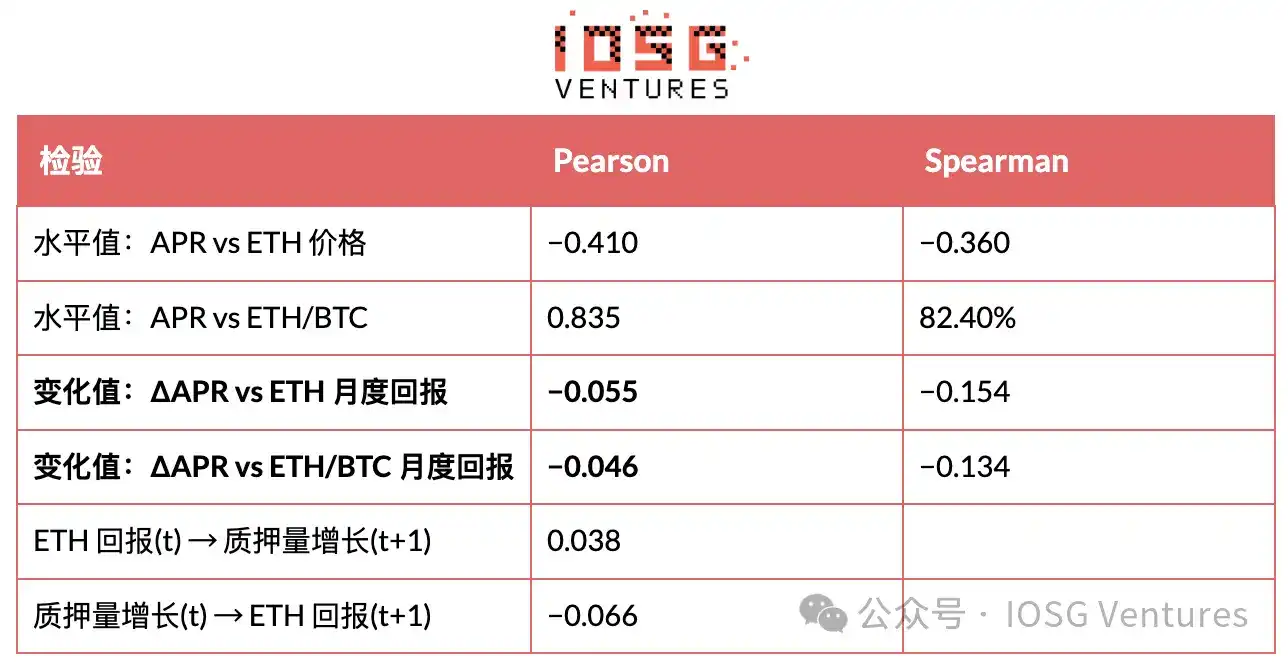
Regression Results
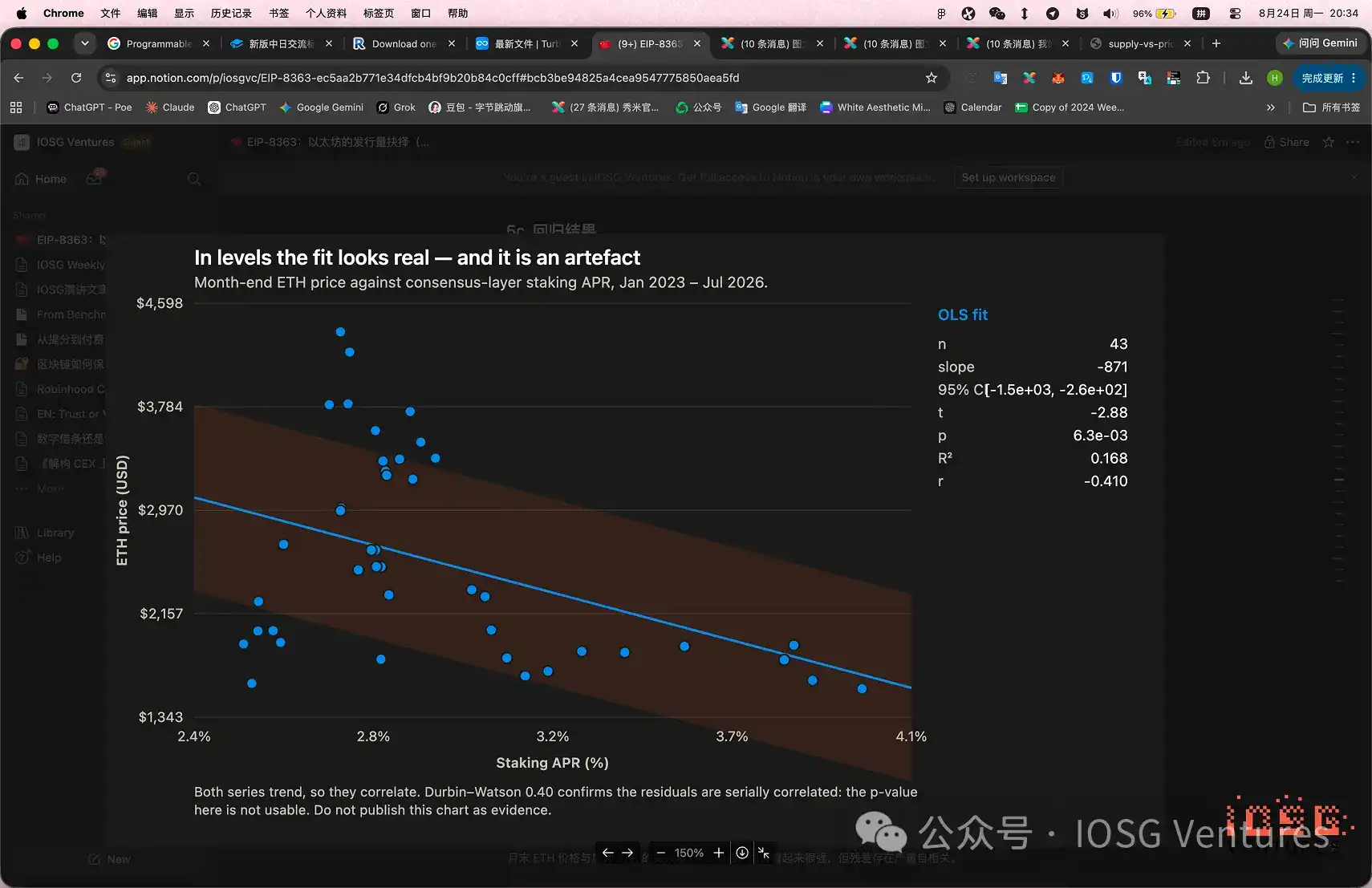
▲ End-of-month ETH price vs. staking APR relationship and OLS fit. The fit looks strong, but residuals show severe autocorrelation.

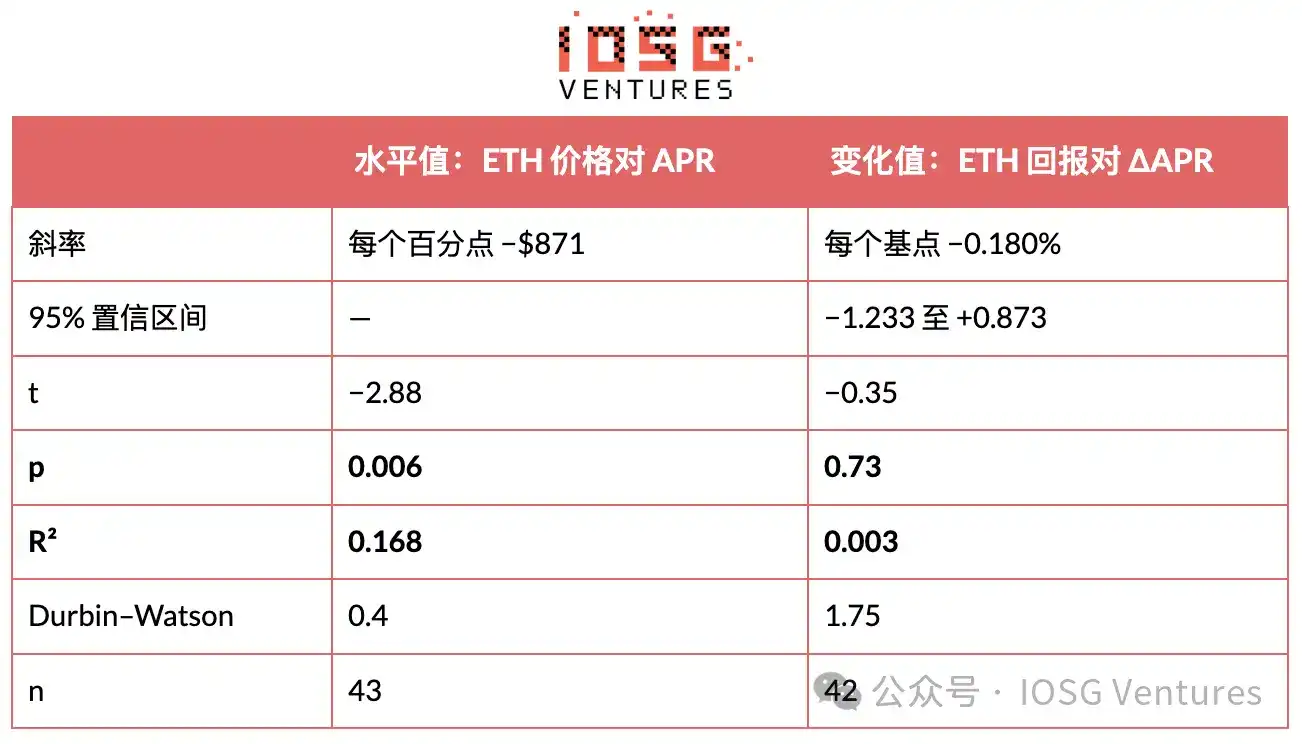
This level regression is "significant" at p = 0.006—but it's worthless. Durbin–Watson is 0.40, indicating severe serial correlation in residuals, a textbook sign of spurious regression between two trending series. Both variables have trends, so they correlate; standard errors are underestimated, p-values unusable. This chart is kept as a warning, not as evidence.
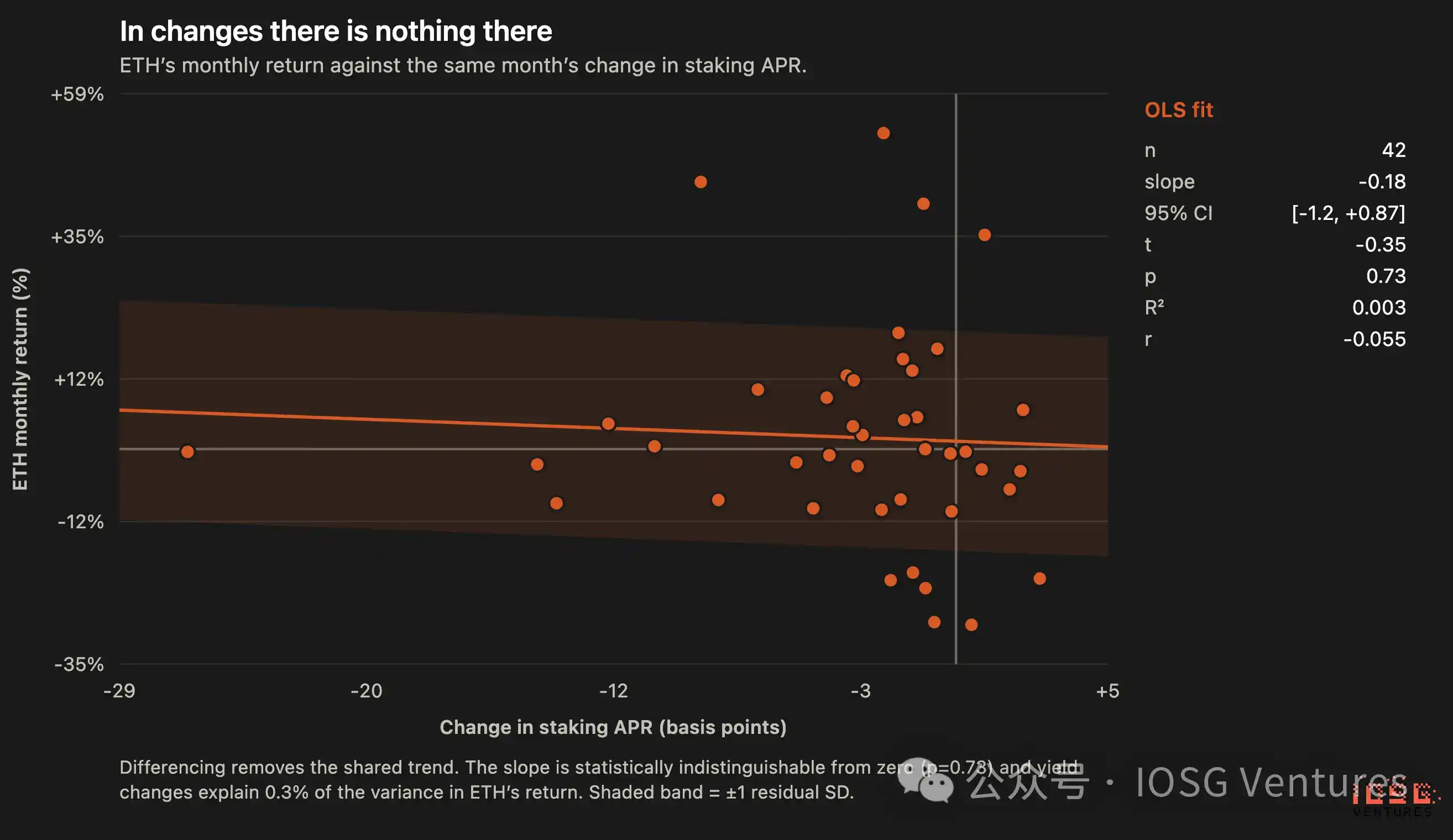
▲ Scatter plot of monthly ETH returns vs. change in monthly staking APR, with near-horizontal OLS fit line and wide residual bands.

After differencing to remove trends, the relationship disappears: p = 0.73, R2 = 0.003. Durbin–Watson is 1.75, indicating a clean setup. The 95% confidence interval comfortably crosses zero in both directions—the data can't even determine the sign of the effect, let alone its magnitude.
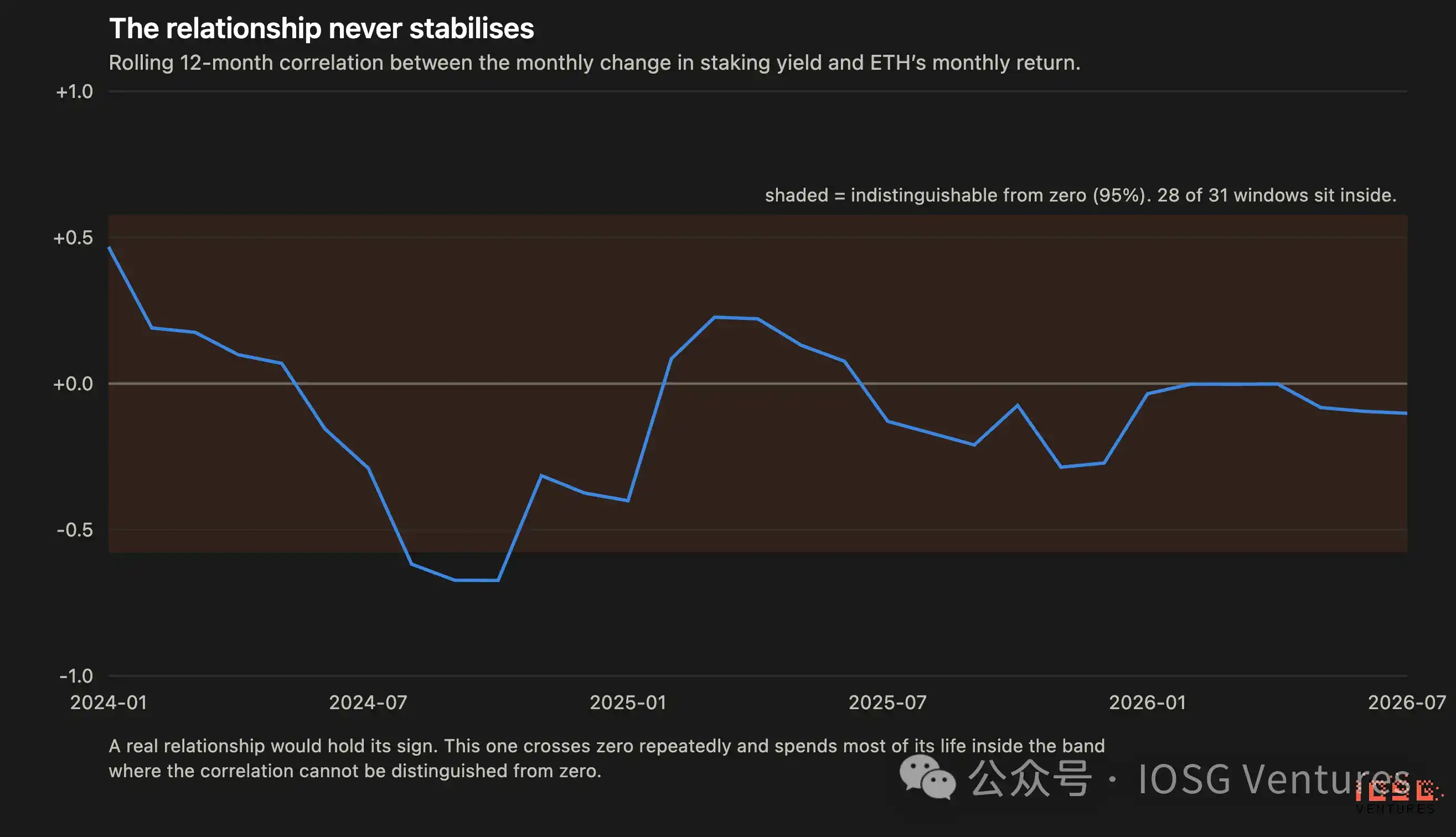
▲ 12-month rolling correlation between changes in staking yield and ETH returns, oscillating around zero and mostly within an interval indistinguishable from zero.

And this isn't a stable relationship hidden in noisy means—the rolling correlation repeatedly crosses zero, spending most of its time in an interval indistinguishable from zero.

From January 2023 to July 2026, ETH's staking yield fell from 3.98% to 2.50%, while ETH/BTC dropped 57%. Over the same window, the monthly correlation between changes in staking yield and ETH returns was −0.05. The yield was always there.

It didn't protect the price, and its compression didn't cause a drop. If a 37% yield reduction brought by the natural existing reward curve had no detectable price effect, the burden of proof lies on anyone claiming "another cut will have an effect."

Caveat: The staking series is reconstructed from on-chain flows, ~5% higher than published data. Direction and shape are reliable, absolute levels not precise.

Supply growth doesn't explain it either

If yield doesn't affect price, what about the actual supply figure this proposal changes? Same test, same window, replacing yield with net supply growth rate.
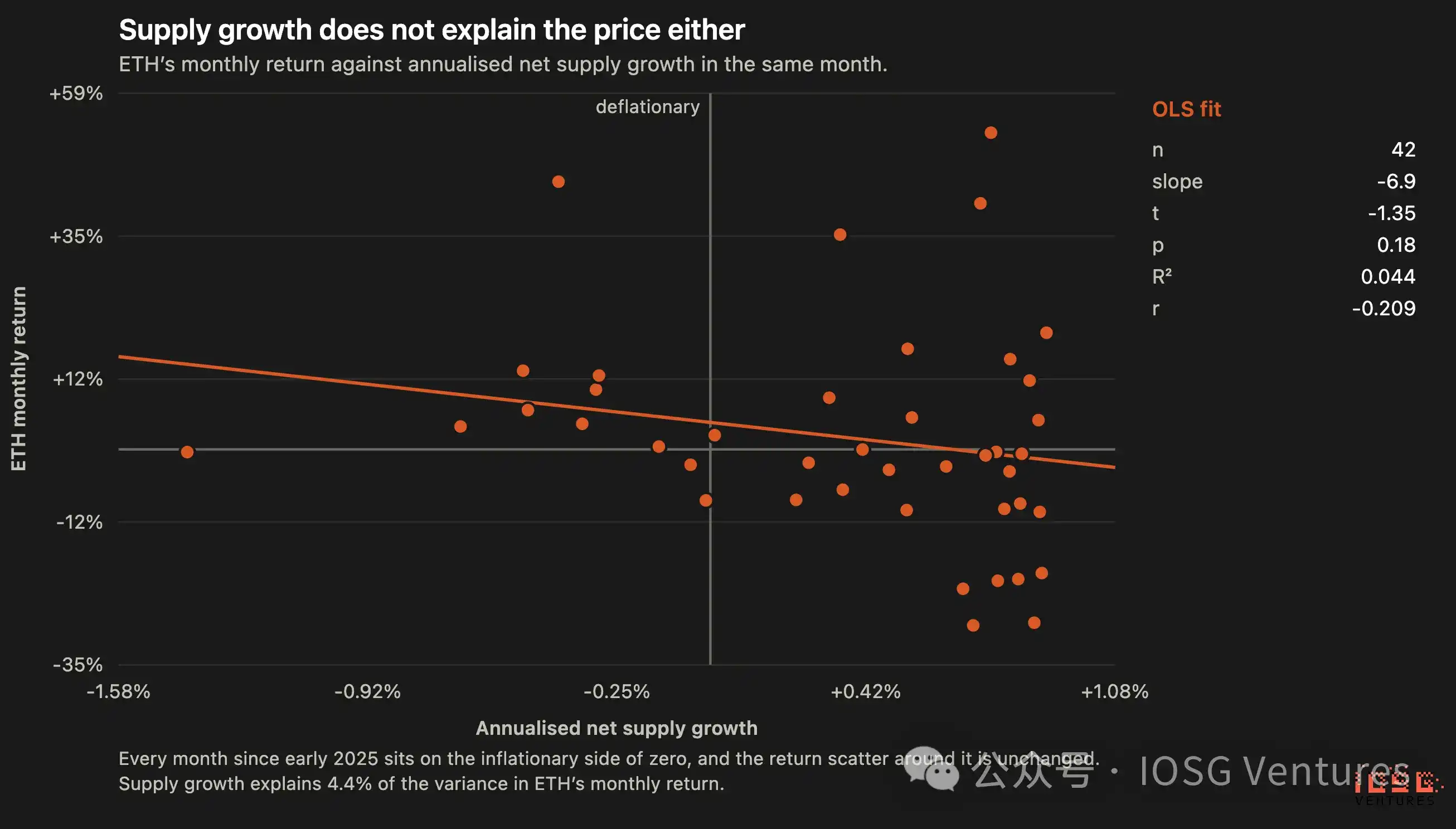
▲ Monthly ETH returns vs. annualized net supply growth rate. The fitted line slopes downward, but scatter is wide, relationship not significant.

Slope −6.9 (each percentage point higher annual supply growth corresponds to 6.9 percentage points lower monthly return), p = 0.18, R2 = 0.044, Durbin–Watson 1.82. 95% interval for slope: −17.1 to +3.4.

Read this result honestly, as it cuts both ways. The relationship is statistically insignificant, interval crosses zero, so it can't serve as evidence that "cutting supply growth boosts price." But it's about fifteen times stronger than the yield relationship (R2 4.4% vs. 0.3%), and the sign matches theoretical prediction. If either variable matters marginally, the data says supply, not yield—and that's precisely the trade EIP-8363 makes.

VI. How Deeply Does the On-Chain Economy Rely on ETH Yield?

Liquid Staking
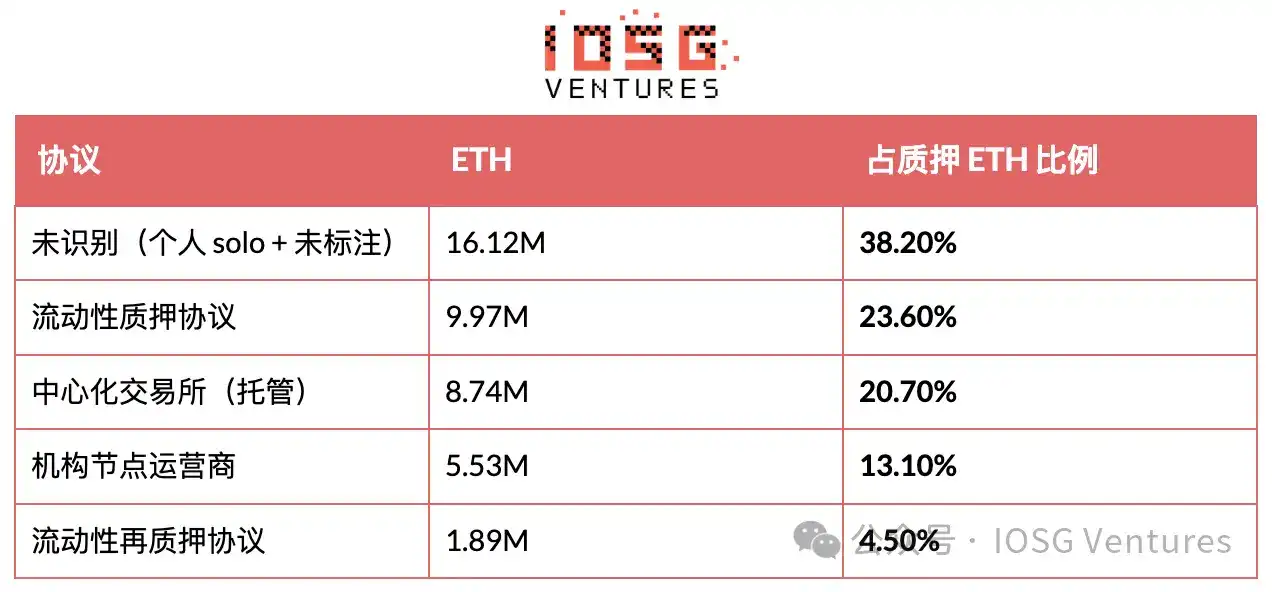
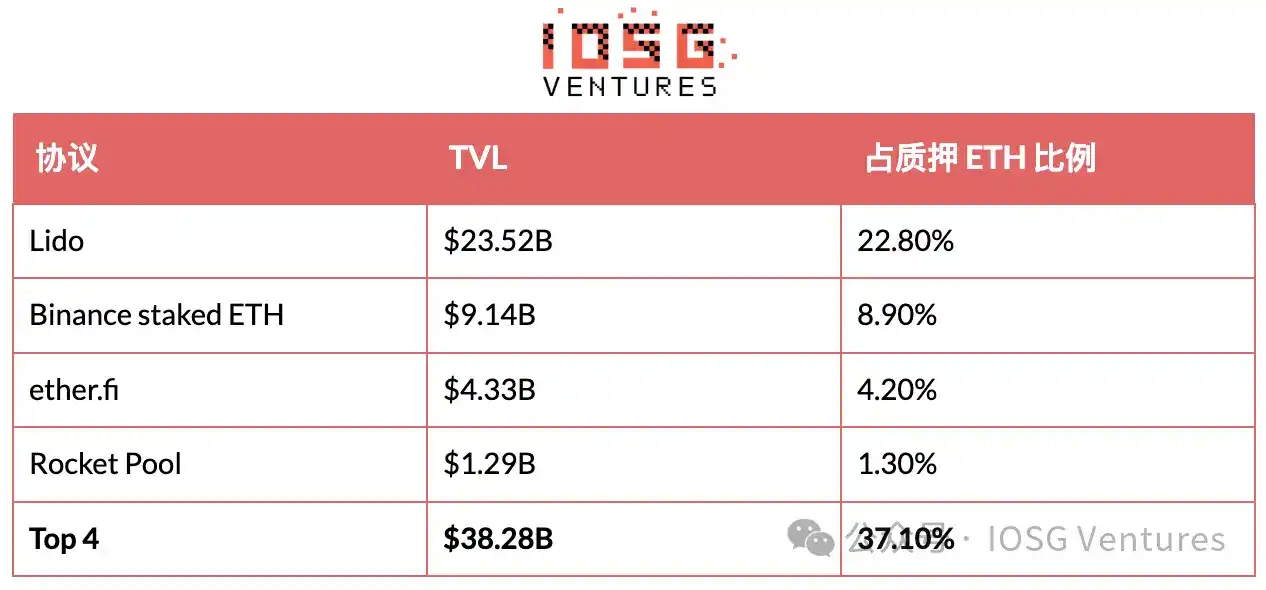
Lido alone accounts for 48% of Ethereum's total $48.5B DeFi TVL. Any claim that "DeFi will be fine" must first withstand this number.

What does the yield cut mean for them respectively?

Liquid staking: Revenue hurt. Lido handles about $602M in staking rewards annually, taking a 10% fee (~$60M/year). Cutting issuance by 58.6% means 633k less ETH in rewards issued per year; at Lido's 22.8% share, that's about $35M less fee income per year: roughly half its income from this segment. Not trivial for Lido, but insignificant at the Ethereum level. And regardless of yield changes, wstETH still beats WETH for any borrower wanting ETH exposure; its role as collateral remains intact.
LSTs as Lending Collateral—The True Dependency
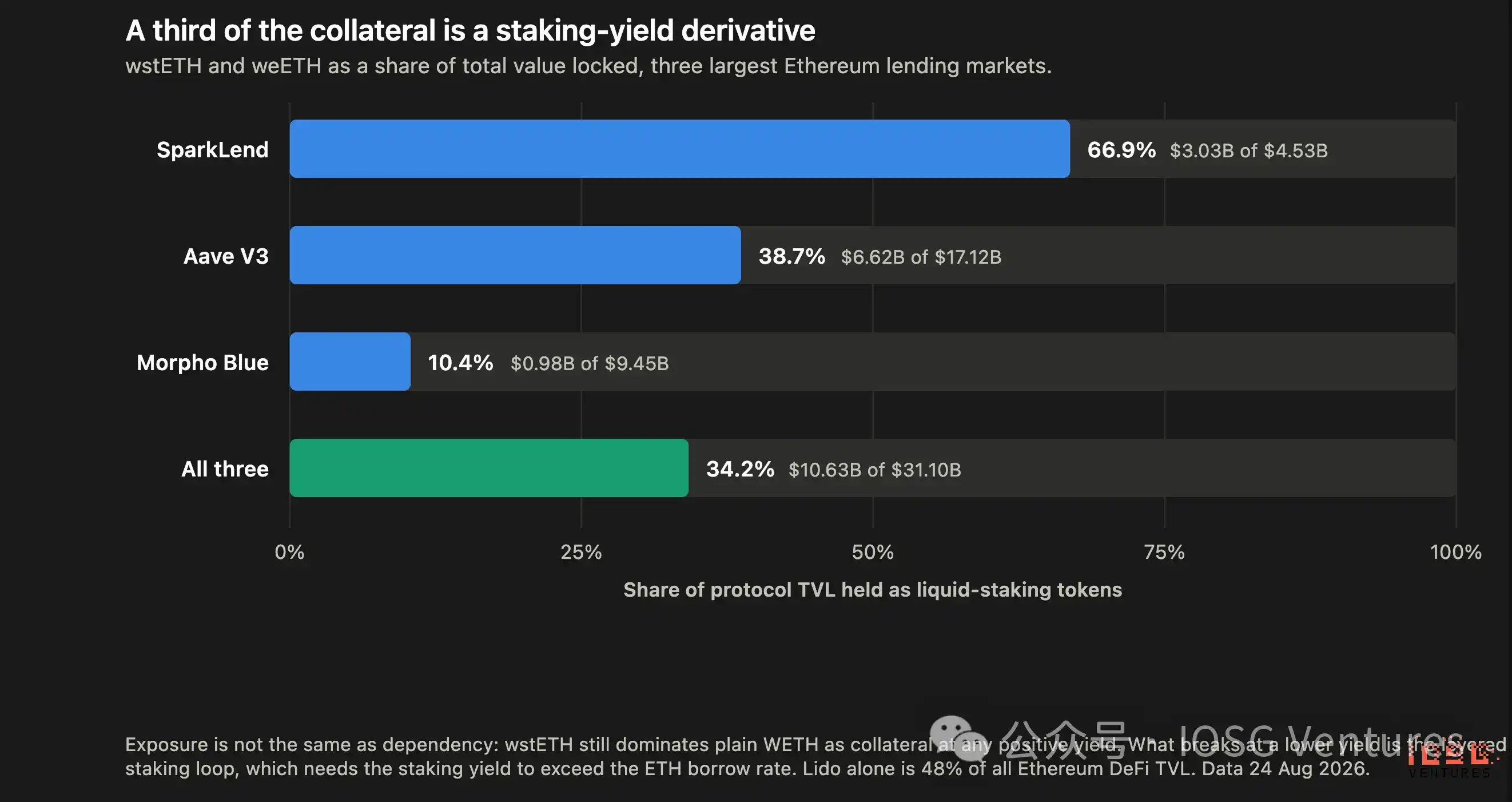
▲ Proportion of liquid staking tokens in TVL: SparkLend 66.9%, Aave V3 38.7%, Morpho Blue 10.4%, combined 34.2%.
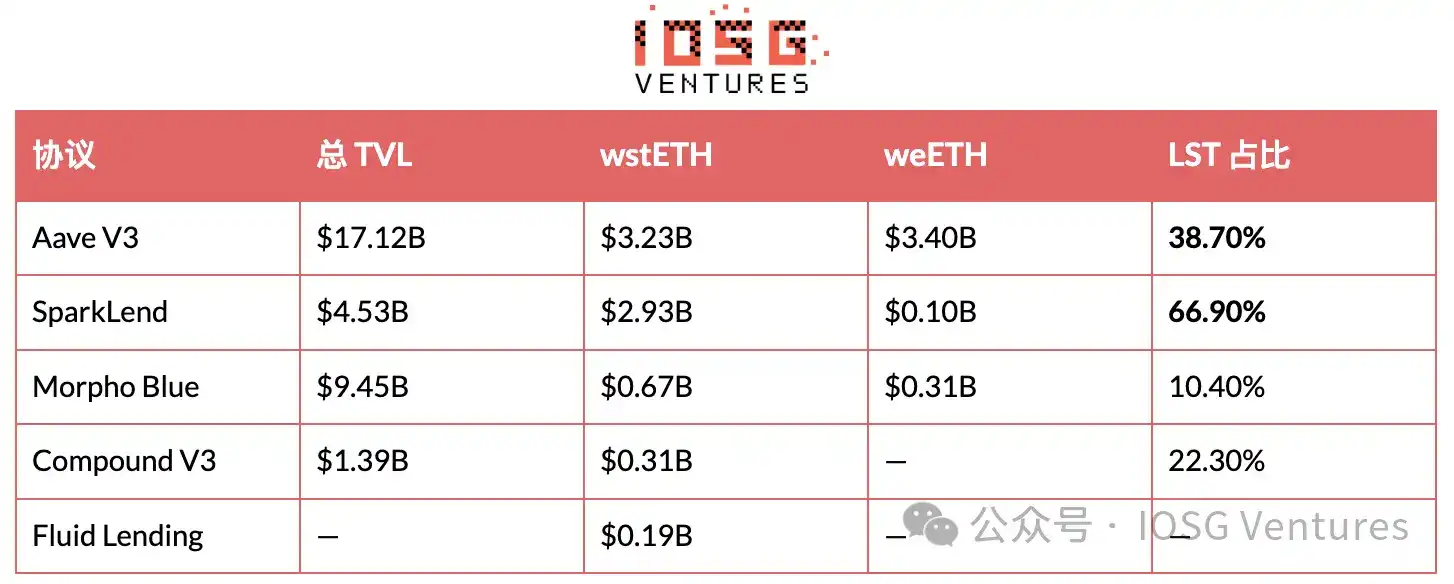
Across Ethereum's three major lending markets, $106.3B out of $311.0B in collateral (34.2%) are staking yield derivatives. SparkLend is a typical single point of failure: two-thirds of that is wstETH.

ETF channel, quantified

The most frequently cited objection: cutting yields will drain institutional buying because staking ETH ETFs market yield to allocators who can't access it directly. This channel is real. But it's also very small today.
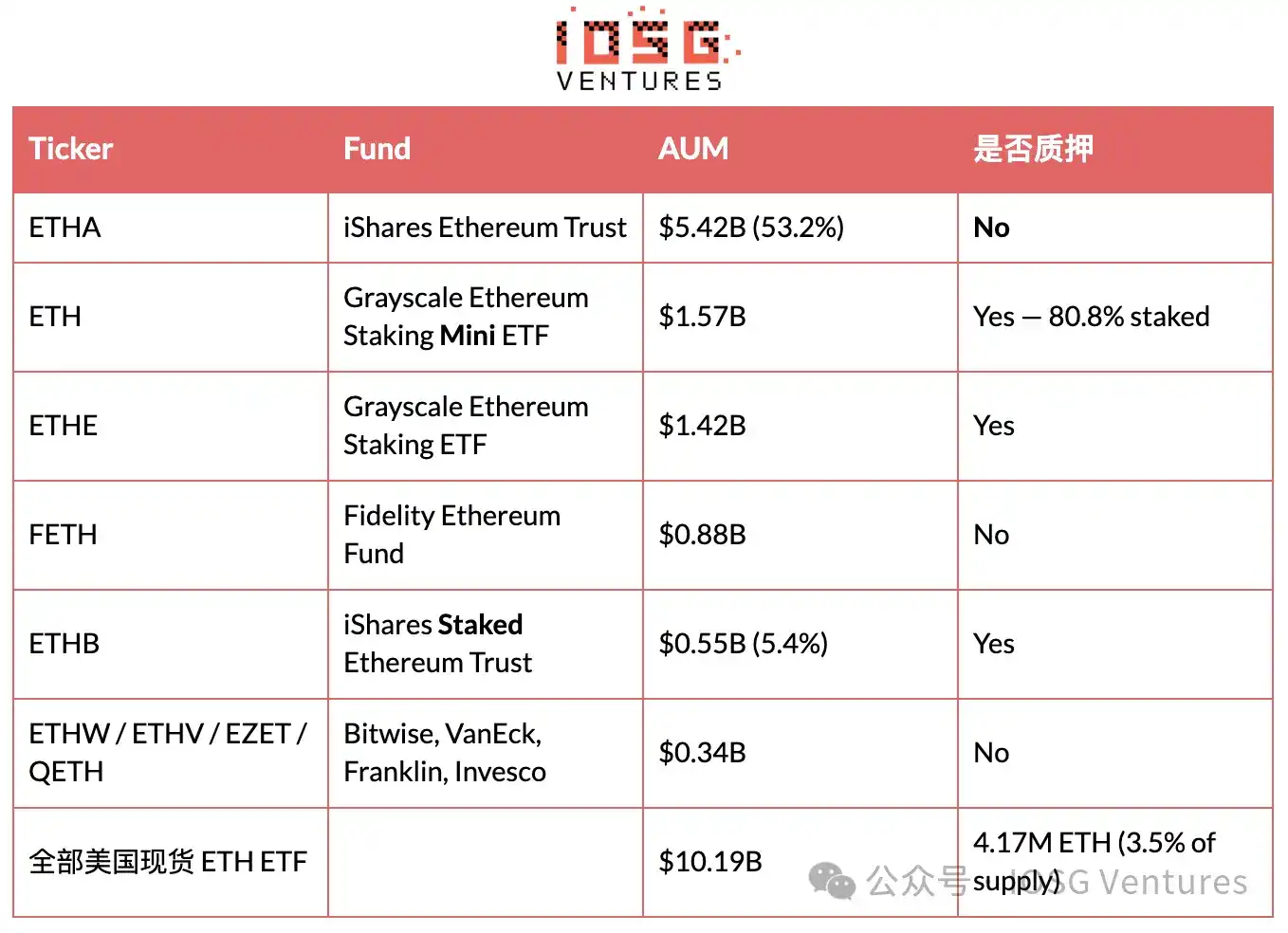
Products that explicitly market yield constitute only 5.4% of ETF assets, 0.53% of all staked ETH, and 0.19% of total ETH supply. BlackRock's non-staking ETH product is ten times its size. Whatever is driving institutional capital into ETH, staking yield is not the main attraction—allocator money overwhelmingly buys non-staking exposure.

Two points prevent this conclusion from being definitive. First, the staking ETF category is still young and growing: Bitwise and Grayscale are now creating staking ETFs for Solana, and Grayscale has one for Hyperliquid, so future risks are larger than current AUM suggests. Second, lower yields will likely slow the conversion of existing non-staking ETF assets into staking share classes, but this is a growth rate impact, not an outflow. Neither changes the order of magnitude: ultimately, this is a $0.5B group arguing over a $1.55B/year redistribution.

VII. Conclusion & Assessment: When "Security Anxiety" Meets "Wealth Redistribution"

First, look beyond the grand security narrative.

We must acknowledge that the core authors of EIP-8363 (like Justin Drake, Jerome) have extremely serious network security motivations. From a game theory perspective, once the network staking ratio crosses the 50% life-or-death line, Ethereum loses its "Social Layer Defense" capability against extreme attacks and faces systemic parasitic risks from LST oligopolies too big to fail. Therefore, the proposal attempts to use economic force—mandatory yield reduction—to lock the staking ratio within a safe zone.

But behind the security philosophy, the reality of on-chain data is even colder.

Since 2022, Ethereum's "Burn" mechanism has existed in name only: burn volume has plummeted 98% and now offsets a mere 2.4% of issuance. Regardless of your stance on the security rationale of EIP-8363, one unavoidable fact is: the old mechanism that "let ETH supply dynamically adjust with market demand" has stalled. In today's L2 economics dominated by Blobs, expecting L1 fee spikes to revive the burn mechanism is wishful thinking. Ethereum's monetary policy is now on "autopilot without a steering wheel," and adjusting issuance is the only lever we can still pull.

Setting aside emotions, the real policy impact lies between the two extreme camps.

Supporters cheer "ending ETH inflation," opponents warn "staking system collapse." Both rhetorics deviate from mathematical reality. At the current staked amount of 42.2 million ETH, the proposal only cuts issuance by ~58.6% and staking APR by ~56%. To reduce issuance completely to zero? That requires staking to surge to 60.25 million ETH (43% higher than now). More importantly, the mechanism has a built-in brake: as yields fall, some stakers exit, and the system eventually stabilizes around "26% staking ratio, 0.48% annual inflation." What it actually delivers is merely halving the dilution rate, not destroying or upending anything.

How important is this saved "half percentage point"? Numbers are more honest than words.

At current prices, cutting 633k ETH of issuance annually is equivalent to preserving $1.55 billion, about 0.53% of the total market cap. Don't dismiss this ratio—it's roughly 5 times the size of Ethereum's entire current L1 fee economy (~0.10%/year). For an asset whose fee revenue has dried up, plugging a 0.5% annual structural bleed isn't a "rounding error"—it's the biggest economic lever currently available.

So what's the cost? Will DeFi really collapse? Risks do exist.

Opponents often cite collateral, like SparkLend being two-thirds wstETH. But we need to distinguish between "exposure" and "dependence": as long as wstETH has positive yield, it will always be superior to plain WETH as collateral—that foundation is solid. What EIP-8363 would truly break is the "leveraged staking loop." When the base staking yield falls below ~1.16%, unable to cover the interest on borrowed ETH, that portion of capital engaged in leveraged arbitrage will unwind. In other words, it's the leverage bubble that would shrink, not the collateral system itself. As for direct protocol losses, Lido would lose about $35 million annually: roughly half its fee income.

The fear that "cutting yield will crash the market" already has an answer from the market.

Over 43 months of data, no significant correlation exists between changes in staking yield and ETH's price performance (p = 0.73, R2 = 0.003). Staking yield fell from 3.98% to 2.50%, yet couldn't stop ETH/BTC from plummeting 57% by July 2026. Yield was neither a price moat, nor did its compression trigger a sell-off. If the previous 37% yield slide made no splash in price, those claiming "another cut will crash Ethereum" need harder evidence.

Why is this debate so fierce?

Because it's a zero-sum game with "highly concentrated losses and extremely diffuse benefits."

Stripping away obscure jargon and grand security rhetoric, EIP-8363 is essentially a crude wealth redistribution: currently, stakers take 100% of newly issued ETH, but they only hold 35% of the network's tokens. This means they offload the inflation cost onto the other 65% of holders. Cutting this $1.55B of issuance is equivalent to forcibly returning $1B in implicit wealth annually from stakers (intermediaries) to all non-staking ETH holders.

This is the real reason everyone is up in arms:

  • The losing side is extremely concentrated: Lido, LST issuers, restaking protocols, leverage players. This is a small, well-funded, highly organized interest group. They know exactly how much real money this proposal takes from their pockets (Lido loses half its profit directly, leverage loops die outright).
  • The benefiting side is extremely diffuse: ordinary holders with 65% of the supply. They suffer 0.5% less dilution annually, but spread across a ~$300B market cap, it's imperceptible—no one will march in the streets for it.

This explains why the current debate is full of "big, empty" slogans. When an interest group can't openly say "this will take $1B in annual profit from us," they raise the shield of "this will destroy DeFi"; and when researchers want to forcibly reclaim the money-printing faucet, the most politically correct weapon is "defending network security." Interpret the volume of opposition and support as the concentration of interest distribution, not the mathematical right or wrong of the proposal itself.

Our Final Assessment

Strategy: Mildly bullish on ETH in ETH terms, explicitly bearish on staking intermediaries/infrastructure. And the proposal is highly likely to be rejected.

  • At the asset level, we are bullish not because of a "scarcity myth," but based on common sense: when the only lever to adjust supply is broken, removing a structural sell pressure of $1.55B annually (paid to those who aren't truly paying for the yield) is a high-value trade. It might not be a game-changer, but the compounding effect is not negligible.
  • For the intermediary system, the logic is airtight. The core valuation logic for Lido, LSTs, LRTs is entirely built on that "staking yield" about to be cut in half. This isn't emotional panic; it's a direct 58.6% shrinkage of the profit sheet.
  • As for the proposal's fate? The probability of passing is very low. In decentralized governance, "concentrated losses vs. diffuse benefits" is the standard script for killing a good proposal. Economically correct, but politically difficult—this is our baseline expectation.

Conditions that would trigger us to change our view (falsification indicators):

  1. On-chain data proves "issuance is reinvested, not sold": If fund flows show newly minted ETH globally stays in auto-compounding LSTs and doesn't flow to exchanges to be sold, then our sell-pressure assumption is invalid.
  2. Staking ETFs bring massive buying waves: The current $0.5B scale is negligible. But if it grows tenfold, the power of marginal demand would outweigh the significance of inflation reduction.
  3. L1 fees miraculously recover: If the burn mechanism regains dominance over fundamentals, the urgency for artificial issuance intervention vanishes.
  4. The negative correlation between supply and price is empirically confirmed: The current relationship is very weak. If data over the next year proves "reducing supply reliably pushes up price," it would become the most unassailable quantitative pillar for being bullish on ETH.


Crypto di tendenza

Domande pertinenti

QAccording to the article, what is the primary reason EIP-8363 is being considered, given the current state of Ethereum's monetary policy?

AThe primary reason is that the previous demand-driven mechanism for regulating ETH supply, the EIP-1559 burn, has become ineffective (burning only 2.4% of new issuance). With L2 scaling moving transaction fees away from L1, the burn mechanism is 'dead.' Therefore, adjusting the issuance rate via proposals like EIP-8363 is the only remaining lever Ethereum has to control its supply.

QWhat are two common misconceptions about EIP-8363's immediate effects that the article corrects?

A1. That issuance would be cut to zero immediately. In reality, at current staking levels (42.2M ETH staked), the proposal cuts issuance by ~58.6%, not 100%. 2. That staking rewards would instantly crash and trigger a DeFi collapse. The proposal includes an 18-month 'soft landing' phase where the base reward factor is temporarily doubled, making the initial impact on net issuance minimal, with the full reduction phased in gradually.

QWhat does the article's data analysis conclude about the relationship between staking yield and the price of ETH?

AThe data analysis finds no statistically significant relationship between changes in staking yield and ETH price returns over the 43-month period studied. The correlation between the two variables is very weak (p = 0.73, R2 = 0.003). The data suggests that past reductions in staking yield have not had a detectable impact on ETH's price performance.

QHow would EIP-8363's mechanism, once fully transitioned, lead to a self-limiting equilibrium for staking?

AThe mechanism is self-limiting because if the staking yield falls below a staker's required return, they will exit, reducing the total staked amount (S). A lower S increases the gross APR (as rewards are spread over fewer ETH) and also reduces the burn ratio (b). This dynamic creates a natural equilibrium point where the net yield stabilizes at a level that marginal stakers are willing to accept, preventing staking from collapsing to zero or skyrocketing to 50%.

QThe article describes the debate over EIP-8363 as a 'zero-sum game.' According to the author, who are the concentrated losers and the dispersed winners in this wealth redistribution?

AThe concentrated losers are staking intermediaries and leveraged players: entities like Lido, LST/LRT issuers, and users engaged in leverage staking loops. They directly lose a significant portion of their profits (e.g., Lido loses ~half its fee income). The dispersed winners are the 65% of ETH holders who do not stake. They benefit from a reduced annual dilution of ~0.5% (worth ~$1.55B), but this gain is spread thinly across a large, unorganized group.

Letture associate

The End of Old Cryptography: How Ethereum is Preparing for the Era of Quantum Computing

Ethereum developers have proposed a new system for handling staking deposits, aiming to future-proof the network against the potential threat of quantum computers. Currently, Ethereum's security relies on elliptic curve cryptography, which could be broken by sufficiently powerful quantum machines capable of deriving private keys from public ones. While estimates of the timeline for this threat vary, with Google research in March 2026 suggesting it could be closer than previously thought, major blockchains are proactively preparing. The new proposal introduces a more flexible deposit contract capable of accepting keys of various types and lengths, identified by a scheme label. It also changes how deposit data is communicated within the network's layers. Crucially, the transition plan involves a three-phase process to ensure a controlled and predictable shift, initially disabling new deposits, then re-enabling the current format, and finally permanently switching to new post-quantum cryptography in a future update. The proposal is currently a draft with no set implementation date. It represents a strategic move to build infrastructure in advance, rather than a direct solution for existing accounts. Analysis notes that Ethereum is structurally vulnerable to a "store now, decrypt later" attack, as public keys revealed in past transactions remain permanently on-chain. This proposal prepares for a signature algorithm change but does not address the risk to keys already exposed.

cryptonews.ru18 min fa

The End of Old Cryptography: How Ethereum is Preparing for the Era of Quantum Computing

cryptonews.ru18 min fa

Meta Faces a $1.4 Trillion Penalty: Algorithmic Recommendation in the Dock. Will the Rules Change in the Second Half of the Internet Era?

A landmark federal trial in Oakland, California, has begun against Meta, with 29 states accusing the company of harming children and teens through its social media platform designs. The states seek a potential maximum penalty of $1.4 trillion, calculated from alleged repeated violations of consumer protection laws and the Children's Online Privacy Protection Act (COPPA) involving millions of underage users. The core legal strategy bypasses the traditional shield of Section 230 by targeting Meta's own platform features—like its recommendation algorithms, infinite scroll, and "like" buttons—rather than user-generated content. The plaintiffs argue these designs are addictive and deceptive. Meta denies the claims, calling the penalty "unprecedented" and disputing the methodology. While the astronomical $1.4 trillion figure is seen as a starting point for negotiations, even a significantly reduced penalty in the hundreds of billions could establish a critical precedent. The case focuses on holding platforms legally responsible for their algorithmic designs. A ruling against Meta could force product changes, such as removing "likes" or imposing usage limits, and provide a legal template for similar suits against other tech giants like TikTok and YouTube. The trial's outcome may redefine accountability for algorithm-driven business models across the internet.

marsbit28 min fa

Meta Faces a $1.4 Trillion Penalty: Algorithmic Recommendation in the Dock. Will the Rules Change in the Second Half of the Internet Era?

marsbit28 min fa

Trading

Spot

Articoli Popolari

Cosa è ETH 3.0

ETH3.0 e $eth 3.0: Un'Analisi Approfondita del Futuro di Ethereum Introduzione Nel panorama in rapida evoluzione delle criptovalute e della tecnologia blockchain, ETH3.0, spesso indicato come $eth 3.0, è emerso come un argomento di considerevole interesse e speculazione. Il termine comprende due concetti principali che warrantono chiarimenti: Ethereum 3.0: Questo rappresenta un potenziale futuro aggiornamento volto ad aumentare le capacità dell'attuale blockchain di Ethereum, concentrandosi principalmente sul miglioramento della scalabilità e delle prestazioni. ETH3.0 Meme Token: Questo progetto di criptovaluta distinto cerca di sfruttare la blockchain di Ethereum per creare un ecosistema incentrato sui meme, promuovendo il coinvolgimento all'interno della comunità delle criptovalute. Comprendere questi aspetti di ETH3.0 è essenziale non solo per gli appassionati di criptovalute, ma anche per coloro che osservano tendenze tecnologiche più ampie nello spazio digitale. Che cos'è ETH3.0? Ethereum 3.0 Ethereum 3.0 è pubblicizzato come un aggiornamento proposto per la rete Ethereum già stabilita, che è stata la spina dorsale di molte applicazioni decentralizzate (dApps) e contratti smart sin dalla sua nascita. I miglioramenti previsti si concentrano principalmente sulla scalabilità, integrando tecnologie avanzate come lo sharding e le prove a conoscenza zero (zk-proofs). Queste innovazioni tecnologiche mirano a facilitare un numero senza precedenti di transazioni al secondo (TPS), potenzialmente raggiungendo milioni, affrontando così una delle limitazioni più significative della tecnologia blockchain attuale. Il miglioramento non è meramente tecnico, ma anche strategico; è volto a preparare la rete Ethereum per un'adozione e un'utilità diffuse in un futuro contrassegnato da un aumento della domanda di soluzioni decentralizzate. ETH3.0 Meme Token Al contrario di Ethereum 3.0, l'ETH3.0 Meme Token si avventura in un dominio più leggero e giocoso, combinando la cultura dei meme di internet con la dinamica delle criptovalute. Questo progetto consente agli utenti di acquistare, vendere e scambiare meme sulla blockchain di Ethereum, fornendo una piattaforma che promuove il coinvolgimento della comunità attraverso la creatività e interessi condivisi. L'ETH3.0 Meme Token mira a dimostrare come la tecnologia blockchain possa intersecarsi con la cultura digitale, creando casi d'uso che siano sia divertenti che finanziariamente praticabili. Chi è il Creatore di ETH3.0? Ethereum 3.0 L'iniziativa verso Ethereum 3.0 è principalmente propulsa da un consorzio di sviluppatori e ricercatori all'interno della comunità di Ethereum, tra cui Justin Drake. Conosciuto per le sue intuizioni e contributi all'evoluzione di Ethereum, Drake è stato una figura di spicco nelle discussioni riguardanti la transizione di Ethereum verso un nuovo livello di consenso, chiamato “Beam Chain.” Questo approccio collaborativo allo sviluppo significa che Ethereum 3.0 non è il prodotto di un creatore singolo, ma piuttosto una manifestazione di ingegno collettivo focalizzato sul progresso della tecnologia blockchain. ETH3.0 Meme Token I dettagli riguardanti il creatore dell'ETH3.0 Meme Token sono attualmente non rintracciabili. La natura dei token meme conduce spesso a una struttura più decentralizzata e guidata dalla comunità, il che potrebbe spiegare la mancanza di attribuzione specifica. Questo si allinea con l'etica della comunità crypto più ampia, dove l'innovazione spesso nasce da sforzi collaborativi piuttosto che individuali. Chi sono gli Investitori di ETH3.0? Ethereum 3.0 Il supporto per Ethereum 3.0 proviene principalmente dalla Ethereum Foundation insieme a una comunità entusiasta di sviluppatori e investitori. Questa associazione fondamentale fornisce un considerevole grado di legittimità e migliora le prospettive di implementazione di successo poiché sfrutta la fiducia e la credibilità costruite nel corso degli anni di operazioni della rete. Nel clima in rapida evoluzione delle criptovalute, il supporto della comunità gioca un ruolo cruciale nello sviluppo e nell'adozione, posizionando Ethereum 3.0 come un serio contenditore per i futuri progressi della blockchain. ETH3.0 Meme Token Sebbene le fonti attualmente disponibili non forniscano informazioni esplicite riguardo ai fondamenti o alle organizzazioni di investimento che sostengono l'ETH3.0 Meme Token, ciò è indicativo del modello di finanziamento tipico per i token meme, che spesso si basa sul supporto di base e sul coinvolgimento della comunità. Gli investitori in tali progetti sono tipicamente individui motivati dal potenziale per innovazioni guidate dalla comunità e dallo spirito di cooperazione trovato all'interno della comunità crypto. Come Funziona ETH3.0? Ethereum 3.0 Le caratteristiche distintive dell'Ethereum 3.0 risiedono nella sua proposta di implementazione della tecnologia di sharding e zk-proof. Lo sharding è un metodo di partizionamento della blockchain in pezzi più piccoli e gestibili o “shard,” che possono elaborare transazioni in modo concorrente piuttosto che sequenziale. Questa decentralizzazione dell'elaborazione aiuta a prevenire la congestione e garantisce che la rete rimanga reattiva anche sotto un carico pesante. La tecnologia delle prove a conoscenza zero (zk-proof) contribuisce con un ulteriore livello di sofisticazione consentendo la validazione delle transazioni senza rivelare i dati sottostanti coinvolti. Questo aspetto non solo migliora la privacy, ma aumenta anche l'efficienza complessiva della rete. Si parla anche di incorporare una macchina virtuale Ethereum a conoscenza zero (zkEVM) in questo aggiornamento, amplificando ulteriormente le capacità e l'utilità della rete. ETH3.0 Meme Token L'ETH3.0 Meme Token si distingue capitalizzando sulla popolarità della cultura dei meme. Stabilisce un mercato per gli utenti che desiderano partecipare al trading di meme, non solo per divertimento, ma anche per potenziale guadagno economico. Integrando funzioni come lo staking, la fornitura di liquidità e meccanismi di governance, il progetto promuove un ambiente che incentiva l'interazione e la partecipazione della comunità. Offrendo una miscela unica di intrattenimento e opportunità economica, l'ETH3.0 Meme Token mira ad attrarre un pubblico variegato, che va dagli appassionati di crypto ai semplici intenditori di meme. Timeline di ETH3.0 Ethereum 3.0 11 Novembre 2024: Justin Drake accenna al prossimo aggiornamento ETH 3.0, incentrato sui miglioramenti della scalabilità. Questo annuncio segna l'inizio delle discussioni formali riguardo l'architettura futura di Ethereum. 12 Novembre 2024: La proposta attesa per Ethereum 3.0 dovrebbe essere svelata a Devcon a Bangkok, preparando il terreno per un feedback più ampio della comunità e potenziali passi successivi nello sviluppo. ETH3.0 Meme Token 21 Marzo 2024: L'ETH3.0 Meme Token viene ufficialmente elencato su CoinMarketCap, segnando il suo ingresso nel dominio pubblico delle criptovalute e aumentando la visibilità per il suo ecosistema basato sui meme. Punti Chiave In conclusione, Ethereum 3.0 rappresenta una significativa evoluzione all'interno della rete Ethereum, concentrandosi sul superamento delle limitazioni riguardanti scalabilità e prestazioni attraverso tecnologie avanzate. I suoi aggiornamenti proposti riflettono un approccio proattivo alle future esigenze e usabilità. D'altra parte, l'ETH3.0 Meme Token incarna l'essenza della cultura guidata dalla comunità nello spazio delle criptovalute, sfruttando la cultura dei meme per creare piattaforme coinvolgenti che incoraggiano la creatività e la partecipazione degli utenti. Comprendere gli scopi e le funzionalità distinte di ETH3.0 e $eth 3.0 è fondamentale per chiunque sia interessato ai continui sviluppi nello spazio crypto. Con entrambe le iniziative che tracciano percorsi unici, esse sottolineano collettivamente la natura dinamica e multifacetica dell'innovazione blockchain.

363 Totale visualizzazioniPubblicato il 2024.04.04Aggiornato il 2024.12.03

Cosa è ETH 3.0

Cosa è ETHEREUM

HarryPotterTrumpHomerSimpson777Inu: Panoramica di un Progetto Crypto Web3 Introduzione Nel mondo in rapida evoluzione delle criptovalute e della finanza decentralizzata, progetti innovativi emergono frequentemente, catturando l'interesse della comunità degli investitori e degli appassionati di crypto. Uno di questi progetti è HarryPotterTrumpHomerSimpson777Inu, una criptovaluta che si trova all'incrocio tra cultura popolare e tecnologia blockchain. Questo token guidato dalla comunità mescola personaggi e figure politiche ben noti, con l'obiettivo di creare una piattaforma coinvolgente e promuovere un'adozione diffusa. Che cos'è HarryPotterTrumpHomerSimpson777Inu? HarryPotterTrumpHomerSimpson777Inu è un token costruito sulla blockchain di Ethereum, progettato per essere accessibile e divertente per un pubblico diversificato. L'unicità di questo progetto deriva dal suo approccio tematico, che intreccia elementi di fantasia, politica e intrattenimento. Sfruttando il fascino nostalgico di personaggi amati, il progetto cerca di creare un'esperienza di criptovaluta coinvolgente, incoraggiando il coinvolgimento e la partecipazione della comunità. L'obiettivo principale di HarryPotterTrumpHomerSimpson777Inu è stabilire un token che risuoni con gli utenti a livello personale, promuovendo sia il divertimento che il coinvolgimento nell'ambito crypto. Questo branding distintivo mira ad attrarre individui che in precedenza potrebbero non essersi interessati alle criptovalute, facilitando un nuovo punto di ingresso per utenti potenziali. Creatore di HarryPotterTrumpHomerSimpson777Inu L'identità del creatore dietro HarryPotterTrumpHomerSimpson777Inu rimane sconosciuta. Questa non è una pratica rara nel dominio delle criptovalute, dove l'anonimato è spesso preferito dai fondatori come mezzo di protezione della privacy e promozione di un ethos decentralizzato. Questa oscurità non diminuisce il valore del progetto; al contrario, riflette una tendenza più ampia all'interno del settore, dove molti progetti di successo sono emersi da origini anonime. Investitori di HarryPotterTrumpHomerSimpson777Inu Le informazioni pubbliche riguardo agli investitori di HarryPotterTrumpHomerSimpson777Inu sono limitate. La natura del progetto, incentrata sul coinvolgimento della comunità, suggerisce una dipendenza da investimenti di piccole dimensioni da parte di singoli appassionati piuttosto che da sostegni sostanziali da fondazioni di investimento consolidate o corporation. Questo livello di trasparenza nel finanziamento è tipico di molti progetti di criptovaluta guidati dalla comunità, dove il supporto spesso proviene da movimenti di base piuttosto che da investitori istituzionali. Come Funziona HarryPotterTrumpHomerSimpson777Inu? Operando sulla blockchain di Ethereum, HarryPotterTrumpHomerSimpson777Inu sfrutta la sua solida infrastruttura per facilitare transazioni e promuovere interazioni tra gli utenti all'interno della comunità. Ciò che distingue questo progetto è il suo posizionamento tematico: canalizzando il carisma di personaggi iconici provenienti da diversi ambiti culturali, crea un'identità di marca distintiva. Questo approccio non solo attrae gli utenti, ma coltiva anche una comunità fedele attorno al token. Le meccaniche operative del progetto si concentrano sul coinvolgimento della comunità. Adotta un modello decentralizzato che incoraggia la partecipazione, consentendo agli utenti di interagire attraverso vari canali mentre promuovono lo scambio di idee e esperienze. Inoltre, il progetto abbraccia i principi del Web3, privilegiando la sovranità degli utenti e la decentralizzazione, che sono i pilastri del futuro di Internet. Timeline di HarryPotterTrumpHomerSimpson777Inu La storia di HarryPotterTrumpHomerSimpson777Inu è segnata da diversi eventi decisivi: 12 agosto 2023: L'inizio di HarryPotterTrumpHomerSimpson777Inu, segnando il suo ingresso nell'ecosistema delle criptovalute. Fase di Sviluppo: Un periodo focalizzato sulla costruzione di una strategia completa per stimolare la crescita guidata dalla comunità e il coinvolgimento degli utenti. Listing sugli Scambi: Sebbene i dettagli specifici di listing non siano stati divulgati, il progetto è stato reso accessibile su vari scambi di criptovalute, migliorando la sua visibilità nel mercato. Coinvolgimento della Comunità: Sforzi continui per coinvolgere attivamente la comunità, stabilendo canali di dialogo e promuovendo la partecipazione attraverso varie attività, tra cui concorsi, discussioni e votazioni comunitarie. Aspetti Chiave di HarryPotterTrumpHomerSimpson777Inu Focus sulla Comunità Un tratto distintivo di HarryPotterTrumpHomerSimpson777Inu è la sua forte enfasi sul coinvolgimento della comunità. Il progetto incoraggia attivamente gli utenti a partecipare a discussioni, condividere idee e contribuire all'evoluzione del progetto. Questa interazione coltiva un senso di appartenenza e di ownership tra i membri della comunità, essenziale per la sostenibilità a lungo termine del token. Utilizzo della Blockchain di Ethereum La scelta di costruire sulla blockchain di Ethereum consente a HarryPotterTrumpHomerSimpson777Inu di sfruttare le sue caratteristiche di sicurezza ben consolidate e architettura decentralizzata. Questa base garantisce affidabilità per le transazioni e fornisce un framework affidabile su cui sviluppare varie funzionalità. Approccio Tematico Unico Fusione di elementi della cultura pop nella sua identità, HarryPotterTrumpHomerSimpson777Inu crea una narrazione coinvolgente che lo differenzia da altre criptovalute. L'amalgama di personaggi e temi genera riconoscimento e intrigo immediati, rendendo il token relazionabile a un'ampia gamma di utenti potenziali. Anonimato nello Sviluppo Il creatore anonimo del progetto rimane una caratteristica ricorrente in molte iniziative di criptovaluta. Questo aspetto evidenzia un ethos di decentralizzazione, introducendo anche un livello di mistero che potrebbe affascinare un segmento della comunità crypto, attirando l'attenzione sul progetto e invitando l'impegno da parte di utenti che supportano l'idea di un'iniziativa decentralizzata e gestita dalla comunità. Conclusione HarryPotterTrumpHomerSimpson777Inu si presenta come un'aggiunta distintiva al panorama delle criptovalute, combinando il fascino della cultura popolare con le meccaniche innovative della tecnologia blockchain. Sebbene i dettagli riguardanti il creatore e gli investitori specifici rimangano non divulgati, il focus del progetto sulla comunità e il suo approccio tematico lo contraddistinguono come un potenziale attore influente nel contesto del Web3 e delle criptovalute. Man mano che l'ecosistema delle criptovalute continua ad espandersi, iniziative come HarryPotterTrumpHomerSimpson777Inu ci ricordano le molteplici modalità in cui la blockchain può connettere le comunità globali attraverso narrazioni e valori condivisi.

1.3k Totale visualizzazioniPubblicato il 2024.04.06Aggiornato il 2024.12.03

Cosa è ETHEREUM

Come comprare ETH

Benvenuto in HTX.com! Abbiamo reso l'acquisto di Ethereum (ETH) semplice e conveniente. Segui la nostra guida passo passo per intraprendere il tuo viaggio nel mondo delle criptovalute.Step 1: Crea il tuo Account HTXUsa la tua email o numero di telefono per registrarti il tuo account gratuito su HTX. Vivi un'esperienza facile e sblocca tutte le funzionalità,Crea il mio accountStep 2: Vai in Acquista crypto e seleziona il tuo metodo di pagamentoCarta di credito/debito: utilizza la tua Visa o Mastercard per acquistare immediatamente EthereumETH.Bilancio: Usa i fondi dal bilancio del tuo account HTX per fare trading senza problemi.Terze parti: abbiamo aggiunto metodi di pagamento molto utilizzati come Google Pay e Apple Pay per maggiore comodità.P2P: Fai trading direttamente con altri utenti HTX.Over-the-Counter (OTC): Offriamo servizi su misura e tassi di cambio competitivi per i trader.Step 3: Conserva Ethereum (ETH)Dopo aver acquistato Ethereum (ETH), conserva nel tuo account HTX. In alternativa, puoi inviare tramite trasferimento blockchain o scambiare per altre criptovalute.Step 4: Scambia Ethereum (ETH)Scambia facilmente Ethereum (ETH) nel mercato spot di HTX. Accedi al tuo account, seleziona la tua coppia di trading, esegui le tue operazioni e monitora in tempo reale. Offriamo un'esperienza user-friendly sia per chi ha appena iniziato che per i trader più esperti.

3.4k Totale visualizzazioniPubblicato il 2024.12.10Aggiornato il 2026.06.02

Come comprare ETH

Discussioni

Benvenuto nella Community HTX. Qui puoi rimanere informato sugli ultimi sviluppi della piattaforma e accedere ad approfondimenti esperti sul mercato. Le opinioni degli utenti sul prezzo di ETH ETH sono presentate come di seguito.

活动图片