QCP Capital Analysts Explained Why Bitcoin Stalled at $63,000

cryptonews.ruPubblicato 2026-08-15Pubblicato ultima volta 2026-08-15

Introduzione

QCP Capital's latest report explains that Bitcoin has stalled around $63,000, testing the lower boundary of its recent trading range ($62,500–$64,000). The retreat wasn't due to a single catalyst but stems from several cross-market pressures: heightened geopolitical risks, rising oil prices, uncertainty around global liquidity, and a muted reaction to positive U.S. macroeconomic data. While U.S. inflation and jobs data softened, reducing expectations of imminent Fed tightening, Bitcoin's price response has been subdued. This highlights the importance of other factors like trader positioning, liquidity conditions, and overall risk appetite. The regulatory landscape is progressing on two tracks: congressional legislation (like the CLARITY Act) is delayed, but SEC rulemaking continues. Corporate treasury activity, exemplified by Strategy's new Bitcoin monetization program, now creates a potential two-way flow, adding complexity to supply dynamics. Geopolitical tensions around the Strait of Hormuz keep oil prices elevated, impacting crypto indirectly through inflation expectations and financial conditions. Historical seasonality shows August and September are typically weak for Bitcoin, but this is descriptive, not predictive, in today's ETF-driven market. In conclusion, Bitcoin has shown resilience by absorbing multiple negative forces without a decisive breakdown. However, it has failed to convert improving macro fundamentals into sustained upward momentum. The market await...

QCP Capital published a fresh report for traders, noting that Bitcoin's range has been tested for resilience but not broken. The asset retreated to the $63,000 mark, abandoning its earlier move towards $64,000, and returned to the lower boundary of its recent trading range. The company's analysts note that this pullback was not triggered by any single dominant industry catalyst—instead, digital assets are simultaneously facing several cross-market pressures: heightened geopolitical risks, rising oil prices, uncertainty surrounding global liquidity, and a weak response to generally favorable U.S. macroeconomic data.
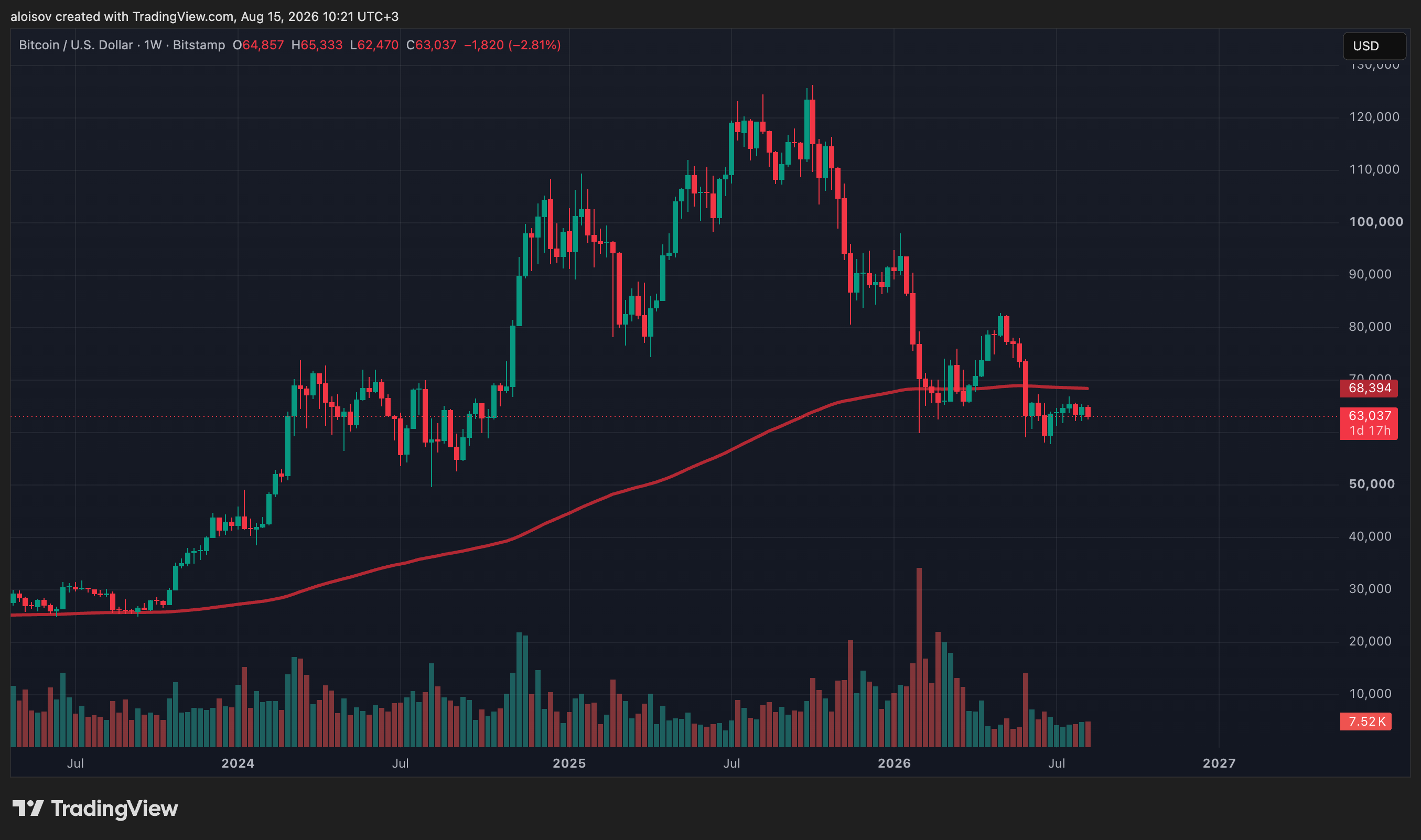
1-week chart of $BTC/USD and 200EMA. Source: Bitstamp

Range Held but Lacked Momentum

According to QCP Capital's observation, last week Bitcoin demonstrated resilience, absorbing several negative headlines without a sharp breakdown. This week, as noted in the report, reinforced the distinction between resilience and momentum: the range remains unchanged, but softer inflation data has so far elicited only a muted response from the market.

The $62,500–63,000 area continues to act as the lower boundary of the recent trading range. Whether this range holds will increasingly depend on the interplay of macroeconomic data, liquidity conditions, and asset-specific fund flows, rather than any single trigger.

Inflation Slows, Bitcoin Remains in Sideways Trend

U.S. inflation data this week provided further confirmation that price pressures are easing. According to the report, the annual Consumer Price Index (CPI) for July fell to 3.4% from 3.5% in June, while core CPI slowed to 2.5% from 2.6%. The Producer Price Index (PPI) also came in softer than expected: the figure remained unchanged in July against a forecast of 0.2% growth, following a 0.3% decline in June.

This data came after a notably weaker July employment report, which showed a decline of 23k in non-farm payrolls and downward revisions to figures for the two previous months. Together, these releases have reduced market expectations for imminent monetary policy tightening, although inflation still exceeds the Fed's long-term target.

Bitcoin's response, however, remained subdued. QCP Capital emphasizes that this should not be interpreted as a directional signal—the divergence between softening macro data and a sluggish price reaction points to the importance of other variables: trader positioning, the state of liquidity, and overall risk appetite, which determine how macro data is translated into crypto asset prices.

Market attention is now shifting to the U.S. Personal Consumption Expenditures (PCE) index, due on August 26, and the September meeting of the Federal Open Market Committee (FOMC). Investors appear likely to focus on whether the slowdown in inflation is accompanied by sufficient economic resilience to keep financial conditions stable.

Regulation Progresses Along Two Trajectories

The report notes that U.S. digital asset policy is increasingly developing along two parallel paths. In Congress, Senate consideration of the CLARITY Act has moved beyond the August recess. Senate Majority Leader John Thune stated that the bill will return for House consideration in September, though disagreements over ethics provisions and banking issues remain unresolved.

Simultaneously, regulatory work continues independently of the legislative schedule. The Securities and Exchange Commission's (SEC) 2026 agenda includes further work on capital raising through crypto assets and tokenized securities, with the agency already taking steps this year regarding trading of tokenized stocks.

QCP Capital emphasizes that this is an important distinction: delays in passing comprehensive legislation do not mean regulatory development has stopped—individual elements of the regulatory framework continue to take shape through agency rulemaking, guidance, and existing legislative procedures.

Strategy Now Both Buys and Sells

Corporate treasury activity also remains significant for Bitcoin's supply dynamics. According to the report, Strategy disclosed another sale of 1,690 $BTC for $109 million last week, using the proceeds for preferred stock buybacks. Additionally, the company raised approximately $653 million through an issuance of common stock to replenish dollar reserves.

These transactions follow the launch of a formal Bitcoin Monetization Program, which Strategy introduced this summer. Under this program, the company can sell Bitcoin to support dollar reserves and other balance sheet needs. JPMorgan notes that this creates a risk of "two-way" fund flows, as Strategy can now act as both a major buyer and seller of Bitcoin—depending on its financing needs.

QCP Capital clarifies: this does not mean corporate treasuries should be viewed as a constant source of supply in the market. However, it makes the flow picture more conditional than in earlier stages of the cycle. For the market, it's now not only the volumes that corporate treasuries acquire that matter, but also their liquid position, financing conditions, and disclosed asset sale policies.

Negotiations Around the Strait of Hormuz Continue, Oil Remains High

Geopolitical uncertainty remains another source of pressure across several asset classes. According to the report, Oman-mediated negotiations on the framework conditions for commercial shipping through the Strait of Hormuz are ongoing, with Qatar and Pakistan still participating in the broader mediation process between the U.S. and Iran. Negotiators have made progress on possible shipping agreements, but full and sustainable resumption of passage is not yet secured.

This uncertainty is reflected in energy markets. Brent crude traded around $88 on the morning of August 14 and is heading for a significant weekly gain—limited shipping through the Strait of Hormuz and the absence of a sustainable agreement maintain a geopolitical risk premium.

For cryptocurrencies, QCP Capital notes, the macroeconomic transmission channel remains relevant. Sustained increases in energy prices can impact overall inflation, inflation expectations, and long-term bond yields—all of which, in turn, affect financial conditions for liquidity-sensitive assets.

As long as physical shipping does not normalize on a sustainable basis, the situation around the Strait of Hormuz remains significant for cryptocurrencies primarily through oil, interest rates, and global liquidity, rather than through a direct channel of influence on digital assets.

Seasonality as Context, Not as a Guide

The calendar also provides historical context for the current price dynamics. According to data from Bespoke Investment Group cited in the QCP Capital report, Bitcoin's median return for August historically stands around -7.5%, with positive returns occurring in roughly 30% of observations. September has also traditionally been weaker—with a median decline of about 5.3%. Bitcoin posted negative returns in August each year from 2022 through 2025.

QCP Capital emphasizes: historical seasonality is descriptive, not predictive, especially considering how the structure of the crypto market has changed due to exchange-traded funds (ETFs) and increased institutional participation. Nevertheless, seasonality provides useful context for periods when thinner late-summer liquidity may coincide with reduced trading activity and heightened sensitivity to trader positioning.

More relevant, according to the company's analysts, is not the question of whether history will repeat itself, but whether the current range will hold as the market moves through the seasonally calmer part of the calendar.

Resilience Exists, Momentum Not Yet Present

In the concluding part of the report, QCP Capital notes that Bitcoin is not reacting to any single dominant negative catalyst. Instead, it continues to absorb several competing forces simultaneously: easing U.S. inflation, a weakening labor market, elevated oil prices, evolving regulation, and the more conditional nature of flows from corporate treasuries.

The analysts' conclusion largely reiterates their conclusion from a week ago. Bitcoin has demonstrated the ability to absorb negative news without a sustained breakdown, but the market has so far failed to convert improving elements of the macroeconomic backdrop into sustained upward momentum.

An exit from the current range in either direction, according to QCP Capital, would give the market much more information than intraday fluctuations within it. Until then, resilience remains the market's main characteristic—but not momentum.

Key Events in the Coming Weeks

  • August 19 — Publication of FOMC meeting minutes

  • August 26 — U.S. PCE index for July, second estimate of Q2 GDP

  • August 27–29 — Economic Symposium in Jackson Hole

  • September 15–16 — FOMC meeting

Bitcoin's current range resembles a tightly coiled spring: pressure is building from all sides, but the form holds for now. The market is testing the strength of this structure from both sides, finding no immediate reason for a sharp move.

The coming weeks—with the release of PCE data, the Jackson Hole symposium, and the September Fed meeting—will test whether this structure can withstand the seasonally weaker period or whether the accumulated pressure finally finds an outlet.

AI Opinion

From the perspective of machine data analysis, the current linkage of "oil—liquidity—Bitcoin" is not new to the crypto market. Earlier this year, the asset already faced similar pressure: when Brent exceeded $119 per barrel, Bitcoin unexpectedly held firm and moved upward, breaking the usual correlation with risky assets. This shows that the transmission channel "oil → inflation expectations → yields → crypto market," described in the QCP Capital report, does not work mechanically—in practice, Bitcoin's behavior depends on whether the asset is perceived in the moment as a risky instrument or a defensive one.

A technical aspect not covered in the report: the narrow range of $62,500–64,000 amid declining realized volatility statistically increases the probability of a sharp, directional move—regardless of macro news. Will the current compression maintain directional uncertainty until the September FOMC meeting, or will the market find a reason to exit earlier?


Crypto di tendenza

Domande pertinenti

QAccording to the QCP Capital report, what are the main cross-market factors currently pressuring Bitcoin and digital assets?

AAccording to the QCP Capital report, Bitcoin and digital assets are facing simultaneous pressure from several cross-market factors: heightened geopolitical risks, rising oil prices, uncertainty around global liquidity, and a weak reaction to generally favorable U.S. macro data.

QHow did Bitcoin react to the latest U.S. inflation and employment data, according to the analysis?

AAccording to the analysis, Bitcoin's reaction to the softening U.S. inflation data (CPI, PPI) and weaker employment report has been restrained or muted. The report states this divergence highlights the importance of other variables like trader positioning, liquidity conditions, and overall risk appetite in translating macro data into crypto asset prices.

QWhat risk does the company Strategy's new Bitcoin Monetization Program introduce to the market, as mentioned by JPMorgan?

AJPMorgan points out that Strategy's formal Bitcoin Monetization Program creates a risk of 'two-way' fund flows. This means Strategy can now act as both a major buyer and a major seller of Bitcoin, depending on its funding and balance sheet needs, making the supply flow picture more conditional.

QBeyond legislation, how is U.S. crypto regulation continuing to evolve, as noted in the report?

AThe report notes that U.S. crypto regulation is progressing independently of the legislative calendar. The SEC's 2026 agenda includes further work on capital raising via crypto assets and tokenized securities, and the agency has already taken steps this year regarding trading of tokenized securities. This shows regulatory development continues through agency rulemaking, guidance, and existing legislative procedures.

QWhat is the historical seasonal performance context for Bitcoin in August and September, and how should it be viewed according to QCP?

AHistorically, Bitcoin's median return in August is around -7.5% and in September around -5.3%, with positive August returns occurring only about 30% of the time. QCP Capital emphasizes that this seasonality is descriptive, not predictive, especially given structural market changes like ETFs. It provides context for periods of thinner late-summer liquidity and reduced trading activity, but the key question is whether the current trading range will hold during this seasonally quieter period.

Letture associate

Elon Musk Building Terafab: The Largest Chip Factory for AI, Robots, and Space Data Centers

Elon Musk's SpaceX and Tesla have launched the Terafab project to build a massive semiconductor facility in Grimes County, Texas. The plant, exceeding 9.3 million square meters, aims to integrate logic chip manufacturing, memory production, advanced packaging, and testing. The initial phase requires $16.8 billion in capital investment, with a long-term goal of producing over 1 terawatt of computing power annually. This capacity will support Tesla's Optimus robots and Cybercab autonomous vehicles, as well as SpaceX's orbital data centers. Texas Governor Greg Abbott confirmed the project's start in August 2026, highlighting 3,000 new jobs and a $30 million state grant. Elon Musk emphasized the strategic advantage of combining logic, memory, and packaging under one roof. Musk called the future complex the "largest and most valuable building on Earth," with an area roughly 50 times that of the Pentagon. Intel is the key technology partner, with plans to use its 14A process node for chip production. This partnership aims to diversify supply chains currently dominated by TSMC. The project aligns with the U.S. Pax Silica initiative to secure semiconductor supply chains. An AI analysis notes the project's scale and potential challenges, comparing it to delays seen in other U.S. megafab projects like Intel's Ohio facility. It questions whether Terafab can avoid similar pitfalls related to timelines, budgets, workforce, and supply chain stability. The facility's success could significantly shift the global semiconductor balance and strengthen the U.S. position in the tech race.

cryptonews.ru2 h fa

Elon Musk Building Terafab: The Largest Chip Factory for AI, Robots, and Space Data Centers

cryptonews.ru2 h fa

Elon Musk is Building Terafab: The Largest Chip Plant for AI, Robots, and Space Data Centers

Elon Musk's SpaceX and Tesla have launched the massive Terafab project to build a semiconductor plant in Grimes County, Texas. Spanning over 9.3 million square meters, the facility will integrate logic chip and memory production, advanced packaging, and testing. The initial phase requires $16.8 billion in capital investment, with a long-term goal of producing over 1 terawatt of computing power annually. This output is intended to supply Tesla's Optimus robots and Cybercab autonomous vehicles, as well as SpaceX's orbital data centers. Texas Governor Greg Abbott confirmed the project's start on August 6, 2026, highlighting the creation of 3,000 jobs and a $30 million grant from the Texas Enterprise Fund. Musk emphasized the strategic advantage of combining chip design, memory production, and packaging under one roof to accelerate hardware development. He stated the fully built complex would be "the largest and most valuable building on Earth," about 50 times larger than the Pentagon. An estimated 25% of production is earmarked for Tesla's robotics, with 75% for SpaceX's space-based AI systems. Earlier tax documents suggested a total project cost of up to $119 billion, but this has not been officially confirmed. Intel is the key technology partner, with plans to use its 14A process node for chip manufacturing. This partnership aims to diversify supply chains and reduce dependence on dominant foundries like TSMC. The initiative aligns with the broader U.S. Pax Silica program, which seeks to build secure international semiconductor supply chains with allied nations. An AI-driven analysis notes that megafab projects, such as Intel's delayed Ohio facility, often face schedule and budget overruns. While Terafab represents a significant step toward U.S. semiconductor self-sufficiency and could shift the global tech balance, its success will depend on factors like skilled labor availability, energy supply, and supply chain stability. The final outcome may not be clear until the late 2030s.

cryptonews.ru2 h fa

Elon Musk is Building Terafab: The Largest Chip Plant for AI, Robots, and Space Data Centers

cryptonews.ru2 h fa

Trading

Spot

Articoli Popolari

Cosa è BITCOIN

Comprendere HarryPotterObamaSonic10Inu (ERC-20) e la sua posizione nel mondo delle criptovalute Negli ultimi anni, il mercato delle criptovalute ha assistito a un aumento della popolarità delle meme coin, catturando l'interesse non solo dei trader, ma anche di coloro che cercano coinvolgimento comunitario e valore di intrattenimento. Tra questi token unici c'è HarryPotterObamaSonic10Inu (ERC-20), un progetto intrigante che mescola riferimenti culturali nel tessuto delle criptovalute. Questo articolo esplora gli aspetti chiave di HarryPotterObamaSonic10Inu, analizzando i suoi meccanismi, l'etica guidata dalla comunità e il suo coinvolgimento con il panorama crittografico più ampio. Che cos'è HarryPotterObamaSonic10Inu (ERC-20)? Come suggerisce il suo nome, HarryPotterObamaSonic10Inu è una meme coin costruita sulla blockchain di Ethereum, classificata secondo lo standard ERC-20. A differenza delle criptovalute tradizionali che possono enfatizzare l'utilità pratica o il potenziale investimento, questo token prospera grazie al valore di intrattenimento e alla forza della sua comunità. Il progetto mira a creare un ambiente in cui gli utenti coinvolti possono riunirsi, condividere idee e partecipare ad attività ispirate a diversi fenomeni culturali. Una caratteristica notevole di HarryPotterObamaSonic10Inu è la zero tassa sulle transazioni. Questo elemento allettante tende a incoraggiare il trading e il coinvolgimento della comunità, privo di costi aggiuntivi che possono scoraggiare i trader di piccole dimensioni. L'offerta totale della moneta è fissata a un miliardo di token, un numero che segna la sua intenzione di mantenere una circolazione sostanziale all'interno della comunità. Creatore di HarryPotterObamaSonic10Inu (ERC-20) Le origini di HarryPotterObamaSonic10Inu sono avvolte in un certo mistero; i dettagli sul creatore rimangono sconosciuti. Lo sviluppo di questo token non presenta un team identificabile o un piano esplicito, cosa non rara nel settore delle meme coin. Invece, il progetto è emerso organicamente, con il suo progresso fortemente dipendente dall'entusiasmo e dalla partecipazione della sua comunità. Investitori di HarryPotterObamaSonic10Inu (ERC-20) Per quanto riguarda investimenti esterni e finanziamenti, HarryPotterObamaSonic10Inu rimane ambiguo. Il token non elenca alcuna fondazione di investimento conosciuta o un sostegno organizzativo significativo. Invece, la linfa vitale del progetto è la sua comunità di base, che informa la sua crescita e sostenibilità attraverso azioni collettive e coinvolgimento nello spazio crittografico. Come funziona HarryPotterObamaSonic10Inu (ERC-20)? In quanto meme coin, HarryPotterObamaSonic10Inu opera principalmente al di fuori delle strutture tradizionali che governano spesso il valore degli asset. Ci sono diversi aspetti distintivi che definiscono il funzionamento del progetto: Transazioni senza tasse: Senza costi fiscali sulle transazioni, gli utenti possono comprare e vendere liberamente il token senza preoccuparsi di costi nascosti. Coinvolgimento della comunità: Il progetto prospera sull'interazione della comunità, sfruttando le piattaforme social per creare entusiasmo e facilitare il coinvolgimento. Discussioni, condivisione di contenuti e coinvolgimento sono elementi cruciali che aiutano ad espandere la sua portata e a favorire la lealtà tra i sostenitori. Nessuna utilità pratica: Va notato che HarryPotterObamaSonic10Inu non offre un'utilità concreta all'interno dell'ecosistema finanziario. Piuttosto, è classificato come un token principalmente per attività di intrattenimento e comunitarie. Riferimento culturale: Il token incorpora astutamente elementi della cultura pop per attirare interesse, collegandosi a appassionati di meme e seguaci delle criptovalute. HarryPotterObamaSonic10Inu esemplifica come le meme coin operino in modo diverso rispetto ai progetti di criptovalute più tradizionali, entrando nel mercato come costrutti sociali innovativi piuttosto che come asset utilitari. Cronologia di HarryPotterObamaSonic10Inu (ERC-20) La storia di HarryPotterObamaSonic10Inu è segnata da diversi traguardi notevoli: Creazione: Il token è emerso da un meme virale, catturando l'immaginazione di molti appassionati di criptovalute. Le date di creazione specifiche non sono disponibili, sottolineando la sua crescita organica. Inserimento negli scambi: HarryPotterObamaSonic10Inu ha fatto il suo ingresso in vari scambi, consentendo un accesso e un trading più facili da parte della comunità. Iniziative di coinvolgimento della comunità: Attività in corso volte a migliorare l'interazione della comunità, comprese gare, campagne sui social media e generazione di contenuti da parte di fan e sostenitori. Piani di espansione futura: La tabella di marcia del progetto include il lancio di una collezione NFT, merchandising e un sito di eCommerce relativo ai suoi temi culturali, coinvolgendo ulteriormente la comunità e cercando di aggiungere più dimensioni al suo ecosistema. Punti chiave su HarryPotterObamaSonic10Inu (ERC-20) Natura guidata dalla comunità: Il progetto dà priorità al contributo collettivo e alla creatività, garantendo che il coinvolgimento degli utenti sia al centro del suo sviluppo. Classificazione come meme coin: Rappresenta l'epitome delle criptovalute basate sull'intrattenimento, distinguendosi dai veicoli d'investimento tradizionali. Nessuna affiliazione diretta con Bitcoin: Nonostante la somiglianza nel nome del ticker, HarryPotterObamaSonic10Inu è distintivo e non ha alcuna relazione con Bitcoin o altre criptovalute consolidate. Focus sulla collaborazione: HarryPotterObamaSonic10Inu è progettato per creare uno spazio per la collaborazione e la condivisione di storie tra i suoi detentori, fornendo un canale per la creatività e il legame comunitario. Prospettive future: L'ambizione di espandersi oltre il suo presupposto iniziale verso NFT e merchandising delinea un percorso per il progetto per potenzialmente entrare in strade più mainstream all'interno della cultura digitale. Poiché le meme coin continuano a catturare l'immaginazione della comunità crittografica, HarryPotterObamaSonic10Inu (ERC-20) si distingue per i suoi legami culturali e il suo approccio centrato sulla comunità. Anche se potrebbe non adattarsi al modello tipico di un token orientato all'utilità, la sua essenza risiede nella gioia e nella camaraderia coltivate tra i suoi sostenitori, evidenziando la natura in evoluzione delle criptovalute in un'epoca sempre più digitale. Con la continuazione dello sviluppo del progetto, sarà importante osservare come le dinamiche della comunità influenzano la sua traiettoria nel panorama in continuo cambiamento della tecnologia blockchain.

2.3k Totale visualizzazioniPubblicato il 2024.04.01Aggiornato il 2024.12.03

Cosa è BITCOIN

Come comprare BTC

Benvenuto in HTX.com! Abbiamo reso l'acquisto di Bitcoin (BTC) semplice e conveniente. Segui la nostra guida passo passo per intraprendere il tuo viaggio nel mondo delle criptovalute.Step 1: Crea il tuo Account HTXUsa la tua email o numero di telefono per registrarti il tuo account gratuito su HTX. Vivi un'esperienza facile e sblocca tutte le funzionalità,Crea il mio accountStep 2: Vai in Acquista crypto e seleziona il tuo metodo di pagamentoCarta di credito/debito: utilizza la tua Visa o Mastercard per acquistare immediatamente BitcoinBTC.Bilancio: Usa i fondi dal bilancio del tuo account HTX per fare trading senza problemi.Terze parti: abbiamo aggiunto metodi di pagamento molto utilizzati come Google Pay e Apple Pay per maggiore comodità.P2P: Fai trading direttamente con altri utenti HTX.Over-the-Counter (OTC): Offriamo servizi su misura e tassi di cambio competitivi per i trader.Step 3: Conserva Bitcoin (BTC)Dopo aver acquistato Bitcoin (BTC), conserva nel tuo account HTX. In alternativa, puoi inviare tramite trasferimento blockchain o scambiare per altre criptovalute.Step 4: Scambia Bitcoin (BTC)Scambia facilmente Bitcoin (BTC) nel mercato spot di HTX. Accedi al tuo account, seleziona la tua coppia di trading, esegui le tue operazioni e monitora in tempo reale. Offriamo un'esperienza user-friendly sia per chi ha appena iniziato che per i trader più esperti.

4.8k Totale visualizzazioniPubblicato il 2024.12.12Aggiornato il 2026.06.02

Come comprare BTC

Cosa è $BITCOIN

ORO DIGITALE ($BITCOIN): Un'Analisi Completa Introduzione all'ORO DIGITALE ($BITCOIN) L'ORO DIGITALE ($BITCOIN) è un progetto basato su blockchain che opera sulla rete Solana, con l'obiettivo di combinare le caratteristiche dei metalli preziosi tradizionali con l'innovazione delle tecnologie decentralizzate. Sebbene condivida un nome con Bitcoin, spesso definito “oro digitale” a causa della sua percezione come riserva di valore, l'ORO DIGITALE è un token separato progettato per creare un ecosistema unico all'interno del panorama Web3. Il suo obiettivo è posizionarsi come un asset digitale alternativo valido, anche se i dettagli riguardanti le sue applicazioni e funzionalità sono ancora in fase di sviluppo. Cos'è l'ORO DIGITALE ($BITCOIN)? L'ORO DIGITALE ($BITCOIN) è un token di criptovaluta esplicitamente progettato per l'uso sulla blockchain di Solana. A differenza di Bitcoin, che fornisce un ruolo di stoccaggio di valore ampiamente riconosciuto, questo token sembra concentrarsi su applicazioni e caratteristiche più ampie. Aspetti notevoli includono: Infrastruttura Blockchain: Il token è costruito sulla blockchain di Solana, nota per la sua capacità di gestire transazioni ad alta velocità e a basso costo. Dinamiche di Offerta: L'ORO DIGITALE ha un'offerta massima fissata a 100 quadrilioni di token (100P $BITCOIN), sebbene i dettagli riguardanti la sua offerta circolante siano attualmente non divulgati. Utilità: Sebbene le funzionalità precise non siano esplicitamente delineate, ci sono indicazioni che il token potrebbe essere utilizzato per varie applicazioni, potenzialmente coinvolgendo applicazioni decentralizzate (dApp) o strategie di tokenizzazione degli asset. Chi è il Creatore dell'ORO DIGITALE ($BITCOIN)? Attualmente, l'identità dei creatori e del team di sviluppo dietro l'ORO DIGITALE ($BITCOIN) rimane sconosciuta. Questa situazione è tipica tra molti progetti innovativi nel settore blockchain, in particolare quelli allineati con la finanza decentralizzata e i fenomeni delle meme coin. Sebbene tale anonimato possa favorire una cultura guidata dalla comunità, intensifica le preoccupazioni riguardo alla governance e alla responsabilità. Chi sono gli Investitori dell'ORO DIGITALE ($BITCOIN)? Le informazioni disponibili indicano che l'ORO DIGITALE ($BITCOIN) non ha alcun sostenitore istituzionale noto o investimenti di venture capital prominenti. Il progetto sembra operare su un modello peer-to-peer incentrato sul supporto e sull'adozione della comunità piuttosto che su percorsi di finanziamento tradizionali. La sua attività e liquidità si trovano principalmente su exchange decentralizzati (DEX), come PumpSwap, piuttosto che su piattaforme di trading centralizzate consolidate, evidenziando ulteriormente il suo approccio di base. Come Funziona l'ORO DIGITALE ($BITCOIN) Le meccaniche operative dell'ORO DIGITALE ($BITCOIN) possono essere elaborate in base al suo design blockchain e alle caratteristiche della rete: Meccanismo di Consenso: Sfruttando il proof-of-history (PoH) unico di Solana combinato con un modello di proof-of-stake (PoS), il progetto garantisce una validazione efficiente delle transazioni contribuendo all'alta performance della rete. Tokenomics: Sebbene meccanismi deflazionistici specifici non siano stati dettagliati ampiamente, l'ampia offerta massima di token implica che potrebbe soddisfare microtransazioni o casi d'uso di nicchia che devono ancora essere definiti. Interoperabilità: Esiste il potenziale per l'integrazione con l'ecosistema più ampio di Solana, inclusi vari piattaforme di finanza decentralizzata (DeFi). Tuttavia, i dettagli riguardanti integrazioni specifiche rimangono non specificati. Cronologia degli Eventi Chiave Ecco una cronologia che evidenzia traguardi significativi riguardanti l'ORO DIGITALE ($BITCOIN): 2023: Il dispiegamento iniziale del token avviene sulla blockchain di Solana, contrassegnato dal suo indirizzo di contratto. 2024: L'ORO DIGITALE guadagna visibilità poiché diventa disponibile per il trading su exchange decentralizzati come PumpSwap, consentendo agli utenti di scambiarlo contro SOL. 2025: Il progetto assiste a un'attività di trading sporadica e a un potenziale interesse per impegni guidati dalla comunità, sebbene non siano state documentate partnership significative o avanzamenti tecnici fino ad ora. Analisi Critica Punti di Forza Scalabilità: L'infrastruttura sottostante di Solana supporta alti volumi di transazioni, il che potrebbe migliorare l'utilità di $BITCOIN in vari scenari di transazione. Accessibilità: Il potenziale basso prezzo di trading per token potrebbe attrarre investitori al dettaglio, facilitando una partecipazione più ampia grazie a opportunità di proprietà frazionata. Rischi Mancanza di Trasparenza: L'assenza di sostenitori, sviluppatori o di un processo di audit pubblicamente noti potrebbe generare scetticismo riguardo alla sostenibilità e all'affidabilità del progetto. Volatilità del Mercato: L'attività di trading è fortemente dipendente dal comportamento speculativo, il che può comportare una significativa volatilità dei prezzi e incertezze per gli investitori. Conclusione L'ORO DIGITALE ($BITCOIN) emerge come un progetto intrigante ma ambiguo all'interno dell'evolvente ecosistema di Solana. Sebbene tenti di sfruttare la narrativa dell'“oro digitale”, la sua partenza dal ruolo consolidato di Bitcoin come riserva di valore sottolinea la necessità di una chiara differenziazione della sua utilità e struttura di governance. L'accettazione e l'adozione future dipenderanno probabilmente dall'affrontare l'attuale opacità e dalla definizione più esplicita delle sue strategie operative ed economiche. Nota: Questo rapporto comprende informazioni sintetizzate disponibili a ottobre 2023, e potrebbero essersi verificati sviluppi oltre il periodo di ricerca.

520 Totale visualizzazioniPubblicato il 2025.05.13Aggiornato il 2025.05.13

Cosa è $BITCOIN

Discussioni

Benvenuto nella Community HTX. Qui puoi rimanere informato sugli ultimi sviluppi della piattaforma e accedere ad approfondimenti esperti sul mercato. Le opinioni degli utenti sul prezzo di BTC BTC sono presentate come di seguito.

活动图片