Last week, the market capitalization of Ripple USD ($RLUSD) exceeded $2 billion. On August 25, Ripple announced this achievement in a post on X:
"Last week, the market cap of $RLUSD surpassed $2 billion, with nearly $1 billion issued on the $XRP Ledger. The system has been operational since December 2024, built for real-world utility and designed for enterprise use cases."
Each $RLUSD token is designed to maintain a value of $1 through reserves consisting of cash and permitted cash equivalents. Ripple's documentation for $RLUSD states that reserves are held in segregated accounts and include short-term U.S. Treasury bills, government money market funds, overnight reverse repurchase agreements, and bank deposits. According to Ripple, Deloitte performs monthly reserve attestations.
According to RWA.xyz, the market capitalization of $RLUSD was approximately $2.02 billion, having increased by 31.45% over 30 days, with about $962.8 million issued on the $XRP Ledger and $1.05 billion on the Ethereum network. According to the same data, over the previous 30 days, the transfer volume in $RLUSD amounted to $11.81 billion, distributed across 1.39 million transactions.
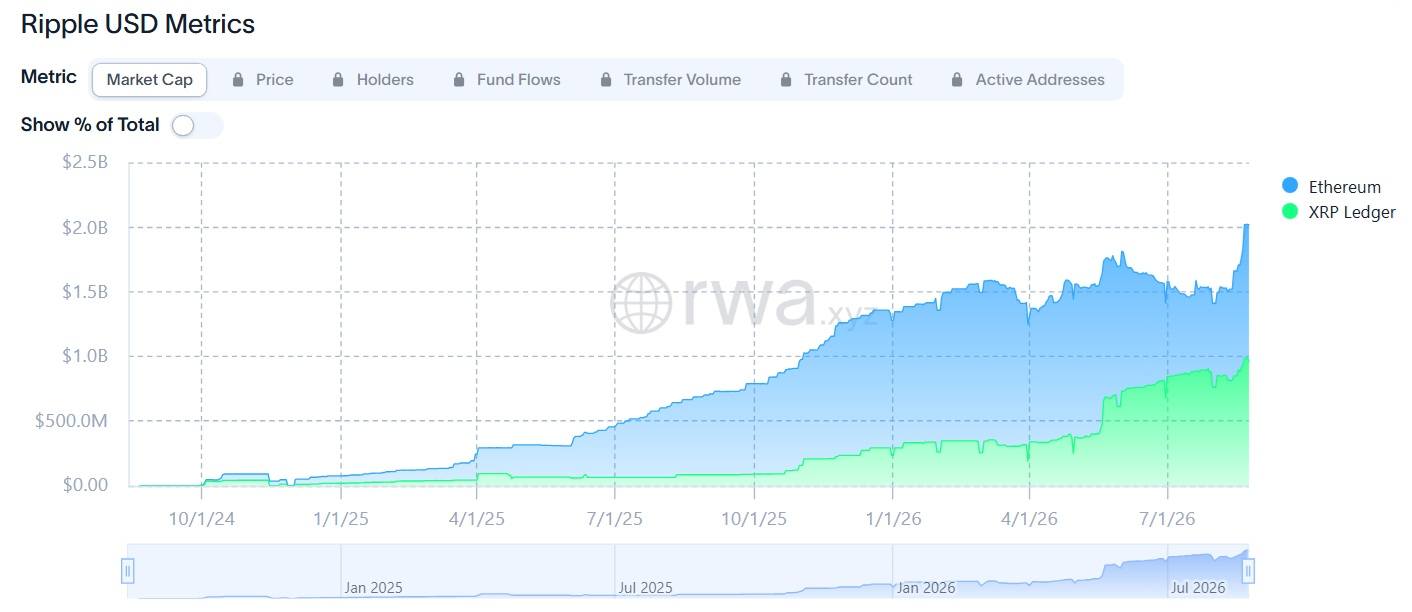
Currently, these two networks account for nearly equal portions of the $RLUSD supply, with a difference of less than $90 million between them. Ripple mints the stablecoin directly on each chain rather than bridging them into a single pool, so these two balances comprise almost the entire $2.02 billion sum.
The stablecoin's current market cap is eight times the figure from its first four months post-launch. In April 2025, Ripple reported that the market capitalization of $RLUSD was approaching $250 million. At the time, the company had integrated the stablecoin into the Ripple Payments platform for cross-border transactions, treasury operations, and settlements with institutional investors.
Activity on $XRP Ledger Grows with $RLUSD Supply
The growing issuance of $RLUSD has provided additional dollar liquidity for the trading and payment infrastructure of the $XRP Ledger. According to an analysis by Evernorth, from the stablecoin's launch through the end of June, over $2.5 billion was processed through trading pairs with $RLUSD. The $RLUSD-$XRP pair accounted for approximately $900 million over the previous six months and constituted nearly 90% of $RLUSD trading volume on the network.
$RLUSD could also support institutional lending if two proposed amendments to the $XRP Ledger gain validator approval. Ripple supports an institutional lending initiative for $RLUSD involving Clearpool and Cicada Partners. The system remains in development on the Devnet and depends on the approval of amendments XLS-65 "Discreet Asset Vaults" and XLS-66 "Lending Protocol" before launching on the mainnet.
Institutional users gained another method of accessing the stablecoin when Ripple introduced a unified issuance and redemption platform in July. Ripple Mint allows eligible institutions to manage $RLUSD via a web interface or API. Its features include minting, redeeming, cross-chain bridging, balance monitoring, transaction tracking, and automated notifications, covering every step of the settlement process.
Payments and Multi-Chain Access Expand $RLUSD Utility
Ripple has expanded $RLUSD's utility through integrations with payment systems, exchange listings, regional distribution agreements, and support for additional blockchain networks. Among eight new $RLUSD introductions announced in July were: settlement support via Mastercard, availability in Japan and Turkey, integration with Bitso, and Flutterwave investments related to African payment corridors. Ripple also expanded the stablecoin's reach beyond its initial deployments on the $XRP Ledger and Ethereum.
Stablecoins are cryptocurrencies designed to be pegged to underlying assets, most commonly the U.S. dollar, through reserves, collateral, redemption mechanisms, or other structures. A stablecoin's collateral and redemption models determine how each token aims to maintain its peg to the underlying asset, as well as the risks faced by holders. The transfer volume metric measures on-chain movement, not payments, revenue, or net inflows, while market capitalization reflects the value of tokens in circulation.
end-content