Ether ETFs break outflow streak while XRP products hit multi-week highs

cointelegraphPubblicato 2025-12-23Pubblicato ultima volta 2025-12-23

Introduzione

US spot Ether ETFs broke a seven-day outflow streak with $84.6 million in net inflows on Monday, reversing a trend that saw over $700 million exit the previous week. Cumulative net inflows for Ether products now stand at approximately $12.5 billion. Meanwhile, XRP ETFs extended their uninterrupted inflow streak, recording $43.9 million in net inflows—their strongest day since early December—bringing cumulative inflows to over $1.1 billion. Solana and Chainlink ETFs also saw steady inflows, reaching about $750 million and $58 million cumulatively, respectively. In contrast, Dogecoin ETF demand cooled further. Despite these gains, global crypto ETPs faced nearly $1 billion in outflows last week, largely due to spot Bitcoin and Ether fund withdrawals amid regulatory uncertainty.

Spot Ether exchange-traded funds (ETFs) in the US recorded $84.6 million in net inflows on Monday, breaking a seven-day outflow streak in one of the biggest single-day reversals this month.

The shift came after over $700 million exited spot Ether (ETH) products last week, highlighting a pause in selling pressure. According to SoSoValue data, the rebound lifted cumulative net inflows to about $12.5 billion.

At the same time, XRP (XRP) ETFs extended their uninterrupted inflow streak, recording $43.9 million in net inflows on Monday, their strongest daily showing since early December. XRP ETFs have not experienced a single net outflow day since their launch, resulting in cumulative net inflows exceeding $1.1 billion.

While XRP ETF volumes remain modest compared to Ether products, the consistency of the inflows stands out. Instead of the rapid in-and-out rotation, the data suggested that early allocators are gradually building exposure, treating the asset as a positioning tool rather than a short-term trade.
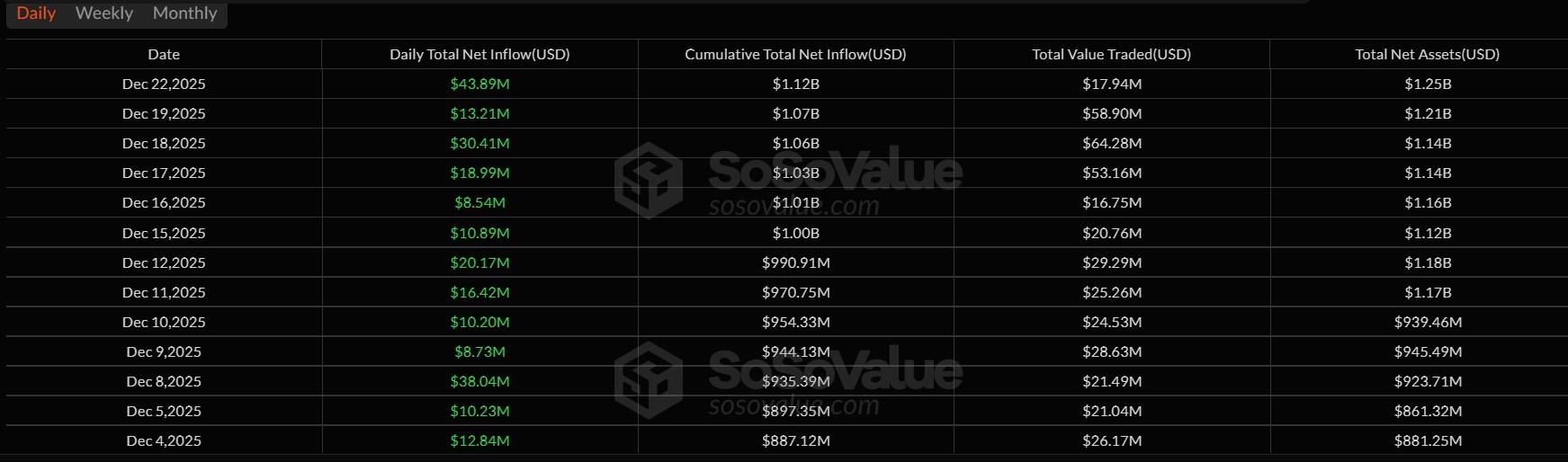
Daily inflow data for XRP ETFs. Source: SoSoValue

US altcoin ETF flows diverge

Beyond Ether and XRP, flows across other altcoin ETFs point to increasing differentiation within the crypto exchange-traded products (ETPs) space.

Solana (SOL) ETFs continued to attract steady capital, lifting cumulative net inflows to about $750 million. After a net negative on Dec. 3, Solana products returned to consistent positive flows, but on smaller levels compared to XRP. In total, Solana ETF products have had only three outflow days since launch.

Chainlink ETFs showed a similar pattern of incremental accumulation throughout December. Chainlink (LINK) products added nearly $2 million in inflows on Monday, bringing its cumulative net inflows to about $58 million.

Several flat-flow days point to muted trading activity, with inflows appearing steadier rather than driven by short-term speculation.

Meanwhile, Dogecoin (DOGE) ETFs, which showed early signs of cooling demand in December, continued the downtrend.

SoSoValue data showed that cumulative net inflow remained stuck at $2 million, while its total value traded fell to $67,000 on Monday, its second-lowest day in December.

Related: Crypto ETPs could see a flood of liquidations by 2027: Analyst

Global crypto ETF outflows neared $1 billion last week

While several altcoin ETFs continue to attract steady inflows, their volumes remain too small to offset broader market trends. Last week, global crypto ETPs recorded roughly $952 million in net outflows, driven primarily by spot Bitcoin and Ether funds.

Asset manager CoinShares attributed the pullback to delays surrounding the Digital Asset Market Clarity Act, which prolonged regulatory uncertainty and coincided with increased selling pressure from large holders.

Magazine: Ethereum’s Fusaka fork explained for dummies: What the hell is PeerDAS?

Crypto di tendenza

Domande pertinenti

QWhat was the net inflow for US spot Ether ETFs on Monday, and why was it significant?

AUS spot Ether ETFs recorded $84.6 million in net inflows on Monday, breaking a seven-day outflow streak in one of the biggest single-day reversals this month.

QHow have XRP ETF inflows performed since their launch, and what does the data suggest about investor behavior?

AXRP ETFs have not experienced a single net outflow day since their launch, with cumulative net inflows exceeding $1.1 billion. The data suggests that early allocators are gradually building exposure, treating the asset as a positioning tool rather than a short-term trade.

QWhich altcoin ETFs showed steady inflows in December besides Ether and XRP?

ASolana (SOL) ETFs continued to attract steady capital, lifting cumulative net inflows to about $750 million, and Chainlink (LINK) ETFs showed a pattern of incremental accumulation, bringing its cumulative net inflows to about $58 million.

QWhat was the trend for Dogecoin (DOGE) ETFs in December, according to SoSoValue data?

ADogecoin ETFs showed early signs of cooling demand in December, with cumulative net inflow stuck at $2 million and total value traded falling to $67,000 on Monday, its second-lowest day in December.

QWhat was the main reason for the $952 million in net outflows from global crypto ETPs last week, as attributed by CoinShares?

AAsset manager CoinShares attributed the pullback to delays surrounding the Digital Asset Market Clarity Act, which prolonged regulatory uncertainty and coincided with increased selling pressure from large holders.

Letture associate

Wang Xing Is Happy, Wang Xingxing Is Not Necessarily

Yu Shu Technology's (Unitree) IPO on the STAR Market sparked discussions centered on wealth creation: the surge in founder Wang Xingxing's net worth, the substantial gains for early investors like Meituan's Wang Xing, and employee stock wealth. Yet, a key observation from the listing ceremony was the founder's calm demeanor, contrasting with the celebratory atmosphere. The article explores this divergence. For investor Wang Xing, the IPO represents a successful bet on embodied AI and robotics as the next foundational tech wave, with Meituan's stake now highly valuable. For founder Wang Xingxing, the milestone brings a new set of pressures. His company, now valued at ~341.8 billion yuan, must transition from proving technological feasibility (which it has done with its quadruped and humanoid robots) to delivering scalable commercial success. The market's high valuation is an advance payment for a future that Yu Shu must now build. Post-IPO, Yu Shu faces the critical challenge of moving beyond impressive demos to creating sustainable businesses. This means making robots reliable, affordable, and indispensable for both consumers and industrial clients, proving their real-world economic value. As the "first stock" in embodied AI on the STAR Market, Yu Shu also becomes a public benchmark for the entire industry, its performance influencing sector-wide expectations. Ultimately, while investors can celebrate realized gains, Wang Xingxing's work is just beginning. He must now manage a public company, meet heightened market expectations, and navigate the complex journey from innovative engineering to large-scale commercial execution. The IPO is a starting line, not a finish line.

marsbit6 min fa

Wang Xing Is Happy, Wang Xingxing Is Not Necessarily

marsbit6 min fa

U.S. Market Trend (August 20): U.S. Treasury Intervention Halts Stock Decline; Moderna's Cancer Vaccine Breakthrough Sparks 180% Surge

U.S. Stocks Rebound on Treasury Intervention; Moderna Soars 180% on Cancer Vaccine Breakthrough Key Points: • U.S. stocks ended a three-day decline, with the rebound driven primarily by the U.S. Treasury Department's move to significantly increase its long-term bond repurchase ceiling. This action briefly pushed the 30-year Treasury yield down by about 10 basis points, easing long-term interest rate pressures. • Despite this, the market faced a countervailing force from the hawkish July FOMC meeting minutes, which revealed broader support for potential rate hikes among officials due to lingering inflation concerns. • Moderna shares skyrocketed nearly 180% after announcing positive Phase 3 trial results for its personalized mRNA cancer vaccine in partnership with Merck, which also rose nearly 13%. This fueled a major rally in the healthcare sector. • Contrary to the broader market, the Philadelphia Semiconductor Index fell over 2%, highlighting persistent pressure on the AI hardware chain. Concerns include AI's potential inflationary impact and questions about application-side cash flows supporting high capital expenditures. • Commodities and cryptocurrencies rallied alongside the equity rebound, supported by a weaker dollar and lower long-term yields. Geopolitical risks continued to underpin oil prices. Outlook: Market focus shifts to whether long-term bond yields stabilize post-intervention, upcoming U.S. economic data (jobless claims, Philly Fed index), and the impact of SK Hynix's massive share buyback plan on the memory chip sector. The tech sector's full recovery remains contingent on the semiconductor index's performance.

marsbit15 min fa

U.S. Market Trend (August 20): U.S. Treasury Intervention Halts Stock Decline; Moderna's Cancer Vaccine Breakthrough Sparks 180% Surge

marsbit15 min fa

The 19 Must-Know Top Chinese and American Entrepreneurs Born After 2000 • The 21st-Century Successors Have Arrived

The 21st century's first generation of entrepreneurs, born in the 2000s, are already taking center stage. This analysis of publicly prominent founders reveals distinct trends between China and the U.S., shaped by their respective ecosystems. In China, young founders are heavily focused on giving AI a physical presence, tackling challenges in robotics and hardware. Examples include Huang Yi (RoboParty, humanoid robots), Qin Shentao (Yuanchen Taichu, embodied AI data infrastructure), and founders working on robotic hands, home cleaning robots, and computing power networks. Their paths often emerge from university labs and robotics competitions, prioritizing prototype demonstration, cost control, and manufacturing delivery. In contrast, their U.S. counterparts frequently leverage software, AI, and capital networks to rapidly reorganize digital services and information flows. Startups like Mercor (AI talent/data, reaching $10B revenue), Etched (AI chips), and various AI-powered SaaS tools for consumers and SMBs demonstrate a focus on user growth, subscription models, and global scalability. However, this velocity has also led to high-profile cases questioning business practices and credibility. The key differentiator for this generation is not merely youth, but the compressed early stage of venture creation. Access to open-source tools, AI models, mature supply chains, and willing venture capital allows them to bypass traditional career ladders. Yet, while technology lowers the barrier to product creation, it does not reduce the challenges of building a sustainable company—managing teams, ensuring reliable delivery, and establishing trust remain hard-earned skills. The article concludes that the true test for these founders will be the "second growth": evolving from product creators into responsible company leaders capable of sustained execution and organizational building. For established businesses, the rise of these fast-moving, technologically adept teams necessitates new strategies for collaboration, competition, and investment.

marsbit20 min fa

The 19 Must-Know Top Chinese and American Entrepreneurs Born After 2000 • The 21st-Century Successors Have Arrived

marsbit20 min fa

A Trillion-Dollar Consumer Credit Market Lacks Key Players

The trillion-dollar global consumer credit market remains largely untapped by blockchain technology. While projects like Pharos have rapidly attracted millions in stablecoin deposits for short-term consumer loans in emerging markets, they represent early attempts to bring this massive asset class on-chain. The core challenge isn't technical tokenization, but the "repackaging" of countless small, heterogeneous loans into standardized, investable products that digital asset funds can understand and price. Current approaches primarily change the *distribution* of capital—using stablecoins for settlement and smart contracts for transparency—but do not eliminate underlying credit risk. Several models are emerging: Pharos and Huma Finance/Tala focus on connecting high-yield emerging market loans to global crypto capital. Figure stands out by building full-stack, regulated infrastructure, securing AAA ratings for its securitizations and proving blockchain assets can meet traditional institutional standards. Conversely, Goldfinch's difficulties highlight that on-chain transparency cannot replace offline credit underwriting and collection capabilities. The article identifies a four-layer value chain: 1) loan origination, 2) credit structuring & securitization, 3) on-chain infrastructure, and 4) capital. The current gap is in the second layer—the mature capital markets expertise for structuring, rating, credit enhancement, and institutional distribution. This is the critical link needed to transform scattered loans into large-scale, trustworthy on-chain credit assets, bridging traditional finance's rigor with blockchain's new capital pools.

marsbit55 min fa

A Trillion-Dollar Consumer Credit Market Lacks Key Players

marsbit55 min fa

Trading

Spot

Articoli Popolari

Cosa è XRP 2.0

XRP 2.0: Una Nuova Frontiera nel Paesaggio delle Criptovalute Introduzione a XRP 2.0 Nel mondo in continua evoluzione delle criptovalute, nuovi progetti emergono continuamente, cercando attenzione e adozione. Una tale iniziativa promettente è XRP 2.0, un nuovo progetto di criptovaluta progettato per sfruttare avanzate tecnologie blockchain e metodologie di crittografia robuste. Anche se il nome richiama alla mente l'XRP di Ripple, è fondamentale notare che XRP 2.0 opera in modo indipendente, concentrandosi sul miglioramento della sicurezza delle transazioni, della privacy e della scalabilità. Mentre il panorama finanziario digitale abbraccia sempre di più soluzioni decentralizzate, XRP 2.0 mira a contribuire in modo significativo al web3 e all'espansione generale dei progetti crypto. Cos'è XRP 2.0? Alla sua base, XRP 2.0 è un progetto di criptovaluta che mira a creare un ecosistema di valuta digitale sicuro e decentralizzato. La sua tecnologia fondamentale integra principi di blockchain sofisticati con tecniche di crittografia all'avanguardia. L'obiettivo principale di XRP 2.0 è quello di affermarsi come una piattaforma affidabile ed efficiente in grado di consentire un'esecuzione rapida delle transazioni, dando priorità a migliori protezioni della privacy per i suoi utenti. Il progetto è promosso come una soluzione a molte limitazioni affrontate dalle criptovalute esistenti, proponendo un sistema in grado di gestire un volume maggiore di transazioni con migliorata velocità e privacy. Questa versatilità pone XRP 2.0 come un significativo competitor in un mercato affollato di varie valute digitali. Chi è il Creatore di XRP 2.0? L'identità del creatore dietro XRP 2.0 è stata segnalata come 'Wilbur'. Tuttavia, i dettagli completi riguardanti Wilbur o l'entità associata rimangono sfuggenti. L'anonimato di molti creatori di criptovalute non è un fenomeno raro nel settore, spesso progettato per mantenere un certo grado di privacy e sicurezza. Chi sono gli Investitori di XRP 2.0? Al momento, informazioni specifiche relative alle fondazioni o organizzazioni di investimento a supporto di XRP 2.0 non sono disponibili pubblicamente. Nel settore delle criptovalute, il supporto di investitori rinomati può influenzare significativamente la credibilità e il successo di un progetto, tuttavia la trasparenza riguardo ai sostenitori finanziari di XRP 2.0 non è stata stabilita. Come Funziona XRP 2.0? XRP 2.0 si distingue per l'impiego di una combinazione di tecnologia blockchain e algoritmi di crittografia avanzati che garantiscono transazioni sicure e decentralizzate. La sua struttura innovativa include caratteristiche uniche progettate per promuovere il coinvolgimento degli utenti e ampliare le funzionalità oltre le transazioni convenzionali delle criptovalute. Tra queste caratteristiche, XRP 2.0 incorpora capacità alimentate da intelligenza artificiale, come funzionalità di testo in immagini e testo in voce. Queste aggiunte sono progettate per migliorare l'esperienza interattiva per gli utenti, promuovendo una maggiore applicabilità in vari settori. Unendo progressi tecnologici con design incentrati sugli utenti, XRP 2.0 mira a catturare l'attenzione di una vasta gamma di individui e aziende che cercano di integrare soluzioni di criptovaluta nei loro framework operativi. Cronologia di XRP 2.0 Comprendere XRP 2.0 richiede di esaminare i traguardi che hanno definito il suo percorso fino ad ora: 23 luglio 2023: XRP 2.0 viene introdotto come un nuovo progetto di criptovaluta, mirante a rivoluzionare le capacità di transazione sicura e decentralizzata nel dominio blockchain. 8 settembre 2023: Si verifica il lancio di un altro progetto, XRP20, marcando l'emergere di un token ERC-20 sulla blockchain di Ethereum che resta non correlato a XRP 2.0. 13 novembre 2023: Il ledger XRP subisce un significativo aggiornamento con il rilascio della versione 2.0.0 del software server rippled. È essenziale notare che questo sviluppo è scollegato dal progetto di criptovaluta XRP 2.0. Punti Chiave su XRP 2.0 Per distillare l'essenza di XRP 2.0, emergono diversi fattori critici: Caratteristiche Uniche: L'inclusione di funzionalità come il testo in immagini e testo in voce alimentato da intelligenza artificiale diversifica ulteriormente le potenziali applicazioni di XRP 2.0. Tecnologia Blockchain: Il framework utilizza meccanismi blockchain avanzati e protocolli di crittografia, garantendo un ambiente sicuro e decentralizzato per le transazioni. Scalabilità e Privacy: XRP 2.0 dà priorità a migliori protezioni della privacy nei processi di transazione e alla scalabilità necessaria per accogliere una base di utenti in crescita. Nessuna Affiliazione con Ripple: È importante notare che, nonostante il suo nome, XRP 2.0 non ha alcuna fedeltà o collaborazione con l'XRP di Ripple, distinguendo il proprio framework operativo e obiettivi all'interno dell'ecosistema delle criptovalute. Conclusione XRP 2.0 rappresenta un'ambiziosa venture nell'ambito delle criptovalute, mirante a offrire una combinazione di sicurezza, privacy ed efficienza nelle transazioni digitali. Integrando tecnologie sofisticate e caratteristiche user-friendly, il progetto si propone di ampliare gli orizzonti di ciò che le criptovalute possono realizzare nell'economia digitale odierna. Sebbene l'anonimato del suo creatore e la mancanza di investitori dichiarati possano sollevare domande per alcuni, il focus di XRP 2.0 su funzionalità avanzate e decentralizzazione ne amplifica l'appeal in un mercato crypto sempre più affollato. Man mano che il panorama delle criptovalute continua a evolversi, XRP 2.0 potrebbe emergere come un attore decisivo nell'espansione di soluzioni blockchain sicure e scalabili.

321 Totale visualizzazioniPubblicato il 2024.04.05Aggiornato il 2024.12.03

Cosa è XRP 2.0

Come comprare XRP

Benvenuto in HTX.com! Abbiamo reso l'acquisto di XRP (XRP) semplice e conveniente. Segui la nostra guida passo passo per intraprendere il tuo viaggio nel mondo delle criptovalute.Step 1: Crea il tuo Account HTXUsa la tua email o numero di telefono per registrarti il tuo account gratuito su HTX. Vivi un'esperienza facile e sblocca tutte le funzionalità,Crea il mio accountStep 2: Vai in Acquista crypto e seleziona il tuo metodo di pagamentoCarta di credito/debito: utilizza la tua Visa o Mastercard per acquistare immediatamente XRPXRP.Bilancio: Usa i fondi dal bilancio del tuo account HTX per fare trading senza problemi.Terze parti: abbiamo aggiunto metodi di pagamento molto utilizzati come Google Pay e Apple Pay per maggiore comodità.P2P: Fai trading direttamente con altri utenti HTX.Over-the-Counter (OTC): Offriamo servizi su misura e tassi di cambio competitivi per i trader.Step 3: Conserva XRP (XRP)Dopo aver acquistato XRP (XRP), conserva nel tuo account HTX. In alternativa, puoi inviare tramite trasferimento blockchain o scambiare per altre criptovalute.Step 4: Scambia XRP (XRP)Scambia facilmente XRP (XRP) nel mercato spot di HTX. Accedi al tuo account, seleziona la tua coppia di trading, esegui le tue operazioni e monitora in tempo reale. Offriamo un'esperienza user-friendly sia per chi ha appena iniziato che per i trader più esperti.

1.9k Totale visualizzazioniPubblicato il 2024.12.10Aggiornato il 2026.06.02

Come comprare XRP

Discussioni

Benvenuto nella Community HTX. Qui puoi rimanere informato sugli ultimi sviluppi della piattaforma e accedere ad approfondimenti esperti sul mercato. Le opinioni degli utenti sul prezzo di XRP XRP sono presentate come di seguito.

活动图片