Market Trends in U.S. Stocks (June 23): Peak at Listing? SpaceX Loses Over $800 Billion in Three Days, Tech Stocks Experience Severe Internal Divergence

marsbitPubblicato 2026-06-23Pubblicato ultima volta 2026-06-23

Introduzione

Stock Market Trends (June 23): Did SpaceX Peak at IPO? The company loses over $800 billion in market value in three days as a sharp divergence unfolds within the tech sector. SpaceX's post-IPO decline of over 20%, falling below its first-day close, reflects a swift market repricing. The catalyst is a clear shift in narrative from "AI platform potential" to concerns over rising capital costs, as its $8.57 billion IPO and subsequent $20 billion debt offering are earmarked for acquisitions and refinancing existing bridge loans rather than de-leveraging. While high-valuation tech stocks like Google, Meta, Amazon, and Microsoft faced pressure, Micron surged nearly 7% to a record high following a strategic supply deal with Anthropic for HBM and memory, highlighting robust, tangible demand in AI infrastructure. The broader market saw funds rotate into more defensive industrial and financial names. Macro factors included a dip in oil prices to a three-month low on news of a US-Iran framework deal, though logistical hurdles for resuming full Strait of Hormuz shipments remain. Key events ahead include Nvidia's shareholder meeting, Micron's earnings, and the May PCE inflation data. The latter will be crucial in determining whether the sell-off in high-valuation growth stocks, which appears to have just begun, will persist.

Author: Tide Research

The market sentiment towards SpaceX has shifted within ten days of its listing. A $20 billion bond financing confirmed that the $8.57 billion IPO proceeds were not for deleveraging but for continued spending. The market's repricing speed was even faster than its initial surge on the first trading day.

Market Performance

Indexes faced overall pressure: the S&P 500 fell 0.37% to 7472.79, the Nasdaq dropped 1.32% to 26166.60, and the Dow Jones rose 0.29% to 51712.71.

SpaceX plunged 16.43% to $154.6, losing over 20% in three days, completely shedding its IPO halo. After hitting an intraday high of $225.64 on June 16, it fell below the first-day closing price of $160.95 by Monday, erasing $800 billion in market value from its peak.

The core issue lies in its financing logic. The $8.57 billion IPO proceeds had a clear destination: $6 billion for the acquisition of Cursor, with the remainder used to repay xAI bridge loans. Subsequently, SpaceX issued $20 billion in bonds to continue refinancing bridge loans. 22V Research noted that up to 44% of insider shares could flood the market cumulatively from August to September, while the current float is only 4.2%.

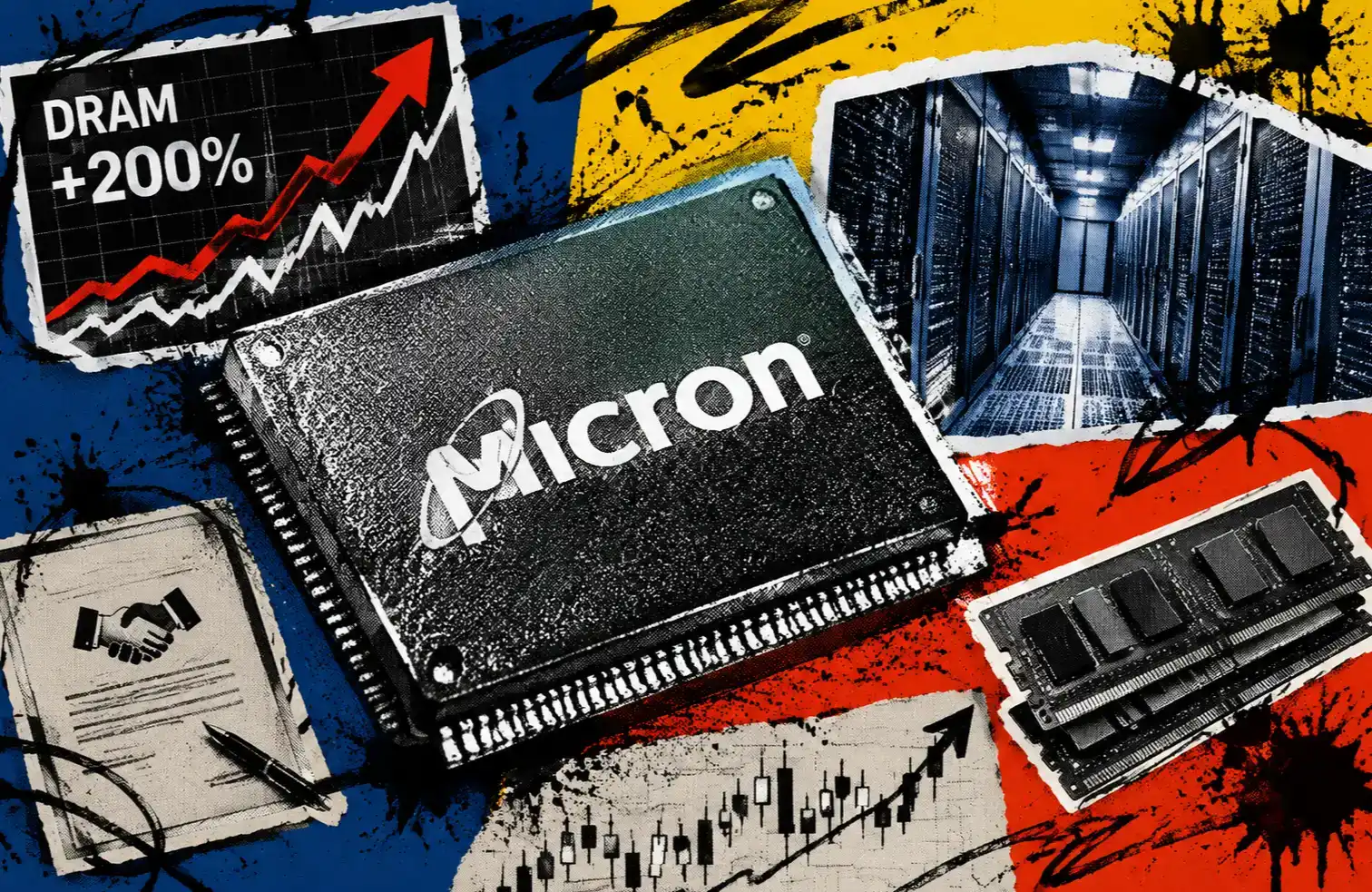
Micron surged 6.9% to $1,211.38, reaching a historical high. The driver was its strategic agreement with Anthropic for the long-term supply of HBM, DRAM, and solid-state drives. This deal effectively seals the long-term demand for AI infrastructure.

High-valuation tech stocks faced broad pressure: Alphabet fell over 5%, Meta dropped 2.3%, Amazon declined 4.8%, and Microsoft slid 3%. The communications sector saw its biggest single-day decline since April, nearing 4%. Caterpillar rose nearly 4%, leading the Dow. Industrial and financial stocks showed relative resilience as capital executed a clear rotation within the tech sector.

Oil prices fell to $76, hitting a new low in over three months. A U.S.-Iran framework agreement over the weekend prompted the market to price in the most optimistic scenario for the Strait of Hormuz in advance. The VIX rose to around 16, with selling pressure in high-valuation tech stocks far from fully released.

Macro & Outlook

The SpaceX story is simple: the uses of the IPO proceeds and bond financing were predetermined, with no plans for deleveraging. Morningstar analysts set the fair value at $62, making the current stock price 2.8 times the fair value, the second highest valuation within Morningstar's coverage. Oppenheimer's debt model is more direct: net debt could balloon from $13 billion to $400 billion by 2031. No one denies SpaceX's technological capabilities, but its cost of capital is rising rapidly.

The U.S.-Iran deal alleviates oil price pressures, but the reopening of the Strait of Hormuz is not as fast as imagined. Infrastructure damaged in conflict will take time to restore, shipping capacity needs to recover, inventories are depleted, and supply rebuilding requires time. The market has priced in the most optimistic scenario in advance; any negotiation delays, detailed disagreements, or subsequent conflicts could cause oil prices to rebound.

Nvidia's shareholder meeting and new architecture capacity disclosure early Wednesday, alongside Micron's earnings and May PCE data landing on Thursday, are the decisive moments of the week. If Micron can provide visibility on HBM supply through 2027, the chip sector's new highs will have support. If PCE continues to exceed expectations, high-valuation tech stocks will face further pressure.

Tide's Perspective

SpaceX's narrative shifted from "AI platform premium" to "rising financing cost" in just ten days. With a $2 trillion market cap, it continues to raise capital relentlessly. Investors are repricing not its profitability, but how long the financing story can last.

The Micron-Anthropic agreement provides a comparative case: AI demand is real and resilient, but the highest certainty lies in the infrastructure layer, not the application layer. One is burning cash to raise funds, the other is securing supply. The market's choice is clear.

SpaceX's decline drags down the entire tech sector in the short term. Be wary of any rebounds before Thursday. Progress on the U.S.-Iran deal might be a false signal, delaying but not altering the direction of the high-valuation reassessment. What truly dictates the trend are the two data points on Thursday: whether Micron's earnings provide satisfactory HBM guidance and whether PCE confirms the interest rate hike cycle is not over. The adjustment in high-valuation growth stocks has just begun, it's not about to end.

Domande pertinenti

QAccording to the article, why did SpaceX's stock price drop sharply after its IPO?

AThe drop was due to a rapid market repricing driven by concerns over its financing logic. The IPO raised $8.57 billion, which along with a subsequent $20 billion bond issuance, was earmarked for acquisitions (like Cursor), repaying bridge loans (for xAI), and further debt, not for deleveraging. This highlighted the company's continued high cash burn and rising capital costs.

QWhat was the primary driver behind Micron's stock reaching a record high?

AMicron's stock surged due to a strategic supply agreement with Anthropic for the long-term provision of HBM (High Bandwidth Memory), DRAM, and solid-state drives. This deal effectively 'stamped' long-term demand certainty for AI infrastructure components.

QWhat key event related to the U.S. and Iran contributed to the drop in oil prices?

AThe drop in oil prices to a three-month low was triggered by the market's front-running of the most optimistic scenario following the weekend announcement of a U.S.-Iran framework agreement. This eased concerns about potential disruptions in the Strait of Hormuz.

QWhat two crucial data points or events does the article highlight as decisive for the market later in the week?

AThe article highlights two key events: 1) Micron's earnings report on Thursday, which could provide visibility on HBM supply into 2027, and 2) The release of the May PCE (Personal Consumption Expenditures) inflation data on the same day, which could signal whether the Fed's hiking cycle is truly over.

QFrom the '潮向视角 (Tide Perspective)' section, what fundamental shift in narrative does the article identify for SpaceX?

AThe narrative for SpaceX shifted from commanding an 'AI platform premium' to facing 'rising financing costs' within just ten days of its IPO. Investors are repricing the stock not based on profitability, but on how long its story of continuous large-scale fundraising can be sustained.

Letture associate

A Chip Company Releases AIDC Energy Storage Certification Standards. Why NVIDIA? Computing Power Reshapes Power Supply Logic. Who's in the Lead and Who's Left Out?

NVIDIA has released a "Battery Energy Storage System Self-Certification Guide," setting strict technical standards for energy storage systems specifically for AI data centers (AIDC). The guide focuses solely on certifying the Power Conversion System (PCS), not the batteries, with 10 mandatory performance metrics and 12 validation tests requiring real-world and simulation comparisons. Key requirements include rapid dynamic response to AI workloads, high-frequency system telemetry, and detailed electromagnetic transient models. The move is driven by the extreme and fluctuating power demands of next-generation AI hardware. Modern AIDCs require energy storage systems to act as intelligent, controllable grid assets, not just passive backup, to manage instantaneous, massive power load shifts that traditional UPS systems cannot handle. This redefines the competitive landscape for energy storage providers, shifting focus from capacity and cost to advanced control capabilities and system integration. While the market potential is significant—with forecasts of hundreds of GWh in new demand by 2030—the certification creates a high barrier to entry. It requires proven PCS delivery volumes and credible plans for rapid capacity scaling, favoring established, well-resourced players. Early movers like Fluence (partnering with Siemens) and several Chinese companies have secured projects ahead of the standard, but new entrants must now navigate this rigorous, costly, and time-intensive certification process to compete in the AIDC energy storage market.

marsbit45 min fa

A Chip Company Releases AIDC Energy Storage Certification Standards. Why NVIDIA? Computing Power Reshapes Power Supply Logic. Who's in the Lead and Who's Left Out?

marsbit45 min fa

After Missing the 20x, I've Found a 'Dumb' Method for AI Investing

**Missing the 20x Opportunity: A Simple 'Dumb' Approach to AI Investing** The AI boom, driving NVIDIA's revenue from $60B to $216B in two years, creates immense investment pressure. However, like the internet bubble of 2000, the largest AI opportunities likely lie ahead, perhaps after a correction. Instead of rushing in now or waiting paralyzed for a crash, the author proposes a third way: building a "knowledge warehouse" by systematically mapping the AI industry to be ready when opportunities arise. The core of the strategy is understanding AI's four-layer value chain: 1. **Compute Infrastructure (The "Engine"):** This foundational layer, where all money eventually flows, includes: a) **Chip Design:** NVIDIA's dominance via its CUDA ecosystem, b) **Chip Manufacturing/Packaging/Memory:** TSMC's near-monopoly in advanced manufacturing and SK Hynix's lead in High Bandwidth Memory (HBM), c) **Optical Interconnects:** Essential for large-scale AI clusters (e.g., Lumentum, Coherent), d) **Cooling & Power:** Critical for high-density AI data centers (e.g., Vertiv), e) **Servers/Data Centers & Cloud Platforms:** The physical and virtual wholesale providers. 2. **Models & Tools (The "OS"):** The competitive layer of foundation models (OpenAI, Anthropic, Google, Meta, xAI), now generating real revenue. A key shift is the center of gravity moving from **Training** models to **Inference** (running models), which demands different chip characteristics and could challenge NVIDIA's monopoly. 3. **Middleware & Platform ("The Glue"):** Connects models and applications (e.g., Scale AI, Hugging Face). This layer could explode if applications take off. 4. **Vertical Applications ("The Cash Register"):** Where AI meets end-users (e.g., enterprise AI, coding tools, medical AI, robotics). A critical cross-cutting constraint is **Energy**, as AI's massive power consumption drives investment in nuclear and other energy infrastructure. The author identifies four key questions for further research: 1) How will the shift from Training to Inference reshape the competitive landscape? 2) With tech giants spending over $600B on capex, where is the ROI from AI applications? 3) What are the under-the-radar opportunities in the "second" and "third" circles of the value chain (e.g., cooling, specialty foundries)? 4) How will geopolitics (e.g., U.S.-China chip restrictions) bifurcate the supply chain? The conclusion is that missed opportunities stem from insufficient research, not slow timing. By methodically studying each layer—its business models, competition, and valuations—investors can build the "killer intuition" needed to act decisively when the market presents its chance.

marsbit1 h fa

After Missing the 20x, I've Found a 'Dumb' Method for AI Investing

marsbit1 h fa

Trading

Spot
Futures
活动图片