Google's Q2 Free Cash Flow Turns Negative for the First Time, Raises Full-Year Capital Expenditure Forecast to as High as $205 Billion, Cloud Business Surges 82%

链捕手Pubblicato 2026-07-24Pubblicato ultima volta 2026-07-24

Introduzione

Alphabet (Google's parent) reported its Q2 2026 results. Revenue grew 24% to $119.8B, with Google Cloud revenue surging 82% to $24.8B, significantly exceeding expectations. Cloud backlog also surpassed $500B for the first time. However, the company's capital expenditures soared to $44.9B, leading to negative free cash flow (-$5.86B) for the first time in its history as a public company. Alphabet raised its full-year capex guidance to a range of $195B-$205B, its second upward revision this year. This massive spending on AI infrastructure fueled investor concerns about returns, causing the stock to fall. Despite the cash flow pressure, the results highlight a dual narrative: strong commercial returns from AI in the cloud, but significant financial strain from the ongoing investment race. CEO Sundar Pichai emphasized focus on the next-generation Gemini 4 model and stated that AI is reshaping the entire company.

Authors: Yang Chen, Long Yue
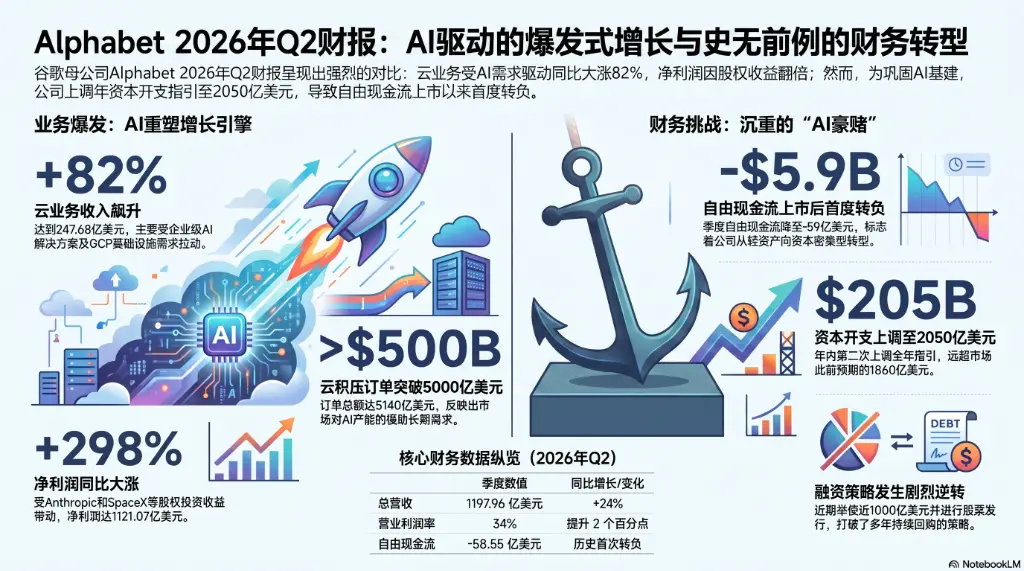
Alphabet, Google's parent company, released its second-quarter results, with cloud revenue significantly exceeding Wall Street expectations, and cloud backlog surpassing the $500 billion mark for the first time.However, market focus quickly shifted to another aspect: this marks the first time Google's free cash flow has turned negative in decades since its IPO. Simultaneously, the company raised its full-year capital expenditure guidance for the second time this year, abruptly intensifying investor concerns over whether the massive AI bet can deliver corresponding returns.

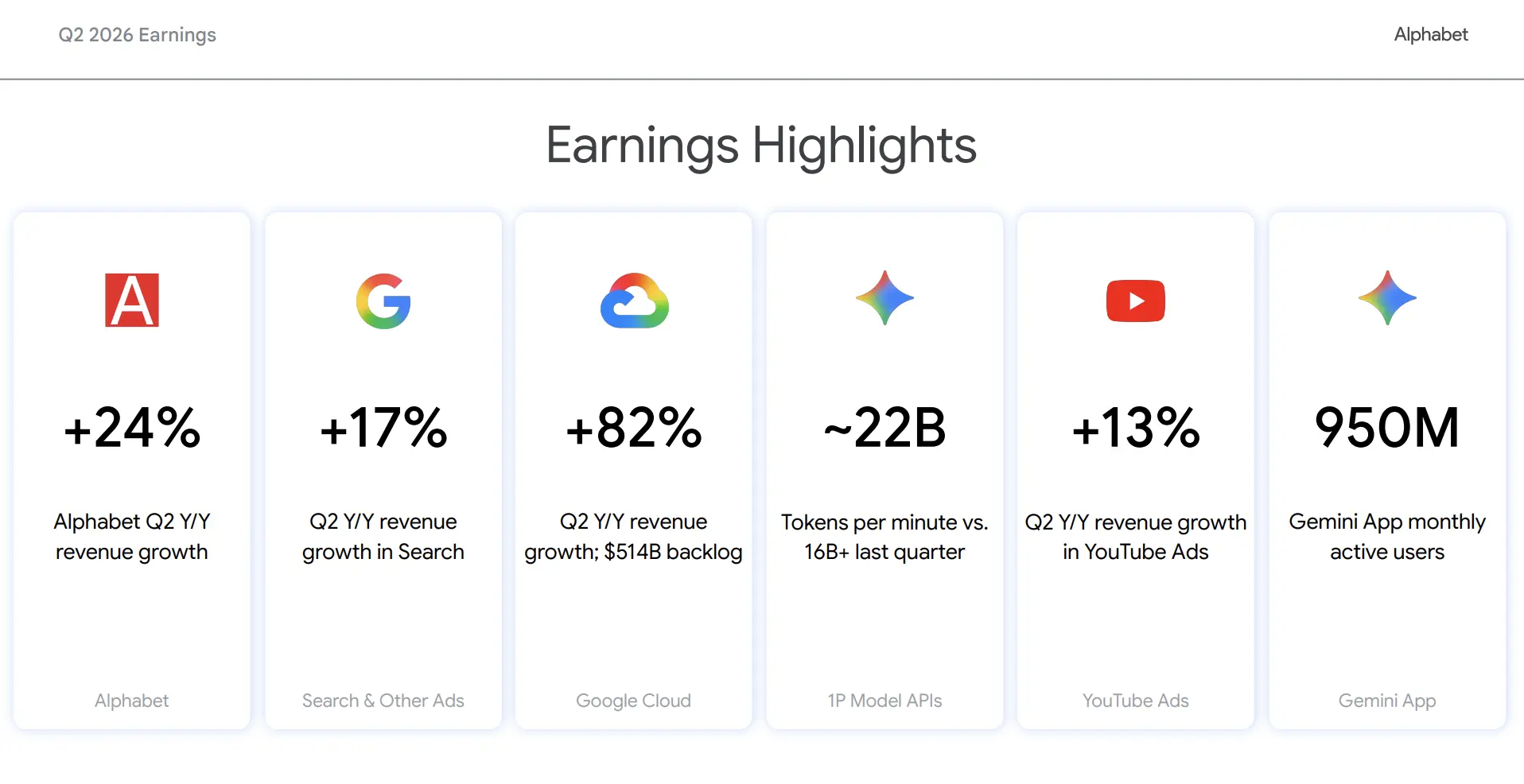
For the second quarter ended June 30, Alphabet reported revenue of $119.796 billion, a 24% year-over-year increase; growth was 23% on a constant currency basis, marking the 12th consecutive quarter of double-digit revenue growth. Operating profit rose 30% to $40.77 billion, with the operating margin improving by 2 percentage points to 34%.

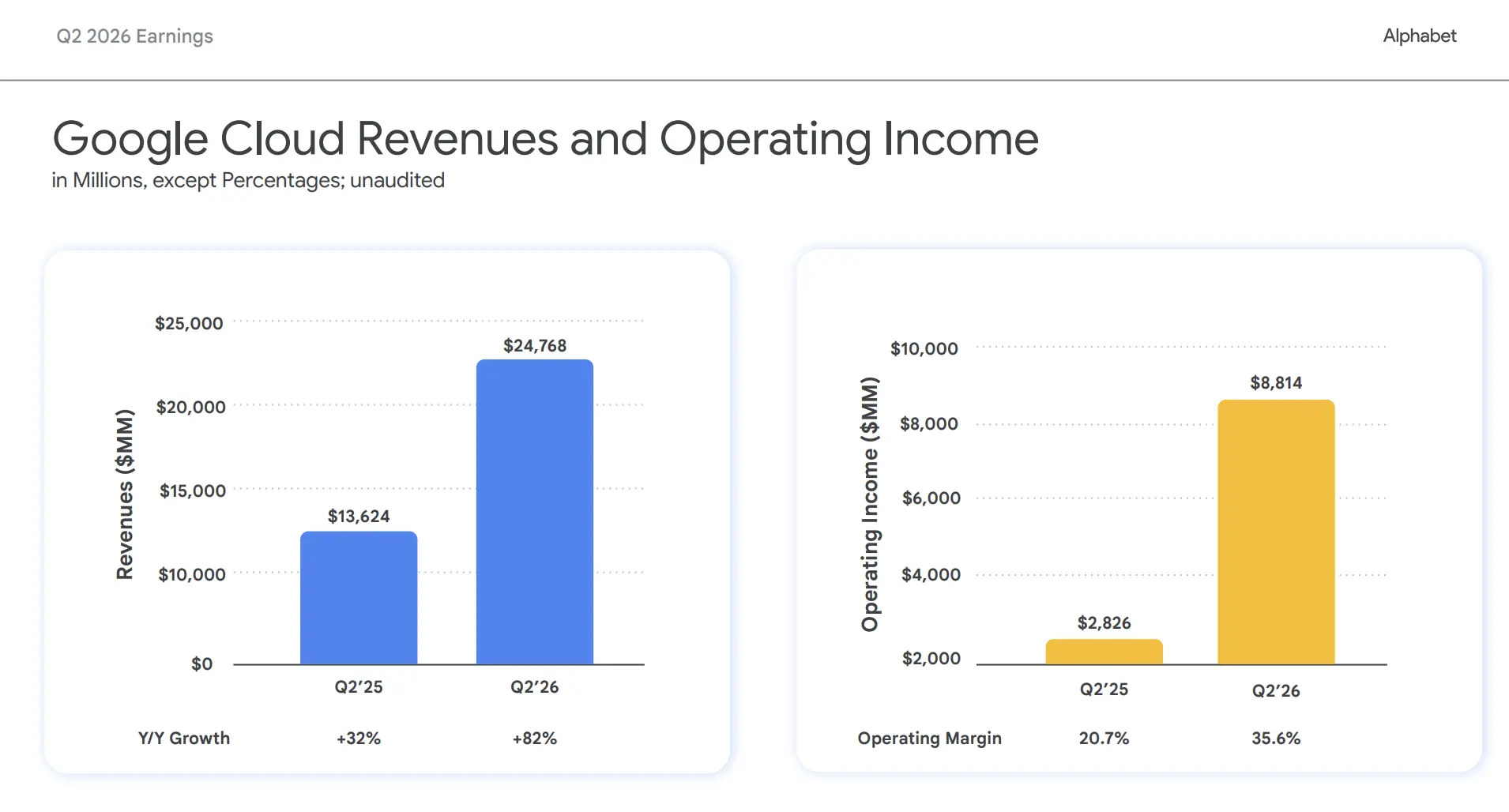
Among these,Google Cloud revenue reached $24.768 billion, surpassing market expectations of $22.46 billion, soaring 82% year-over-year, marking the fastest growth rate in recent years, indicating that AI investments are consistently translating into commercial returns. Search advertising revenue was $63.27 billion, slightly below the market expectation of $63.28 billion.

Alphabet holds stakes in several companies including Anthropic and SpaceX. Influenced by a significant increase in unrealized gains on equity securities,investment income for the quarter approached $100 billion, driving net income attributable to common stockholders to $112.107 billion, a 298% year-over-year increase.
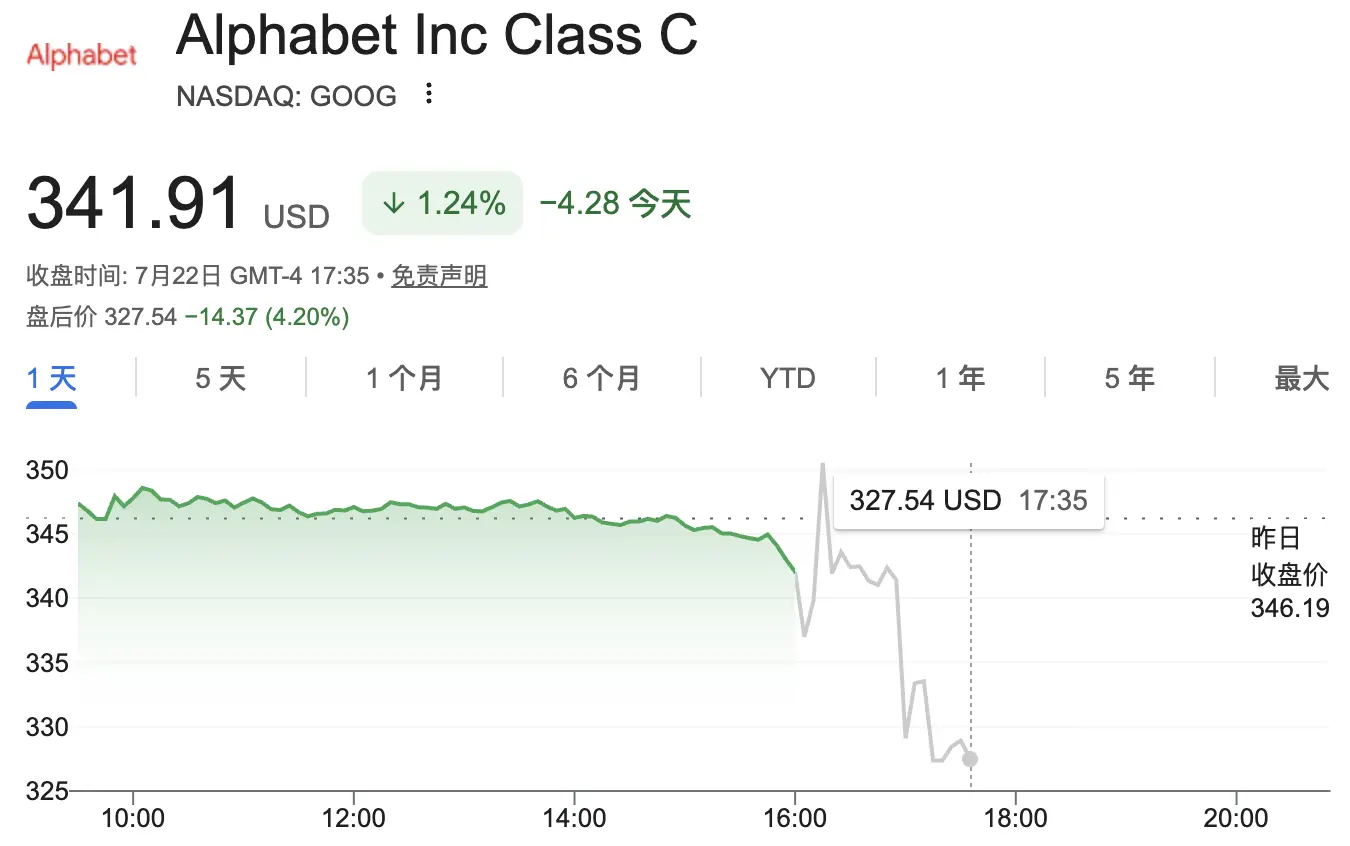
Following the earnings release, Google's stock price experienced minor fluctuations. During the earnings call, Google raised its full-year capital expenditure guidance to a range between $195 billion and $205 billion, up from the previous estimate of $180 billion to $190 billion. After the announcement, market concerns over whether massive capital expenditures can yield corresponding returns led Google's stock to drop by 4.2%.
Free Cash Flow Turns Negative for First Time, Capital Expenditure Raised Again

Alphabet's second-quarter capital expenditures reached $44.924 billion, significantly higher than $22.446 billion in the same period last year,directly causing the quarter's free cash flow to turn negative at -$5.855 billion (approximately -$5.9 billion) — the first time Google has reported negative quarterly free cash flow in decades since its IPO.

Free cash flow is a measure of the cash available for debt repayment or shareholder returns after covering operational costs and capital expenditures, and has long been a core metric used by Wall Street to assess the financial health of technology companies.

During the earnings call, Chief Financial Officer Anat Ashkenazi announced thatthe full-year 2026 capital expenditure guidance is being raised to $195 billion-$205 billion, higher than the previous expectation of $180 billion-$190 billion, and also exceeding analysts' previous prediction of approximately $186 billion. This marks Google's second upward revision of its capital expenditure guidance this year — in April of this year, the forecast had already been raised from previous levels to a maximum of $190 billion.

Ashkenazi stated: "We expect free cash flow to remain under pressure, driven by our investments in technical infrastructure, which enable us to seize AI opportunities and continue to deliver substantial returns."

However, the stock price fell following the announcement. Investors' concern lies in: Google is rapidly transitioning from a light-asset company to a capital-intensive one. To support massive AI infrastructure investments, Alphabet recently raised nearly $100 billion in debt and completed its first stock issuance in over twenty years since its IPO in June, netting approximately $85 billion — a stark reversal from the strategy of continuous stock buybacks pursued for many prior years.

Investing.com senior analyst Thomas Monteiro stated bluntly: "The upward revision in capital expenditure is unfavorable for Alphabet. Combined with a rising interest rate environment and ongoing tight supply and demand for AI infrastructure, the logic of 'self-sustenance through operating cash flow' is beginning to falter."

However, Dec Mullarkey, Managing Director at asset management firm SLC Management, holds a relatively optimistic view: "The market wants to see hyperscale cloud vendors fiercely competing for AI leadership, but not at the expense of eroding profitability. Alphabet is still maintaining that balance for now."

Ashkenazi added that the company will utilize a combination of operating cash flow, debt, and equity financing to support expenditures. She explicitly stated that there would be no further stock issuance beyond the announced scope, while emphasizing the maintenance of a robust balance sheet.

Google Cloud Becomes the Largest Growth Engine

By business segment, Google Cloud continues to be Alphabet's fastest-growing business.

In the second quarter, Google Cloud revenue reached $24.768 billion, an 82% year-over-year increase, accelerating further from previous rates. The company stated that growth primarily stemmed from sustained demand for Google Cloud Platform (GCP) enterprise AI solutions, enterprise AI infrastructure, and core cloud services. Concurrently, Google Cloud's operating profit reached $8.814 billion, a significant improvement from $2.826 billion in the same period last year, indicating markedly enhanced profitability.

The cloud business backlog (contracted but not yet recognized revenue) increased to $514 billion, up from approximately $460 billion last quarter, exceeding $500 billion for the first time. The company stated that over half of this is expected to be recognized as revenue within the next 24 months, with the customer base encompassing a "broad mix of customers."

Monteiro noted that the cloud business's outperformance at least clearly indicates that the company's AI investments are "translating into rapidly growing, profitable revenue, with contracts being fulfilled immediately upon capacity completion."

Although Google Cloud still trails Amazon AWS and Microsoft Azure, driven by strong demand for AI infrastructure from AI startups and enterprise customers, it has become one of Alphabet's fastest-growing businesses.
In contrast, the traditional advertising business continued steady growth:

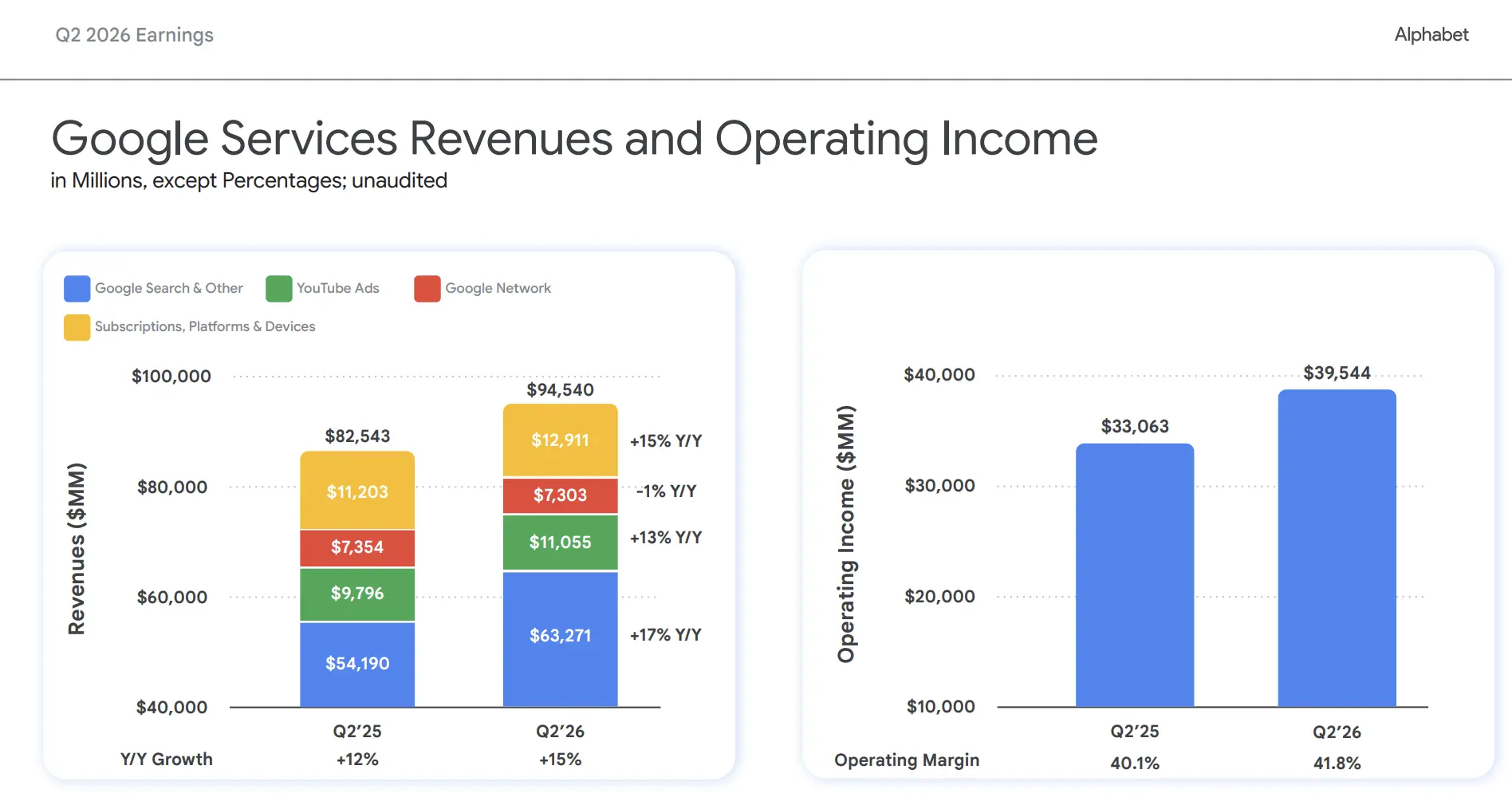
  • Google Search and other revenue was $63.271 billion, a 17% year-over-year increase;
  • YouTube ads revenue was $11.055 billion, a 13% year-over-year increase; regarding YouTube monthly unique users, during the 2026 FIFA World Cup, over 1.7 billion unique users watched related videos on the platform, further driving traffic growth;
  • Google subscriptions, platforms, and devices revenue was $12.911 billion, a 15% year-over-year increase.

Overall, Google Services revenue reached $94.54 billion, a 15% year-over-year increase.
CEO: AI Investment is Reshaping All of Google, Focus on Gemini 4

Alphabet CEO Sundar Pichai stated that the company's AI investment is redefining the entire business.He told investors: "It feels like we're at the very early stages of long-term structural shifts across multiple domains... Over the past year, we have grown increasingly optimistic about future opportunities."

He revealed that nearly 90% of Fortune 100 companies are now using Gemini Enterprise; Gemini models process 220 billion API tokens per minute, and the Gemini App monthly active users have reached 950 million. Nate Elliott, Chief Analyst at eMarketer, pointed out: "Gemini is just one step away from becoming Google's third consumer AI product with a billion users (joining AI Overviews and AI Mode)."

Regarding the model roadmap, Pichai shifted focus to the next-generation flagship model, Gemini 4, describing it as a 'larger-scale next-generation frontier model.' He stated that the company is prioritizing its training by concentrating computing power and indicated that Google's model release pace will accelerate. The delayed release of Gemini 3.5 Pro had previously raised external doubts about Google's competitiveness in areas like AI programming, where Anthropic and OpenAI have gained significant advantages among developer communities.

Simultaneously, AI features continue to drive growth in Google search query volume, demand for the company's cybersecurity products remains robust, and the newly launched Gemini 3.5 Flash Cyber shows outstanding cost efficiency. Additionally, during the 2026 FIFA World Cup, over 1.7 billion unique users watched related videos on YouTube, further driving platform traffic growth.

Pichai stated that the company's "differentiated, full-stack AI strategy" is continuously creating quantifiable commercial value for consumers, enterprise customers, and partners.

Continued Investment in AI Infrastructure

To meet the growing demand for AI computing power, Alphabet intensified its financing efforts in the second quarter.

In June, the company completed the issuance of Class A shares, Class C shares, and mandatory convertible preferred shares, netting $49.6 billion; concurrently, it issued $20.3 billion in senior unsecured bonds; additionally, it established an at-the-market (ATM) equity offering program for up to $40 billion, which had not been initiated as of the end of the second quarter. These measures have brought Alphabet's recent cumulative debt raising close to $100 billion.
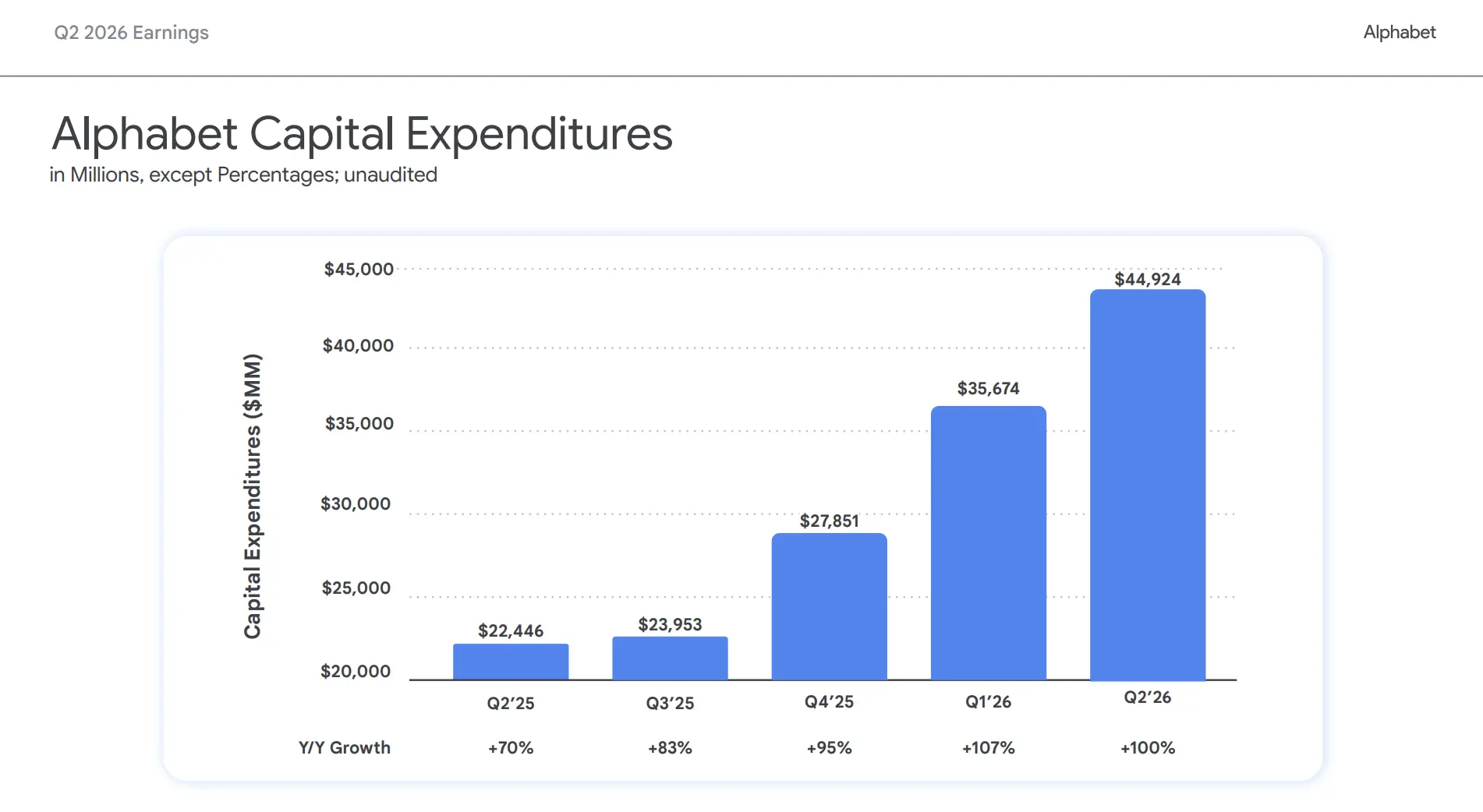
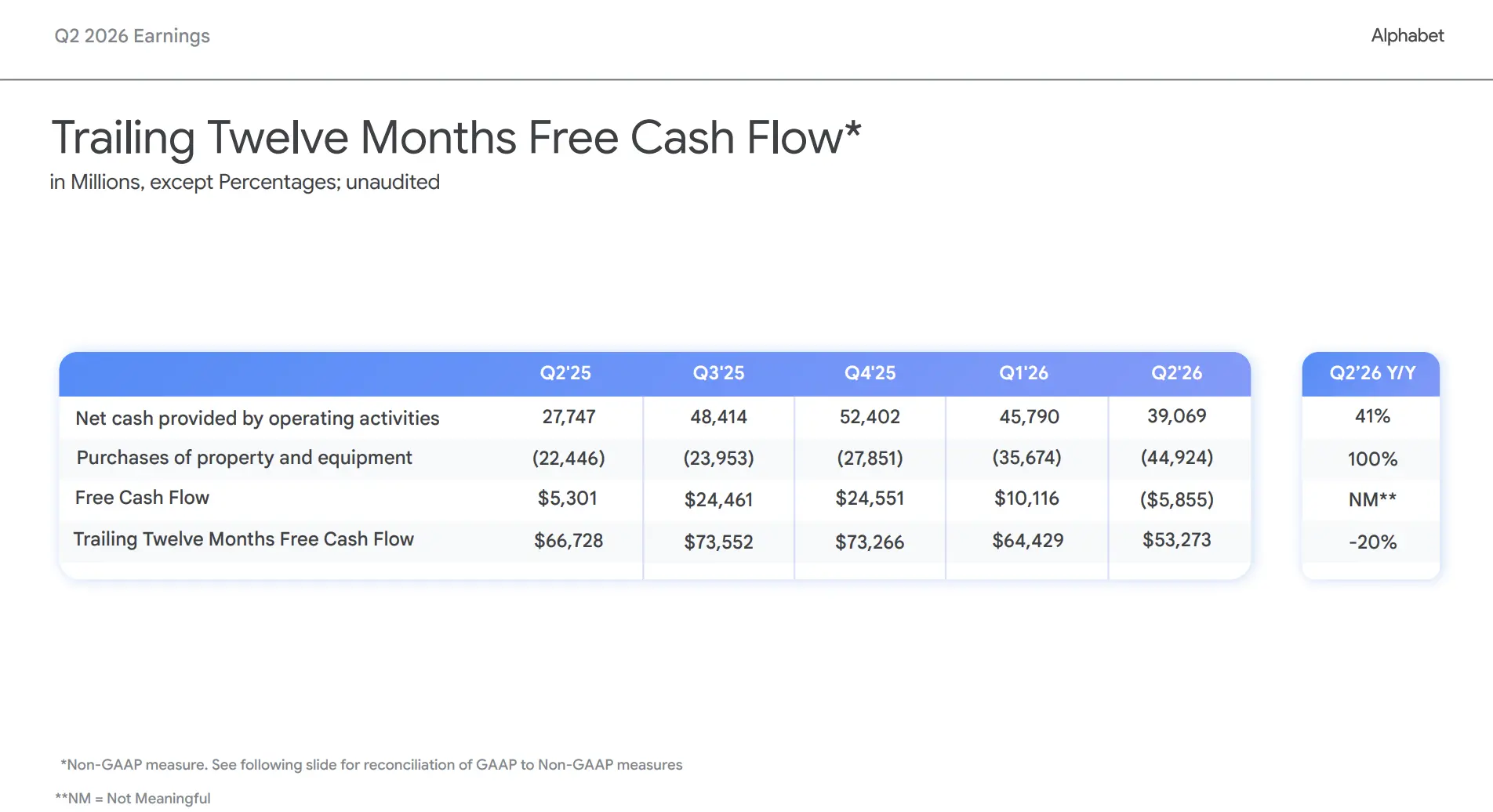
Due to the substantial increase in capital expenditures, free cash flow for the quarter turned negative at -$5.855 billion, but free cash flow over the past 12 months remained at $53.273 billion. Meanwhile, the combined capital expenditures of the four hyperscale cloud providers (Google, Meta, Microsoft, Amazon) in 2026 are projected to exceed $725 billion, with the entire technology industry's free cash flow having fallen to a decade-low level.
Overall, this earnings report presents a distinct 'dual nature': the explosive growth of the cloud business and the backlog exceeding $500 billion confirm that AI investments are beginning to yield commercial returns; however, the first-ever negative free cash flow and the second upward revision of capital expenditure guidance this year have kept the market highly vigilant regarding the sustainability of this AI arms race. Whether Google can continue to walk the tightrope between competing for AI leadership and maintaining financial health will be the core proposition most closely watched by investors over the coming quarters.


Crypto di tendenza

Domande pertinenti

QAccording to the article, what are the two major financial highlights of Alphabet's Q2 performance that have caused market concern?

AThe two major highlights causing concern are: 1) Alphabet's quarterly free cash flow turned negative for the first time since going public, at approximately -$5.9 billion. 2) The company raised its full-year 2026 capital expenditure guidance for the second time this year, now to a range of $195 billion to $205 billion.

QHow did Google Cloud perform in Q2, and what milestone did its backlog reach?

AGoogle Cloud revenue in Q2 reached $24.768 billion, surging 82% year-over-year and exceeding market expectations. Its contract backlog grew to $514 billion, surpassing the $500 billion milestone for the first time.

QWhat reasons did Alphabet's CFO Anat Ashkenazi give for the pressure on free cash flow and how does the company plan to support its expenditures?

AAnat Ashkenazi stated that the pressure on free cash flow is driven by investments in technical infrastructure to seize AI opportunities. The company plans to support these expenditures through a combination of operating cash flow, debt, and equity financing, while committing not to issue additional shares beyond announced plans and to maintain a strong balance sheet.

QWhat significant financing activities did Alphabet undertake in Q2 to support its AI infrastructure investments?

AIn Q2, Alphabet completed equity offerings (Class A, Class C, and mandatory convertible preferred shares) raising net proceeds of $49.6 billion. It also issued $20.3 billion in senior unsecured bonds and established an At-The-Market (ATM) equity offering program for up to $40 billion. These moves brought its recent cumulative debt raising close to $100 billion.

QAccording to CEO Sundar Pichai, what is the current focus of Alphabet's AI model roadmap and what user metrics did he share for the Gemini models?

ACEO Sundar Pichai indicated the roadmap focus has shifted to the next-generation flagship model, Gemini 4, described as a 'larger-scale next-generation frontier model.' He shared that Gemini models are processing 22 billion API tokens per minute and that the Gemini App has reached 950 million monthly active users.

Letture associate

The Verdict in Choi Tae-won's Divorce Case: Revealing the Inheritance Undercurrent Behind SK Hynix's Trillion-Won Empire

SK Group Chairman Chey Tae-won's high-profile divorce case, involving a record 1.38 trillion won settlement, has drawn attention to the succession plans for Korea's second-largest conglomerate, especially its crown jewel, SK hynix. Unlike traditional chaebol scripts centered on the eldest son, Chey's three children from his marriage to former President Roh Tae-woo's daughter, Roh Soh-yeong, are carving distinct, non-traditional paths. Eldest daughter Chey Yun-jung (b. 1989) is seen as the most evident successor. With a scientific and consulting background, she holds executive roles at SK bioscience and SK Inc.'s growth support department, focusing on future strategy and biopharma. Her marriage is to an AI infrastructure entrepreneur, not a traditional business alliance. Second daughter Chey Min-jung (b. 1991) took a unique route, voluntarily serving as a South Korean naval officer, including an anti-piracy deployment. She later worked on policy and strategy for SK hynix in Washington D.C. before co-founding an AI-driven healthcare startup. She married a former U.S. Marine Corps officer, connecting her to U.S. defense and policy circles—networks crucial for a global semiconductor giant. The only son, Chey In-geun (b. 1995), who studied physics like his father, worked briefly at SK E&S before joining McKinsey. Despite fitting the traditional "heir" profile as the eldest son, he remains silent and holds no public position or shares in SK, suggesting the old succession playbook is obsolete. As SK hynix's valuation soars, becoming a geopolitical asset in the AI era, the heirs' legitimacy is no longer automatic. They must prove themselves in fields like AI biotech, global policy, and strategic consulting. Their marriages also reflect new elite networks in tech and defense, not old political alliances. Their inheritance is the complex challenge of navigating a globalized, tech-driven world, not just a corporate throne.

marsbit12 h fa

The Verdict in Choi Tae-won's Divorce Case: Revealing the Inheritance Undercurrent Behind SK Hynix's Trillion-Won Empire

marsbit12 h fa

From OpenSea to OpenRouter: Is Alex Atallah Repeating His 'Exit at the Peak' Playbook?

From OpenSea to OpenRouter: Is Alex Atallah Repeating His "Exit at the Peak" Playbook? According to the Wall Street Journal, payments giant Stripe is in talks to acquire the AI model aggregation platform OpenRouter in a potential deal valuing the company near $100 billion. This would mark founder Alex Atallah's second creation of a company reaching a $100 billion valuation, following his co-founding of NFT marketplace OpenSea. OpenRouter, founded just over three years ago, has grown rapidly by acting as a unified gateway for developers to access over 400 AI models. It currently has about 10 million users and processes over 200 trillion tokens monthly. While the platform's annualized revenue is around $50 million, its valuation has skyrocketed from $1.3 billion in March 2026. The potential acquisition by Stripe, a company OpenRouter's founder once likened it to, represents a major expansion into AI infrastructure for the payments leader. This move echoes Atallah's previous timing with OpenSea, where he departed before the NFT market's significant downturn. For OpenRouter, selling now may be strategic. Despite its scale, its business model—charging a 5-5.5% fee on AI inference calls—faces pressure from competition, open-source models, and potential price wars among model providers, limiting its profitability narrative for an IPO. A key asset for potential acquirers like Stripe is OpenRouter's vast repository of real-world AI usage data, which offers unique insights into model performance and developer preferences that are difficult to replicate. Whether this potential deal signifies a new valuation benchmark for AI infrastructure or another market peak signal remains to be seen.

链捕手12 h fa

From OpenSea to OpenRouter: Is Alex Atallah Repeating His 'Exit at the Peak' Playbook?

链捕手12 h fa

Trading

Spot

Articoli Popolari

Cosa è $S$

Comprendere SPERO: Una Panoramica Completa Introduzione a SPERO Mentre il panorama dell'innovazione continua a evolversi, l'emergere delle tecnologie web3 e dei progetti di criptovaluta gioca un ruolo fondamentale nel plasmare il futuro digitale. Un progetto che ha attirato l'attenzione in questo campo dinamico è SPERO, denotato come SPERO,$$s$. Questo articolo mira a raccogliere e presentare informazioni dettagliate su SPERO, per aiutare gli appassionati e gli investitori a comprendere le sue basi, obiettivi e innovazioni nei domini web3 e crypto. Che cos'è SPERO,$$s$? SPERO,$$s$ è un progetto unico all'interno dello spazio crypto che cerca di sfruttare i principi della decentralizzazione e della tecnologia blockchain per creare un ecosistema che promuove l'impegno, l'utilità e l'inclusione finanziaria. Il progetto è progettato per facilitare interazioni peer-to-peer in modi nuovi, fornendo agli utenti soluzioni e servizi finanziari innovativi. Al suo interno, SPERO,$$s$ mira a responsabilizzare gli individui fornendo strumenti e piattaforme che migliorano l'esperienza dell'utente nello spazio delle criptovalute. Questo include la possibilità di metodi di transazione più flessibili, la promozione di iniziative guidate dalla comunità e la creazione di percorsi per opportunità finanziarie attraverso applicazioni decentralizzate (dApps). La visione sottostante di SPERO,$$s$ ruota attorno all'inclusività, cercando di colmare le lacune all'interno della finanza tradizionale mentre sfrutta i vantaggi della tecnologia blockchain. Chi è il Creatore di SPERO,$$s$? L'identità del creatore di SPERO,$$s$ rimane piuttosto oscura, poiché ci sono risorse pubblicamente disponibili limitate che forniscono informazioni dettagliate sul suo fondatore o fondatori. Questa mancanza di trasparenza può derivare dall'impegno del progetto per la decentralizzazione—un ethos che molti progetti web3 condividono, dando priorità ai contributi collettivi rispetto al riconoscimento individuale. Centrando le discussioni attorno alla comunità e ai suoi obiettivi collettivi, SPERO,$$s$ incarna l'essenza dell'empowerment senza mettere in evidenza individui specifici. Pertanto, comprendere l'etica e la missione di SPERO rimane più importante che identificare un creatore singolo. Chi sono gli Investitori di SPERO,$$s$? SPERO,$$s$ è supportato da una varietà di investitori che vanno dai capitalisti di rischio agli investitori angelici dedicati a promuovere l'innovazione nel settore crypto. Il focus di questi investitori generalmente si allinea con la missione di SPERO—dando priorità a progetti che promettono avanzamenti tecnologici sociali, inclusività finanziaria e governance decentralizzata. Queste fondazioni di investitori sono tipicamente interessate a progetti che non solo offrono prodotti innovativi, ma contribuiscono anche positivamente alla comunità blockchain e ai suoi ecosistemi. Il supporto di questi investitori rafforza SPERO,$$s$ come un concorrente degno di nota nel dominio in rapida evoluzione dei progetti crypto. Come Funziona SPERO,$$s$? SPERO,$$s$ impiega un framework multifunzionale che lo distingue dai progetti di criptovaluta convenzionali. Ecco alcune delle caratteristiche chiave che sottolineano la sua unicità e innovazione: Governance Decentralizzata: SPERO,$$s$ integra modelli di governance decentralizzati, responsabilizzando gli utenti a partecipare attivamente ai processi decisionali riguardanti il futuro del progetto. Questo approccio favorisce un senso di proprietà e responsabilità tra i membri della comunità. Utilità del Token: SPERO,$$s$ utilizza il proprio token di criptovaluta, progettato per servire varie funzioni all'interno dell'ecosistema. Questi token abilitano transazioni, premi e la facilitazione dei servizi offerti sulla piattaforma, migliorando l'impegno e l'utilità complessivi. Architettura Stratificata: L'architettura tecnica di SPERO,$$s$ supporta la modularità e la scalabilità, consentendo un'integrazione fluida di funzionalità e applicazioni aggiuntive man mano che il progetto evolve. Questa adattabilità è fondamentale per mantenere la rilevanza nel panorama crypto in continua evoluzione. Coinvolgimento della Comunità: Il progetto enfatizza iniziative guidate dalla comunità, impiegando meccanismi che incentivano la collaborazione e il feedback. Nutrendo una comunità forte, SPERO,$$s$ può affrontare meglio le esigenze degli utenti e adattarsi alle tendenze di mercato. Focus sull'Inclusione: Offrendo basse commissioni di transazione e interfacce user-friendly, SPERO,$$s$ mira ad attrarre una base utenti diversificata, inclusi individui che potrebbero non aver precedentemente interagito nello spazio crypto. Questo impegno per l'inclusione si allinea con la sua missione generale di empowerment attraverso l'accessibilità. Cronologia di SPERO,$$s$ Comprendere la storia di un progetto fornisce preziose intuizioni sulla sua traiettoria di sviluppo e sui traguardi. Di seguito è riportata una cronologia suggerita che mappa eventi significativi nell'evoluzione di SPERO,$$s$: Fase di Concettualizzazione e Ideazione: Le idee iniziali che formano la base di SPERO,$$s$ sono state concepite, allineandosi strettamente con i principi di decentralizzazione e focus sulla comunità all'interno dell'industria blockchain. Lancio del Whitepaper del Progetto: Dopo la fase concettuale, è stato rilasciato un whitepaper completo che dettaglia la visione, gli obiettivi e l'infrastruttura tecnologica di SPERO,$$s$ per suscitare interesse e feedback dalla comunità. Costruzione della Comunità e Prime Interazioni: Sono stati effettuati sforzi attivi di outreach per costruire una comunità di early adopters e potenziali investitori, facilitando discussioni attorno agli obiettivi del progetto e ottenendo supporto. Evento di Generazione del Token: SPERO,$$s$ ha condotto un evento di generazione del token (TGE) per distribuire i propri token nativi ai primi sostenitori e stabilire una liquidità iniziale all'interno dell'ecosistema. Lancio della Prima dApp: La prima applicazione decentralizzata (dApp) associata a SPERO,$$s$ è stata attivata, consentendo agli utenti di interagire con le funzionalità principali della piattaforma. Sviluppo Continuo e Partnership: Aggiornamenti e miglioramenti continui alle offerte del progetto, inclusi partnership strategiche con altri attori nello spazio blockchain, hanno plasmato SPERO,$$s$ in un concorrente competitivo e in evoluzione nel mercato crypto. Conclusione SPERO,$$s$ rappresenta una testimonianza del potenziale del web3 e delle criptovalute di rivoluzionare i sistemi finanziari e responsabilizzare gli individui. Con un impegno per la governance decentralizzata, il coinvolgimento della comunità e funzionalità progettate in modo innovativo, apre la strada verso un panorama finanziario più inclusivo. Come per qualsiasi investimento nello spazio crypto in rapida evoluzione, si incoraggiano potenziali investitori e utenti a ricercare approfonditamente e a impegnarsi in modo riflessivo con gli sviluppi in corso all'interno di SPERO,$$s$. Il progetto mostra lo spirito innovativo dell'industria crypto, invitando a ulteriori esplorazioni delle sue innumerevoli possibilità. Mentre il percorso di SPERO,$$s$ è ancora in fase di sviluppo, i suoi principi fondamentali potrebbero effettivamente influenzare il futuro di come interagiamo con la tecnologia, la finanza e tra di noi in ecosistemi digitali interconnessi.

132 Totale visualizzazioniPubblicato il 2024.12.17Aggiornato il 2024.12.17

Cosa è $S$

Cosa è AGENT S

Agent S: Il Futuro dell'Interazione Autonoma in Web3 Introduzione Nel panorama in continua evoluzione di Web3 e criptovalute, le innovazioni stanno costantemente ridefinendo il modo in cui gli individui interagiscono con le piattaforme digitali. Uno di questi progetti pionieristici, Agent S, promette di rivoluzionare l'interazione uomo-computer attraverso il suo framework agentico aperto. Aprendo la strada a interazioni autonome, Agent S mira a semplificare compiti complessi, offrendo applicazioni trasformative nell'intelligenza artificiale (AI). Questa esplorazione dettagliata approfondirà le complessità del progetto, le sue caratteristiche uniche e le implicazioni per il dominio delle criptovalute. Cos'è Agent S? Agent S si presenta come un innovativo framework agentico aperto, progettato specificamente per affrontare tre sfide fondamentali nell'automazione dei compiti informatici: Acquisizione di Conoscenze Specifiche del Dominio: Il framework apprende in modo intelligente da varie fonti di conoscenza esterne ed esperienze interne. Questo approccio duale gli consente di costruire un ricco repository di conoscenze specifiche del dominio, migliorando le sue prestazioni nell'esecuzione dei compiti. Pianificazione su Lungo Orizzonte di Compiti: Agent S impiega una pianificazione gerarchica potenziata dall'esperienza, un approccio strategico che facilita la suddivisione e l'esecuzione efficiente di compiti complessi. Questa caratteristica migliora significativamente la sua capacità di gestire più sottocompiti in modo efficiente ed efficace. Gestione di Interfacce Dinamiche e Non Uniformi: Il progetto introduce l'Interfaccia Agente-Computer (ACI), una soluzione innovativa che migliora l'interazione tra agenti e utenti. Utilizzando Modelli Linguistici Multimodali di Grandi Dimensioni (MLLM), Agent S può navigare e manipolare senza sforzo diverse interfacce grafiche utente. Attraverso queste caratteristiche pionieristiche, Agent S fornisce un framework robusto che affronta le complessità coinvolte nell'automazione dell'interazione umana con le macchine, preparando il terreno per innumerevoli applicazioni nell'AI e oltre. Chi è il Creatore di Agent S? Sebbene il concetto di Agent S sia fondamentalmente innovativo, informazioni specifiche sul suo creatore rimangono elusive. Il creatore è attualmente sconosciuto, il che evidenzia sia la fase embrionale del progetto sia la scelta strategica di mantenere i membri fondatori sotto anonimato. Indipendentemente dall'anonimato, l'attenzione rimane sulle capacità e sul potenziale del framework. Chi sono gli Investitori di Agent S? Poiché Agent S è relativamente nuovo nell'ecosistema crittografico, informazioni dettagliate riguardanti i suoi investitori e sostenitori finanziari non sono documentate esplicitamente. La mancanza di approfondimenti pubblicamente disponibili sulle fondazioni di investimento o sulle organizzazioni che supportano il progetto solleva interrogativi sulla sua struttura di finanziamento e sulla roadmap di sviluppo. Comprendere il supporto è cruciale per valutare la sostenibilità del progetto e il suo potenziale impatto sul mercato. Come Funziona Agent S? Al centro di Agent S si trova una tecnologia all'avanguardia che gli consente di funzionare efficacemente in contesti diversi. Il suo modello operativo è costruito attorno a diverse caratteristiche chiave: Interazione Uomo-Computer Simile a Quella Umana: Il framework offre una pianificazione AI avanzata, cercando di rendere le interazioni con i computer più intuitive. Mimando il comportamento umano nell'esecuzione dei compiti, promette di elevare le esperienze degli utenti. Memoria Narrativa: Utilizzata per sfruttare esperienze di alto livello, Agent S utilizza la memoria narrativa per tenere traccia delle storie dei compiti, migliorando così i suoi processi decisionali. Memoria Episodica: Questa caratteristica fornisce agli utenti una guida passo-passo, consentendo al framework di offrire supporto contestuale mentre i compiti si sviluppano. Supporto per OpenACI: Con la capacità di funzionare localmente, Agent S consente agli utenti di mantenere il controllo sulle proprie interazioni e flussi di lavoro, allineandosi con l'etica decentralizzata di Web3. Facile Integrazione con API Esterne: La sua versatilità e compatibilità con varie piattaforme AI garantiscono che Agent S possa adattarsi senza problemi agli ecosistemi tecnologici esistenti, rendendolo una scelta attraente per sviluppatori e organizzazioni. Queste funzionalità contribuiscono collettivamente alla posizione unica di Agent S all'interno dello spazio crittografico, poiché automatizza compiti complessi e multi-fase con un intervento umano minimo. Man mano che il progetto evolve, le sue potenziali applicazioni in Web3 potrebbero ridefinire il modo in cui si svolgono le interazioni digitali. Cronologia di Agent S Lo sviluppo e le tappe di Agent S possono essere riassunti in una cronologia che evidenzia i suoi eventi significativi: 27 Settembre 2024: Il concetto di Agent S è stato lanciato in un documento di ricerca completo intitolato “Un Framework Agentico Aperto che Usa i Computer Come un Umano”, mostrando le basi per il progetto. 10 Ottobre 2024: Il documento di ricerca è stato reso pubblicamente disponibile su arXiv, offrendo un'esplorazione approfondita del framework e della sua valutazione delle prestazioni basata sul benchmark OSWorld. 12 Ottobre 2024: È stata rilasciata una presentazione video, fornendo un'idea visiva delle capacità e delle caratteristiche di Agent S, coinvolgendo ulteriormente potenziali utenti e investitori. Questi indicatori nella cronologia non solo illustrano i progressi di Agent S, ma indicano anche il suo impegno per la trasparenza e il coinvolgimento della comunità. Punti Chiave su Agent S Man mano che il framework Agent S continua a evolversi, diversi attributi chiave si distinguono, sottolineando la sua natura innovativa e il potenziale: Framework Innovativo: Progettato per fornire un uso intuitivo dei computer simile all'interazione umana, Agent S porta un approccio nuovo all'automazione dei compiti. Interazione Autonoma: La capacità di interagire autonomamente con i computer attraverso GUI segna un passo avanti verso soluzioni informatiche più intelligenti ed efficienti. Automazione di Compiti Complessi: Con la sua metodologia robusta, può automatizzare compiti complessi e multi-fase, rendendo i processi più veloci e meno soggetti a errori. Miglioramento Continuo: I meccanismi di apprendimento consentono ad Agent S di migliorare dalle esperienze passate, migliorando continuamente le sue prestazioni e la sua efficacia. Versatilità: La sua adattabilità attraverso diversi ambienti operativi come OSWorld e WindowsAgentArena garantisce che possa servire un'ampia gamma di applicazioni. Man mano che Agent S si posiziona nel panorama di Web3 e delle criptovalute, il suo potenziale per migliorare le capacità di interazione e automatizzare i processi segna un significativo avanzamento nelle tecnologie AI. Attraverso il suo framework innovativo, Agent S esemplifica il futuro delle interazioni digitali, promettendo un'esperienza più fluida ed efficiente per gli utenti in vari settori. Conclusione Agent S rappresenta un audace passo avanti nell'unione tra AI e Web3, con la capacità di ridefinire il modo in cui interagiamo con la tecnologia. Sebbene sia ancora nelle sue fasi iniziali, le possibilità per la sua applicazione sono vaste e coinvolgenti. Attraverso il suo framework completo che affronta sfide critiche, Agent S mira a portare le interazioni autonome al centro dell'esperienza digitale. Man mano che ci addentriamo nei regni delle criptovalute e della decentralizzazione, progetti come Agent S giocheranno senza dubbio un ruolo cruciale nel plasmare il futuro della tecnologia e della collaborazione uomo-computer.

586 Totale visualizzazioniPubblicato il 2025.01.14Aggiornato il 2025.01.14

Cosa è AGENT S

Come comprare S

Benvenuto in HTX.com! Abbiamo reso l'acquisto di Sonic (S) semplice e conveniente. Segui la nostra guida passo passo per intraprendere il tuo viaggio nel mondo delle criptovalute.Step 1: Crea il tuo Account HTXUsa la tua email o numero di telefono per registrarti il tuo account gratuito su HTX. Vivi un'esperienza facile e sblocca tutte le funzionalità,Crea il mio accountStep 2: Vai in Acquista crypto e seleziona il tuo metodo di pagamentoCarta di credito/debito: utilizza la tua Visa o Mastercard per acquistare immediatamente SonicS.Bilancio: Usa i fondi dal bilancio del tuo account HTX per fare trading senza problemi.Terze parti: abbiamo aggiunto metodi di pagamento molto utilizzati come Google Pay e Apple Pay per maggiore comodità.P2P: Fai trading direttamente con altri utenti HTX.Over-the-Counter (OTC): Offriamo servizi su misura e tassi di cambio competitivi per i trader.Step 3: Conserva Sonic (S)Dopo aver acquistato Sonic (S), conserva nel tuo account HTX. In alternativa, puoi inviare tramite trasferimento blockchain o scambiare per altre criptovalute.Step 4: Scambia Sonic (S)Scambia facilmente Sonic (S) nel mercato spot di HTX. Accedi al tuo account, seleziona la tua coppia di trading, esegui le tue operazioni e monitora in tempo reale. Offriamo un'esperienza user-friendly sia per chi ha appena iniziato che per i trader più esperti.

1.2k Totale visualizzazioniPubblicato il 2025.01.15Aggiornato il 2026.06.02

Come comprare S

Discussioni

Benvenuto nella Community HTX. Qui puoi rimanere informato sugli ultimi sviluppi della piattaforma e accedere ad approfondimenti esperti sul mercato. Le opinioni degli utenti sul prezzo di S S sono presentate come di seguito.

活动图片