Both Suffer Losses Exceeding $9 Billion, Which Is More at Risk: Strategy or Bitmine?

Odaily星球日报Pubblicato 2026-06-04Pubblicato ultima volta 2026-06-04

Introduzione

As Bitcoin and Ethereum prices drop significantly, two major corporate treasury holders, Strategy and Bitmine, are facing massive unrealized losses—approximately $100 billion and $90 billion, respectively. The article compares their financial health and underlying risks. Bitmine, holding over 5.4 million ETH, relies primarily on equity financing (like ATM offerings) and has substantial cash reserves, alongside staking income from its ETH holdings. It plans a $300 million perpetual preferred stock offering. In contrast, Strategy, holding Bitcoin, is burdened by significant convertible debt and preferred stock dividends, with cash reserves covering only about six months of its annual dividend obligations. Strategy's leverage is higher, and it faces potential liquidity pressure if BTC prices fall further, possibly forcing asset sales. While both companies are under pressure, Bitmine’s financial structure appears more resilient, whereas Strategy’s high leverage makes it more vulnerable to continued market declines.

Original|Odaily Planet Daily(@OdailyChina)

Author|Wenser(@wenser2010)

Amid the ongoing market decline, Strategy and Bitmine, the "Twin Titans of DAT Treasuries," have both incurred massive floating losses.

This morning, BTC briefly fell below $62,000, currently hovering around $63,800; ETH dropped below $1,800, currently around $1,780. At current prices, Strategy's floating loss has reached a staggering $10 billion; Bitmine's floating loss is also around $9 billion. For now, Michael Saylor and Tom Lee are "fellow sufferers in the same predicament," with Strategy and Bitmine ranking as the top two "DAT companies with the largest losses."

However, compared to Strategy, which requires continuous dividend payments, Bitmine faces less financial pressure and retains flexibility such as raising funds through STRC preferred shares. It is reported that Bitmine plans to raise $300 million by issuing perpetual preferred shares with an annual dividend yield of 9.5%. It seems Bitmine's pace of acquiring ETH continues; meanwhile, the Sword of Damocles hanging over Strategy becomes: Where will the funds for subsequent STRC dividend payments come from? Between the two, who faces greater financial pressure? Odaily Planet Daily will analyze for readers.

Bitmine VS Strategy: The Divergent Paths of DAT Holdings

Following today's BTC plunge, community members used AI to mock Saylor's "promotion" of BTC: "A man in his sixties personally promotes, ancestral BTC price drops to $62,000 per coin."

Returning to Bitmine and Strategy, currently, Bitmine's financial structure appears safer; whereas Strategy's leverage pressure is greater.

Bitmine's Equity Issuance Game: The Debt-Free DAT Financing Play

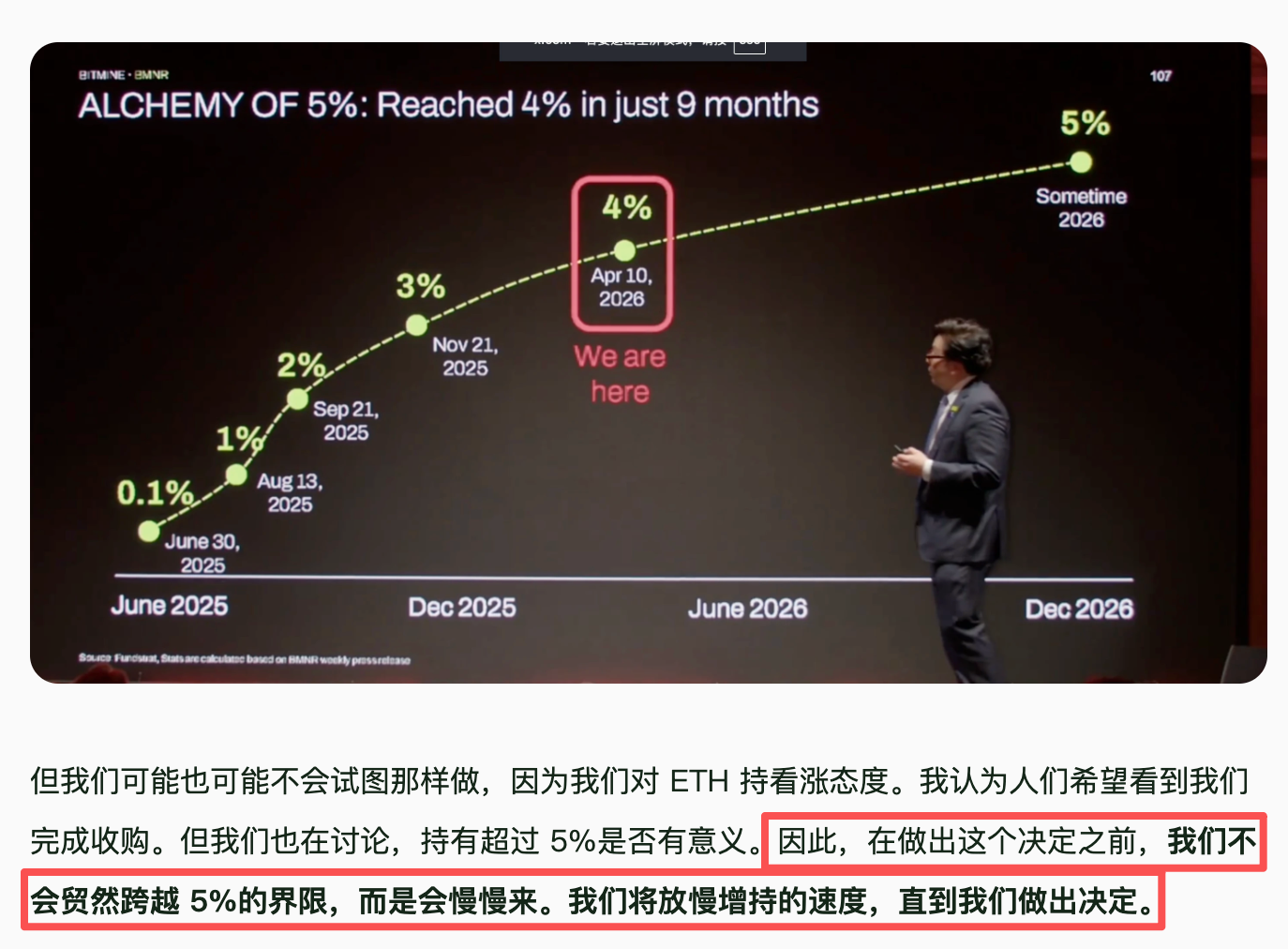
As of June 1, Bitmine holds 5,416,901 ETH; accounting for approximately 4.49% of ETH's total supply, nearing the '5% cap' repeatedly emphasized by Bitmine Chairman Tom Lee. Yesterday, Bitmine once again acquired 25,000 ETH via BitGo, valued at $48 million at the time. Currently, its holdings stand at 5,441,901 ETH.

The reason Bitmine has the confidence to continue accumulating during a market downturn is multifaceted. The primary reason is that Bitmine's funding source is equity issuance:

  • When initiating its ETH treasury and establishing the DAT company in June last year, Bitmine obtained initial seed capital through financing — $250 million, along with a small PIPE financing.
  • After July last year, Bitmine primarily relied on ATM equity issuance, gradually increasing this figure from $2 billion to $24.5 billion.

Sufficient funds give Tom Lee ample confidence, and Bitmine's book cash supports further acquisitions — in its June 1 public announcement, Bitmine also mentioned: The company's stake in Beast Industries is valued at $180 million; its stake in Eightco Holdings is valued at $93 million. The company's total cash amounts to $446 million.

Additionally, Tom Lee has previously boasted that Bitmine's Ethereum treasury generates daily staking rewards of $1 million. This refers to Bitmine staking approximately 87% (about 4.71 million ETH) of its ETH holdings through its MAVAN staking network, with estimated annualized returns of about 2.73%-3% (approximately $250-$300 million), which can also provide relatively stable cash flow.

In summary, Bitmine's financial condition is sound; and the latest preferred share financing with a 9.5% annualized dividend is expected to secure $300 million, further alleviating its financial pressure. For this company, the biggest risk points lie in equity dilution (issuing new shares) and further stock price declines due to book floating losses. If mNVA remains <1, it might trigger stock selling.

Strategy's Debt Leverage Game: Pressure from Convertible Bonds and Preferred Share Dividends

Compared to Bitmine's "using investors' money to buy ETH," Strategy faces greater financial pressure in acquiring BTC because it primarily "borrows money to increase BTC holdings."

According to information on Strategy's official website, currently, Strategy holds approximately $6.7 billion in convertible bond debt, plus about $9.9 billion in STRC preferred shares and market-value-varying amounts of STRD, STRK, STRF, requiring annual massive dividend and interest payments. At the end of May, after repurchasing $1.5 billion in convertible debt, Strategy's cash reserves fell to about $871 million, covering only about 6 months of its estimated $1.7 billion annual preferred dividend obligation.

Moreover, Strategy previously initiated a vote on "proposing to increase STRC dividend payments from monthly to twice monthly." The voting began on April 28 and will conclude on the meeting day of June 8. If approved, the first record date under the new schedule is June 30, and the first payment date is July 15. Eligible voting shareholders (holders of MSTR and STRC shares) must have held shares before April 17.
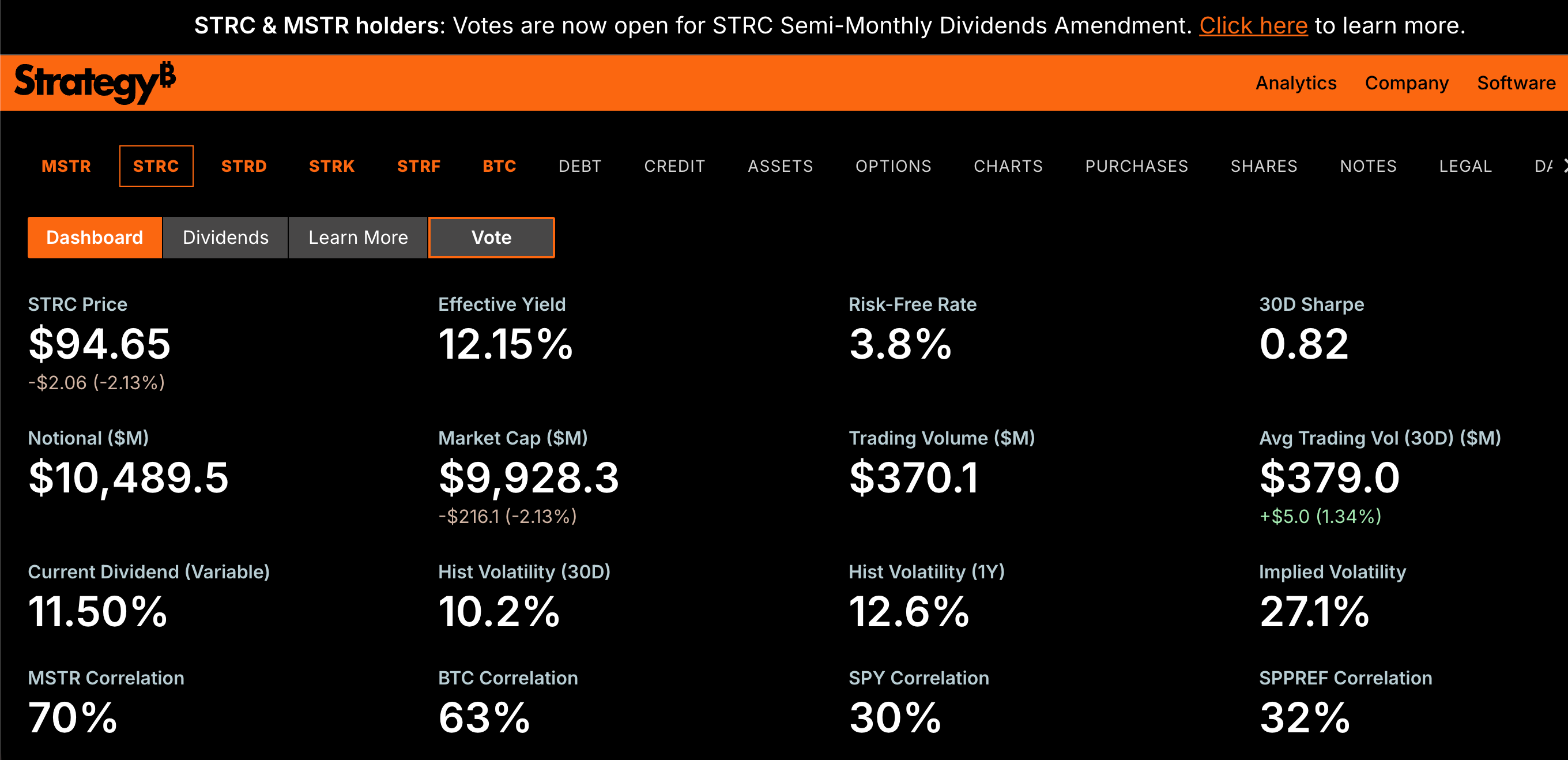
Also worth mentioning is that STRC's authorized issuance cap is approximately $28.3 billion. Possibly affected by BTC's continuous decline and shaken market confidence, STRC fell below $95 this morning, currently at $94.65, "de-pegging" over 5% from the $100 target price.

Compared to Bitmine, Strategy currently faces a significant gap between excessive preferred share financing amounts and dividend payments, exacerbated by BTC's continuous decline. Furthermore, unlike ETH which has a staking ecosystem for additional liquidity, BTC lacks such options.

Therefore, after Strategy sold 32 BTC last month, the market began to doubt the identity of "diamond-handed Strategy that only buys and never sells." Amid BTC's persistent decline, Strategy might face a series of liquidity crises, leading to an inability to repay debts and dividends, thereby selling more BTC and driving down prices. Essentially, Strategy is playing a "high-leverage bet that the BTC price won't fall below a certain level" debt leverage game.

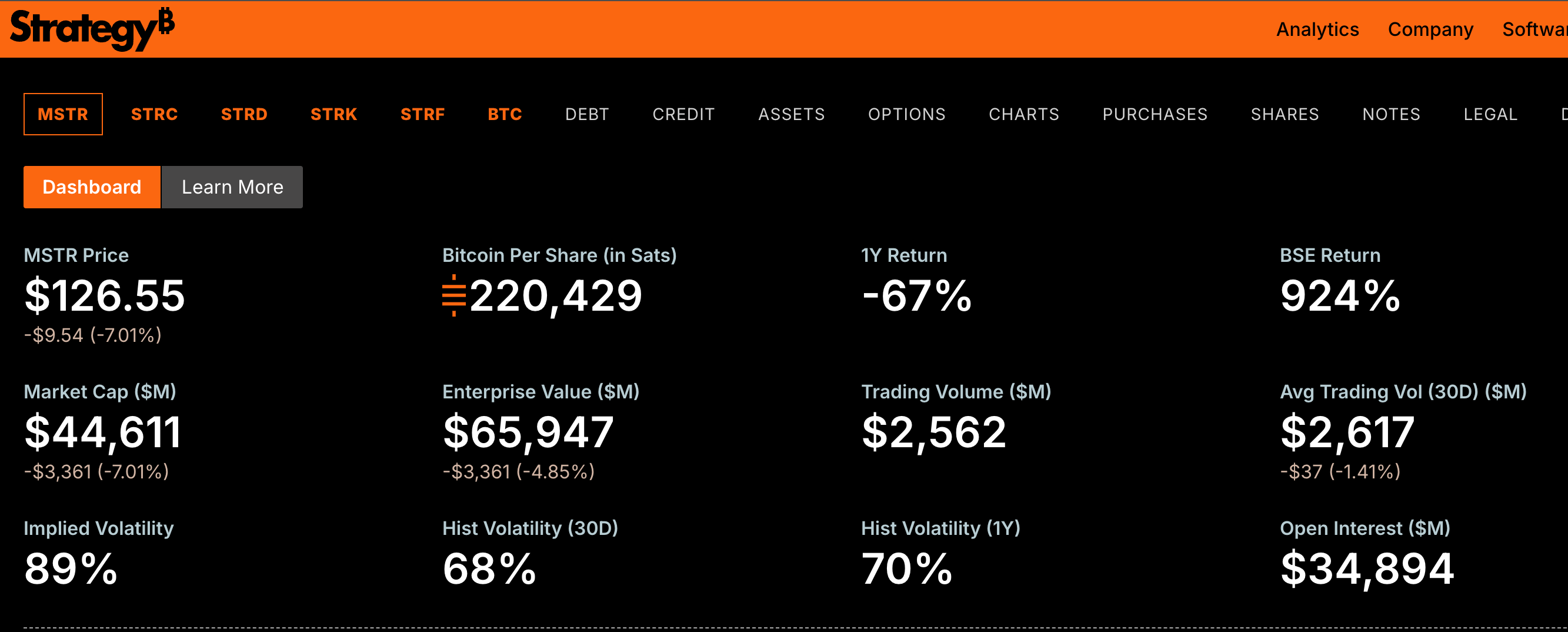
Thus, considering Strategy's current mNAV value of 0.83, the market remains highly skeptical of its future stock performance. Yesterday, its market capitalization already fell out of the top 200 US companies. Currently, Strategy (MSTR) stock is at $126, down 7% in 24 hours; market cap stands at $44.6 billion.
Of course, as a leader among DAT treasury companies, Bitmine Chairman Tom Lee remains quite optimistic about Strategy, previously stating: "Strategy selling Bitcoin and ETF outflows are typical bottoming behavior, not risk signals." At the recent "Proof of Talk 2026" conference at the Louvre in Paris, Tom Lee made bold claims: "With AI and tokenization driving major changes in financial infrastructure, ETH could ultimately reach $250,000." However, when discussing "Bitmine's actions after its ETH holdings reach 5% of the total supply," he also expressed caution about further ETH accumulation. (See "Tom Lee Recharges Faith: Crypto Spring Has Arrived, ETH Will Rise to $250,000")
Currently, Bitmine and Strategy find themselves in highly similar market situations, but Bitmine's financial condition is slightly better; Strategy faces the choice between "selling more BTC to obtain cash flow for dividend payments" and "sitting idle or continuing to borrow for acquisition as BTC keeps falling."


Domande pertinenti

QAccording to the article, what is the main difference in how Bitmine and Strategy finance their digital asset acquisitions?

ABitmine primarily funds its ETH acquisitions through equity issuance (ATM offerings and stock sales), which is a debt-free method. In contrast, Strategy primarily uses debt leverage, including convertible notes and preferred stock, to finance its BTC purchases, creating significant interest and dividend obligations.

QWhat specific financial pressure does Strategy face that the article highlights as its 'sword of Damocles'?

AStrategy faces significant pressure to cover its substantial annual dividend payments for its preferred stock (like STRC), estimated at $1.7 billion. With its cash reserves dwindling, the core question is where the funds for these ongoing dividend payments will come from.

QHow does Bitmine generate an additional income stream from its ETH holdings, as mentioned in the article?

ABitmine stakes approximately 87% of its ETH holdings (around 4.71 million ETH) through the MAVAN staking network. This generates daily staking rewards estimated at $1 million, providing a stable annualized cash flow of approximately $250-300 million.

QWhat are the key risk factors mentioned for Bitmine and Strategy's stock prices respectively?

AFor Bitmine, the main risk is equity dilution from issuing new shares and a declining stock price if its mNVA (market value to net asset value) falls below 1. For Strategy, the key risk is its high leverage and liquidity crisis if BTC prices fall further, potentially forcing asset sales and causing its mNAV to drop (currently 0.83), which could severely impact its stock price.

QWhat recent action by Strategy has caused market doubts about its 'diamond hands' reputation, and what potential consequence does the article suggest?

AStrategy recently sold 32 BTC. This action has led the market to doubt its long-held 'diamond hands' (never selling) policy. The article suggests that if BTC continues to fall, Strategy might face a liquidity crisis, forcing it to sell more BTC to meet its debt and dividend obligations, which could further depress the market.

Letture associate

SpaceX, OpenAI, Anthropic: The Three AI Giants Racing for IPO, Which One Is Worth Betting On?

SpaceX, OpenAI, and Anthropic are poised for historic IPOs within weeks, potentially raising a combined $180 billion—a sum exceeding the entire internet bubble's fundraising. The hosts of the Limitless Podcast argue this isn't just individual company financing but an unprecedented capital concentration for AI infrastructure, driven by an insatiable need for compute, data centers, power, and chips. SpaceX's IPO is notable for reportedly changing market index rules to allow faster inclusion, potentially funneling trillions in passive retirement funds into its stock, despite its unproven space-based data center business model. In contrast, Anthropic demonstrates explosive growth, with ARR reportedly hitting $45 billion and approaching profitability, fueled by strong enterprise adoption of products like Claude Code. Google's separate $80 billion raise highlights the immense capital pressure, even for giants. The discussion acknowledges bubble risks but leans optimistic. The hosts contend the massive spending is building essential physical infrastructure for the next technological era. A key bottleneck isn't capital but the real-world limits of chip manufacturing and construction speed. As long as demand for AI compute outstrips supply, this investment cycle represents a foundational build-out rather than a purely financial bubble. All three companies are seen as foundational bets on the future, with Anthropic often cited as the most immediately compelling due to its proven revenue trajectory.

marsbit11 min fa

SpaceX, OpenAI, Anthropic: The Three AI Giants Racing for IPO, Which One Is Worth Betting On?

marsbit11 min fa

From 'Old Guys' to 'New Favorites': How AI Is Revaluing Old Infrastructure from Dell to Nokia?

From "Vintage Tech" to "New AI Darlings": How AI Revalues Old Infrastructure One year ago, tech giants like Dell, Nokia, Cisco, and Western Data were seen as slow-growth, low-valuation stories, far from the AI spotlight dominated by players like Nvidia. Now, these legacy tech stocks are gaining market attention, sparking debate on whether this is genuine industry revaluation or a temporary narrative. As AI moves from model parameters to real-world data centers, the market is recognizing companies with proven delivery and infrastructure capabilities. This shift marks a change in the AI investment thesis: from pure model and GPU focus to the complex systems engineering required for deployment. Companies like Dell, HPE, and Corning are being revalued not for being "sexy" AI innovators, but for their decades of accumulated expertise in supply chains, enterprise delivery, and infrastructure—assets that have become critical in the AI buildout phase. The revaluation is unfolding across three key infrastructure lines: 1. **Servers & System Integration:** Dell and HPE are emerging as crucial system integrators or "general contractors" for AI data centers, translating GPU orders into complete, deployable server racks integrated with power, cooling, and networking. 2. **Networking & Connectivity:** AI's scale demands robust high-speed connections. Corning (fiber optics), Nokia (AI-RAN, 6G), and Cisco (data center switches) are gaining importance for enabling efficient data transfer within and between AI clusters. 3. **Storage:** Beyond high-speed memory (HBM/DRAM), the AI data explosion is driving demand for high-capacity hard drives (HDDs) from companies like Western Digital and Seagate to handle training data, logs, and cold storage cost-effectively. For this revaluation to be substantive and not just a narrative, three criteria are key: 1) Concrete AI-related order and revenue growth (e.g., Dell's AI server sales), 2) Upward revisions to company financial guidance, and 3) Sustainable improvements in profit quality, not just top-line revenue spikes. In essence, AI's transition to a real construction phase is re-pricing "old assets" against "new demand." The opportunity, however, is selective. Only those legacy firms that are demonstrably integrated into the capital expenditure chains of data center and enterprise AI deployment are likely to experience a true "logic re-rating" rather than just a temporary valuation bounce.

marsbit17 min fa

From 'Old Guys' to 'New Favorites': How AI Is Revaluing Old Infrastructure from Dell to Nokia?

marsbit17 min fa

The Merger of Codex and ChatGPT Marks the Beginning of a Major Reshuffle in Programming Tools

OpenAI is shifting its strategic focus from ChatGPT to Codex, merging them along with the browser tool Atlas into a unified desktop super-app. This move signals an internal belief that Codex, originally a programming tool, represents the next evolution of AI more than conversational models like ChatGPT. Over the past year, Codex's weekly active users have surged past 5 million. The key distinction is that while ChatGPT answers questions, Codex executes tasks. Enterprises increasingly value this ability to get work done over simply receiving advice. Consequently, Codex is attracting professionals beyond developers, including analysts, bankers, marketers, and product managers. OpenAI's reorganization and increased investment in Codex stem from recognizing that the future of AI competition lies in execution capabilities, not just conversation. The company is launching role-specific plugins (e.g., for data analysis, sales, design) to transform Codex into a broad knowledge work platform that automates and redefines white-collar workflows. Beyond being a tool, Codex reflects OpenAI's ambition to redefine software. New features like "Sites"—which generates interactive websites from documents—and collaborative "Annotations" aim to create a paradigm where the AI understands the goal and handles the tools and steps, functioning more like a digital colleague than traditional software. The ultimate goal is a unified experience where the user cares only about the completed task.

marsbit26 min fa

The Merger of Codex and ChatGPT Marks the Beginning of a Major Reshuffle in Programming Tools

marsbit26 min fa

Interpreting Investment Opportunities in the Age of Great Navigation, Invesco Great Wall Fund Releases '2026 Report on Chinese Enterprises Going Global'

Invesco Great Wall Fund has released its "2026 China Corporate Globalization Report," titled "The 'Great Navigation Era' of Chinese Enterprises." The report analyzes the new trends and investment opportunities as Chinese companies expand globally, moving from simple product exports to comprehensive overseas operations involving services, branding, and local production. Driven by factors like trade friction, the pursuit of higher profit margins abroad, and policy support, globalization is becoming essential for Chinese companies. The report outlines an evolution: from early product export ("Globalization 1.0") to the current "Globalization 2.0," characterized by overseas capacity, capital goods investment, consumer brand expansion, and service exports. Chinese firms' competitive advantages are highlighted, including a vast engineer talent pool, low-cost and robust infrastructure, and complete industrial clusters. Specific sectors with significant出海 potential are identified: * **Capital Goods** (e.g., engineering machinery, power equipment): Benefiting from global demand, especially in Belt & Road markets and the AI-driven power grid upgrade cycle. * **Consumer Brands**: Transitioning from cost to brand advantage, leveraging供应链 efficiency. * **Technology & Innovation**: Including AI applications, optical modules within global tech supply chains, and new energy vehicles focusing on local production. * **Pharmaceuticals**: Chinese biotech firms are becoming preferred partners for global pharma, with potential for breakthrough drugs in areas like oncology and weight loss. The report concludes that corporate globalization represents a sustained, core theme for China's capital markets, though companies must navigate challenges like geopolitics and localization.

marsbit38 min fa

Interpreting Investment Opportunities in the Age of Great Navigation, Invesco Great Wall Fund Releases '2026 Report on Chinese Enterprises Going Global'

marsbit38 min fa

Trading

Spot
Futures
活动图片