
Trading Time: Bitcoin Remains Under Pressure, Gold Price Falls Below Key Moving Average, Market Focus on Tonight's CPI

marsbitPubblicato 2026-06-10Pubblicato ultima volta 2026-06-10

Introduzione

**Market Overview: Risk Assets Under Pressure Ahead of Key US CPI Data** Major risk assets faced selling pressure on Tuesday, with heightened geopolitical tensions and caution ahead of pivotal US inflation data weighing on sentiment. The Nasdaq fell 0.97%, led lower by a sharp sell-off in major tech stocks like Apple. Oil prices (WTI) plunged over 3% to around $88.50. **Key Assets in Focus:** * **Gold:** Spot gold tumbled to the $4,200 level, breaking below its 200-day moving average. Analysts cited ETF outflows and higher real yields, with support now eyed near $4,100. * **Bitcoin:** Continued its decline, with ETFs seeing net outflows. Analysts warn a break below $60,000 could trigger a move toward $50,000. * **Stocks:** Tech and semiconductor stocks were hit hard. Super Micro Computer sank on dilution fears, while a bearish research report triggered a crash in optical communication stocks like AAOI and Coherent. **Tonight's Macro Catalyst: US CPI** All eyes are on the US May CPI report. Headline inflation is forecast to rise to multi-year highs (~4.3%), driven by energy, while core CPI is expected to show moderation. **Asia-Pacific Markets Tumble** Asian markets followed US tech losses. South Korea's KOSPI index crashed 6.46%, briefly triggering a trading halt, and Japan's Nikkei 225 fell 2.49%. Semiconductor stocks like Samsung Electronics and SK Hynix led declines. **Crypto Market Notes:** Ethereum shows weakness with declining open interest. Two tokens, SAHAR...

Daily market key data review and trend analysis, produced by PANews.

Macro Markets
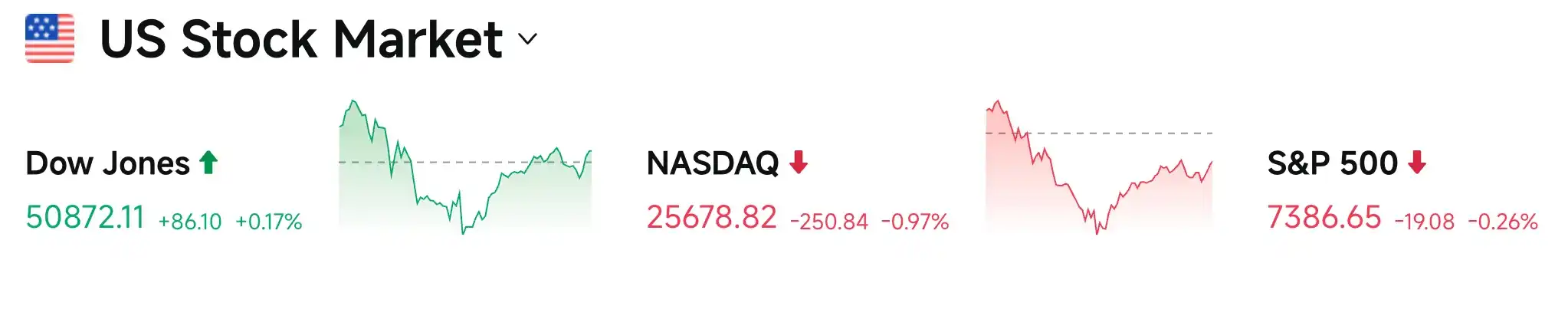
Tech stock selling caused sharp intraday volatility in US stocks on Tuesday, with the Nasdaq index at one point falling over 4%, closing down 0.97% below last Friday's low. The S&P 500 fell 0.26% to 7386.65 points, while the Dow Jones Industrial Average edged up 0.17% to 50872.11 points, supported by defensive sectors like consumer goods.

Geopolitical tensions escalated again. In response to the downing of a US military helicopter, US forces completed strikes on 20 targets within Iran. Iran subsequently retaliated against US bases in Jordan and Bahrain. Affected by this, the crude oil market saw intense volatility, with WTI crude oil briefly falling below $87, eventually closing sharply down over 3% near $88.50.

Gold prices were also impacted, with spot gold falling to the $4200 mark, hitting a nearly three-month low and already below the 200-day moving average. Analysts at Standard Chartered pointed out that as inflation rises and real yields climb, ETF funds are accelerating their outflow. The current ETP holdings structure is relatively fragile, potentially amplifying downward price pressure, with the next key technical support located near $4100. Notably, Citigroup analysts stated in a Monday report that if the Strait of Hormuz remains closed until late summer, gold prices could fall to $3500. Despite this, Ed Yardeni, founder of Yardeni Research, remains bullish, believing $4000 is a solid floor and sees potential up to $10,000.

US May inflation data will be released tonight at 8:30 PM. Wall Street institutions generally predict that, driven by surging energy prices, the May headline CPI year-on-year may rise to 4.2%~4.3%, hitting a nearly three-year high. However, the month-on-month core CPI is expected to be only 0.17%~0.22%, significantly below market consensus, with cooling in components like housing and auto insurance potentially being key to the slowdown in core inflation. The market is currently closely watching this data to gauge the policy stance of the new Federal Reserve Chairman, Kevin Warsh, at next week's interest rate meeting.

US Stock Dynamics
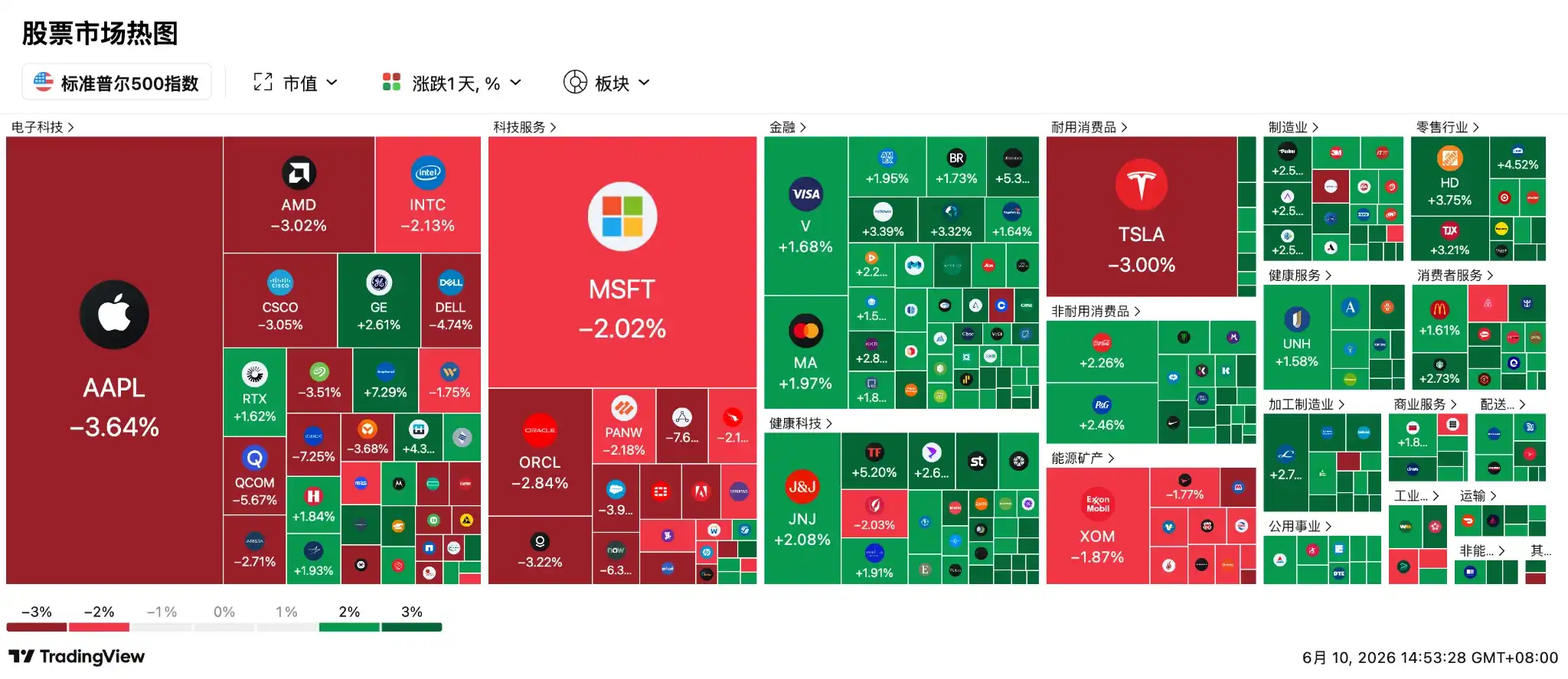
US stocks performed poorly after the AI frenzy subsided, with tech stocks experiencing heavy selling. The Philadelphia Semiconductor Index at one point plunged as much as 8.6%; ARM and Marvell Technology fell over 10% during the day; Micron Technology and Intel also fell up to 7% and 5% respectively. Apple, failing to deliver super-expected surprises at the WWDC conference, led the decline with its stock plummeting 3.64%. Super Micro Computer (SMCI) announced up to $7 billion in equity financing to purchase AI server components, with severe concerns about equity dilution causing its stock to crash over 10% in a single day, closing down 7.62%.

The optical communications sector experienced a "massacre" triggered by a research report. The prominent AI research firm SemiAnalysis released a report stating that NVIDIA's 800VDC power architecture and CPO (Co-Packaged Optics) large-scale production will be delayed until 2028. This expectation hammered the supply chain directly: Applied Optoelectronics (AAOI) plummeted 17% in a single day, Lumentum fell 8%, and chip giant COHERENT crashed 11.44%. Although NVIDIA Vice President Gilad Shainer strongly refuted this at the Computex exhibition, calling CPO "the most exciting technology today" and stating it would ramp up in the second half of the year, it failed to stop the spread of panic. The market began betting on NPO and traditional pluggable modules as transitional substitutes.

Meanwhile, Oracle is scheduled to release its earnings report after the US market close on Wednesday. The market generally expects revenue to reach $19.1 billion. TD Cowen and UBS have raised their price targets to $300 and $285 respectively, believing there is still room for acceleration in the cloud infrastructure business. Jefferies analyst Brent Thill stated that strong demand in the cloud infrastructure business will be a key factor driving the stock price. The options market indicates traders expect the company's stock price could swing up to 11% in a single week after the earnings release.

Cryptocurrency

Bitcoin continues to face pressure. Bitcoin ETFs saw a net outflow of $77.43 million yesterday, with total assets falling back to $775.8 billion, completely erasing the incremental funds since Trump's election victory.

The market remains cautious about the upcoming US CPI data. Analysts point out that if inflation remains high, it could further dampen the rationale for Bitcoin as a hedge tool. Bitwise research shows Bitcoin often reacts ahead of traditional markets, so its current trend may indicate a broader risk adjustment. Glassnode's MVRV model warns that once $60,000 is decisively lost, the deep value zone of $50,000 will become the next ruthless magnetic attraction point.

Ethereum is also weak. Options market data shows that ETH's open interest has fallen 25% since the May high, indicating weakening investor confidence in future price movements. Although institutions like Bitmine bought 75,000 ETH worth $122 million against the trend, analyst Ash Crypto warned that if it falls below $1500, Ethereum could head straight to $1000.

On-chain black swan events have intensified panic. Sahara AI saw its token halved by nearly 60% in a single day due to a rumor about a CCIP cross-chain bridge supplementing liquidity being misinterpreted as a sell-off. The Humanity project suffered a devastating blow, with hackers invading employee computers and wildly minting 1 billion H tokens. Currently, both H and SAHARA token prices have somewhat rebounded.

Today's Outlook:

  • Informed sources: SpaceX will determine the issuance price as early as June 11, with the stock listing on June 12.

  • Upbit 24-hour trading volume ranking: SAHARA, WLD, XRP, BTC, ETH.

  • Magic Eden (ME) will unlock approximately 172 million tokens worth about $10.4 million on June 11.

  • HOME (HOME) will unlock approximately 750 million tokens worth about $40.2 million.

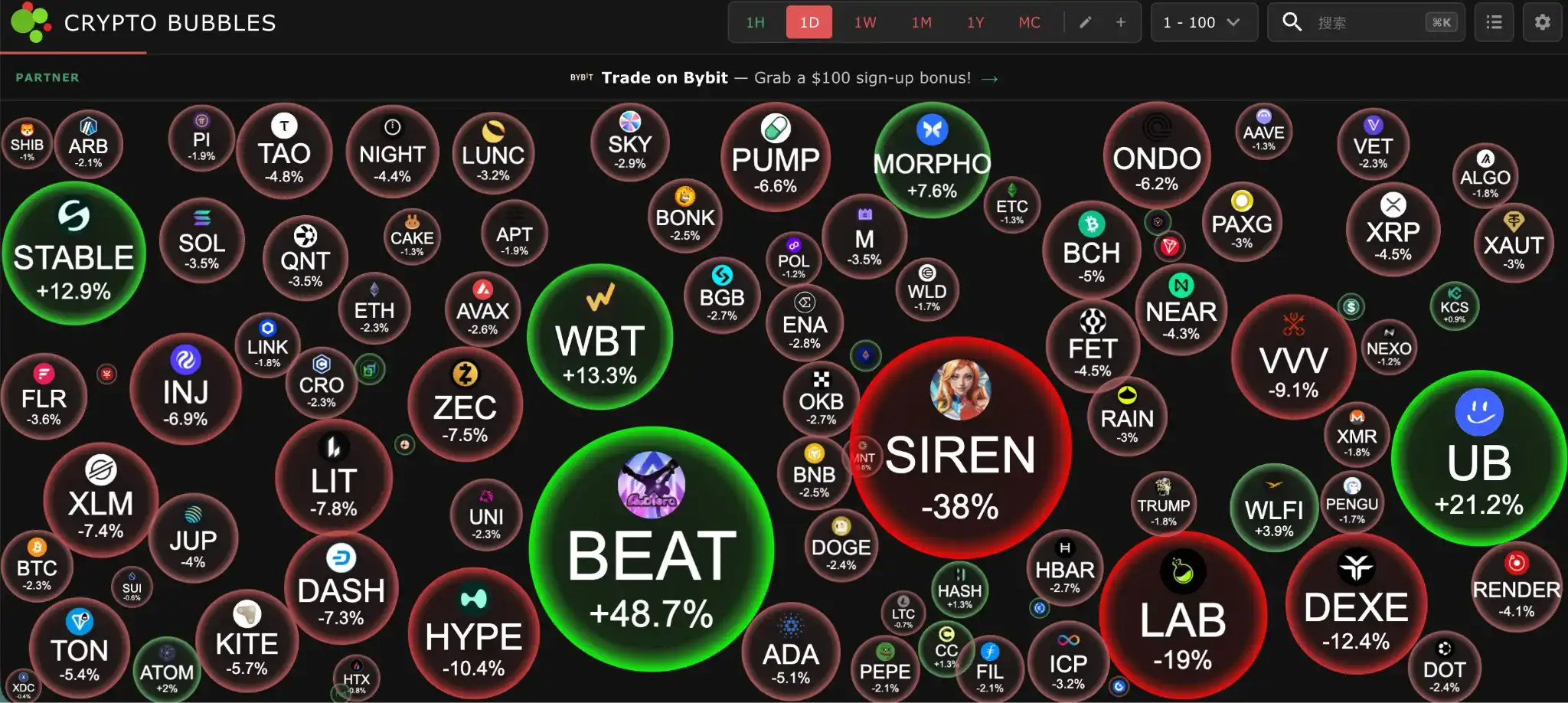
Top gainers among the top 100 cryptocurrencies by market cap today: BEAT up 48.7%, UB up 21.2%, WBT up 13.3%, STABLE up 12.9%, MORPHO up 7.6%.
Asia-Pacific Market

Asia-Pacific stock markets failed to stay immune. Under the dual pressure of Middle East conflict and the rout of US tech stocks, they experienced a major plunge.

The South Korean KOSPI index faced extremely severe selling, plummeting 6.46% and triggering circuit breakers at one point. The Japanese Nikkei 225 index also plunged over 1600 points, down 2.49%. Arjun Jayaraman, portfolio manager at Causeway Capital, pointed out that the proliferation of retail funds with high leverage and new ETFs in Japanese and Korean markets is amplifying this panic-driven volatility manifold.

Semiconductor giants became the epicenter of the selling wave in the Asia-Pacific market. Despite *The Korea Economic Daily* reporting the positive news that Samsung Electronics plans to build an advanced packaging plant in Gwangju, it seemed pale in the face of macro panic. Samsung Electronics stock plunged over 7%, and SK Hynix fell more than 8%. The Japanese chip contingent also retreated, with Advantest and Kioxia both falling nearly 4%. Not only that, even SoftBank Group saw its stock crash over 9% in a single day due to its attempt to use OpenAI shares as collateral for a $6 billion loan being blocked.

Amid the wailing, the A-share market walked its own independent logic due to strong data and World Cup expectations. China's May export data shone brightly, with a year-on-year surge of 19.4% in US dollar terms. Among them, integrated circuits skyrocketed 111%, and computer equipment surged 66%. Xing Zhaopeng, strategist at ANZ, remarked that the global AI hardware frenzy is substantively reshaping China's trade landscape. On the consumer side, with less than 48 hours until the US-Canada-Mexico World Cup opening, expectations for the "midnight viewing" late-night snack economy sparked by the time difference ignited the beer sector. Hui Quan Beer hit the daily limit up, while Zhujiang Beer and Yanjing Beer rose over 5%, becoming a rare bright spot in the gloomy market.


Domande pertinenti

QWhat are the key factors putting pressure on Bitcoin and gold prices according to the article?

ABitcoin is under pressure due to net outflows from Bitcoin ETFs and market caution ahead of the US CPI data. Gold fell below the key 200-day moving average to around $4200, pressured by rising inflation, higher real yields, ETF outflows, and geopolitical tensions.

QWhat major event is the market focused on tonight (the night the article was published), and what is the general forecast for the data?

AThe market is focused on the release of the US May CPI (Consumer Price Index) data. Forecasts suggest the headline CPI may rise to 4.2%~4.3% year-over-year, driven by energy prices, but core CPI month-over-month is expected to be significantly lower at 0.17%~0.22%.

QWhich sectors and specific companies in the US stock market experienced significant declines, and what were the main reasons?

AUS tech stocks, especially semiconductors and AI-related companies, saw significant declines. Key losers included Apple (down 3.64% post-WWDC), ARM, Marvell Technology, Micron, Intel, and Super Micro Computer (SMCI, down over 10% on dilution fears). The optical communications sector (e.g., AAOI, Lumentum, COHERENT) crashed due to a bearish analyst report delaying expectations for CPO technology adoption.

QWhat caused the severe sell-off in major Asian stock markets like South Korea's KOSPI and Japan's Nikkei 225?

AThe severe sell-off in Asian markets was caused by a combination of escalating geopolitical tensions in the Middle East and the sharp decline in US tech stocks. The panic was amplified by high levels of leveraged retail money and new ETFs in these markets.

QDespite the broader market downturn, which Chinese sectors showed strength and why?

AChina's A-shares showed relative strength, driven by robust export data (with integrated circuit exports surging 111%) linked to the global AI hardware boom, and positive expectations for the 'late-night snacking' economy ahead of the FIFA World Cup, which boosted beer stocks like HuiQuan Brewery.

Letture associate

AI Investors' 2026 Anxiety: When Models Devour Everything, What Moat Is Left for Startups?

In 2026, a wave of investor anxiety questions the defensibility of AI startups as models improve, fearing that most companies are just "thin wrappers" destined to be absorbed by foundation models or chipmakers. The author argues against this despair, positing that true moats lie not in benchmark performance but in areas models cannot easily reach. The logic of despair is that if models excel at all measurable tasks, only compute and cutting-edge model weights hold lasting value. However, the essay contends that the most valuable work is inherently "untrainable." Benchmarks measure what can be measured and thus optimized for, but real-world correctness often resides in private, complex systems. Examples include legacy codebases, intricate legal transactions, or hospital workflows. This kind of correctness is proprietary, costly to establish, and cannot be validated quickly—it requires time and trust within an organization. As models commodify visible, measurable tasks from both above (labs absorbing scaffolding) and below (saturation by cheaper models), value shifts to "untrainable ground." This encompasses work where correctness is a private truth, locked behind integration barriers, licenses, liability frameworks, and entrenched user habits. Trust and adoption are slow, human-centric processes that smarter models cannot accelerate. Successful companies defend their position by embedding deeply into client operations, owning the definition of "good" within a specific domain (e.g., Harvey in law, OpenEvidence in medicine), and pricing on outcomes rather than tokens. While labs compete fiercely, they are incentivized to keep the application layer vibrant. The future belongs not to those competing on generic benchmarks but to those navigating unscoreable terrain, doing the "unsexy work" of translation between models and messy human realities. The most cited benchmark scores are thus maps of territory about to become worthless, signaling who will lose the right to define what counts as good.

marsbit25 min fa

AI Investors' 2026 Anxiety: When Models Devour Everything, What Moat Is Left for Startups?

marsbit25 min fa

Trump's Crypto Empire: A $2.3 Billion Wealth Transfer Experiment

In June 2026, Reuters investigations revealed that since Donald Trump's return to the White House, his family has accumulated roughly $2.3 billion in profits from four core crypto ventures: World Liberty Financial (WLFI), the $TRUMP meme coin, American Bitcoin, and ALT5 Sigma (later renamed AI Financial). Coincidentally, overall investor losses in these projects were estimated to be a similar amount. The businesses, spanning DeFi, stablecoins, meme coins, Bitcoin mining, and digital payments, largely relied not on technological innovation but on converting the political influence and notoriety of the Trump brand into financial assets sold to the market. This marks a dramatic shift from Trump's earlier skepticism of cryptocurrencies. The ventures operated on a similar logic: leveraging the Trump name to generate market hype and trust, attracting investment through token sales or public listings, and enabling the family to capture profits upfront through equity, token allocations, and fees, while later entrants often bore the brunt of the risk as markets cooled. WLFI, the most profitable venture, generated an estimated $1.6 billion for the family, primarily through sales of its locked, illiquid governance token and its USD1 stablecoin. The $TRUMP meme coin, a direct monetization of the presidential IP, brought in over $600 million for Trump-linked entities before its price crashed nearly 97% from its peak. American Bitcoin gained a "Trump stock" premium for its mining operations, and ALT5 Sigma/AI Financial combined Trump, AI, and crypto themes for a temporary valuation surge. The episode underscores how political influence can be packaged into financial assets, creating substantial wealth for promoters while highlighting the risks for investors who base decisions on hype and brand allegiance over fundamental business models and cash flows.

marsbit1 h fa

Trump's Crypto Empire: A $2.3 Billion Wealth Transfer Experiment

marsbit1 h fa

CFTC Proposes New Rules for Prediction Markets, Redefining Which Events Can Be Listed and Who Can Participate

The U.S. Commodity Futures Trading Commission (CFTC) has proposed new rules to establish a clearer regulatory framework for prediction markets. The proposal aims to modify how "event contracts" are reviewed, creating a structured process to determine if contracts involving terrorism, assassination, war, or illegal activities violate the public interest. This moves away from a blanket ban toward a case-by-case assessment of whether a contract's subject matter is acceptable for financial trading. A key focus is distinguishing between predicting the impact of risks and predicting the occurrence of harm. The proposal suggests that many sports-based prediction markets—such as those on game outcomes, scores, or season standings—may be permissible as they can provide price discovery and meaningful information. However, markets on easily manipulated events like specific player injuries, referee calls, or outcomes of youth sports would face stricter scrutiny. The rules directly target insider trading and manipulation risks, highlighting cases where individuals with non-public information or the ability to influence an event's outcome could unfairly profit. This underscores a shift toward ensuring market fairness. The proposal does not end the regulatory debate, particularly with state gambling regulators who argue that sports prediction markets are essentially sports betting and should fall under state jurisdiction. Nonetheless, the CFTC's action signals a move toward formalizing prediction markets, pushing the industry from a phase of rapid, often unregulated expansion into a more institutionalized, rule-based environment that more closely resembles traditional financial markets.

marsbit1 h fa

CFTC Proposes New Rules for Prediction Markets, Redefining Which Events Can Be Listed and Who Can Participate

marsbit1 h fa

Trading

Spot
Futures

Articoli Popolari

Cosa è $S$

Comprendere SPERO: Una Panoramica Completa Introduzione a SPERO Mentre il panorama dell'innovazione continua a evolversi, l'emergere delle tecnologie web3 e dei progetti di criptovaluta gioca un ruolo fondamentale nel plasmare il futuro digitale. Un progetto che ha attirato l'attenzione in questo campo dinamico è SPERO, denotato come SPERO,$$s$. Questo articolo mira a raccogliere e presentare informazioni dettagliate su SPERO, per aiutare gli appassionati e gli investitori a comprendere le sue basi, obiettivi e innovazioni nei domini web3 e crypto. Che cos'è SPERO,$$s$? SPERO,$$s$ è un progetto unico all'interno dello spazio crypto che cerca di sfruttare i principi della decentralizzazione e della tecnologia blockchain per creare un ecosistema che promuove l'impegno, l'utilità e l'inclusione finanziaria. Il progetto è progettato per facilitare interazioni peer-to-peer in modi nuovi, fornendo agli utenti soluzioni e servizi finanziari innovativi. Al suo interno, SPERO,$$s$ mira a responsabilizzare gli individui fornendo strumenti e piattaforme che migliorano l'esperienza dell'utente nello spazio delle criptovalute. Questo include la possibilità di metodi di transazione più flessibili, la promozione di iniziative guidate dalla comunità e la creazione di percorsi per opportunità finanziarie attraverso applicazioni decentralizzate (dApps). La visione sottostante di SPERO,$$s$ ruota attorno all'inclusività, cercando di colmare le lacune all'interno della finanza tradizionale mentre sfrutta i vantaggi della tecnologia blockchain. Chi è il Creatore di SPERO,$$s$? L'identità del creatore di SPERO,$$s$ rimane piuttosto oscura, poiché ci sono risorse pubblicamente disponibili limitate che forniscono informazioni dettagliate sul suo fondatore o fondatori. Questa mancanza di trasparenza può derivare dall'impegno del progetto per la decentralizzazione—un ethos che molti progetti web3 condividono, dando priorità ai contributi collettivi rispetto al riconoscimento individuale. Centrando le discussioni attorno alla comunità e ai suoi obiettivi collettivi, SPERO,$$s$ incarna l'essenza dell'empowerment senza mettere in evidenza individui specifici. Pertanto, comprendere l'etica e la missione di SPERO rimane più importante che identificare un creatore singolo. Chi sono gli Investitori di SPERO,$$s$? SPERO,$$s$ è supportato da una varietà di investitori che vanno dai capitalisti di rischio agli investitori angelici dedicati a promuovere l'innovazione nel settore crypto. Il focus di questi investitori generalmente si allinea con la missione di SPERO—dando priorità a progetti che promettono avanzamenti tecnologici sociali, inclusività finanziaria e governance decentralizzata. Queste fondazioni di investitori sono tipicamente interessate a progetti che non solo offrono prodotti innovativi, ma contribuiscono anche positivamente alla comunità blockchain e ai suoi ecosistemi. Il supporto di questi investitori rafforza SPERO,$$s$ come un concorrente degno di nota nel dominio in rapida evoluzione dei progetti crypto. Come Funziona SPERO,$$s$? SPERO,$$s$ impiega un framework multifunzionale che lo distingue dai progetti di criptovaluta convenzionali. Ecco alcune delle caratteristiche chiave che sottolineano la sua unicità e innovazione: Governance Decentralizzata: SPERO,$$s$ integra modelli di governance decentralizzati, responsabilizzando gli utenti a partecipare attivamente ai processi decisionali riguardanti il futuro del progetto. Questo approccio favorisce un senso di proprietà e responsabilità tra i membri della comunità. Utilità del Token: SPERO,$$s$ utilizza il proprio token di criptovaluta, progettato per servire varie funzioni all'interno dell'ecosistema. Questi token abilitano transazioni, premi e la facilitazione dei servizi offerti sulla piattaforma, migliorando l'impegno e l'utilità complessivi. Architettura Stratificata: L'architettura tecnica di SPERO,$$s$ supporta la modularità e la scalabilità, consentendo un'integrazione fluida di funzionalità e applicazioni aggiuntive man mano che il progetto evolve. Questa adattabilità è fondamentale per mantenere la rilevanza nel panorama crypto in continua evoluzione. Coinvolgimento della Comunità: Il progetto enfatizza iniziative guidate dalla comunità, impiegando meccanismi che incentivano la collaborazione e il feedback. Nutrendo una comunità forte, SPERO,$$s$ può affrontare meglio le esigenze degli utenti e adattarsi alle tendenze di mercato. Focus sull'Inclusione: Offrendo basse commissioni di transazione e interfacce user-friendly, SPERO,$$s$ mira ad attrarre una base utenti diversificata, inclusi individui che potrebbero non aver precedentemente interagito nello spazio crypto. Questo impegno per l'inclusione si allinea con la sua missione generale di empowerment attraverso l'accessibilità. Cronologia di SPERO,$$s$ Comprendere la storia di un progetto fornisce preziose intuizioni sulla sua traiettoria di sviluppo e sui traguardi. Di seguito è riportata una cronologia suggerita che mappa eventi significativi nell'evoluzione di SPERO,$$s$: Fase di Concettualizzazione e Ideazione: Le idee iniziali che formano la base di SPERO,$$s$ sono state concepite, allineandosi strettamente con i principi di decentralizzazione e focus sulla comunità all'interno dell'industria blockchain. Lancio del Whitepaper del Progetto: Dopo la fase concettuale, è stato rilasciato un whitepaper completo che dettaglia la visione, gli obiettivi e l'infrastruttura tecnologica di SPERO,$$s$ per suscitare interesse e feedback dalla comunità. Costruzione della Comunità e Prime Interazioni: Sono stati effettuati sforzi attivi di outreach per costruire una comunità di early adopters e potenziali investitori, facilitando discussioni attorno agli obiettivi del progetto e ottenendo supporto. Evento di Generazione del Token: SPERO,$$s$ ha condotto un evento di generazione del token (TGE) per distribuire i propri token nativi ai primi sostenitori e stabilire una liquidità iniziale all'interno dell'ecosistema. Lancio della Prima dApp: La prima applicazione decentralizzata (dApp) associata a SPERO,$$s$ è stata attivata, consentendo agli utenti di interagire con le funzionalità principali della piattaforma. Sviluppo Continuo e Partnership: Aggiornamenti e miglioramenti continui alle offerte del progetto, inclusi partnership strategiche con altri attori nello spazio blockchain, hanno plasmato SPERO,$$s$ in un concorrente competitivo e in evoluzione nel mercato crypto. Conclusione SPERO,$$s$ rappresenta una testimonianza del potenziale del web3 e delle criptovalute di rivoluzionare i sistemi finanziari e responsabilizzare gli individui. Con un impegno per la governance decentralizzata, il coinvolgimento della comunità e funzionalità progettate in modo innovativo, apre la strada verso un panorama finanziario più inclusivo. Come per qualsiasi investimento nello spazio crypto in rapida evoluzione, si incoraggiano potenziali investitori e utenti a ricercare approfonditamente e a impegnarsi in modo riflessivo con gli sviluppi in corso all'interno di SPERO,$$s$. Il progetto mostra lo spirito innovativo dell'industria crypto, invitando a ulteriori esplorazioni delle sue innumerevoli possibilità. Mentre il percorso di SPERO,$$s$ è ancora in fase di sviluppo, i suoi principi fondamentali potrebbero effettivamente influenzare il futuro di come interagiamo con la tecnologia, la finanza e tra di noi in ecosistemi digitali interconnessi.

75 Totale visualizzazioniPubblicato il 2024.12.17Aggiornato il 2024.12.17

Cosa è $S$

Cosa è AGENT S

Agent S: Il Futuro dell'Interazione Autonoma in Web3 Introduzione Nel panorama in continua evoluzione di Web3 e criptovalute, le innovazioni stanno costantemente ridefinendo il modo in cui gli individui interagiscono con le piattaforme digitali. Uno di questi progetti pionieristici, Agent S, promette di rivoluzionare l'interazione uomo-computer attraverso il suo framework agentico aperto. Aprendo la strada a interazioni autonome, Agent S mira a semplificare compiti complessi, offrendo applicazioni trasformative nell'intelligenza artificiale (AI). Questa esplorazione dettagliata approfondirà le complessità del progetto, le sue caratteristiche uniche e le implicazioni per il dominio delle criptovalute. Cos'è Agent S? Agent S si presenta come un innovativo framework agentico aperto, progettato specificamente per affrontare tre sfide fondamentali nell'automazione dei compiti informatici: Acquisizione di Conoscenze Specifiche del Dominio: Il framework apprende in modo intelligente da varie fonti di conoscenza esterne ed esperienze interne. Questo approccio duale gli consente di costruire un ricco repository di conoscenze specifiche del dominio, migliorando le sue prestazioni nell'esecuzione dei compiti. Pianificazione su Lungo Orizzonte di Compiti: Agent S impiega una pianificazione gerarchica potenziata dall'esperienza, un approccio strategico che facilita la suddivisione e l'esecuzione efficiente di compiti complessi. Questa caratteristica migliora significativamente la sua capacità di gestire più sottocompiti in modo efficiente ed efficace. Gestione di Interfacce Dinamiche e Non Uniformi: Il progetto introduce l'Interfaccia Agente-Computer (ACI), una soluzione innovativa che migliora l'interazione tra agenti e utenti. Utilizzando Modelli Linguistici Multimodali di Grandi Dimensioni (MLLM), Agent S può navigare e manipolare senza sforzo diverse interfacce grafiche utente. Attraverso queste caratteristiche pionieristiche, Agent S fornisce un framework robusto che affronta le complessità coinvolte nell'automazione dell'interazione umana con le macchine, preparando il terreno per innumerevoli applicazioni nell'AI e oltre. Chi è il Creatore di Agent S? Sebbene il concetto di Agent S sia fondamentalmente innovativo, informazioni specifiche sul suo creatore rimangono elusive. Il creatore è attualmente sconosciuto, il che evidenzia sia la fase embrionale del progetto sia la scelta strategica di mantenere i membri fondatori sotto anonimato. Indipendentemente dall'anonimato, l'attenzione rimane sulle capacità e sul potenziale del framework. Chi sono gli Investitori di Agent S? Poiché Agent S è relativamente nuovo nell'ecosistema crittografico, informazioni dettagliate riguardanti i suoi investitori e sostenitori finanziari non sono documentate esplicitamente. La mancanza di approfondimenti pubblicamente disponibili sulle fondazioni di investimento o sulle organizzazioni che supportano il progetto solleva interrogativi sulla sua struttura di finanziamento e sulla roadmap di sviluppo. Comprendere il supporto è cruciale per valutare la sostenibilità del progetto e il suo potenziale impatto sul mercato. Come Funziona Agent S? Al centro di Agent S si trova una tecnologia all'avanguardia che gli consente di funzionare efficacemente in contesti diversi. Il suo modello operativo è costruito attorno a diverse caratteristiche chiave: Interazione Uomo-Computer Simile a Quella Umana: Il framework offre una pianificazione AI avanzata, cercando di rendere le interazioni con i computer più intuitive. Mimando il comportamento umano nell'esecuzione dei compiti, promette di elevare le esperienze degli utenti. Memoria Narrativa: Utilizzata per sfruttare esperienze di alto livello, Agent S utilizza la memoria narrativa per tenere traccia delle storie dei compiti, migliorando così i suoi processi decisionali. Memoria Episodica: Questa caratteristica fornisce agli utenti una guida passo-passo, consentendo al framework di offrire supporto contestuale mentre i compiti si sviluppano. Supporto per OpenACI: Con la capacità di funzionare localmente, Agent S consente agli utenti di mantenere il controllo sulle proprie interazioni e flussi di lavoro, allineandosi con l'etica decentralizzata di Web3. Facile Integrazione con API Esterne: La sua versatilità e compatibilità con varie piattaforme AI garantiscono che Agent S possa adattarsi senza problemi agli ecosistemi tecnologici esistenti, rendendolo una scelta attraente per sviluppatori e organizzazioni. Queste funzionalità contribuiscono collettivamente alla posizione unica di Agent S all'interno dello spazio crittografico, poiché automatizza compiti complessi e multi-fase con un intervento umano minimo. Man mano che il progetto evolve, le sue potenziali applicazioni in Web3 potrebbero ridefinire il modo in cui si svolgono le interazioni digitali. Cronologia di Agent S Lo sviluppo e le tappe di Agent S possono essere riassunti in una cronologia che evidenzia i suoi eventi significativi: 27 Settembre 2024: Il concetto di Agent S è stato lanciato in un documento di ricerca completo intitolato “Un Framework Agentico Aperto che Usa i Computer Come un Umano”, mostrando le basi per il progetto. 10 Ottobre 2024: Il documento di ricerca è stato reso pubblicamente disponibile su arXiv, offrendo un'esplorazione approfondita del framework e della sua valutazione delle prestazioni basata sul benchmark OSWorld. 12 Ottobre 2024: È stata rilasciata una presentazione video, fornendo un'idea visiva delle capacità e delle caratteristiche di Agent S, coinvolgendo ulteriormente potenziali utenti e investitori. Questi indicatori nella cronologia non solo illustrano i progressi di Agent S, ma indicano anche il suo impegno per la trasparenza e il coinvolgimento della comunità. Punti Chiave su Agent S Man mano che il framework Agent S continua a evolversi, diversi attributi chiave si distinguono, sottolineando la sua natura innovativa e il potenziale: Framework Innovativo: Progettato per fornire un uso intuitivo dei computer simile all'interazione umana, Agent S porta un approccio nuovo all'automazione dei compiti. Interazione Autonoma: La capacità di interagire autonomamente con i computer attraverso GUI segna un passo avanti verso soluzioni informatiche più intelligenti ed efficienti. Automazione di Compiti Complessi: Con la sua metodologia robusta, può automatizzare compiti complessi e multi-fase, rendendo i processi più veloci e meno soggetti a errori. Miglioramento Continuo: I meccanismi di apprendimento consentono ad Agent S di migliorare dalle esperienze passate, migliorando continuamente le sue prestazioni e la sua efficacia. Versatilità: La sua adattabilità attraverso diversi ambienti operativi come OSWorld e WindowsAgentArena garantisce che possa servire un'ampia gamma di applicazioni. Man mano che Agent S si posiziona nel panorama di Web3 e delle criptovalute, il suo potenziale per migliorare le capacità di interazione e automatizzare i processi segna un significativo avanzamento nelle tecnologie AI. Attraverso il suo framework innovativo, Agent S esemplifica il futuro delle interazioni digitali, promettendo un'esperienza più fluida ed efficiente per gli utenti in vari settori. Conclusione Agent S rappresenta un audace passo avanti nell'unione tra AI e Web3, con la capacità di ridefinire il modo in cui interagiamo con la tecnologia. Sebbene sia ancora nelle sue fasi iniziali, le possibilità per la sua applicazione sono vaste e coinvolgenti. Attraverso il suo framework completo che affronta sfide critiche, Agent S mira a portare le interazioni autonome al centro dell'esperienza digitale. Man mano che ci addentriamo nei regni delle criptovalute e della decentralizzazione, progetti come Agent S giocheranno senza dubbio un ruolo cruciale nel plasmare il futuro della tecnologia e della collaborazione uomo-computer.

538 Totale visualizzazioniPubblicato il 2025.01.14Aggiornato il 2025.01.14

Cosa è AGENT S

Come comprare S

Benvenuto in HTX.com! Abbiamo reso l'acquisto di Sonic (S) semplice e conveniente. Segui la nostra guida passo passo per intraprendere il tuo viaggio nel mondo delle criptovalute.Step 1: Crea il tuo Account HTXUsa la tua email o numero di telefono per registrarti il tuo account gratuito su HTX. Vivi un'esperienza facile e sblocca tutte le funzionalità,Crea il mio accountStep 2: Vai in Acquista crypto e seleziona il tuo metodo di pagamentoCarta di credito/debito: utilizza la tua Visa o Mastercard per acquistare immediatamente SonicS.Bilancio: Usa i fondi dal bilancio del tuo account HTX per fare trading senza problemi.Terze parti: abbiamo aggiunto metodi di pagamento molto utilizzati come Google Pay e Apple Pay per maggiore comodità.P2P: Fai trading direttamente con altri utenti HTX.Over-the-Counter (OTC): Offriamo servizi su misura e tassi di cambio competitivi per i trader.Step 3: Conserva Sonic (S)Dopo aver acquistato Sonic (S), conserva nel tuo account HTX. In alternativa, puoi inviare tramite trasferimento blockchain o scambiare per altre criptovalute.Step 4: Scambia Sonic (S)Scambia facilmente Sonic (S) nel mercato spot di HTX. Accedi al tuo account, seleziona la tua coppia di trading, esegui le tue operazioni e monitora in tempo reale. Offriamo un'esperienza user-friendly sia per chi ha appena iniziato che per i trader più esperti.

1.1k Totale visualizzazioniPubblicato il 2025.01.15Aggiornato il 2026.06.02

Come comprare S

Discussioni

Benvenuto nella Community HTX. Qui puoi rimanere informato sugli ultimi sviluppi della piattaforma e accedere ad approfondimenti esperti sul mercato. Le opinioni degli utenti sul prezzo di S S sono presentate come di seguito.

活动图片