Opinion: Most Tokenized Assets Are Still Traditional Finance Wrapped On-Chain

marsbitPubblicato 2026-05-25Pubblicato ultima volta 2026-05-25

Introduzione

**Summary:** A market analysis reveals that the vast majority of tokenized assets remain mere "wrappers" for traditional finance on-chain. Of 593 surveyed assets, 77.6% are "Wrapped" assets where the token exists on-chain but key lifecycle functions (issuance, redemption, custody, access) remain off-chain. Only 11.1% are "Hybrid" assets, where some operational logic (transfers, settlement, yield accrual) is migrating on-chain, representing the true beginning of transformation. A mere 2.7% are "Native" assets built with a fully on-chain operational model. This explains why stablecoins feel structurally advanced compared to other RWA—they are true on-chain financial primitives, not just digitized traditional processes. The key future distinction won't be between tokenized and non-tokenized assets, but between those that are merely distributed on-chain and those that begin to *operate* on-chain.

Author: Yaroslav Writtle

Compiled by: Deep Tide TechFlow

Deep Tide Guide: The RWA sector has been discussed for so long, yet 77.6% of tokenized assets are still just "on-chain wrapping paper" — the token is on-chain, but issuance, redemption, and custody are entirely off-chain. What's truly worth attention are the 11.1% of "hybrid" assets, which are moving part of their lifecycle on-chain. This explains why stablecoins feel far ahead of other RWAs: they are genuine on-chain financial primitives, not just digital shells for traditional processes.

Market Size Growing Faster Than Market Maturity

An effective way to understand this market is not to look at whether it's tokenized or not.

Instead, look at:

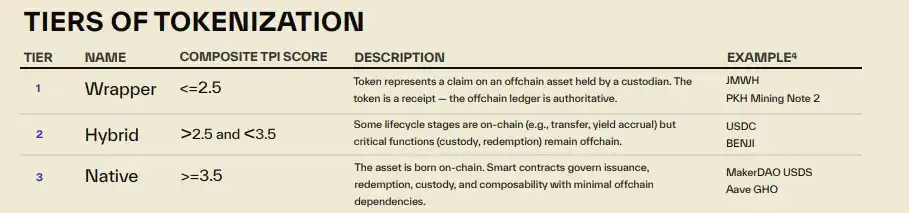
  • Wrapped
  • Hybrid
  • Native

A 2026 market survey covering 593 tokenized assets showed that 460 assets, or 77.6%, were still classified as wrapped. Only 66 assets, or 11.1%, were hybrid, and a mere 16 assets, or 2.7%, had reached a native state.

This is the true shape of the market.

Wrapped Remains the Default Form
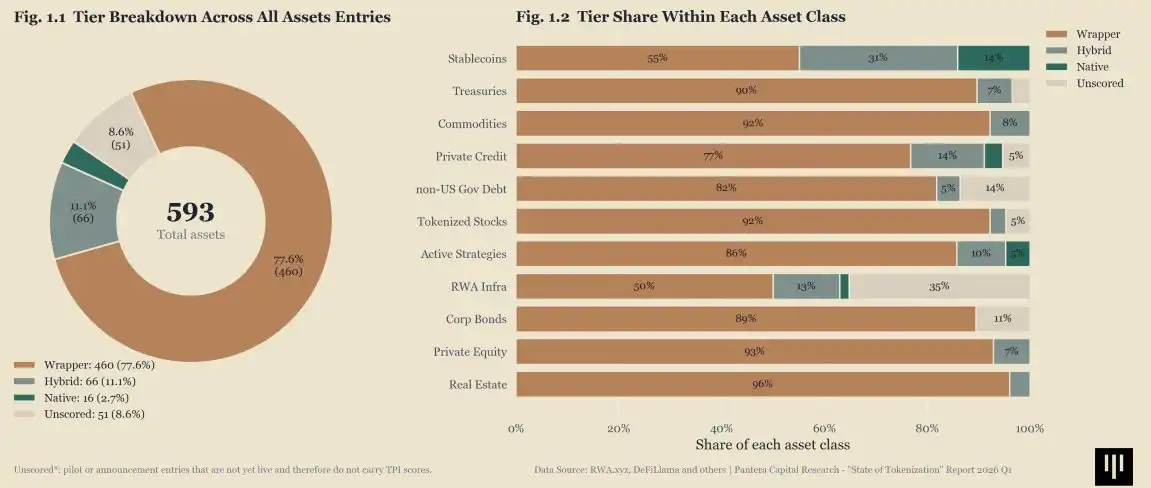
Most tokenized assets improve distribution, not infrastructure.

The token exists on-chain.

Most of its lifecycle does not.

Issuance, redemption, custody, transfer permissions, pricing, and investor access still heavily rely on off-chain systems.

So surface growth may be real, but on-chain autonomy remains low.

Hybrid Is Where Real Transformation Begins

Hybrid is the part of the market worth watching.

This is where certain parts of the lifecycle begin migrating on-chain:

  • Transfer logic
  • Settlement processes
  • Yield accrual
  • Partial compliance or access controls

Not fully native.

But no longer just wrapping paper.

This middle category is still small, which is why the market feels like it's moving faster than it actually is.

Native Is Rare for a Reason

Native assets are rare because the bar is high.

To reach that level, it's not just about the token being on-chain.

The operating model must also be on-chain.

This includes:

  • Issuance and redemption
  • Transfer execution
  • Custody assumptions
  • Composability with other systems

Very few assets truly meet this standard today.

Stablecoins Still Feel Ahead of Other Assets

This also helps explain why stablecoins still feel structurally ahead of most RWAs.
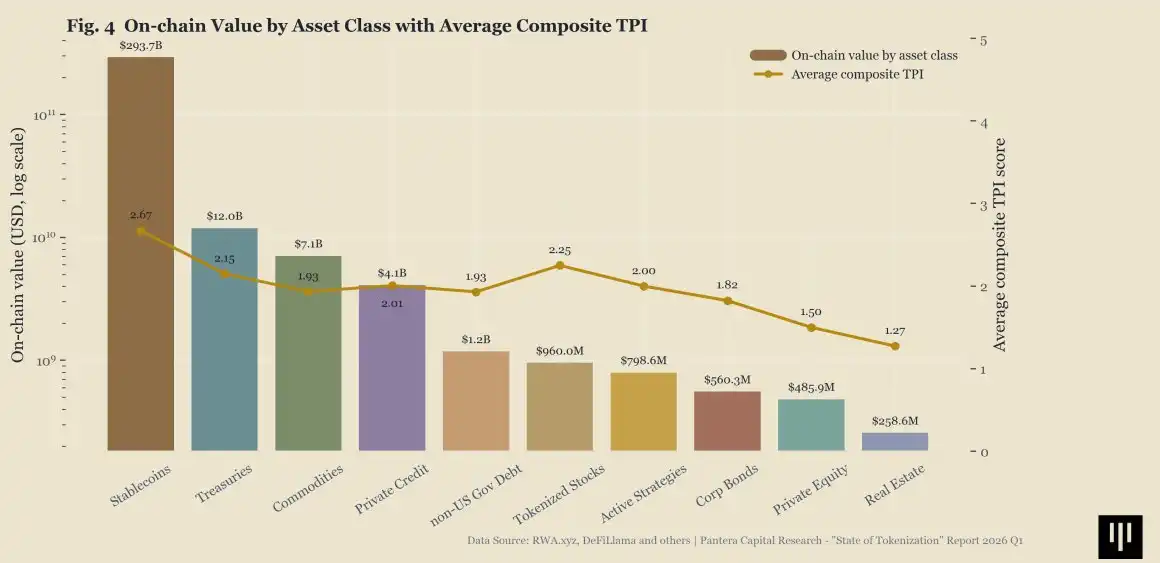
They are closer to being true on-chain financial primitives.

Many other tokenized assets still resemble digital wrapping paper for traditional processes, rather than assets that genuinely operate within an on-chain financial system.

What Matters Next

The market doesn't need more proof that assets can be tokenized.

A more useful question now is: which parts of the lifecycle have truly migrated along with it?

This is where the next round of differentiation will occur.

Not between tokenized and non-tokenized.

But between assets that are still distributed on-chain, and assets that are beginning to operate on-chain.

Domande pertinenti

QAccording to the article, what percentage of tokenized assets are considered 'wrapped' and what does this category mean?

A77.6% of tokenized assets are considered 'wrapped'. This means the token exists on-chain, but key lifecycle functions like issuance, redemption, custody, transfer permissions, pricing, and investor access remain heavily dependent on off-chain systems.

QWhat is the 'hybrid' category of tokenized assets, and why does the article suggest it's the important one to watch?

AThe 'hybrid' category refers to assets where some parts of their lifecycle, like transfer logic, settlement, yield accrual, or compliance controls, are beginning to move on-chain. The article suggests this is the important category because it represents the real start of infrastructure transformation, moving beyond just being a digital wrapper for traditional processes.

QWhy are truly 'native' on-chain assets still so rare according to the analysis?

ATruly 'native' on-chain assets are rare because the bar is very high. It requires not just the token to be on-chain, but the entire operational model—including issuance, redemption, transfer execution, custody assumptions, and composability with other systems—to be fundamentally built on-chain.

QHow does the article explain the perceived structural lead of stablecoins over most other Real World Assets (RWAs)?

AThe article explains that stablecoins feel structurally ahead because they are closer to being genuine on-chain financial primitives. In contrast, many other tokenized RWAs still resemble digital wrappers for traditional financial processes, not assets operating within an on-chain financial system.

QWhat does the article propose as the key question for the next phase of development in tokenized assets?

AThe article proposes that the key question is no longer whether assets can be put on-chain, but which parts of their lifecycle are genuinely migrating on-chain. The next phase of differentiation will occur between assets that are merely distributed on-chain and those that are beginning to operate on-chain.
Letture associate

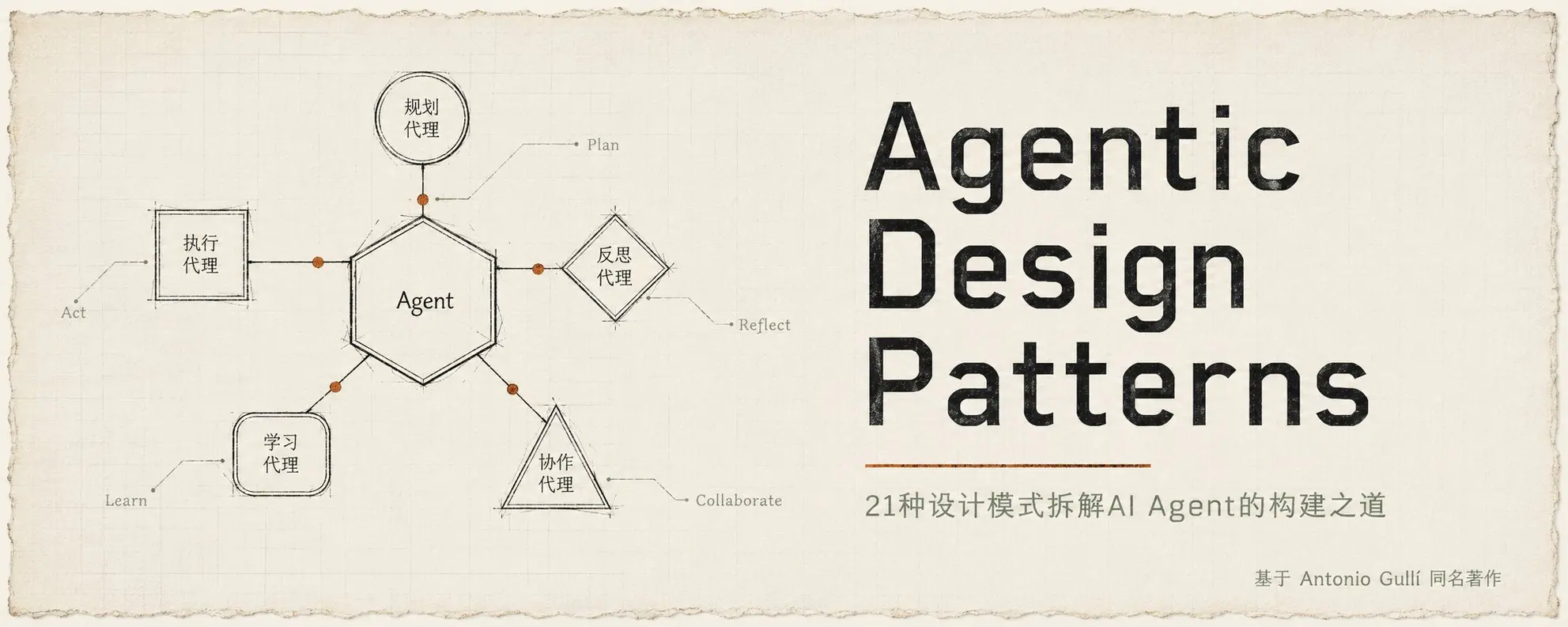
Agentic Design Patterns: A Book That Made Me Re-Understand "What Is an Agent, Really?"

"Agentic Design Patterns" is a 2025 book by Antonio Gullí, a Google engineering director, which offers a systematic framework for AI Agent development through 21 design patterns. A core contribution is the "Four Levels of Agency": Level 0 (bare LLMs) are not true agents. Level 1 agents actively decide when and how to use tools. Level 2 agents engage in strategic planning, context engineering (curating and filtering information), and self-reflection. Level 3 involves multi-agent collaboration with defined communication topologies. The book introduces **Context Engineering** as a superset of prompt engineering, managing four layers of information for the agent: system prompts, external data, implicit context (user history, environment), and feedback loops for automated optimization. A key pattern is **Reflection (Producer-Critic)**, where two distinct agents with different prompts collaborate iteratively—one produces output, the other critiques it—until quality is satisfactory or a max iteration limit is reached. For **Memory**, a three-layer model is proposed: Session (ephemeral conversation context), State (temporary task data), and Memory (persistent, long-term storage). Regarding **Multi-Agent Systems**, the book advises against unnecessary complexity, recommending simple topologies like Supervisor or Peer-to-Peer based on task needs. It emphasizes perfecting a single Level 2 agent before moving to multi-agent setups. The author concludes with three actionable takeaways: 1) Add a Critic agent to existing workflows, 2) Practice Context Engineering beyond simple prompts, and 3) Avoid premature multi-agent complexity; first master a robust single agent. The book provides a practical map, codifying common challenges like reflection, memory, and coordination into reusable patterns, saving developers from reinventing foundational solutions.

链捕手3 min fa

Agentic Design Patterns: A Book That Made Me Re-Understand "What Is an Agent, Really?"

链捕手3 min fa

An AI Read SpaceX's Prospectus and Wrote This Investment Memo in 12 Minutes

An AI agent autonomously analyzed SpaceX's 226MB S-1 filing, purchased real-time market data on-chain for $1.87, and generated a comprehensive investment memo in 12 minutes. The memo concludes a "Hold" recommendation. Bull Thesis: SpaceX holds a near-monopoly in commercial launch (80% of global orbital mass since 2023), operates the profitable Starlink business (10.3M subscribers, $7.2B adj. EBITDA), and is vertically integrated from rockets to AI via the xAI acquisition. Starlink alone is a standout, high-margin business. Bear Thesis: The AI division is a massive cash burn ($6.4B operating loss on $3.2B revenue in 2025). True debt obligations approach ~$42B, not the headline $29B, due to bridge loans and X-related debt. Significant contingent liabilities exist, including a potential $10B fee from a Cursor option agreement. The company faces concentrated counterparty risk (e.g., a $45B Anthropic contract), slowing revenue growth, and complex governance as a controlled company with four share classes. Valuation anchors Starlink's standalone value at ~$84B (applying Iridium's 7.4x sales multiple), suggesting the current ~$500B+ IPO target prices in immense future execution risk for Starship and AI. Key risks include Starship delays, accelerating AI losses, and underwriter conflicts (the IPO's lead banks are also lenders on the $20B bridge loan it aims to refinance). Investment triggers: upgrade to "Overweight" if priced ≤$350B and Starship meets milestones; downgrade to "Pass" if priced >$510B or key risks materialize.

marsbit23 min fa

An AI Read SpaceX's Prospectus and Wrote This Investment Memo in 12 Minutes

marsbit23 min fa

MLCC Capacitor Price Increase: A Comprehensive Overview of Beneficiary Companies

Recent teardown reports of Nvidia's next-generation AI chips have reignited investor interest in the MLCC (Multi-Layer Ceramic Capacitor) sector. Analysis of the Rubin architecture VR200 server reveals a 30% increase in MLCC count and a 182% surge in component value per rack compared to the previous generation, with GPU board usage nearly doubling. High-power, high-voltage hardware designs are driving massive adoption of high-end, high-withstand-voltage, and large-capacity MLCCs, exacerbating supply shortages. The global MLCC supply-demand balance remains tight. Leading Japanese and Korean manufacturers have successively raised prices across series, compounded by overseas capacity constraints and long-term customer order locks at major factories. Delivery lead times for high-end products now exceed 20 weeks, with capacity struggling to keep pace with surging orders. Demand drivers include AI servers, automotive electronics, and recovering consumer electronics, leading to both volume and price increases for MLCCs. The industry chain beneficiaries are outlined as follows: **1. MLCC Product Manufacturers:** Direct beneficiaries of price hikes. Key Chinese companies include Fenghua Advanced Technology (leading domestic player), Sanhuan Group (vertical integration from materials to products), and others like Hongyuan Electronics (military focus) and Torch Electron (specialty ceramics). **2. MLCC Raw Materials & Components:** The foundation of the supply chain. * **Release Film:** A critical consumable in production. Companies include Jiemei Technology (domestic leader), Shuangxing New Materials, and Sidike. * **Metal Powders (Ni/Cu):** Core materials for internal electrodes. Key suppliers are Boqian New Materials, Yuean New Materials, and Gripm Advanced Materials. * **Dielectric Ceramic Powder:** The core material determining MLCC performance. Sinocera Advanced Materials is a global leader, while Sanhuan Group and Fenghua Advanced Technology also have significant in-house capabilities. The report highlights that rising AI server power is significantly increasing requirements for chip capacitors and inductors, forecasting explosive industry growth aligned with projected GPU/TPU shipments through 2027-2028.

marsbit1 h fa

MLCC Capacitor Price Increase: A Comprehensive Overview of Beneficiary Companies

marsbit1 h fa

Trading

Spot
Futures
活动图片