Spain's Stunning Upset: A Sharp Review of World Cup Betting Methods from 'Solid' to 'Meh'

marsbitPubblicato 2026-06-17Pubblicato ultima volta 2026-06-17

Introduzione

"Spain Stunned: A Critical Review of World Cup Betting Methods from 'Awesome' to 'Trash'" The 2026 World Cup has already delivered its first major upset, as tournament favorite Spain was held to a goalless draw by Cape Verde. This shock result highlights the unpredictable nature of sports and the risks involved in betting on favorites. The article critically compares four major channels for World Cup predictions across five key dimensions: market clarity, transaction transparency, variety of bets, user access/compliance, and promotional incentives. Traditional online sportsbooks and China's official sports lottery offer familiar but opaque systems using complex odds. While they provide a vast array of betting options, their market mechanics and liquidity are not transparent to users. In contrast, new crypto prediction markets like Polymarket, Kalshi, Opinion, and Predict.fun present a clearer model. They translate probability directly into a tradable price (e.g., a 16¢ price equals a perceived 16% chance to win), making market sentiment easily visible. These platforms offer full transparency into order books and trading activity. User access varies significantly. China's sports lottery is fully compliant but primarily offline. Crypto markets require digital wallets and carry regulatory uncertainties. Kalshi is US-regulated but geographically restricted. Traditional offshore books pose the highest compliance and fund security risks. For engagement, Predict.fun leads with...

Author: Alan, Biteye Content Team

Today is the fifth day of the 2026 FIFA World Cup in the USA, Canada, and Mexico, and the tournament has witnessed its first major upset. The heavily favored Spanish team, with a squad valued at 500 million euros, was held to a 0-0 draw by the 40-year-old goalkeeper from Cape Verde, whose market value is a mere 50,000 euros. Netizens joked: How can human feet possibly compete with 'Buddha's feet' (a pun on Cape Verde's name in Chinese)?

To the friends who bet on Spain, the championship favorite, we ask: How are your heart and wallet holding up?

Unstable favorites, dark horses emerging, dramatic injury-time goals—the 48-team World Cup has barely begun, yet it has already dealt a resounding slap to the 'on-paper strength' theory. In other words, the true charm of sports competition might just be the possibility of the underdog triumphing over the top dog.

So here's the question: Have you ever supported a team or predicted scores in a group chat with friends? Have you ever participated in predictions, whether offline or on compliant platforms?

In fact, the kickoff of the World Cup isn't just about the battle of 48 teams on the pitch; it's also a face-off between several prediction products.

If you open Polymarket, you'll find it has prominently added a World Cup entry with a golden football icon to its top navigation bar. Click further, and the entire tournament's matches, betting options, brackets, and map are laid out clearly.
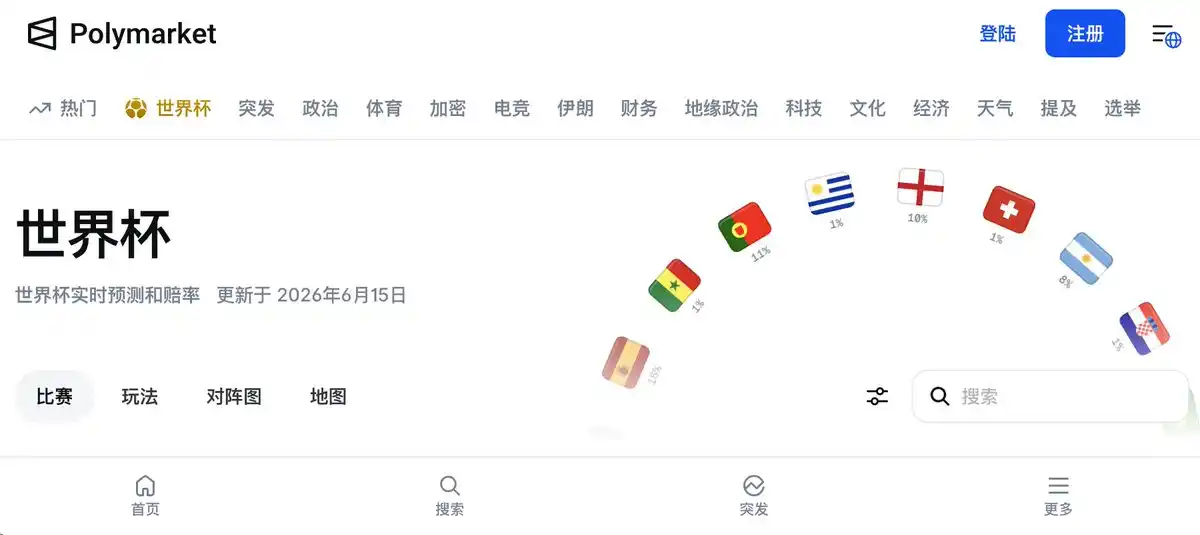
Currently, there are roughly three different categories of prediction methods for the World Cup: first, traditional official sports lotteries; second, traditional online gambling platforms; and third, emerging crypto prediction markets. The latter can be further divided into more established platforms like Polymarket @Polymarket .fun and Kalshi @Kalshi, and new blockchain contenders like Opinion @opinionlabsxyz and Predict.fun @predictdotfun.

On the surface, all of these are answering the same question: Who will win? But the underlying product logic, transparency, compliance paths, and user experience differ significantly and cannot be lumped together.

Next, Biteye will provide a sharp review, ranking from 'Solid' to 'Meh', of the overall betting experience across four different channels and multiple platforms for the 2026 World Cup.

First, the 'From Solid to Meh' Table

To prevent everyone from getting lost in jargon like odds, contracts, and dividend indices, let's first rank them directly from best to worst across five dimensions:
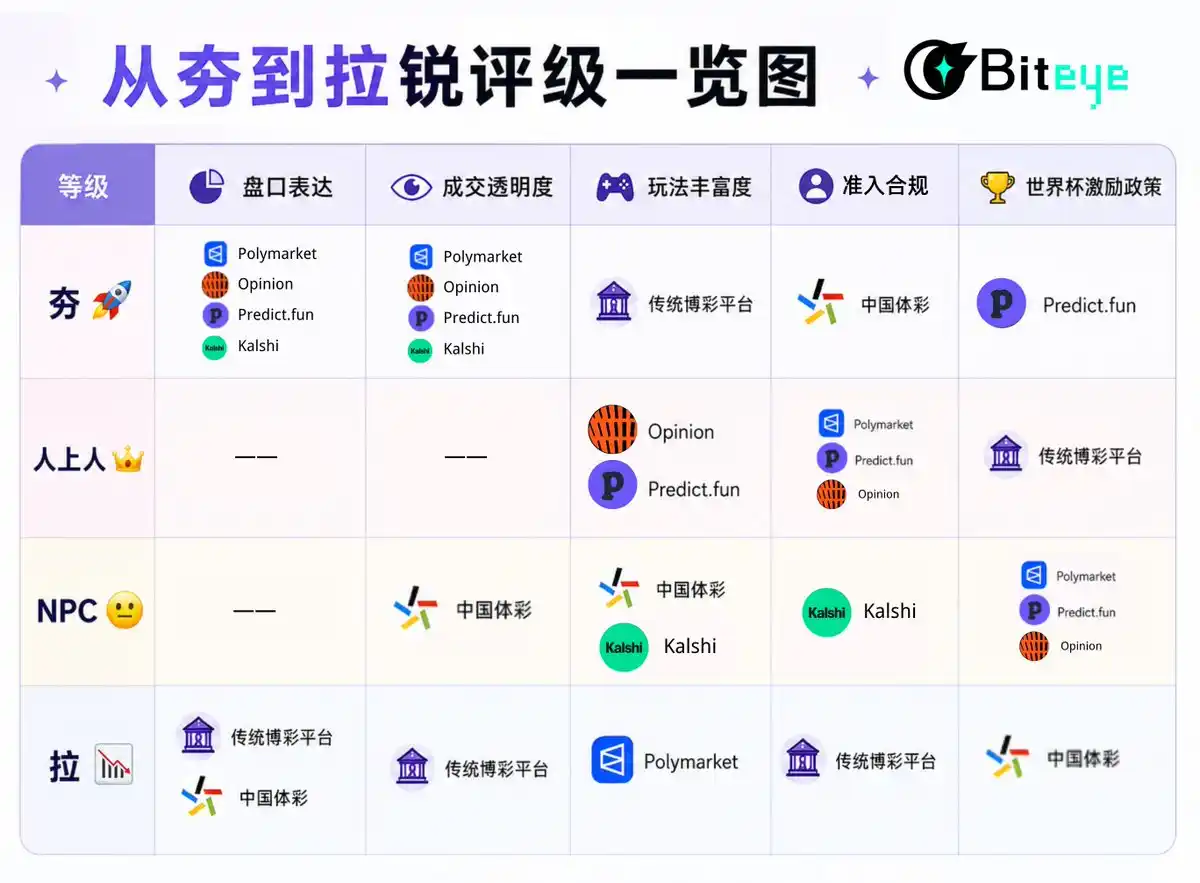
A one-sentence sharp review:

Polymarket is the World Cup betting market trending chart, with Opinion close behind. Predict.fun is the best at throwing money around with World Cup events on BNB Chain. Kalshi is the stock exchange in a suit watching the game. Traditional gambling platforms are feature-packed, enduring gambling supermarkets. The official sports lottery is the officially-sanctioned side dish for watching matches.

Market Expression: Do I Understand What It's Selling?

If you're new to World Cup betting, the odds on traditional gambling platforms might be confusing.

Traditional platforms use the classic language of odds, like +450, +850, +1000. Veterans might understand instantly, but newcomers might stare blankly for three seconds. The numbers look tempting, but why the complicated math? Similarly, the payout calculations for China's sports lottery are essentially odds-based menus that require conversion, rather than an easily understandable market price.

In contrast, whether it's the veteran prediction platforms Polymarket and self-styled event contract exchange Kalshi, or the newcomers Opinion and Predict.fun, the communicative advantage of prediction markets lies in not needing to convert odds or understand a bunch of betting terminology. They turn the World Cup into a visible, real-time probability curve.
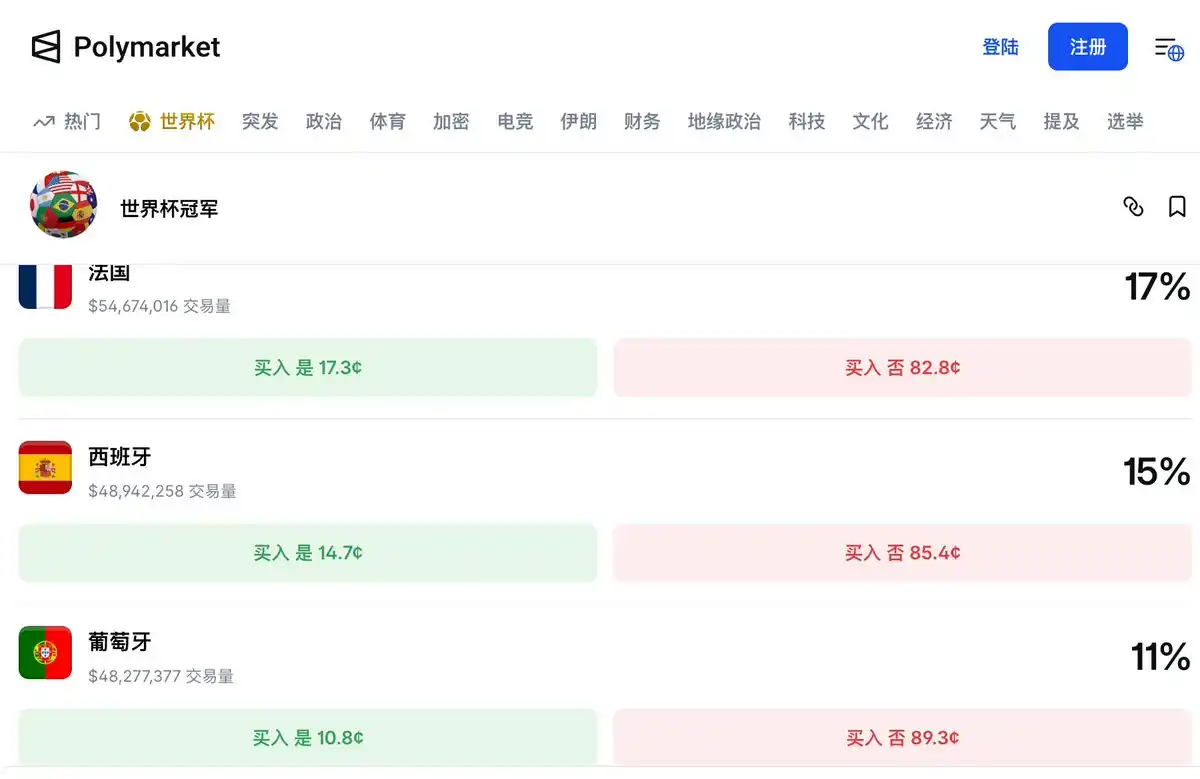
For example, Spain at 16¢, France at 16¢, Portugal at 11¢ corresponds to the market estimating their championship probability at roughly 16%, 16%, and 11%. If your supported Spain wins, you'll capture the multiple increase from 16% to 100%, about a 6.17x return.

This market language is very friendly for newcomers wanting to participate in World Cup predictions. It's not necessarily about making betting easier, but about making it easier to gauge the direction of market sentiment.

Simultaneously, such prediction market data is naturally suitable for media citation because it turns the subjective judgment of 'which team is stronger' into a real-time price voted on with money.

This round is more complex and heavily depends on user habits. Ranking based on communicative properties:

  • Solid: Polymarket / Kalshi/Opinion/Predict.fun. Probability is price, most suitable for communication.
  • Upper Class:/
  • NPC:/
  • Meh: Traditional gambling platforms / Sports lottery. Odds menus are not friendly to newcomers.

Transaction Transparency: Can I See How Others Are Betting?

Understanding the price is just the first step. The real key is: How is this price determined?

This is also the most fatal blow that emerging prediction markets deliver to the traditional bookmaker model. While prediction market data doesn't necessarily represent the 'truth', at least we can intuitively see how the market is trading.

Polymarket discloses price, trading volume, order book, liquidity, price curves, and market heat. Kalshi, Opinion, and Predict.fun are similar, displaying market data, trades, and price changes. In comparison, Kalshi's data, due to compliance requirements, resembles formal financial reports, while Opinion and Predict.fun resemble complete event-focused pages within new blockchain projects.
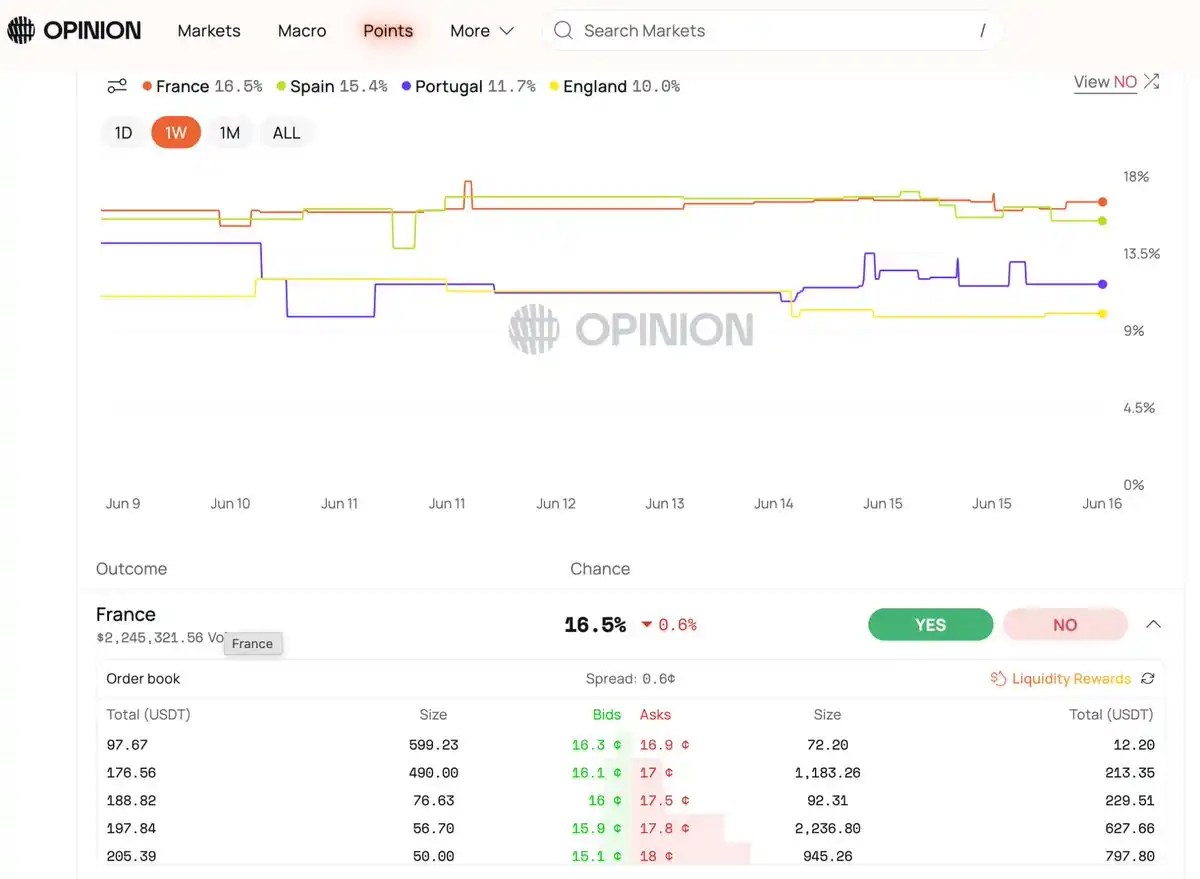
Traditional gambling platforms are different. Bettors can see the payout index or odds, but it's difficult to see the real volume behind a specific market, how funds flow, or the actual market depth. Traders primarily bet by trusting the platform's reputation. This isn't to say they lack liquidity, but the real issue is: this liquidity isn't transparent to ordinary users. It's like enjoying delicious braised chicken but worrying if it's frozen pre-made food.

China's sports lottery, under macro-level regulation, generally doesn't see extreme market manipulation, but behind each set of odds, there's an opaque, uncertain black box.

So this round's review is simple:

  • Solid: Polymarket / Kalshi/Opinion/Predict.fun. The foundation of prediction markets.
  • Upper Class:/
  • NPC: China Sports Lottery. Officially endorsed, large scale, but the process is invisible.
  • Meh: Traditional gambling platforms. Complete black box.

Variety of Betting Options: Can I Choose to Bet on Details I Like?

When it comes to who's best at creating diverse options, traditional gambling platforms are the seasoned veterans.

Outright winner, handicap, over/under, correct score, half-time/full-time, corners, yellow cards, player to score, golden boot, accumulators, same-match combos, live betting, cash-out... Traditional platforms have turned almost every detail of a World Cup match into products on the shelves of a gambling supermarket, dazzling to the eye.

This is also the strongest and most dangerous aspect of traditional platforms: the more options, the easier it is for users to think 'there must be one angle I understand'. But for the platform, the more detailed the options, the longer users stay, the higher the trading frequency, and the greater the profit.

China's sports lottery also offers a fair variety. During the World Cup, options like outright winner, finalists, win/draw/loss, correct score, total goals, and half-time/full-time basically cover the most familiar betting needs for Chinese users.

In comparison, Kalshi is catching up in this direction, starting to offer more single-match, over/under, both teams to score, and other event contracts.

Polymarket is more restrained, focusing on core markets like outright winner, advancement, and match winner. For instance, as of June 15th, trading volume for the World Cup winner prediction on Polymarket has exceeded $20 billion. In contrast, liquidity for split markets like over/under or handicap for individual matches is generally lower, and there are rarely corresponding markets for the traditional accumulator bets involving multiple matches.

Opinion and Predict.fun are more aggressive among new blockchain platforms, both offering markets for champion, group stage, knockout stage, golden boot, top assist provider, etc.

So this round:

  • Solid: Traditional gambling platforms. The gambling buffet.
  • Upper Class: Opinion / Predict.fun. Actively capturing the market.
  • NPC: Kalshi, adding more dishes / Sports Lottery, the official menu is sufficient.
  • Meh: Polymarket. The signature dishes are strong, but the menu isn't extensive.

User Access & Compliance: How Do I Get In & Can I Get Out?

This point is especially important for users in Chinese-speaking regions.

The advantage of the sports lottery is its clear legal status and familiarity within the Chinese context—you often see stores with 'Sports Lottery' signs just a few steps from your daily life. But its drawback is also obvious: it's not something you can participate in by casually opening a webpage; formal channels still emphasize offline physical outlets.

Polymarket, Opinion, and Predict.fun operate on a more Web3 access logic. Wallets, stablecoins, on-chain assets—these are relatively straightforward for those with a crypto background; but for average soccer fans, wallets, private keys, USDC, and regional restrictions are all barriers. Simultaneously, all three face the challenge of compliance for crypto prediction markets.

In contrast, Kalshi leans more towards a US-compliant financial account logic. Its rules are clear, positioning itself on the regulated event contract path, but KYC, regional, and account requirements mean it's not a product for all global users.

Traditional gambling platforms may seem to have many entry points in many regions, but they also have the most issues: regional restrictions, deposit/withdrawal risks, account risk controls, and inconsistent platform compliance. Even though some European and American markets have mature licensing systems, users in Chinese-speaking regions need to be cautious.

Therefore, the most important question isn't which platform offers the most exciting bets, but:

Where does the money go in? How are results settled? Can the money come out? Who do you turn to if the platform has a problem?

This round:

  • Solid: China Sports Lottery. The most legitimate and familiar in Chinese-speaking regions, but requires offline channels.
  • Upper Class: Polymarket/Opinion/Predict.fun. Friendly for crypto users, with barriers for average users, but compliance needs testing.
  • NPC: Kalshi. Access limited primarily to US users, compliance is clear.
  • Meh: Traditional gambling platforms. Deposit/withdrawal and compliance risks require the most vigilance.

Incentive Activities: Should I Bet More for the Rewards?

As a new contender in on-chain prediction markets, Predict.fun has launched a $2 million special incentive campaign for the World Cup. It has created the Predict Cup on BNB Chain, offering a rich prize pool, and built a series of on-chain World Cup activities with Fan Points, team lineups, leaderboards, and round rewards.
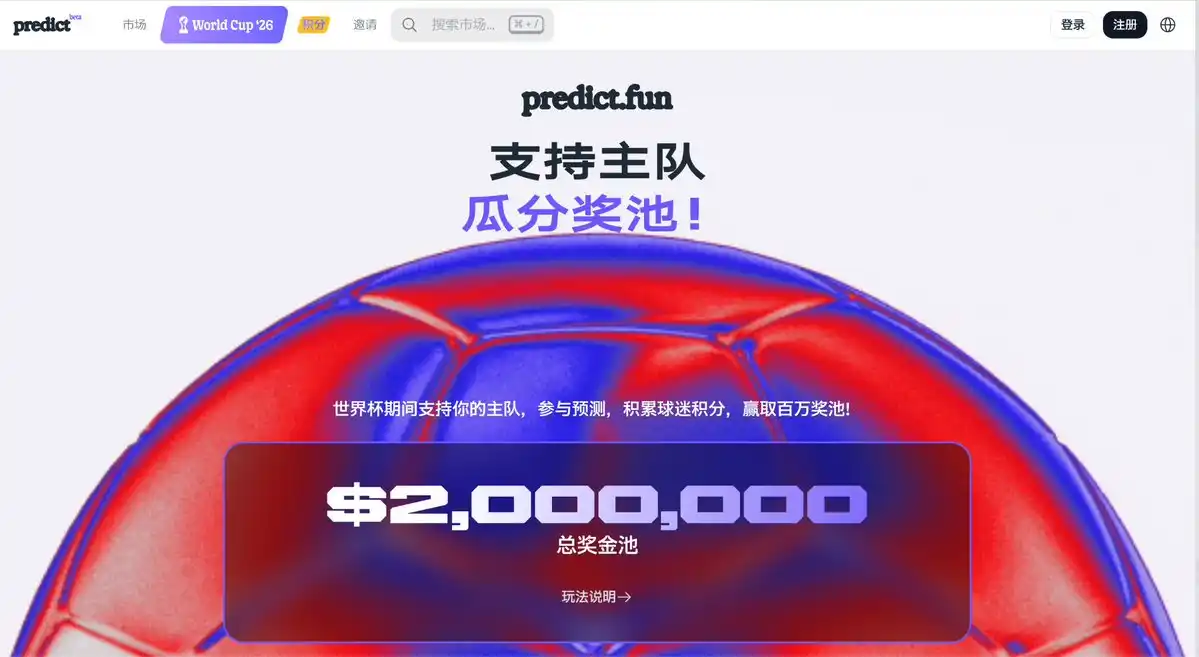
This is very attractive to users: you're not just predicting match outcomes; you're also competing for points, climbing the rankings, and earning rewards.

Traditional gambling platforms are also going all out for the World Cup; after all, this is the quadrennial fan frenzy, and traffic almost equals revenue.

Polymarket, Kalshi, and Opinion, however, still focus on the markets themselves: price, volume, market depth, communication—they haven't created separate incentive schemes for the World Cup.

The sports lottery emphasizes public welfare and rational purchasing; while it often has promotions, in the Chinese context, it's not appropriate to expand on them as traffic-driving introductions.

But amidst the excitement, it's also worth asking: Am I enjoying the match, or am I trading for points? Am I looking at odds, or am I being pushed along by the leaderboard?

This round:

  • Solid: Predict.fun. The most aggressive with World Cup-specific operations.
  • Upper Class: Traditional gambling platforms. The golden period of the World Cup.
  • NPC: Polymarket / Kalshi/Opinion. Incentives are not the main selling point.
  • Meh: Sports Lottery. Emphasizes rationality and public welfare attributes.

Conclusion

The 2026 World Cup has placed several product logics on the same table.

  • China's Sports Lottery says: The match can be a viewing interaction within the framework of an official public welfare lottery.
  • Traditional gambling platforms say: The match is a highly mature entertainment product.
  • Polymarket says: The match is a real-time, fluctuating probability market.
  • Kalshi says: The match is a regulatable event contract.
  • Opinion says: On-chain prediction markets can also be built like complete event-focused pages.
  • Predict.fun says: The World Cup isn't just about markets; it can also be an on-chain points game.

But perhaps what's truly worth noting is not who can replace whom, but how World Cup betting markets are shifting from closed, odds-based products into open, real-time, communicable information markets.

Sports are just the stage. The bigger business is humanity's eternal desire to price the future, to price its own judgment.

Crypto di tendenza

Domande pertinenti

QWhat was the major upset mentioned in the article regarding the 2026 FIFA World Cup?

AThe major upset was that the highly favored Spanish team, valued at 500 million euros, was held to a 0-0 draw by Cape Verde's 40-year-old goalkeeper, who has a market value of only 50,000 euros.

QAccording to the article, what are the three main categories of World Cup prediction methods discussed?

AThe three main categories are: 1) Traditional official sports lottery, 2) Traditional online betting platforms, and 3) Emerging crypto prediction markets, which include more established platforms like Polymarket and Kalshi, as well as newer chain-based platforms like Opinion and Predict.fun.

QWhat key advantage do prediction markets like Polymarket offer over traditional betting platforms in terms of information presentation?

APrediction markets offer the advantage of presenting information as real-time probability curves and prices (e.g., Spain 16¢ for a 16% chance), which are more intuitive and easier for传播 (dissemination) than the complex odds calculations required by traditional betting platforms.

QWhich platform received the lowest ranking ('拉') for 'User Access & Compliance' for Chinese-speaking users, and why?

ATraditional online betting platforms received the lowest ranking ('拉'). This is because they pose the highest risks regarding geographical restrictions, fund deposit/withdrawal issues, account risk control, and inconsistent platform compliance, making them particularly risky for Chinese-speaking users.

QWhich platform was highlighted for having the most aggressive and specialized incentive activities during the World Cup?

APredict.fun was highlighted for having the most aggressive specialized incentives, running a 'Predict Cup' on BNB Chain with a $2 million prize pool, featuring Fan Points, team lineups, leaderboards, and round rewards to engage users.

Letture associate

Unveiling the Whales of the World Cup Prediction Market: Smart Money Stumbles on the Pitch, 'Buy No' Outperforms 'Buy Yes'

**Title: Unveiling the Whales of the World Cup Prediction Market: "Smart Money" Stumbles on the Pitch as "Buying No" Outperforms "Buying Yes"** An analysis of pre-match trades over $5,000 on Polymarket for 20 completed group stage matches reveals a counterintuitive finding: large "smart money" bets were not consistently accurate. Aggregated pre-match buying volume was $89.55 million, with a weighted hit rate of only 48.5%. Holding these positions would have resulted in an estimated net loss of about $1.76 million (ROI -2.0%), challenging the notion that big money reliably predicts outcomes. The data highlights several key dynamics. Draws proved to be a major risk, significantly impacting bets on favored teams, as seen in Belgium-Egypt and Spain-Cape Verde. Markets were more efficient for clear mismatches (e.g., Germany's big win) but became prone to bias when favorites were overvalued. Notably, buying "No" shares (betting against a specific outcome) significantly outperformed buying "Yes," with hit rates of 62.4% vs. 37.5%. This suggests the market often overprices popular narratives, creating value in contrarian positions. Individual trades showed extreme volatility. One wallet (mintblade) earned an estimated $6.77 million by betting against Iran, while another (LEEEROYJENKINS) lost roughly $8.39 million on a Belgium win. The market favors high-risk, high-reward information trading rather than steady arbitrage. For sustained insight, wallets with consistent performance across multiple matches (e.g., swisstony) are more telling than one-off big bets. Ultimately, the Polymarket acts less as a crystal ball and more as a mirror, reflecting crowd bias and the inherent unpredictability of football. True "smart money" may lie not in predicting the future, but in identifying and exploiting market mispricings while respecting risk.

marsbit12 min fa

Unveiling the Whales of the World Cup Prediction Market: Smart Money Stumbles on the Pitch, 'Buy No' Outperforms 'Buy Yes'

marsbit12 min fa

Bezos' Third Startup Still Can't Avoid Musk

Jeff Bezos Returns as CEO for Third Venture, Still Can't Avoid Musk After stepping down as Amazon CEO in 2021, Jeff Bezos has returned to the front lines as co-CEO of Prometheus, an AI startup he founded. In a recent CNBC interview, Bezos described the experience as "Type 2 fun"—exhausting but ultimately rewarding. Founded less than a year ago, Prometheus has already raised over $18 billion in two funding rounds, achieving a staggering $41 billion valuation. Prometheus aims to develop a "General Engineer AI" to accelerate the entire "invention loop"—design, simulation, testing, and manufacturing—for complex physical products like jet engines, spacecraft, and medical devices. This positions the company at the intersection of Bezos's past experiences: Amazon's platform-building scale and Blue Origin's rigorous physical engineering. This marks Bezos's third major venture, following Amazon and Blue Origin. His co-CEO is Vik Bajaj, bringing expertise from life sciences and hard tech. Bezos now dedicates most of his time to Prometheus, signaling his belief in its transformative potential. The move also comes as Bezos's space company, Blue Origin, faces challenges, including a recent test explosion delaying its New Glenn rocket. Meanwhile, Elon Musk's SpaceX achieved a record-breaking IPO, surpassing Amazon's market cap. While Musk focuses on AI for executing physical tasks (like Tesla's robots and SpaceX's engineering), Bezos is betting on AI to *invent* in the physical world. Prometheus enters a crowded industrial AI field with players like OpenAI, NVIDIA, and Tesla's Optimus. Its lofty valuation bets on the unproven but massive opportunity to become the foundational platform for engineering in the AI era—a "blue ocean" Bezos hopes to define before Musk does.

marsbit15 min fa

Bezos' Third Startup Still Can't Avoid Musk

marsbit15 min fa

Won't US Stocks Ever Fall Again? The 'Great Melt-up' Trap in the Era of High Debt

The article analyzes a popular theory circulating online that the U.S. stock market may be mathematically incapable of a true, sustained decline due to the country's massive and growing national debt. The argument suggests that the government's only path to managing this debt is through inflation and money printing, which would nominally lift asset prices like stocks, creating a perpetual "melt-up." The author places this idea within the historical context of market melt-ups, such as the dot-com bubble and Japan's asset bubble, where prices detach from fundamentals driven by momentum and FOMO. While acknowledging that a high-debt environment creates incentives for inflation, which is generally favorable for assets over cash, the article refutes key claims of the online theory. It clarifies that interest payments are not about to exceed GDP, that printing money is not the only option for the government, and that stocks do not reliably rise in lockstep with hyperinflation, citing historical examples from Germany, Zimbabwe, and Venezuela. The more probable outcome, according to the author, is a prolonged period of financial repression—moderate inflation above interest rates that slowly erodes debt and cash purchasing power, leading to nominally higher asset prices but potentially lower real returns. The core warning is that while long-term market trends may be upward, this does not eliminate the risk of significant interim crashes (30%, 40%, or more) or guarantee real wealth creation during inflationary times. The conclusion advises against betting one's entire financial future on a smooth, perpetually rising market narrative. Instead, it recommends a disciplined, diversified strategy involving productive assets (stocks, real estate, some gold, short-term bonds) and an adequate cash buffer to avoid forced selling during downturns. The key takeaway is to avoid extreme concentration in expensive assets and leverage, and not to base investment decisions on the hope that every market dip will inevitably be rescued.

marsbit35 min fa

Won't US Stocks Ever Fall Again? The 'Great Melt-up' Trap in the Era of High Debt

marsbit35 min fa

The Fate of Digital Banks: No Fancy App Can Outshine a Banking License

The Fate of Digital Banks: A Flashy App is No Match for a Banking License The article argues that despite attracting billions of users with fee-free checking accounts and sleek apps, most "neobanks" struggle to be profitable because their core business—transaction fees—is inherently low-margin. The real profit engine of banking is lending (credit), which generates interest income. However, many early neobanks operated without their own banking licenses, which restricted their ability to lend at scale. Examples like Nubank, Revolut, and Chime illustrate the point. While they gained users with free accounts, their eventual profitability came from rolling out credit products. The piece highlights systemic risks for neobanks that rely on third-party infrastructure, citing the Synapse bankruptcy, which froze user funds and revealed the fragility of such models. The solution, according to the author, is obtaining a formal banking license, like the U.S. OCC's national trust charter. This provides regulatory backing, allows direct custody of funds, and eliminates dependency on intermediary partners. The trend is now evident in the crypto sector, where companies like Kraken, SoFi, and others are actively pursuing such licenses. The article concludes that while technology changes, the fundamental business logic of banking—profiting from lending—remains constant. Successful digital banks ultimately conform to this old model, just with better interfaces and fairer terms.

Foresight News43 min fa

The Fate of Digital Banks: No Fancy App Can Outshine a Banking License

Foresight News43 min fa

Trading

Spot
Futures

Articoli Popolari

Cosa è $S$

Comprendere SPERO: Una Panoramica Completa Introduzione a SPERO Mentre il panorama dell'innovazione continua a evolversi, l'emergere delle tecnologie web3 e dei progetti di criptovaluta gioca un ruolo fondamentale nel plasmare il futuro digitale. Un progetto che ha attirato l'attenzione in questo campo dinamico è SPERO, denotato come SPERO,$$s$. Questo articolo mira a raccogliere e presentare informazioni dettagliate su SPERO, per aiutare gli appassionati e gli investitori a comprendere le sue basi, obiettivi e innovazioni nei domini web3 e crypto. Che cos'è SPERO,$$s$? SPERO,$$s$ è un progetto unico all'interno dello spazio crypto che cerca di sfruttare i principi della decentralizzazione e della tecnologia blockchain per creare un ecosistema che promuove l'impegno, l'utilità e l'inclusione finanziaria. Il progetto è progettato per facilitare interazioni peer-to-peer in modi nuovi, fornendo agli utenti soluzioni e servizi finanziari innovativi. Al suo interno, SPERO,$$s$ mira a responsabilizzare gli individui fornendo strumenti e piattaforme che migliorano l'esperienza dell'utente nello spazio delle criptovalute. Questo include la possibilità di metodi di transazione più flessibili, la promozione di iniziative guidate dalla comunità e la creazione di percorsi per opportunità finanziarie attraverso applicazioni decentralizzate (dApps). La visione sottostante di SPERO,$$s$ ruota attorno all'inclusività, cercando di colmare le lacune all'interno della finanza tradizionale mentre sfrutta i vantaggi della tecnologia blockchain. Chi è il Creatore di SPERO,$$s$? L'identità del creatore di SPERO,$$s$ rimane piuttosto oscura, poiché ci sono risorse pubblicamente disponibili limitate che forniscono informazioni dettagliate sul suo fondatore o fondatori. Questa mancanza di trasparenza può derivare dall'impegno del progetto per la decentralizzazione—un ethos che molti progetti web3 condividono, dando priorità ai contributi collettivi rispetto al riconoscimento individuale. Centrando le discussioni attorno alla comunità e ai suoi obiettivi collettivi, SPERO,$$s$ incarna l'essenza dell'empowerment senza mettere in evidenza individui specifici. Pertanto, comprendere l'etica e la missione di SPERO rimane più importante che identificare un creatore singolo. Chi sono gli Investitori di SPERO,$$s$? SPERO,$$s$ è supportato da una varietà di investitori che vanno dai capitalisti di rischio agli investitori angelici dedicati a promuovere l'innovazione nel settore crypto. Il focus di questi investitori generalmente si allinea con la missione di SPERO—dando priorità a progetti che promettono avanzamenti tecnologici sociali, inclusività finanziaria e governance decentralizzata. Queste fondazioni di investitori sono tipicamente interessate a progetti che non solo offrono prodotti innovativi, ma contribuiscono anche positivamente alla comunità blockchain e ai suoi ecosistemi. Il supporto di questi investitori rafforza SPERO,$$s$ come un concorrente degno di nota nel dominio in rapida evoluzione dei progetti crypto. Come Funziona SPERO,$$s$? SPERO,$$s$ impiega un framework multifunzionale che lo distingue dai progetti di criptovaluta convenzionali. Ecco alcune delle caratteristiche chiave che sottolineano la sua unicità e innovazione: Governance Decentralizzata: SPERO,$$s$ integra modelli di governance decentralizzati, responsabilizzando gli utenti a partecipare attivamente ai processi decisionali riguardanti il futuro del progetto. Questo approccio favorisce un senso di proprietà e responsabilità tra i membri della comunità. Utilità del Token: SPERO,$$s$ utilizza il proprio token di criptovaluta, progettato per servire varie funzioni all'interno dell'ecosistema. Questi token abilitano transazioni, premi e la facilitazione dei servizi offerti sulla piattaforma, migliorando l'impegno e l'utilità complessivi. Architettura Stratificata: L'architettura tecnica di SPERO,$$s$ supporta la modularità e la scalabilità, consentendo un'integrazione fluida di funzionalità e applicazioni aggiuntive man mano che il progetto evolve. Questa adattabilità è fondamentale per mantenere la rilevanza nel panorama crypto in continua evoluzione. Coinvolgimento della Comunità: Il progetto enfatizza iniziative guidate dalla comunità, impiegando meccanismi che incentivano la collaborazione e il feedback. Nutrendo una comunità forte, SPERO,$$s$ può affrontare meglio le esigenze degli utenti e adattarsi alle tendenze di mercato. Focus sull'Inclusione: Offrendo basse commissioni di transazione e interfacce user-friendly, SPERO,$$s$ mira ad attrarre una base utenti diversificata, inclusi individui che potrebbero non aver precedentemente interagito nello spazio crypto. Questo impegno per l'inclusione si allinea con la sua missione generale di empowerment attraverso l'accessibilità. Cronologia di SPERO,$$s$ Comprendere la storia di un progetto fornisce preziose intuizioni sulla sua traiettoria di sviluppo e sui traguardi. Di seguito è riportata una cronologia suggerita che mappa eventi significativi nell'evoluzione di SPERO,$$s$: Fase di Concettualizzazione e Ideazione: Le idee iniziali che formano la base di SPERO,$$s$ sono state concepite, allineandosi strettamente con i principi di decentralizzazione e focus sulla comunità all'interno dell'industria blockchain. Lancio del Whitepaper del Progetto: Dopo la fase concettuale, è stato rilasciato un whitepaper completo che dettaglia la visione, gli obiettivi e l'infrastruttura tecnologica di SPERO,$$s$ per suscitare interesse e feedback dalla comunità. Costruzione della Comunità e Prime Interazioni: Sono stati effettuati sforzi attivi di outreach per costruire una comunità di early adopters e potenziali investitori, facilitando discussioni attorno agli obiettivi del progetto e ottenendo supporto. Evento di Generazione del Token: SPERO,$$s$ ha condotto un evento di generazione del token (TGE) per distribuire i propri token nativi ai primi sostenitori e stabilire una liquidità iniziale all'interno dell'ecosistema. Lancio della Prima dApp: La prima applicazione decentralizzata (dApp) associata a SPERO,$$s$ è stata attivata, consentendo agli utenti di interagire con le funzionalità principali della piattaforma. Sviluppo Continuo e Partnership: Aggiornamenti e miglioramenti continui alle offerte del progetto, inclusi partnership strategiche con altri attori nello spazio blockchain, hanno plasmato SPERO,$$s$ in un concorrente competitivo e in evoluzione nel mercato crypto. Conclusione SPERO,$$s$ rappresenta una testimonianza del potenziale del web3 e delle criptovalute di rivoluzionare i sistemi finanziari e responsabilizzare gli individui. Con un impegno per la governance decentralizzata, il coinvolgimento della comunità e funzionalità progettate in modo innovativo, apre la strada verso un panorama finanziario più inclusivo. Come per qualsiasi investimento nello spazio crypto in rapida evoluzione, si incoraggiano potenziali investitori e utenti a ricercare approfonditamente e a impegnarsi in modo riflessivo con gli sviluppi in corso all'interno di SPERO,$$s$. Il progetto mostra lo spirito innovativo dell'industria crypto, invitando a ulteriori esplorazioni delle sue innumerevoli possibilità. Mentre il percorso di SPERO,$$s$ è ancora in fase di sviluppo, i suoi principi fondamentali potrebbero effettivamente influenzare il futuro di come interagiamo con la tecnologia, la finanza e tra di noi in ecosistemi digitali interconnessi.

75 Totale visualizzazioniPubblicato il 2024.12.17Aggiornato il 2024.12.17

Cosa è $S$

Cosa è AGENT S

Agent S: Il Futuro dell'Interazione Autonoma in Web3 Introduzione Nel panorama in continua evoluzione di Web3 e criptovalute, le innovazioni stanno costantemente ridefinendo il modo in cui gli individui interagiscono con le piattaforme digitali. Uno di questi progetti pionieristici, Agent S, promette di rivoluzionare l'interazione uomo-computer attraverso il suo framework agentico aperto. Aprendo la strada a interazioni autonome, Agent S mira a semplificare compiti complessi, offrendo applicazioni trasformative nell'intelligenza artificiale (AI). Questa esplorazione dettagliata approfondirà le complessità del progetto, le sue caratteristiche uniche e le implicazioni per il dominio delle criptovalute. Cos'è Agent S? Agent S si presenta come un innovativo framework agentico aperto, progettato specificamente per affrontare tre sfide fondamentali nell'automazione dei compiti informatici: Acquisizione di Conoscenze Specifiche del Dominio: Il framework apprende in modo intelligente da varie fonti di conoscenza esterne ed esperienze interne. Questo approccio duale gli consente di costruire un ricco repository di conoscenze specifiche del dominio, migliorando le sue prestazioni nell'esecuzione dei compiti. Pianificazione su Lungo Orizzonte di Compiti: Agent S impiega una pianificazione gerarchica potenziata dall'esperienza, un approccio strategico che facilita la suddivisione e l'esecuzione efficiente di compiti complessi. Questa caratteristica migliora significativamente la sua capacità di gestire più sottocompiti in modo efficiente ed efficace. Gestione di Interfacce Dinamiche e Non Uniformi: Il progetto introduce l'Interfaccia Agente-Computer (ACI), una soluzione innovativa che migliora l'interazione tra agenti e utenti. Utilizzando Modelli Linguistici Multimodali di Grandi Dimensioni (MLLM), Agent S può navigare e manipolare senza sforzo diverse interfacce grafiche utente. Attraverso queste caratteristiche pionieristiche, Agent S fornisce un framework robusto che affronta le complessità coinvolte nell'automazione dell'interazione umana con le macchine, preparando il terreno per innumerevoli applicazioni nell'AI e oltre. Chi è il Creatore di Agent S? Sebbene il concetto di Agent S sia fondamentalmente innovativo, informazioni specifiche sul suo creatore rimangono elusive. Il creatore è attualmente sconosciuto, il che evidenzia sia la fase embrionale del progetto sia la scelta strategica di mantenere i membri fondatori sotto anonimato. Indipendentemente dall'anonimato, l'attenzione rimane sulle capacità e sul potenziale del framework. Chi sono gli Investitori di Agent S? Poiché Agent S è relativamente nuovo nell'ecosistema crittografico, informazioni dettagliate riguardanti i suoi investitori e sostenitori finanziari non sono documentate esplicitamente. La mancanza di approfondimenti pubblicamente disponibili sulle fondazioni di investimento o sulle organizzazioni che supportano il progetto solleva interrogativi sulla sua struttura di finanziamento e sulla roadmap di sviluppo. Comprendere il supporto è cruciale per valutare la sostenibilità del progetto e il suo potenziale impatto sul mercato. Come Funziona Agent S? Al centro di Agent S si trova una tecnologia all'avanguardia che gli consente di funzionare efficacemente in contesti diversi. Il suo modello operativo è costruito attorno a diverse caratteristiche chiave: Interazione Uomo-Computer Simile a Quella Umana: Il framework offre una pianificazione AI avanzata, cercando di rendere le interazioni con i computer più intuitive. Mimando il comportamento umano nell'esecuzione dei compiti, promette di elevare le esperienze degli utenti. Memoria Narrativa: Utilizzata per sfruttare esperienze di alto livello, Agent S utilizza la memoria narrativa per tenere traccia delle storie dei compiti, migliorando così i suoi processi decisionali. Memoria Episodica: Questa caratteristica fornisce agli utenti una guida passo-passo, consentendo al framework di offrire supporto contestuale mentre i compiti si sviluppano. Supporto per OpenACI: Con la capacità di funzionare localmente, Agent S consente agli utenti di mantenere il controllo sulle proprie interazioni e flussi di lavoro, allineandosi con l'etica decentralizzata di Web3. Facile Integrazione con API Esterne: La sua versatilità e compatibilità con varie piattaforme AI garantiscono che Agent S possa adattarsi senza problemi agli ecosistemi tecnologici esistenti, rendendolo una scelta attraente per sviluppatori e organizzazioni. Queste funzionalità contribuiscono collettivamente alla posizione unica di Agent S all'interno dello spazio crittografico, poiché automatizza compiti complessi e multi-fase con un intervento umano minimo. Man mano che il progetto evolve, le sue potenziali applicazioni in Web3 potrebbero ridefinire il modo in cui si svolgono le interazioni digitali. Cronologia di Agent S Lo sviluppo e le tappe di Agent S possono essere riassunti in una cronologia che evidenzia i suoi eventi significativi: 27 Settembre 2024: Il concetto di Agent S è stato lanciato in un documento di ricerca completo intitolato “Un Framework Agentico Aperto che Usa i Computer Come un Umano”, mostrando le basi per il progetto. 10 Ottobre 2024: Il documento di ricerca è stato reso pubblicamente disponibile su arXiv, offrendo un'esplorazione approfondita del framework e della sua valutazione delle prestazioni basata sul benchmark OSWorld. 12 Ottobre 2024: È stata rilasciata una presentazione video, fornendo un'idea visiva delle capacità e delle caratteristiche di Agent S, coinvolgendo ulteriormente potenziali utenti e investitori. Questi indicatori nella cronologia non solo illustrano i progressi di Agent S, ma indicano anche il suo impegno per la trasparenza e il coinvolgimento della comunità. Punti Chiave su Agent S Man mano che il framework Agent S continua a evolversi, diversi attributi chiave si distinguono, sottolineando la sua natura innovativa e il potenziale: Framework Innovativo: Progettato per fornire un uso intuitivo dei computer simile all'interazione umana, Agent S porta un approccio nuovo all'automazione dei compiti. Interazione Autonoma: La capacità di interagire autonomamente con i computer attraverso GUI segna un passo avanti verso soluzioni informatiche più intelligenti ed efficienti. Automazione di Compiti Complessi: Con la sua metodologia robusta, può automatizzare compiti complessi e multi-fase, rendendo i processi più veloci e meno soggetti a errori. Miglioramento Continuo: I meccanismi di apprendimento consentono ad Agent S di migliorare dalle esperienze passate, migliorando continuamente le sue prestazioni e la sua efficacia. Versatilità: La sua adattabilità attraverso diversi ambienti operativi come OSWorld e WindowsAgentArena garantisce che possa servire un'ampia gamma di applicazioni. Man mano che Agent S si posiziona nel panorama di Web3 e delle criptovalute, il suo potenziale per migliorare le capacità di interazione e automatizzare i processi segna un significativo avanzamento nelle tecnologie AI. Attraverso il suo framework innovativo, Agent S esemplifica il futuro delle interazioni digitali, promettendo un'esperienza più fluida ed efficiente per gli utenti in vari settori. Conclusione Agent S rappresenta un audace passo avanti nell'unione tra AI e Web3, con la capacità di ridefinire il modo in cui interagiamo con la tecnologia. Sebbene sia ancora nelle sue fasi iniziali, le possibilità per la sua applicazione sono vaste e coinvolgenti. Attraverso il suo framework completo che affronta sfide critiche, Agent S mira a portare le interazioni autonome al centro dell'esperienza digitale. Man mano che ci addentriamo nei regni delle criptovalute e della decentralizzazione, progetti come Agent S giocheranno senza dubbio un ruolo cruciale nel plasmare il futuro della tecnologia e della collaborazione uomo-computer.

547 Totale visualizzazioniPubblicato il 2025.01.14Aggiornato il 2025.01.14

Cosa è AGENT S

Come comprare S

Benvenuto in HTX.com! Abbiamo reso l'acquisto di Sonic (S) semplice e conveniente. Segui la nostra guida passo passo per intraprendere il tuo viaggio nel mondo delle criptovalute.Step 1: Crea il tuo Account HTXUsa la tua email o numero di telefono per registrarti il tuo account gratuito su HTX. Vivi un'esperienza facile e sblocca tutte le funzionalità,Crea il mio accountStep 2: Vai in Acquista crypto e seleziona il tuo metodo di pagamentoCarta di credito/debito: utilizza la tua Visa o Mastercard per acquistare immediatamente SonicS.Bilancio: Usa i fondi dal bilancio del tuo account HTX per fare trading senza problemi.Terze parti: abbiamo aggiunto metodi di pagamento molto utilizzati come Google Pay e Apple Pay per maggiore comodità.P2P: Fai trading direttamente con altri utenti HTX.Over-the-Counter (OTC): Offriamo servizi su misura e tassi di cambio competitivi per i trader.Step 3: Conserva Sonic (S)Dopo aver acquistato Sonic (S), conserva nel tuo account HTX. In alternativa, puoi inviare tramite trasferimento blockchain o scambiare per altre criptovalute.Step 4: Scambia Sonic (S)Scambia facilmente Sonic (S) nel mercato spot di HTX. Accedi al tuo account, seleziona la tua coppia di trading, esegui le tue operazioni e monitora in tempo reale. Offriamo un'esperienza user-friendly sia per chi ha appena iniziato che per i trader più esperti.

1.1k Totale visualizzazioniPubblicato il 2025.01.15Aggiornato il 2026.06.02

Come comprare S

Discussioni

Benvenuto nella Community HTX. Qui puoi rimanere informato sugli ultimi sviluppi della piattaforma e accedere ad approfondimenti esperti sul mercato. Le opinioni degli utenti sul prezzo di S S sono presentate come di seguito.

活动图片