What “Professional-Grade” Actually Means in a Prediction Market on the Example of Outpoll

TheNewsCryptoPubblicato 2026-06-05Pubblicato ultima volta 2026-06-05

Introduzione

The article examines the concept of "professional-grade" in crypto prediction markets, using the launch of Outpoll as an example. It argues that true professionalism means providing traders with the same infrastructure and tools they expect from traditional markets like FX or futures, not just a darker UI. Key features highlighted include: advanced position management with take-profit and stop-loss orders to execute strategies without constant screen time; a full public REST and WebSocket API for automated trading and integration; a built-in news feed within the trading interface for rapid reaction to headlines; a creator-led program allowing community experts to launch new markets, expanding trading opportunities; and a dedicated mobile app built for trading on the go. The conclusion is that a professional prediction market platform must function reliably under real trading conditions, offering the order types, risk management, and workflow efficiency that active traders require. Outpoll is presented as a platform built to this standard.

In crypto, “professional-grade” gets thrown around pretty loosely. Most of the time it means a darker UI, a few more chart indicators, and a tab somewhere labeled “advanced.” For a lot of products, that’s the whole story. The launch of Outpoll, a global prediction market platform, is a decent moment to ask what the phrase should actually mean once you put it under load. The platform was built around a fairly specific belief: prediction markets deserve to be traded with the same toolkit traders bring over from FX, crypto, or futures. The rest of this piece walks through what that looks like at the level a working trader actually cares about.

The bar in prediction markets ought to be different. If you’re treating event contracts as a real instrument – sizing positions, managing risk through resolution, running strategies across several markets, reacting to news as it breaks – you need the same things you’d expect from any other liquid venue. Not branding. Infrastructure.

Position management without screen time

One of the more familiar failure modes in prediction markets has nothing to do with reading the event wrong. It has to do with not being at the screen when it matters.

Picture it: a trader takes a position on a geopolitical question. A headline drops at 3 a.m. local time and the market re-prices hard. By morning, what should have been a managed exit ended up decided by a sleep schedule. With no protective order sitting under the position, the platform makes the call instead of the trader.

Outpoll, the prediction market platform launching now, handles this the way other trading venues do. Take-profit and stop-loss work on open positions, and the order ticket carries both limit and market types. You set the position, define the levels, and the platform executes once the conditions are met. None of this is exotic on other markets. That’s exactly the point. Traders shouldn’t have to dial down their expectations just because the underlying instrument is a prediction contract instead of a perp.

In practice, this means strategy runs on rules rather than on availability. You size in, set clear exits both ways, and walk. The discipline survives the absence of attention.

A real API, for traders who work through code

There’s a whole tier of traders who never touch a UI. They run models, hedge across venues, watch price drift across dozens of markets at once, and execute through code. For that audience, a missing public API is essentially a missing platform. Either the venue is reachable, or it isn’t on the map.

The Outpoll prediction market platform ships with a full public REST and WebSocket API. The supported workflows are the ones that genuinely matter for active strategies: automating TP and SL across a portfolio of positions, watching price drift in real time, and wiring Outpoll into whatever infrastructure a trader is already running. The help center has a dedicated section for API guides and the rest of the technical reference.

An API is usually the channel through which professional capital arrives in a new market. Whether it exists – and more importantly, how usable it is – says a lot about who a platform expects its users to be.

News, sitting next to the trading layer

Prediction markets are news-driven in a way most venues aren’t. The events being priced move on headlines: political shifts, geopolitical news, macro prints, cultural moments. A trader who can’t see those headlines in context, or who has to flip between tabs and apps to track them, is paying a handicap that compounds across every position.

Within the Outpoll platform, the news section sits directly inside the trading interface, with relevant world news pulled into one place. The path is short by design: a development that matters to a market shows up where the trader is already looking, and the position is one click away. No tab-switching, no fragmented context, no awkward gap between reading something and acting on it.

For active traders this turns out to be one of the more useful workflow changes on the platform. Easy to skim past in a feature list. Hard to ignore once you’ve worked with it for a few sessions, because once one workflow stops costing you context-switches, the friction in every other workflow gets obvious fast.

Markets that aren’t fixed by an exchange catalog

Outpoll, the prediction market platform, runs a creator-led markets program. Approved community leaders, channel owners, and subject-matter experts can launch and curate their own markets for the audiences they already have. Someone covering a specific sport, political beat, or cultural niche can take the conversation they’re already running and turn it into a market the audience can join in on directly.

For traders, this reshapes the topology of opportunity. Rather than a fixed catalog of markets defined by the venue, the platform’s surface keeps expanding wherever an engaged community decides to push it. More event coverage, more thematic depth, and – for traders hunting inefficiency – more markets where pricing is being set by people closer to the underlying topic than to a trading floor.

Mobile, because that’s where the news is

A real share of prediction market activity now happens on phones, usually in direct reaction to news consumed on the same device. The Outpoll platform launches with a native Android app and an iOS version coming later, built mobile-first rather than wrapped from a desktop product, with continued investment planned across the mobile experience.

The order ticket, position management, and notifications all behave the way you’d expect them to on a phone. Quiet to mention in a feature list. Genuinely noticeable when an event resolves while you’re away from a desk.

Put it all together and you get a prediction market platform that treats the trading layer with the seriousness traders bring over from other venues. Protective orders. Real order types. A public API that was actually built to be used. A news layer sitting next to the trading layer. A creator program that keeps expanding what the platform can cover. And a mobile product built around how traders really operate.

This is the standard the category should be holding itself to. The real test is whether the platform behaves the way a trader needs it to when it matters, and that’s what Outpoll was built around.

Visit outpoll.com to explore live markets and start trading, or download the Android app on Google Play.

Disclaimer: TheNewsCrypto does not endorse any content on this page. The content depicted in this Press Release does not represent any investment advice. TheNewsCrypto recommends our readers to make decisions based on their own research. TheNewsCrypto is not accountable for any damage or loss related to content, products, or services stated in this Press Release.

TagsMarketOutpoll

Domande pertinenti

QWhat is the main argument the article makes about what 'professional-grade' should mean for prediction markets?

AThe article argues that 'professional-grade' for prediction markets should mean providing the same serious trading infrastructure—like proper position management tools, a real API, integrated news, flexible market creation, and robust mobile apps—that traders expect from other financial venues like FX or futures markets, rather than just superficial UI changes.

QAccording to the article, what is one significant problem with existing prediction markets that Outpoll addresses?

AOne significant problem is traders being unable to manage positions when a major news event happens outside their active screen time, leading to unmanaged losses. Outpoll addresses this by offering take-profit and stop-loss orders, allowing strategy execution based on rules rather than constant availability.

QWhy is a public API considered crucial for a platform like Outpoll?

AA public API is crucial because it allows professional traders and algorithmic strategies to interact with the platform programmatically. It enables automation of trades, real-time price monitoring, and integration into existing trading infrastructure, making the platform accessible to capital and strategies that operate entirely through code.

QHow does Outpoll integrate news into the trading experience, and why is this important?

AOutpoll integrates a news section directly within the trading interface, pulling relevant world news into one place. This is important because prediction markets are highly news-driven, and this integration eliminates the need to switch tabs or apps, reducing context-switching friction and allowing traders to act on information quickly and efficiently.

QWhat is the 'creator-led markets program' on Outpoll, and how does it benefit traders?

AOutpoll's creator-led markets program allows approved community leaders and subject-matter experts to launch and curate their own prediction markets. This benefits traders by continuously expanding the platform's market coverage into new niches, offering more trading opportunities and potentially markets where pricing is influenced by domain experts rather than general traders.

Letture associate

From Ethereum to AI's 'CROPS': What Exactly is This Set of 'Slow Variables' That Vitalik Repeatedly Emphasizes?

In recent discussions, Vitalik Buterin has frequently emphasized the concept of "CROPS," a framework defining core values for Ethereum's development. CROPS stands for Censorship Resistance, Capture Resistance, Open Source, Privacy, and Security. Initially outlined in the Ethereum Foundation's "EF Mandate," it represents a commitment to user sovereignty, ensuring that the network resists external control, remains open, protects privacy, and prioritizes security. The relevance of CROPS extends beyond Ethereum's foundational principles, becoming crucial in the context of AI integration. As AI agents begin handling wallet operations and automated transactions, the risk increases that users may cede control over their digital assets, privacy, and intentions to centralized AI service providers. A "CROPS AI" would therefore emphasize local execution where possible, privacy-preserving remote model calls (e.g., using zero-knowledge proofs), and transparent, verifiable processes to maintain user agency. Vitalik highlights a significant convergence between "CROPS Ethereum access layer" and "CROPS AI." Both address the same fundamental challenge: how users can access powerful services—be it blockchain data via RPCs or AI models—without exposing sensitive information or relinquishing ultimate control. This intersection points toward a future digital entry point that is more private, secure, and user-controlled. Ultimately, CROPS is not merely an abstract ideal but a practical guidepost. It steers development—from protocol resilience and wallet design to AI agent safety—towards a future where users retain self-sovereignty even as digital systems grow more complex and powerful. In an era of accelerating AI adoption, these "slow variables" of censorship resistance, openness, privacy, and security may define Ethereum's enduring value.

marsbit5 min fa

From Ethereum to AI's 'CROPS': What Exactly is This Set of 'Slow Variables' That Vitalik Repeatedly Emphasizes?

marsbit5 min fa

Silicon Valley 'Startup Guru' Steve Hoffman: Web3 + AI Could Be a Trap

Silicon Valley investor and "Godfather of Startups" Steve Hoffman warns that combining Web3 with AI is likely a trap, not a promising venture. In an interview, Hoffman argues that while AI is a foundational technology touching all industries, Web3 adds complexity, friction, and regulatory risk without solving mainstream consumer or business needs. He advises founders to focus on deep, specialized applications where startups can out-iterate giants, rather than on generic features easily replicated by large tech companies. Hoffman observes that Silicon Valley will lead foundational AI research, while China excels at rapid, large-scale application and commercialization, particularly in robotics. He stresses that AI-driven autonomous agents capable of collaborative, multi-step tasks are 2-4 years away, which will cause significant job displacement. The solution is not to slow AI but to redesign business models around human-AI collaboration and reform social systems like education and retraining. For startups, Hoffman recommends focusing on vertical, expertise-heavy domains to build defensibility. He sees major opportunities in AI fraud detection and cybersecurity. Key founder mindsets include systemic thinking over feature-focus, relentless customer centricity, building adaptive teams, and deeply understanding AI's capabilities and limits. Hoffman is also leading a non-profit initiative to establish university centers aimed at training future leaders in responsible, human-value-aligned AI innovation.

marsbit1 h fa

Silicon Valley 'Startup Guru' Steve Hoffman: Web3 + AI Could Be a Trap

marsbit1 h fa

Token Inefficient, Economy Tokenless

The article "Tokens Aren't Economical, Economics Aren't Tokenized" analyzes a pivotal shift in the AI industry from a technology-driven narrative to one dominated by capital efficiency. It highlights two concurrent trends: a severe capital shortage due to the exorbitant and recurring costs of compute (e.g., OpenAI's high burn rate) and a wave of corporate spin-offs where major tech companies are separating their AI units (like Kuaishou's Kling and Baidu's Kunlunxin). The core argument is that AI's "anti-internet" business model, where user growth increases costs rather than profits, has created a disconnect between high valuations and actual cash flow. Spin-offs address this by allowing AI assets to be valued independently. Within a parent company, they are seen as cost centers, but as standalone entities, they are priced based on their growth potential and scarcity in the primary market, leading to massive valuation premiums (e.g., Kling's estimated value tripling post-spin-off). The industry is at an inflection point, moving from "model worship" to "value realization." The competition is evolving from a pure compute (GPU) race to a broader focus on systemic efficiency and full-stack engineering (involving CPUs and orchestration) to achieve viable commercialization. The year 2026 is framed as a critical moment where the industry must definitively answer how to economically translate AI capability into tangible business value, reshaping the sector's future power structure.

marsbit1 h fa

Token Inefficient, Economy Tokenless

marsbit1 h fa

Crossing the 'Memory Wall': The Wafer-Level Revolution and Computing Power Routes in the AI Inference Era

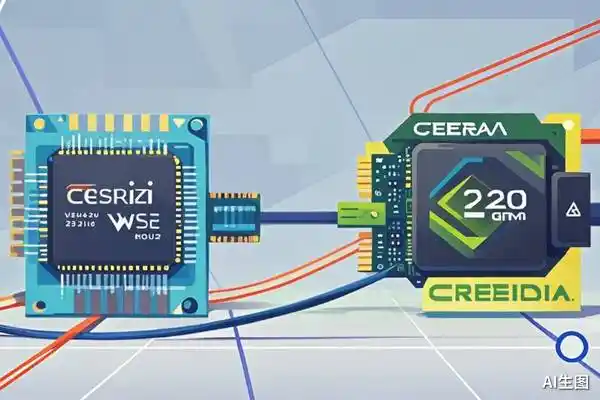
In 2026, a historic shift occurred in AI as major cloud providers' inference spending surpassed training spending for the first time, signaling a move from "building large models" to "using large models." This shifts the core challenge from computing power to the "memory wall"—the bottleneck of data movement (model weights, activations, KV Cache) between external DRAM and processors, where energy and latency from data transfer far exceed computation itself. Companies like Nvidia face GPU idle time due to bandwidth limits. In contrast, Cerebras Systems adopts a radical "wafer-scale" approach with its Wafer-Scale Engine (WSE). Instead of cutting a silicon wafer into many chips, Cerebras uses almost the entire wafer as one massive chip (WSE-3). This design provides 44GB of on-chip SRAM, delivering memory bandwidth thousands of times higher than traditional HBM (e.g., 21 PB/s vs. Nvidia B200). For LLM inference, weights are streamed layer-by-layer from external MemoryX storage to the chip, avoiding HBM bottlenecks. This results in token generation speeds 1.5–5 times faster than Nvidia's B200 in some models and significant advantages in first-token latency and long-context tasks. Additionally, Cerebras's architecture offers much lower interconnect power consumption (0.15 pJ/bit vs. GPU's ~10 pJ/bit). However, Cerebras faces challenges: SRAM scaling has slowed with advanced nodes, limiting future capacity gains; the chip requires specialized liquid cooling and custom software stacks; and its external I/O bandwidth (150 GB/s) is low compared to NVLink, hindering multi-system scaling for very large models. Competition is intensifying. Major players are pursuing three paths: 1) Developing proprietary inference ASICs (e.g., Google TPU, Microsoft Maia), 2) Leveraging advanced packaging (e.g., TSMC's SoW) to democratize wafer-scale-like integration, potentially eroding Cerebras's process advantage within a few years, and 3) Exploring optical interconnects for ultimate bandwidth. Commercially, Cerebras is transitioning from a hardware vendor to a service provider, facing the immense challenge of building high-power, specialized data centers to meet large contracts (e.g., 250MW/year from 2026–2028). In conclusion, the AI inference era presents a fundamental architectural trade-off. Cerebras opts for extreme physical optimization for low-latency, single-task performance, while Nvidia prioritizes versatility and massive cluster throughput. The path forward remains uncertain, with technology and business models still evolving in the race toward advanced AI.

marsbit1 h fa

Crossing the 'Memory Wall': The Wafer-Level Revolution and Computing Power Routes in the AI Inference Era

marsbit1 h fa

Trading

Spot
Futures

Articoli Popolari

Come comprare T

Benvenuto in HTX.com! Abbiamo reso l'acquisto di Threshold Network Token (T) semplice e conveniente. Segui la nostra guida passo passo per intraprendere il tuo viaggio nel mondo delle criptovalute.Step 1: Crea il tuo Account HTXUsa la tua email o numero di telefono per registrarti il tuo account gratuito su HTX. Vivi un'esperienza facile e sblocca tutte le funzionalità,Crea il mio accountStep 2: Vai in Acquista crypto e seleziona il tuo metodo di pagamentoCarta di credito/debito: utilizza la tua Visa o Mastercard per acquistare immediatamente Threshold Network TokenT.Bilancio: Usa i fondi dal bilancio del tuo account HTX per fare trading senza problemi.Terze parti: abbiamo aggiunto metodi di pagamento molto utilizzati come Google Pay e Apple Pay per maggiore comodità.P2P: Fai trading direttamente con altri utenti HTX.Over-the-Counter (OTC): Offriamo servizi su misura e tassi di cambio competitivi per i trader.Step 3: Conserva Threshold Network Token (T)Dopo aver acquistato Threshold Network Token (T), conserva nel tuo account HTX. In alternativa, puoi inviare tramite trasferimento blockchain o scambiare per altre criptovalute.Step 4: Scambia Threshold Network Token (T)Scambia facilmente Threshold Network Token (T) nel mercato spot di HTX. Accedi al tuo account, seleziona la tua coppia di trading, esegui le tue operazioni e monitora in tempo reale. Offriamo un'esperienza user-friendly sia per chi ha appena iniziato che per i trader più esperti.

408 Totale visualizzazioniPubblicato il 2024.12.10Aggiornato il 2026.06.02

Come comprare T

Discussioni

Benvenuto nella Community HTX. Qui puoi rimanere informato sugli ultimi sviluppi della piattaforma e accedere ad approfondimenti esperti sul mercato. Le opinioni degli utenti sul prezzo di T T sono presentate come di seguito.

活动图片