XRP Bull-Bear Showdown Imminent: Downtrend Shows Cracks—Is This a Last Stand or the Final Drop?

金色财经Pubblicato 2025-12-11Pubblicato ultima volta 2025-12-11

Introduzione

XRP remains constrained by a long-term bearish trend, but recent price movements suggest that selling pressure may be weakening. While the overall market structure is still defined by a steep descending red trendline, internal momentum is shifting. Bullish rallies are becoming stronger and more decisive, while bearish declines are losing intensity and duration—a sign that buyers are accumulating at lower levels. Key resistance lies near $2.48; a decisive break above this level could trigger a strong upward move as accumulated bullish energy is released. Important support is found in the $1.88–$1.95 zone, aligned with Fibonacci retracement levels. Failure to break above resistance, however, could lead to further downside toward the $1.40 region. In summary, XRP is at a critical juncture: either it breaks out into a new uptrend or remains trapped within the larger bearish structure. The outcome depends on whether it can sustainably overcome key resistance and convert it into support.

Article Source: WeChat Official Account Mama Encryption Talk

XRP remains constrained by a long-term downtrend, but recent price movements suggest that bears may be losing control. The upward moves are becoming stronger and more forceful, while the downward momentum is slowing, indicating that buyers are quietly entering the market. Once key resistance levels are breached, bulls may be preparing to launch a powerful counterattack.

Overall Bearish Structure: The Upper Limit of the Red Trendline

According to the latest XRP chart from MakroVision Research, the overall market structure remains in a downtrend, with the steep descending red trendline clearly outlining this trend. These trendlines continue to hinder every rebound attempt, keeping the overall technical picture unchanged and biased toward bearish.

Although the internal market structure has begun to show clear signs of improvement, short-term price movements indicate that upward moves are becoming more rapid, forceful, and distinct. Meanwhile, the momentum during downward phases is gradually weakening, with longer durations and reduced kinetic energy.

This shift is typical of waning selling pressure and increased buyer activity at lower levels. The market may still be below key resistance levels, but its internal dynamics are no longer as weak as before.
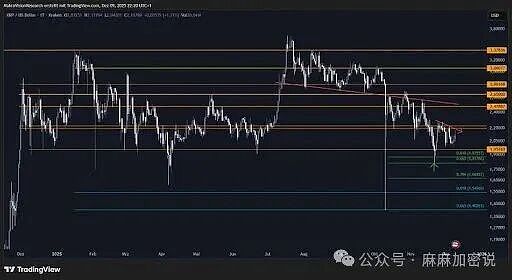
If XRP can decisively break through the red trendline near $2.48, it will unleash the upward potential that has been quietly accumulating. If it fails to break through, the token will technically remain under pressure, but the foundation for a potential reversal is clearly forming.

Key price levels to watch include the resistance zone at $2.20 to $2.22, the major breakout level at $2.48, and the support area around $1.95 to $1.88, which aligns with Fibonacci retracement levels and recent reaction points.

Dual-Track Conflict: Bearish Trend vs. Bullish Internal Structure

In summary, MakroVision Research points out that XRP is currently experiencing a dual-track movement. While the technical picture shows that the broader trend remains downward, its internal price structure is increasingly exhibiting bullish characteristics. This weakening of downward momentum makes the current chart dynamics exciting.

XRP's current fate hinges entirely on its ability to sustainably break through the aforementioned key resistance levels, particularly the $2.48 trendline. Analysts warn that if XRP successfully converts this major resistance level into support, the accumulated upward momentum could be rapidly unleashed, leading to a sharp price surge.

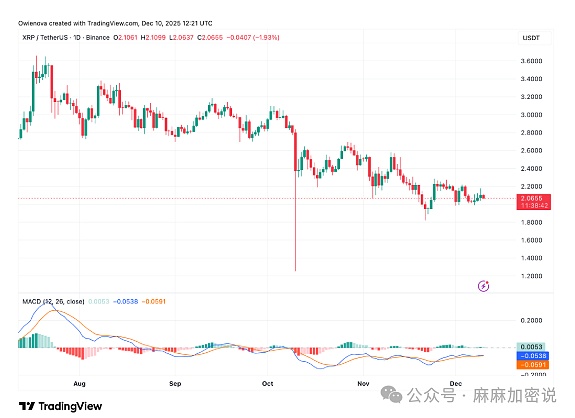
For now, the key question remains whether XRP can achieve a lasting trend reversal and leverage its internal strengths, or whether the overall bearish pressure will ultimately prevail, forcing prices lower toward the significant $1.4 low.
Domande pertinenti

QWhat is the main resistance level that XRP needs to break for a potential trend reversal according to the article?

AThe main resistance level that XRP needs to break is $2.48, which is the key trendline.

QWhat does the article suggest about the internal market structure of XRP despite the overall bearish trend?

AThe article suggests that the internal price structure is becoming increasingly bullish, with stronger rallies and weakening sell-offs, indicating that buyers are becoming more active.

QWhich price zone is mentioned as a support area for XRP in the analysis?

AThe support area mentioned is around $1.95 to $1.88, which aligns with Fibonacci retracement levels and recent reaction points.

QWhat could happen if XRP fails to break the key resistance at $2.48?

AIf XRP fails to break the $2.48 resistance, it will remain technically pressured, and the overall bearish pressure might push the price down further towards the $1.4 low.

QWhat is the 'dual-track conflict' described in the article regarding XRP's price action?

AThe 'dual-track conflict' refers to the situation where the overall market structure is still bearish (controlled by the descending red trendline), but the internal price structure is showing signs of strengthening bullish momentum.

Letture associate

Anthropic Major Release: "The Founder's Playbook" - All 4 Stages of Entrepreneurship, Completely Reimagined with AI

**Anthropic Releases "The Founder's Playbook," Reimagining the Four Stages of Startups with AI** The logic of entrepreneurship is being fundamentally reshaped by AI. Anthropic's new handbook, "The Founder's Playbook: Building an AI-Native Startup," defines the AI-native startup as a new species: not a traditional company with AI tools, but a venture driven by AI from day one. The founder's role is transforming from a hands-on builder to a conductor or architect, orchestrating AI agents for execution while focusing on high-level judgment and strategy. Anthropic outlines a product matrix of Claude tools for different tasks: Claude Chat for interactive research, Claude Code for generating production-ready code, and Claude Cowork for automating knowledge-intensive workflows. The handbook structures the startup lifecycle into four stages, detailing core goals, pitfalls, and AI applications for each: 1. **Idea Stage**: Focuses on validating a real problem. The core challenge is avoiding confirmation bias. AI practices include using Claude as a "structured devil's advocate" to challenge assumptions and for automated market/competitor research. 2. **MVP Stage**: Aims to gather early signals of Product-Market Fit (PMF). Key risks are technical debt and scope creep due to rapid AI-assisted development. Recommended AI uses include maintaining project memory documents (e.g., CLAUDE.md), using Claude Code for structured coding, and automating user feedback analysis. 3. **Launch Stage**: Centers on establishing scalable growth, operations, and compliance. Challenges include accelerating technical debt and founders becoming bottlenecks. AI should be used to build an "operating system" for launch—automating routine tasks (scheduling, reporting, content) and code audits—freeing founders for critical decisions. 4. **Scale Stage**: Focuses on achieving sustainable business operations. The main challenge is delegating operational control. AI should be leveraged for differentiated marketing, operational optimization, and building competitive moats through data network effects. The handbook concludes that in the AI era, "Can we build it?" is no longer the primary constraint. The advantage shifts back to foundational strengths: **insight, judgment, and a deep understanding of a specific problem and audience.**

marsbit5 h fa

Anthropic Major Release: "The Founder's Playbook" - All 4 Stages of Entrepreneurship, Completely Reimagined with AI

marsbit5 h fa

Eight Departments Launch Severe Crackdown on Cross-Border Securities Firms, How to Interpret This?

China's top financial regulators, including the CSRC and seven other ministries, have launched a sweeping crackdown on unlicensed cross-border securities operations. The core action involves a joint enforcement plan and the issuance of administrative penalties against major offshore internet brokers like Futu and Tiger Brokers for conducting unauthorized securities business in mainland China without a domestic license. The primary legal basis is China's requirement for securities businesses to operate with proper, locally issued licenses. The crackdown aims to eliminate a major regulatory gray area, plugging channels that allowed massive, unmonitored capital outflows which posed risks to financial stability, currency controls, and foreign exchange reserves. It also seeks to protect mainland investors who previously lacked legal recourse when dealing with offshore platforms and to secure sensitive financial data. The immediate impact is severe for the targeted brokers, including a complete ban on new mainland business, forced liquidation of existing mainland client positions over two years, and the confiscation of illegal profits estimated in the billions. Their U.S.-listed shares plummeted in response. Market analysts warn that the forced sell-off of an estimated 250-280 billion RMB in assets, concentrated in U.S. tech stocks, Chinese ADRs, and Hong Kong equities, could create sustained selling pressure on these markets over the next two years, potentially lowering valuations. For mainland investors, legal cross-border investment channels will become extremely constrained. The high asset threshold for the Stock Connect program and the severe shortage of QDII fund quotas—leading to chronic high premiums on popular U.S.-focused ETFs—mean retail access to overseas markets like the U.S. will be sharply limited. Conversely, some of the returning capital may flow into domestic A-share sectors like AI, semiconductors, and advanced manufacturing. However, this could further inflate valuations in these already elevated sectors. In conclusion, regulators frame this move not as closing off cross-border investment, but as a necessary step to enforce compliance, manage systemic risk, and steer investors toward regulated, protected channels like QDII and Stock Connect for the long-term health of the financial system.

链捕手5 h fa

Eight Departments Launch Severe Crackdown on Cross-Border Securities Firms, How to Interpret This?

链捕手5 h fa

Trading

Spot
Futures

Articoli Popolari

Cosa è GENIUS

I. Introduzione al Progetto1. Cos'è Genius?Genius (GENIUS) si posiziona come il "terminal on-chain definitivo", una piattaforma di trading decentralizzata focalizzata sulla privacy e sulla velocità. Integrando tecnologie di privacy di alto livello, mira a costruire un'infrastruttura di trading privacy di nuova generazione attraverso reti come BNB Chain, consentendo agli utenti di interagire on-chain con un'esperienza fluida paragonabile a quella degli exchange centralizzati.2. Come Funziona Genius?L'architettura tecnica principale di Genius è strutturata come segue:(1) Invisibile alla catena: Gli utenti non devono gestire manualmente approvazioni a più passaggi per operazioni cross-chain, wrapping di asset o gestione complessa del gas.(2) Trading senza Firma: Attraverso integrazioni come Turnkey, Genius consente trading istantaneo senza conferme a comparsa o autorizzazione per transazione.(3) Aggregatore di Aggregatori: Genius è alimentato da uno stack di aggregazione di prima classe integrato con oltre 150 DEX, vantando un'efficienza di quotazione superiore rispetto ai prodotti concorrenti.(4) Gestione degli Account: La piattaforma adotta un'architettura non custodiale e sfrutta Turnkey e Lit Protocol per la gestione delle chiavi, consentendo agli utenti di accedere in modo sicuro ai propri account tramite passkey.3. Chi Ha Creato Genius?Secondo i suoi Termini di Servizio ufficiali, Genius è stato sviluppato da Shuttle Labs, Inc. Basandosi sull'account ufficiale X del progetto, Ryan Myher è uno dei principali contributori che guidano l'iterazione del prodotto, inclusi sviluppi come il lancio del protocollo Ghost, oltre a un coinvolgimento più ampio della comunità.Il fondatore di Binance CZ ha ufficialmente aderito al progetto come consulente, con l'obiettivo di aiutare il team a costruire un'esperienza di trading on-chain più veloce e rispettosa della privacy.Inoltre, il progetto ha ricevuto un forte sostegno da YZi Labs, che ha investito in Genius e collabora con la Genius Foundation, responsabile della manutenzione del core Genius Bridge Protocol (GBP).4. Tokenomics di GeniusGENIUS è il token nativo dell'ecosistema Genius. Ad oggi, il progetto non ha rilasciato un documento completo di tokenomics.Basandosi sulle ultime divulgazioni ufficiali, Genius incorpora un meccanismo deflazionistico, e il 4,6% dell'offerta totale di token era già stato bruciato durante la fase di lancio iniziale.Sistema di Genius Points (GP):(1) Trade-to-Earn: La piattaforma ha stabilito un pool di ricompensa di 200 milioni di Genius Points, e gli utenti guadagnano GP per ogni trade eseguito tramite il terminale.(2) Livelli e Badge: Genius presenta un sistema di badge basato sulla progressione che va da Smart a God, con livelli superiori che sbloccano vantaggi e benefici aggiuntivi.(3) Rendimento Nativo: Gli utenti che detengono asset designati come usdGG nel dashboard possono guadagnare rendimento nativo direttamente senza dover passare attraverso staking complessi.(4) Incentivi per Referral: I referenti possono guadagnare rimborsi sulle commissioni superiori al 45% pagati in USDC, insieme a GP aggiuntivi.5. Cronologia & Traguardi ChiaveMarzo 2020: È stato creato l'account ufficiale X del progetto, segnando l'inizio della sua fase di preparazione iniziale.13 gennaio 2026: Genius ha annunciato un investimento multimilionario da YZi Labs e ha contemporaneamente confermato CZ come consulente per accelerare lo sviluppo della sua infrastruttura di trading privacy.18 aprile 2026: Il progetto ha annunciato che il protocollo di privacy Ghost sarebbe stato lanciato a breve.29 aprile 2026: Il protocollo Ghost è stato ufficialmente aperto ai suoi primi 50 tester, segnando l'inizio di una nuova era per il trading privacy su BNB Chain. Allo stesso tempo, il team ha confermato che il 4,6% dei token è stato bruciato.​II. Informazioni sul Token1) Informazioni di BaseNome del token: GENIUS (Genius)III. Link CorrelatiSito web:https://www.tradegenius.com/homeEsploratori:https://bscscan.com/address/0x1f12b85aac097e43aa1555b2881e98a51090e9a6Social:https://x.com/GeniusTerminalNota: L'introduzione al progetto proviene dai materiali pubblicati o forniti dal team ufficiale del progetto, che è solo a scopo di riferimento e non costituisce consulenza per gli investimenti. HTX non si assume responsabilità per eventuali perdite dirette o indirette risultanti.

240 Totale visualizzazioniPubblicato il 2026.04.29Aggiornato il 2026.05.12

Cosa è GENIUS

Come comprare GENIUS

Benvenuto in HTX.com! Abbiamo reso l'acquisto di Genius (GENIUS) semplice e conveniente. Segui la nostra guida passo passo per intraprendere il tuo viaggio nel mondo delle criptovalute.Step 1: Crea il tuo Account HTXUsa la tua email o numero di telefono per registrarti il tuo account gratuito su HTX. Vivi un'esperienza facile e sblocca tutte le funzionalità,Crea il mio accountStep 2: Vai in Acquista crypto e seleziona il tuo metodo di pagamentoCarta di credito/debito: utilizza la tua Visa o Mastercard per acquistare immediatamente GeniusGENIUS.Bilancio: Usa i fondi dal bilancio del tuo account HTX per fare trading senza problemi.Terze parti: abbiamo aggiunto metodi di pagamento molto utilizzati come Google Pay e Apple Pay per maggiore comodità.P2P: Fai trading direttamente con altri utenti HTX.Over-the-Counter (OTC): Offriamo servizi su misura e tassi di cambio competitivi per i trader.Step 3: Conserva Genius (GENIUS)Dopo aver acquistato Genius (GENIUS), conserva nel tuo account HTX. In alternativa, puoi inviare tramite trasferimento blockchain o scambiare per altre criptovalute.Step 4: Scambia Genius (GENIUS)Scambia facilmente Genius (GENIUS) nel mercato spot di HTX. Accedi al tuo account, seleziona la tua coppia di trading, esegui le tue operazioni e monitora in tempo reale. Offriamo un'esperienza user-friendly sia per chi ha appena iniziato che per i trader più esperti.

123 Totale visualizzazioniPubblicato il 2026.04.29Aggiornato il 2026.05.12

Come comprare GENIUS

Come comprare MEGA

Benvenuto in HTX.com! Abbiamo reso l'acquisto di MegaETH (MEGA) semplice e conveniente. Segui la nostra guida passo passo per intraprendere il tuo viaggio nel mondo delle criptovalute.Step 1: Crea il tuo Account HTXUsa la tua email o numero di telefono per registrarti il tuo account gratuito su HTX. Vivi un'esperienza facile e sblocca tutte le funzionalità,Crea il mio accountStep 2: Vai in Acquista crypto e seleziona il tuo metodo di pagamentoCarta di credito/debito: utilizza la tua Visa o Mastercard per acquistare immediatamente MegaETHMEGA.Bilancio: Usa i fondi dal bilancio del tuo account HTX per fare trading senza problemi.Terze parti: abbiamo aggiunto metodi di pagamento molto utilizzati come Google Pay e Apple Pay per maggiore comodità.P2P: Fai trading direttamente con altri utenti HTX.Over-the-Counter (OTC): Offriamo servizi su misura e tassi di cambio competitivi per i trader.Step 3: Conserva MegaETH (MEGA)Dopo aver acquistato MegaETH (MEGA), conserva nel tuo account HTX. In alternativa, puoi inviare tramite trasferimento blockchain o scambiare per altre criptovalute.Step 4: Scambia MegaETH (MEGA)Scambia facilmente MegaETH (MEGA) nel mercato spot di HTX. Accedi al tuo account, seleziona la tua coppia di trading, esegui le tue operazioni e monitora in tempo reale. Offriamo un'esperienza user-friendly sia per chi ha appena iniziato che per i trader più esperti.

93 Totale visualizzazioniPubblicato il 2026.04.30Aggiornato il 2026.04.30

Come comprare MEGA

Discussioni

Benvenuto nella Community HTX. Qui puoi rimanere informato sugli ultimi sviluppi della piattaforma e accedere ad approfondimenti esperti sul mercato. Le opinioni degli utenti sul prezzo di A A sono presentate come di seguito.

活动图片