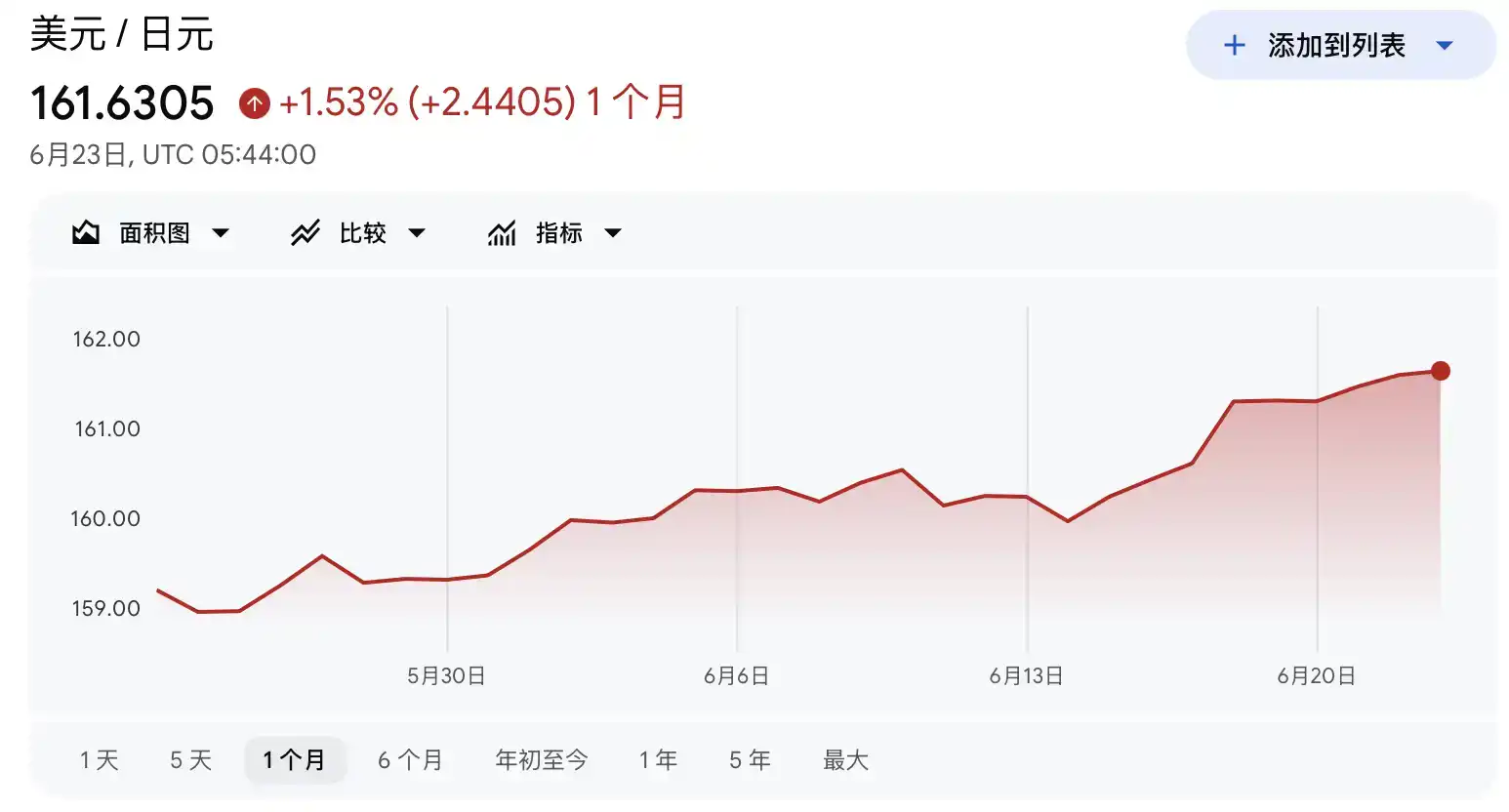
During the session on June 23rd, the US Dollar Index remained above 101, with USD/JPY approaching a key level near 161.96. This level is under scrutiny because a break above it would send the yen into its weakest territory since December 1986. The main theme in the forex market is tightening: Fed policy expectations have turned hawkish again, short-term US Treasury yields are elevated, and the yen's weakness is pushing the question of potential Japanese intervention to the forefront for traders. For investors, this isn't just about a stronger dollar; it's about global funding costs, carry trades, and pressure on Asian currencies.
Fed Expectations Turn Hawkish, Dollar Holds Above 101
As of the June 23rd session, the US Dollar Index was around 101.01, not far from the week's high of 101.13. The DXY, which measures the dollar against a basket of major currencies, regained strength, with the most direct driver being a shift in Federal Reserve policy expectations.
According to Reuters, the Fed held the federal funds rate steady at 3.50% to 3.75% on June 17th, but the latest dot plot showed that nine officials project a rate hike before the end of 2026. The statement also removed wording hinting at a rate cut this year. This change made it harder for markets to continue trading on easing expectations, and futures markets have significantly increased bets on the possibility of a hike within the year or before September.
Short-term US Treasury yields provided concurrent support. The 2-year yield hovered between 4.22% and 4.23% during the session, near its highest level since February 2025. For forex markets, rising short-end yields increase the appeal of dollar-denominated assets, especially when the policy outlooks of other major economies like Japan and Europe remain relatively dovish.
OCBC FX strategist Sim Moh Siong believes that rising yields and more hawkish Fed expectations are jointly supporting the dollar. If the dollar index further breaks above its 14-month high of 101.97, the dollar could gain fresh upward momentum. This level makes the area above 101 not just a simple integer threshold but a technical zone for short-term funds to observe whether the dollar can continue strengthening.
Other major currencies are also under pressure. During the session, the euro was around 1.1423, sterling around 1.3246, and the Australian and New Zealand dollars around 0.6991 and 0.5704, respectively. Remarks from ECB President Lagarde downplaying secondary inflation concerns and political changes in the UK affecting sterling did not alter the day's main theme. The market focused more on whether US rate expectations would continue to rise.
Yen Approaches 161.96, Japan's Verbal Warnings Intensify
The yen is one of the most sensitive assets in this round of dollar strength. As of the June 23rd session, USD/JPY was around 161.59, having touched 161.93 intraday, just a step away from the 161.96 level. According to The Japan Times and Reuters, a break above approximately 161.95 to 161.96 would mean the yen falls to its lowest level since December 1986.
The core reason for the yen's sustained pressure remains the US-Japan interest rate differential. Renewed bets on US rate hikes, coupled with the relatively slow pace of policy normalization by the Bank of Japan, have widened the yield advantage for investors holding dollar assets, increasing selling pressure on the yen. A weak yen benefits Japanese exporters' profit conversion but also raises import costs, particularly for energy and food, putting pressure on household purchasing power and inflation expectations.
Therefore, the stance of Japan's Ministry of Finance has become a market focus. Japanese Finance Minister Katayama Satoki recently issued verbal warnings about yen volatility, stating that Japan is prepared to act if necessary. This has led traders to speculate that Japanese authorities might intervene in the currency market by buying yen and selling dollars as it nears historic lows.
However, intervention remains at the expectation stage and is not a confirmed policy action. Historical experience shows that Japanese FX intervention can typically create sharp volatility in the short term, forcing short-covering. If the US-Japan yield gap continues to widen, a single intervention is unlikely to fundamentally change the USD/JPY trend. Japanese authorities are more likely to alter the pace of appreciation rather than completely reverse the trend.
This makes the area near 161.96 a dual threshold. On one side, yield differentials and dollar strength continue to push USD/JPY higher; on the other, the closer it gets to the nearly 40-year low, the higher the policy intervention risk. For short-term traders, this level is not only a technical point but also a policy risk point.
Oil Price Rebound Brings Inflation Concerns Back into Trading
Beyond forex, oil prices also re-entered the market spotlight during the same trading session. According to Reuters, oil prices fell about 4% on June 22nd on news of progress in US-Iran talks and related reports about the opening of the Strait of Hormuz passage. The subsequent rebound in oil prices shows the market is still waiting for clearer geopolitical and supply signals.
The Strait of Hormuz is one of the world's most crucial oil transport chokepoints, with about one-fifth of seaborne oil passing through it. Once expectations for resumed passage strengthen, oil supply risks decrease, typically pressuring prices. However, as long as progress in talks, shipping security, and actual supply restoration are not fully confirmed, oil prices are prone to fluctuate between news headlines.
The reason oil prices affect dollar trading is that they re-enter inflation expectations and central bank policy assessments. If the oil price rebound persists, markets will find it harder to believe inflationary pressures have subsided, and the Fed's rationale for maintaining higher rates or even hiking would strengthen. If oil prices decline again, some inflation concerns might ease.
Currently, oil prices are more of a supplementary clue alongside the dollar and US Treasury yields rather than the main theme in the forex market that day. However, in an environment where Fed expectations have already turned hawkish, any sustained energy price rebound could amplify market sensitivity to inflation.
The Strong Dollar Trade Still Hinges on Three Unresolved Questions
The market's most immediate question is whether the Fed will actually hike rates within the year or before September. Futures market bets have clearly heated up, but this is not a Fed commitment and ultimately depends on upcoming inflation, employment, and growth data. If data continues to support a hawkish stance, the dollar may find further support. If inflation falls or employment weakens, rate hike bets could cool rapidly.
The second question lies with Japan. The closer USD/JPY gets to 161.96, the stronger intervention expectations become. However, whether Japanese authorities will act, the scale of any action, and whether the US will cooperate all remain uncertain. What the market truly worries about is not the verbal warnings themselves but the potential for instant volatility that intervention could bring.
The third question comes from oil prices. There is still distance between expectations regarding US-Iran talks, the Strait of Hormuz passage opening, and actual supply restoration. If oil prices continue to rebound, they will rekindle inflation concerns, in turn supporting US Treasury yields and the dollar.
For now, this market move is still primarily driven by US rate expectations. Whether the dollar index can break above 101.97, whether USD/JPY will surpass 161.96, and whether Japanese authorities will move from verbal warnings to concrete action will determine whether the forex market continues with a strong dollar or enters a period of more intense two-way volatility.