Original | Odaily Planet Daily (@OdailyChina)
Author | Asher (@Asher_ 0210)

The 2026 World Cup has concluded, and prediction markets are undergoing a phased review.
Over the past six weeks, many users engaged in trading predictions on match outcomes, qualification scenarios, and championship winners, adding a layer of real-time interaction to viewing. Now that the tournament is over, Odaily Planet Daily will review the performance of leading prediction market platforms Kalshi, Polymarket, and predict.fun before, during, and after the World Cup from three dimensions: trading volume, fee revenue, and TVL.
World Cup Drove Prediction Market Trading Volume to New Highs, But the Momentum Didn't Last
Kalshi Maintains Lead, Polymarket Narrows Gap, predict.fun Breaks Through with World Cup
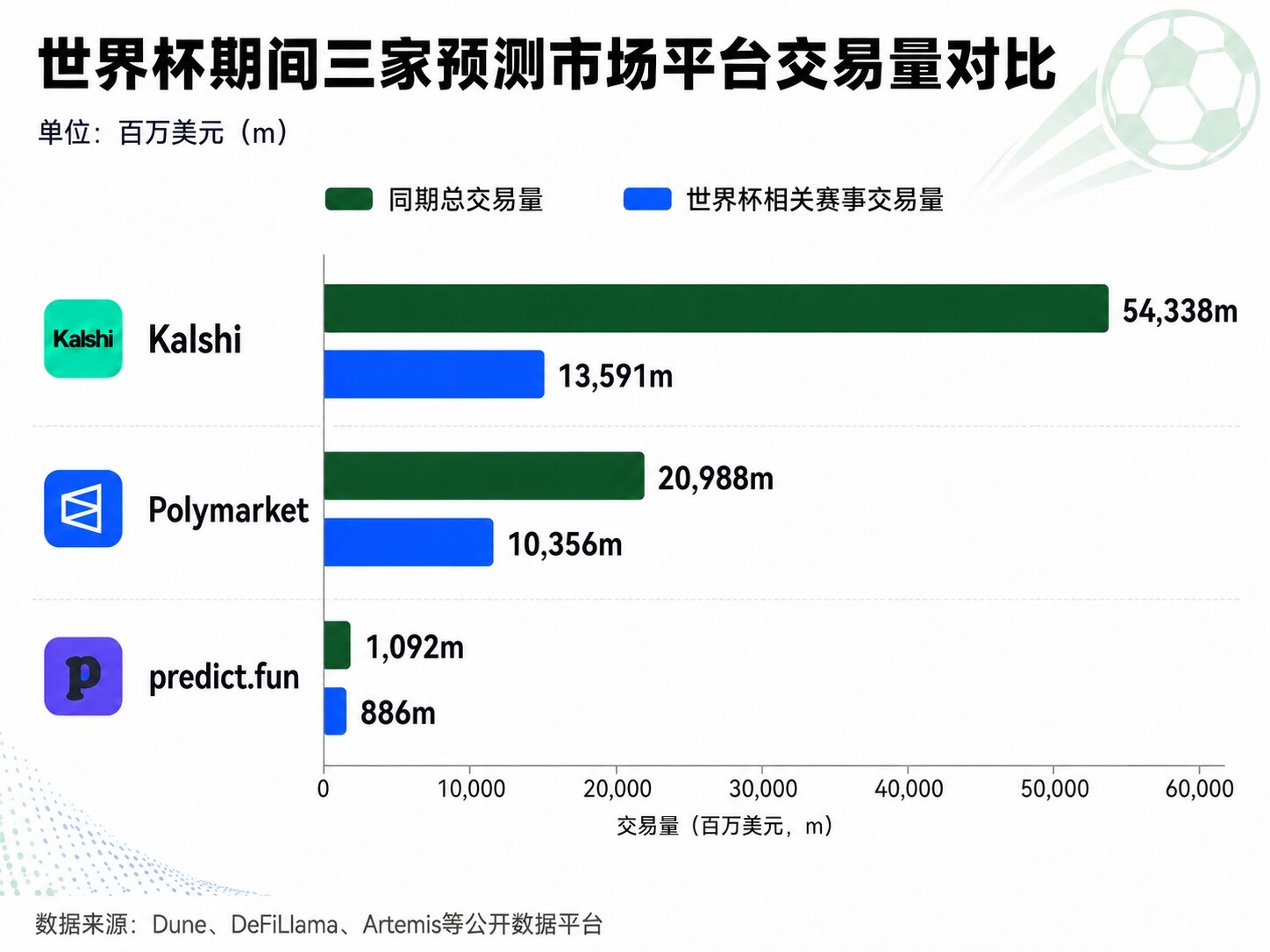
Looking at total platform trading volume during the World Cup period, Kalshi still maintains a clear lead. During the same period, Kalshi's total trading volume reached $54.338 billion, while Polymarket's was $20.988 billion, the former being about 2.6 times the latter. However, considering only World Cup-related events, the gap between the two narrows significantly. Kalshi's related trading volume was $13.591 billion, while Polymarket reached $10.356 billion, the former being only about 1.3 times the latter.(Note: Trading volume discussed in this article is nominal trading volume.)
In the past, Polymarket's representative markets were more concentrated in US elections, cryptocurrency, and geopolitical events. The World Cup further elevated the importance of sports markets on the platform, shifting them from a supplementary category to a core trading segment. Kalshi's advantage lies in its more dispersed trading structure; besides the World Cup, other sports events, politics, and macro markets continue to contribute trading volume, providing more scenarios to sustain activity after the tournament ends.
predict.fun's total platform trading volume during the World Cup reached $1.092 billion, with World Cup-related markets contributing $886 million. Although the overall scale still shows a clear gap compared to Kalshi and Polymarket, for a platform launched just over half a year ago, achieving nearly $900 million in trading volume from this World Cup has made predict.fun one of the most prominent new platforms benefiting from this round of tournament gains.
Changes in Average Daily Trading Volume for the Three Prediction Market Platforms Before, During, and After the World Cup
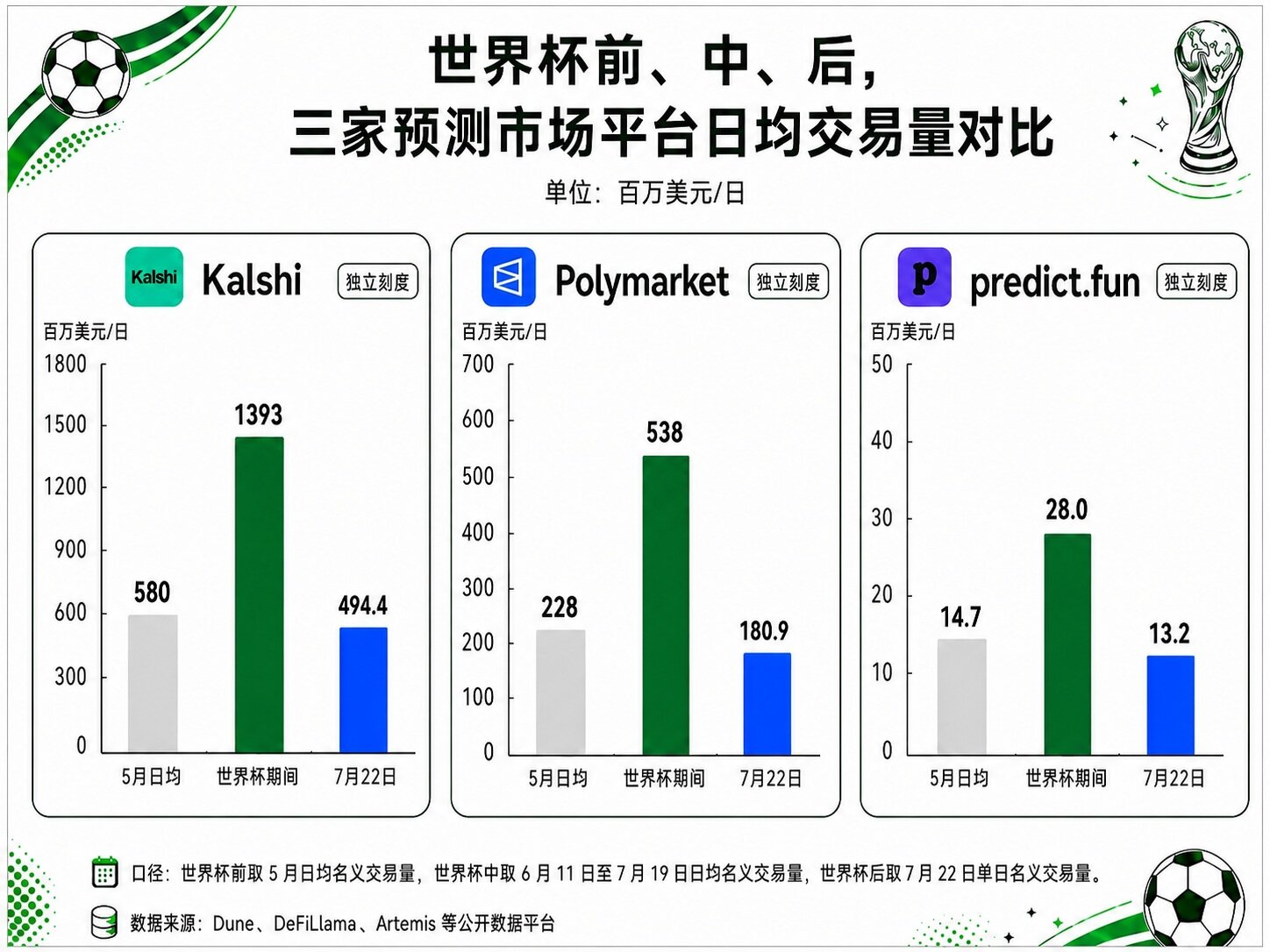
Kalshi's increase in trading volume during the World Cup was the most significant. Its average daily nominal trading volume in May was $580 million, rising to $1.393 billion during the tournament, an increase of about 140%. By July 22nd, trading volume fell back to $494.4 million, already below the May average daily level.
Polymarket's change magnitude was similar to Kalshi's. Its average daily nominal trading volume in May was $228 million, rising to $538 million during the World Cup, an increase of about 136%. By July 22nd, trading volume dropped to $180.9 million, also below pre-tournament levels.
predict.fun had a lower base, but the boost from the World Cup was still clear. Its average daily nominal trading volume in May was $14.7 million, rising to $28 million during the tournament, nearly doubling. By July 22nd, trading volume was $13.2 million, basically returning to pre-tournament levels.
Taking just one day's trading volume after the World Cup for comparison, the growth brought by the World Cup appears more like a concentrated release of event traffic, rather than elevating the platform's daily trading volume to a permanently higher level. Whether it can rise again in the future depends on whether other sports events and non-sports markets can capture the trading demand left after the World Cup.
How Much Fee Revenue Did the World Cup Generate for the Three Prediction Market Platforms?
Kalshi's Fee Revenue Rose Continuously as the Tournament Progressed, Exceeding $100 Million in a Single Week in Week 4
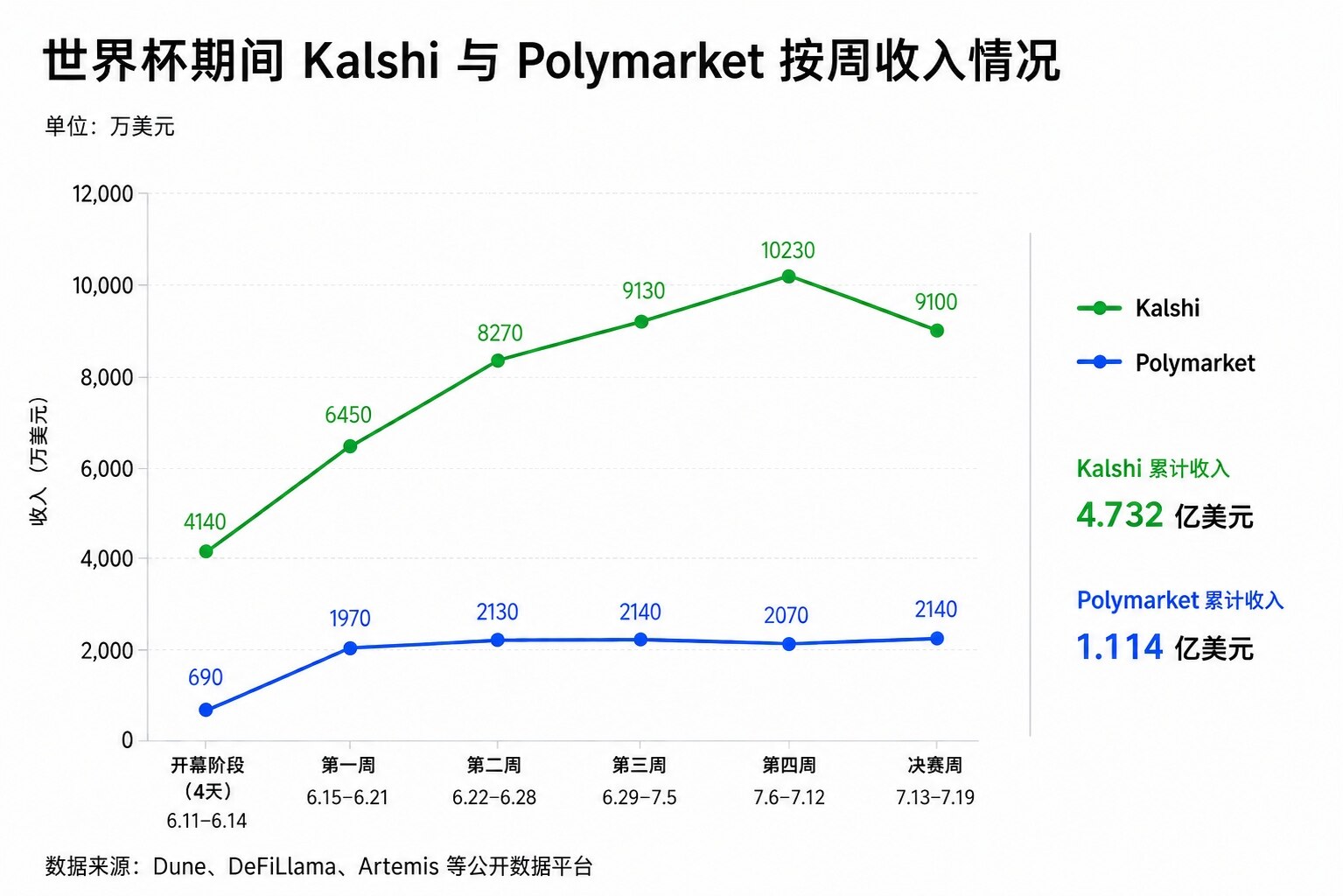
Kalshi's fee revenue curve showed a strong overall upward trend. Revenue for the opening four-day period was $41.4 million, rising to $64.5 million in the first week, further increasing to $82.7 million in the second week, reaching $91.3 million in the third week, and rising another step in the fourth week with single-week revenue reaching $102.3 million, the highest point during the entire World Cup period. The final week saw a slight drop to $91 million. Throughout the World Cup, Kalshi's cumulative fee revenue reached $473.2 million.
The World Cup's impact on Kalshi not only brought initial attention at the start but, more importantly, sustained trading heat into the latter stages of the tournament. Single-week revenue exceeding $100 million also means Kalshi not only benefited from World Cup gains in trading volume but also successfully converted this wave of traffic into platform revenue at the monetization level.
Polymarket's Fee Revenue Was More Stable, But Didn't See Accelerated Volume Growth Like Kalshi in the Latter Stages
Polymarket's fee revenue trend was noticeably flatter. Revenue for the opening four-day period was $6.9 million, rising to $19.7 million in the first week. Subsequent weeks two, three, four, and the final week were $21.3 million, $21.4 million, $20.7 million, and $21.4 million respectively. Throughout the World Cup, Polymarket's cumulative fee revenue reached $111.4 million.
Starting from the first week, Polymarket's weekly fee revenue remained largely stable around $20 million. The World Cup did elevate Polymarket's fee revenue to a higher level, but from the second week onward, the platform did not continue to amplify gains as the tournament progressed like Kalshi did, instead operating within a relatively stable range.
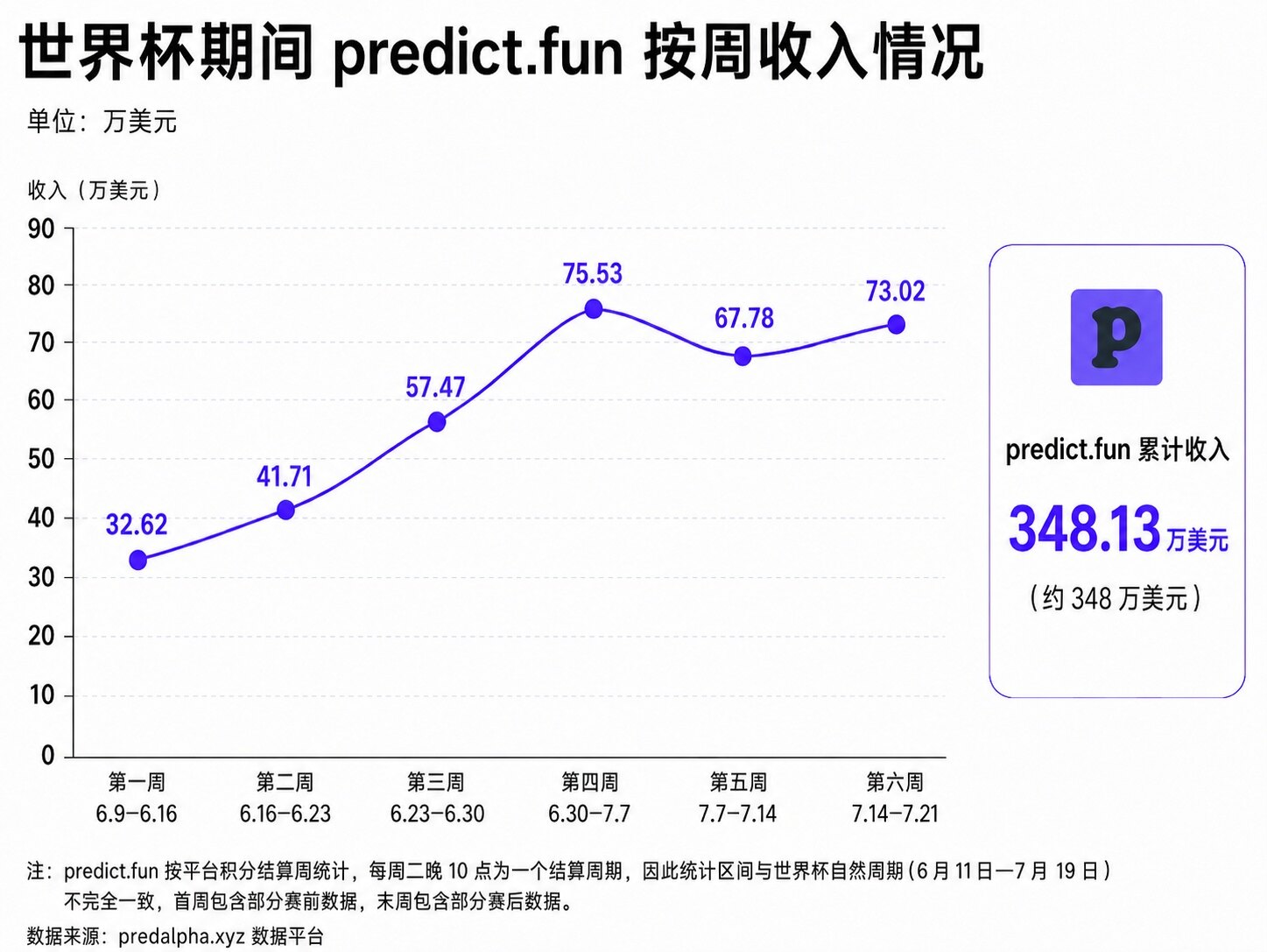
predict.fun's Fee Revenue Gradually Increased as the Tournament Progressed, Cumulative $3.481 Million Over Six Settlement Weeks
predict.fun's fee revenue is counted by platform settlement weeks, switching cycles every Tuesday at 10 PM, so it does not perfectly align with the natural World Cup schedule from June 11th to July 19th. The first settlement week was June 9th to June 16th, including two days of pre-tournament data; the last settlement week was July 14th to July 21st, also incorporating two days of post-tournament data.
Looking at the revenue trend, predict.fun's fee revenue for the first settlement week was $326.2 thousand. It then increased for three consecutive weeks, reaching $755.3 thousand from June 30th to July 7th, setting the single-week high during the World Cup period. The subsequent two weeks recorded $677.8 thousand and $730.2 thousand respectively. Although not setting new highs, these were still significantly higher than early in the tournament. The cumulative fee revenue for the six settlement weeks during the World Cup reached $3.4813 million.
The settlement week before the World Cup, June 2nd to June 9th, predict.fun's fee revenue was only $159.4 thousand. Entering the World Cup period, revenue for the first week rose to $326.2 thousand, an increase of about 105%. Subsequently, most settlement weeks further increased to over $500 thousand. Even though the first and last periods included some pre- and post-tournament data, the World Cup's boost to predict.fun's fee revenue remained significant.
After the World Cup, Fee Revenue Generally Declined Across Platforms, with Kalshi Experiencing the Smallest Drop
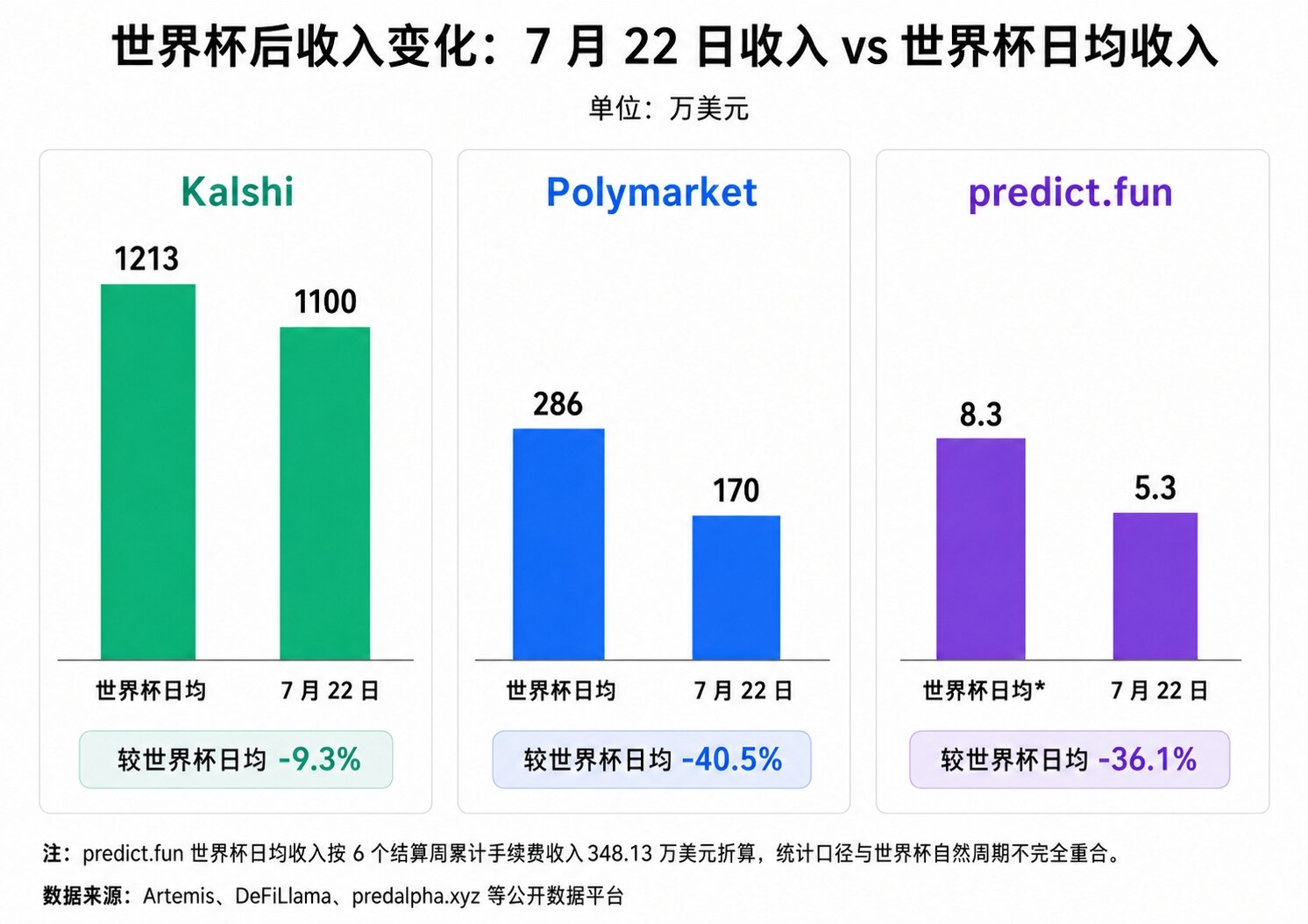
Kalshi's average daily fee revenue during the World Cup was $12.13 million, dropping to $11 million on July 22nd, a decrease of 9.3%. Among the three platforms, Kalshi's post-tournament decline was the smallest. Although fee revenue fell from the peak levels during the tournament, it remained close to the World Cup daily average.
Polymarket's drop was more pronounced. Its average daily fee revenue during the World Cup was $2.86 million, dropping to $1.7 million on July 22nd, a decrease of 40.5%. The revenue increment the World Cup brought to Polymarket was relatively concentrated, and as the tournament ended, this increment quickly dissipated.
predict.fun's average daily fee revenue during the World Cup was approximately $83 thousand, dropping to $53 thousand on July 22nd, a decrease of 36.1%, similar in magnitude to Polymarket's decline. Although the statistical method differs slightly from the first two, the post-tournament trend is clear. The World Cup also provided a significant boost to predict.fun's fee revenue, which similarly receded relatively quickly after the event.
World Cup Didn't Elevate Polymarket's TVL, While predict.fun Saw Capital Inflow in the Latter Stages
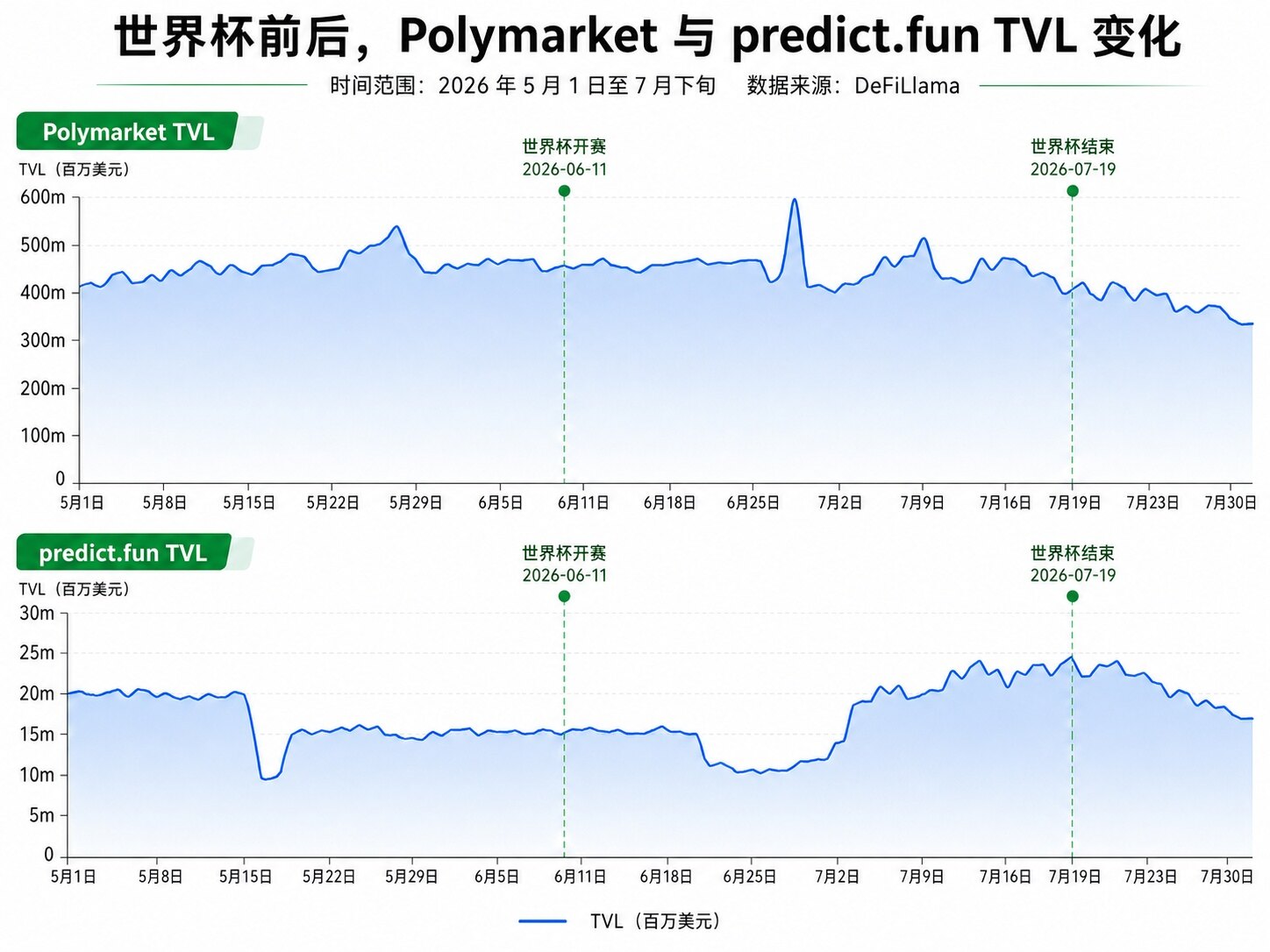
Polymarket's TVL did not rise in sync with trading volume during the World Cup. In early May, the platform's TVL was around $410 million, and for most of the subsequent period, it remained in the range of $440 million to $480 million. After the World Cup began, TVL continued to fluctuate mainly around this level. Although it briefly spiked in late June and early July, it did not form a sustained upward trend.
After mid-July, TVL began to decline noticeably, dropping to around $400 million by the end of the World Cup, and has since fallen further to about $340 million. While trading volume significantly expanded during the tournament, the platform's settled capital did not correspondingly convert into long-term retained funds, indicating that the World Cup brought more high-frequency trading demand rather than simultaneously translating into persistent capital.
predict.fun's trend was more phased. In early May, its TVL was around $20 million. By mid-May, it had dropped to about $10 million, then maintained around $15 million until mid-June. At the start of the World Cup, TVL did not immediately rise. It wasn't until early July that it began to rebound quickly, reaching the $20-25 million range during the latter half of the tournament and hitting a phase high around the end of the World Cup.
After the tournament, TVL gradually declined, currently at about $17 million, but still higher than the low point in late June. Compared to Polymarket, predict.fun's capital changes were more closely linked to the World Cup's progress, especially with more noticeable capital inflows during the knockout stages.
(Note: As Kalshi's TVL data is not available on-chain, this section only discusses Polymarket and predict.fun.)
Summary
The World Cup indeed brought substantial trading volume and fee revenue to prediction markets, but post-tournament data also shows that this growth did not naturally continue. The average daily trading volume and fee revenue for all three platforms declined after the event, and Polymarket's TVL continued to fall. Mega-events can concentrate and amplify trading demand in the short term but may not directly elevate a platform's long-term activity level.
However, the World Cup benefits are not confined to short-term data alone. It at least validated that sports events can provide prediction markets with continuous, high-frequency, short-cycle trading scenarios and helped more users develop the habit of repeated trading across consecutive matches.
The World Cup has ended, but the competition around user retention, market supply, and normalized trading is just beginning.